



Louis Addeo-Weiss
-
Posts
277 -
Joined
-
Last visited
-
Days Won
49
Content Type
Profiles
Miami Marlins Videos
2026 Miami Marlins Top Prospects Ranking
Miami Marlins Free Agent & Trade Rumors, Notes, & Tidbits
Guides & Resources
News
2025 Miami Marlins Draft Pick Tracker
2026 Miami Marlins Draft Tracker: Picks & Bonuses
Forums
Blogs
Events
Store
Downloads
Gallery
Everything posted by Louis Addeo-Weiss
-
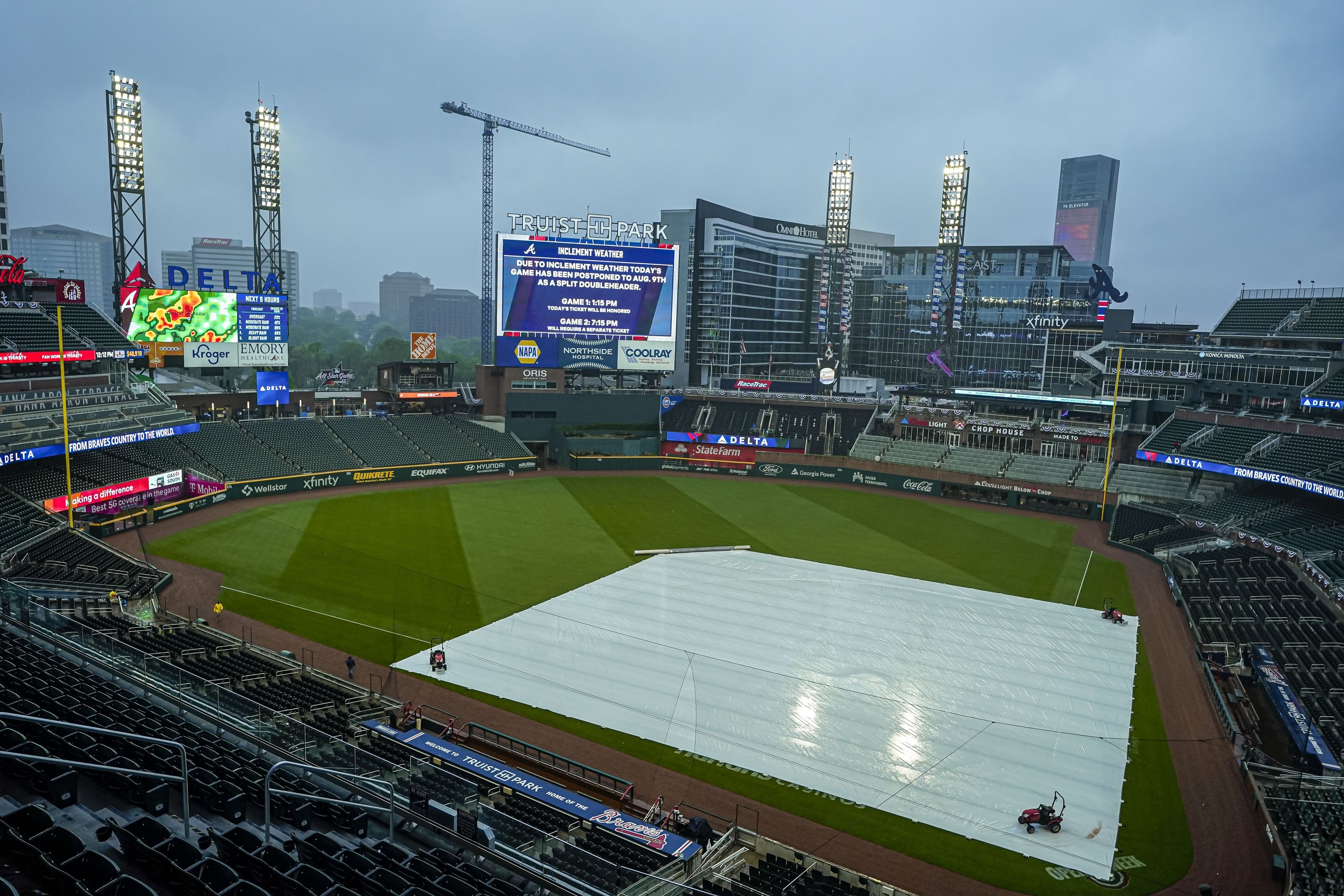 The 2025 Miami Marlins (5-4) will have to wait for their second series win of the year as the finale of their three-game set against the Atlanta Braves (1-8) that had been scheduled for Sunday afternoon was called due to inclement weather. Georgia is on a partial tornado watch until 6 pm CDT. After falling victim to a dominant Spencer Schwellenbach start and a 10-run Atlanta barrage on Friday, Miami bounced back to claim the Saturday affair on the backs of Cal Quantrill's 5 shutout innings as he earned his first win in a Marlins uniform. Miami had returning ace Sandy Alcantara (1-0, 3.72 ERA) slated to start the rubber game, fresh off his first win of the season when he tossed 5 innings of 2-run ball against the Mets on April 1. The former Cy Young Award winner has mostly had his way with the Atlanta lineup, pitching to a 2.94 ERA in 13 prior starts. Among active pitchers to make at least 10 starts against the Braves, only Jacob deGrom and Clayton Kershaw have lower ERA's. Atlanta's scheduled starter, Grant Holmes (0-1, 7.20 ERA) was looking to not only get his 2025 on track but also figure out the Miami bats. In two starts against them in 2024, Holmes pitched to an 8.10 ERA over 8 ⅔ innings. The Marlins make another trip to Atlanta from August 7-10. That will now turn into a five-game series with a split doubleheader scheduled for Saturday, August 9. The Marlins' road trip continues with three games against the New York Mets, but Alcantara will be returning to Miami and go on the paternity list—he and his wife are expecting a baby girl, per Craig Mish. He will rejoin the club for the next homestand. Monday's series opener figures to be a bullpen game for the Fish with an additional arm to be recalled from the minors to take Alcantara's roster spot. Connor Gillispie (0-1, 3.60 ERA) and Max Meyer (0-1, 3.09 ERA) are the probables for Tuesday and Wednesday, respectively. The Braves will welcome the Phillies on Tuesday with Chris Sale (0-1, 5.40 ERA) set for his third start of the season.
 -
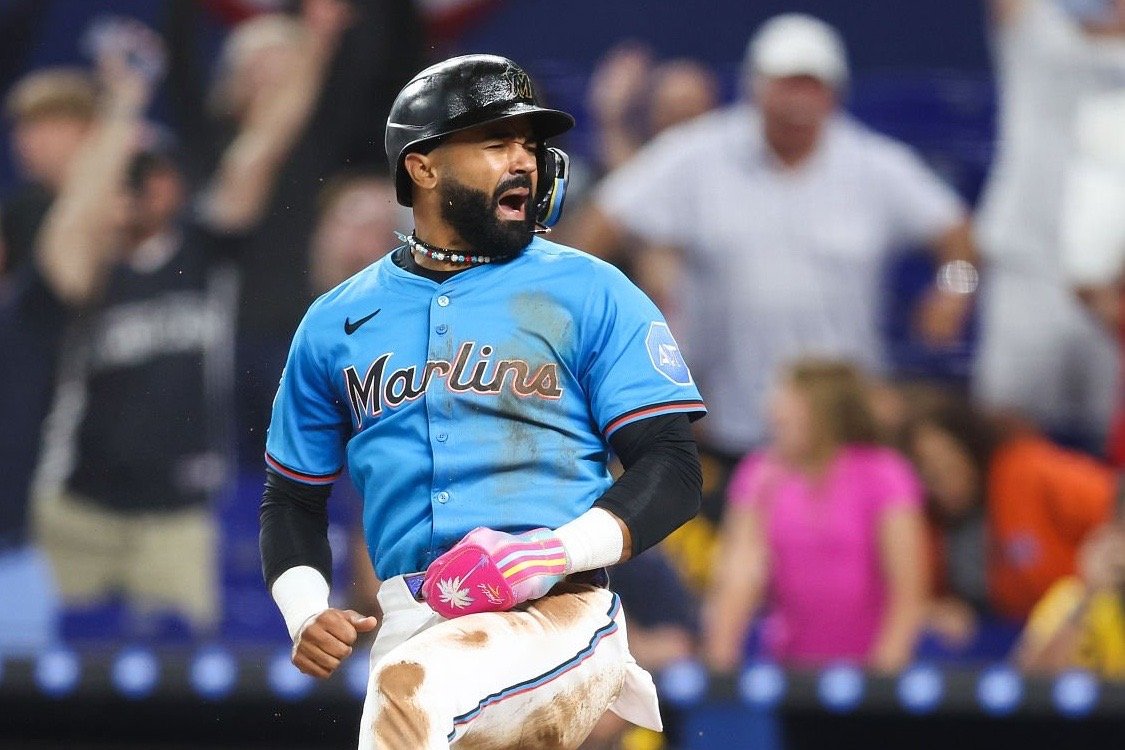 MIAMI—Baseball always seems to have a way to perfectly align with time and space to help create moments one could otherwise only dream of. For the Conine family and the Marlins themselves, one of those moments came Sunday at loanDepot park. On the day when Mr. Marlin, Jeff Conine, became the inaugural member of the team's Hall of Fame, outfielder Griffin Conine gave his father and the fans of Miami another memento from an already unforgettable day. With his Marlins trailing 2-1 in the bottom of the 7th, the younger Conine—0-for-2 to this point—sent a 97 mph fastball from Pirates reliever Colin Holderman 404 feet over the left-center wall for a game-tying home run. "It's up there," said Conine postgame when asked where that home run ranks among moments in his baseball-playing life. As for those Marlins, the flair for the dramatic would accompany them into the bottom of the 9th. Facing Pirates closer David Bednar—already victim to one of Miami's two prior walk-off victories through their first three games to begin the 2025 season—Derek Hill would lead off with a single. He then stole second and advanced to third on an errant throw from Pittsburgh catcher Endy Rodríguez that found its way into center field. Two pitches later and with Conine looming in the on-deck circle, Bednar uncorked a wild pitch that brought Hill home to seal Miami's third walk-off win to begin the season, a 3-2 triumph over the Pirates and second in as many days to give the Marlins their first 3-1 start to a season since 2020. "If every series is going to be like this, it's going to be a very fun season," noted smiling, first-year manager Clayton McCullough. Mad Max In his first start of the season, Max Meyer put forth not only one of the best starts of his young career, but inarguably the best from a Marlins rotation four games into 2025. Miami's first-round pick in the 2020 draft matched another one-time Marlins farmhand, Andrew Heaney (5 IP, 1 R), pitch-for-pitch, striking out a career-high 7 and allowing two runs (one earned) in 5 ⅔ innings of work in Miami's latest winning effort, though Meyer had to settle for a no-decision. In four career March/April starts, he now owns a 2.02 ERA. "The ability to throw breaking balls, some of them in the low-90s, and you have to respect the velocity on the fastball," noted McCullough. The 26-year-old, who authored 65.2 percent first-pitch strikes, also threw the three hardest pitches of his career Sunday, topping out at 97.6 mph. Of his seven strikeouts on the day, all of them came on his slider, a pitch that generated a 52-percent whiff rate. Of Note - Father knows best: In 80 career games against the Pirates, Jeff Conine hit .295/.353/.445/.798 with 7 home runs. - The Marlins achieved their sixth different 3-1 start to a season and first since the COVID-shortened 2020 season. Excluding 2014, the team has finished above .500 in every prior season. For what it's worth, FanGraphs currently projects these Fish to go 71-91. - After 3 ⅓ scoreless innings on Sunday, Miami's bullpen owns a 1.40 ERA through the first four games and 19 ⅓ innings pitched. That's despite high-leverage arm Jesús Tinoco (left low back strain) landing on the 15-day injured list prior to the game. Looking Ahead Miami will continue its season-opening homestand Monday when it welcomes Juan Soto and the New York Mets. Cal Quantrill will make both his loanDepot park and Marlins debuts as he squares off against David Peterson in the series opener. First pitch from loanDepot is slated for 6:40 EST.
- 2 comments
-
- 3
-

-
- max meyer
- griffin conine
- (and 3 more)
-
Call it a fluke, or call it early-season magic. Either way, the Miami Marlins are off to a 3-1 start after their third consecutive walk-off win. MIAMI—Baseball always seems to have a way to perfectly align with time and space to help create moments one could otherwise only dream of. For the Conine family and the Marlins themselves, one of those moments came Sunday at loanDepot park. On the day when Mr. Marlin, Jeff Conine, became the inaugural member of the team's Hall of Fame, outfielder Griffin Conine gave his father and the fans of Miami another memento from an already unforgettable day. With his Marlins trailing 2-1 in the bottom of the 7th, the younger Conine—0-for-2 to this point—sent a 97 mph fastball from Pirates reliever Colin Holderman 404 feet over the left-center wall for a game-tying home run. "It's up there," said Conine postgame when asked where that home run ranks among moments in his baseball-playing life. As for those Marlins, the flair for the dramatic would accompany them into the bottom of the 9th. Facing Pirates closer David Bednar—already victim to one of Miami's two prior walk-off victories through their first three games to begin the 2025 season—Derek Hill would lead off with a single. He then stole second and advanced to third on an errant throw from Pittsburgh catcher Endy Rodríguez that found its way into center field. Two pitches later and with Conine looming in the on-deck circle, Bednar uncorked a wild pitch that brought Hill home to seal Miami's third walk-off win to begin the season, a 3-2 triumph over the Pirates and second in as many days to give the Marlins their first 3-1 start to a season since 2020. "If every series is going to be like this, it's going to be a very fun season," noted smiling, first-year manager Clayton McCullough. Mad Max In his first start of the season, Max Meyer put forth not only one of the best starts of his young career, but inarguably the best from a Marlins rotation four games into 2025. Miami's first-round pick in the 2020 draft matched another one-time Marlins farmhand, Andrew Heaney (5 IP, 1 R), pitch-for-pitch, striking out a career-high 7 and allowing two runs (one earned) in 5 ⅔ innings of work in Miami's latest winning effort, though Meyer had to settle for a no-decision. In four career March/April starts, he now owns a 2.02 ERA. "The ability to throw breaking balls, some of them in the low-90s, and you have to respect the velocity on the fastball," noted McCullough. The 26-year-old, who authored 65.2 percent first-pitch strikes, also threw the three hardest pitches of his career Sunday, topping out at 97.6 mph. Of his seven strikeouts on the day, all of them came on his slider, a pitch that generated a 52-percent whiff rate. Of Note - Father knows best: In 80 career games against the Pirates, Jeff Conine hit .295/.353/.445/.798 with 7 home runs. - The Marlins achieved their sixth different 3-1 start to a season and first since the COVID-shortened 2020 season. Excluding 2014, the team has finished above .500 in every prior season. For what it's worth, FanGraphs currently projects these Fish to go 71-91. - After 3 ⅓ scoreless innings on Sunday, Miami's bullpen owns a 1.40 ERA through the first four games and 19 ⅓ innings pitched. That's despite high-leverage arm Jesús Tinoco (left low back strain) landing on the 15-day injured list prior to the game. Looking Ahead Miami will continue its season-opening homestand Monday when it welcomes Juan Soto and the New York Mets. Cal Quantrill will make both his loanDepot park and Marlins debuts as he squares off against David Peterson in the series opener. First pitch from loanDepot is slated for 6:40 EST. View full article
-
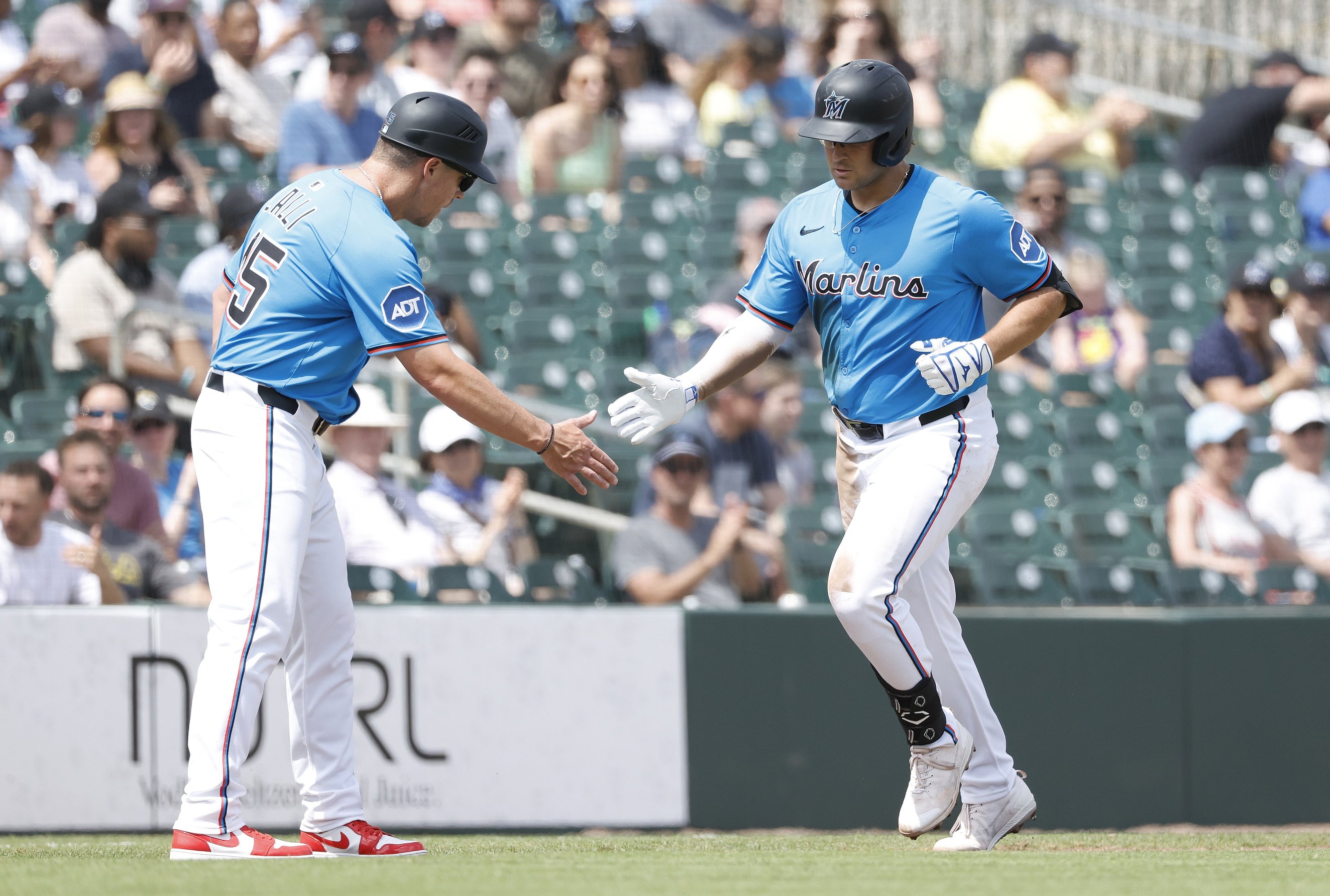 JUPITER, Fla.—While spring training results aren't exactly everything, one may find comfort in established players looking more like themselves as the regular season approaches. Some 11 days away from league-wide Opening Day, the Marlins had one of those kinds of days here at Roger Dean in their 11-5 victory over their shared tenant, the St. Louis Cardinals. Making his third spring start, Cal Quantrill, the most notable offseason addition for the club and the owner of an ERA north of 17 through his first two outings, authored three scoreless innings. "I think the first two innings were very good. The third inning, just a long wait between innings, I didn't come out with the urgency I needed to. I really can't afford to be walking too many eight and nine hitters, so I got a little lucky. The command felt better, and for the most part, we're trending in the right direction," noted Quantrill. Quantrill only registered strikes on 23 of his 43 offerings (53.3%), helping himself out via a pair of successful pickoff attempts in his final inning of work to erase his pair of previously issued free passes. The now-30-year-old led the National League with 69 walks allowed last season, his lone in Colorado. The aforementioned long inning in question came when the Marlins, having recently plated four runs in the bottom of the second, followed it up with a five-run bottom of the third. Eight of the nine starters tallied hits in the win, including Xavier Edwards, who continued a torrid spring with a two-hit, four-RBI performance, upping his average to .333. The Marlins shortstop has reached base safely in 12 of his 13 games this spring. Maybe most encouraging, though, was the rounding-into-form performance of Jonah Bride, who highlighted the day with a two-run home run off St. Louis ace Sonny Gray, capping a 2-for-3 day at the plate. While one would describe him as being off to a slow start by way of his .138 batting average entering play, Bride—the owner of a 121 OPS+ in 272 plate appearances last season—had begun spring walking in nearly 17 percent of his plate appearances. "The big thing, having some barrels mixed, but didn't get the results," commented Bride postgame. "I just need to be more consistent and continue to control the strike zone." Spring Training Notes - Spring training quirk: Cardinals starter Sonny Gray left and re-entered the game three times on Sunday. The Cardinals' scheduled Opening Day starter's final line read as follows: 3.0 IP, 6 H, 8 R, 8 ER, 5 BB, 5 K. - In addition to a stellar defensive play earlier in the game, Otto Lopez added a pair of hits to his spring ledger, driving in a run in the process. The Marlins 2B has hit .324 with a .890 OPS in 41 PA this spring. - Good impression: Heriberto Hernández, a 25-year-old minor league outfielder signed after previously playing in the Rays minor league system during Peter Bendix's tenure there, has made the most of spring invite, hitting .286 with a .768 OPS across 32 plate appearances. Looking Ahead The Marlins will commence the work week when they host the New York Mets on Monday. Ryan Weathers (1-0, 1.23 ERA) looks to continue his stellar spring as he makes his fourth start. Paul Blackburn (1-1, 6.23 ERA) will oppose him for New York. First pitch from Roger Dean Chevrolet Stadium is slated for 1:10 EST.
 -
Separate four-run and five-run innings were more than enough for the Marlins to put away St. Louis on Sunday. JUPITER, Fla.—While spring training results aren't exactly everything, one may find comfort in established players looking more like themselves as the regular season approaches. Some 11 days away from league-wide Opening Day, the Marlins had one of those kinds of days here at Roger Dean in their 11-5 victory over their shared tenant, the St. Louis Cardinals. Making his third spring start, Cal Quantrill, the most notable offseason addition for the club and the owner of an ERA north of 17 through his first two outings, authored three scoreless innings. "I think the first two innings were very good. The third inning, just a long wait between innings, I didn't come out with the urgency I needed to. I really can't afford to be walking too many eight and nine hitters, so I got a little lucky. The command felt better, and for the most part, we're trending in the right direction," noted Quantrill. Quantrill only registered strikes on 23 of his 43 offerings (53.3%), helping himself out via a pair of successful pickoff attempts in his final inning of work to erase his pair of previously issued free passes. The now-30-year-old led the National League with 69 walks allowed last season, his lone in Colorado. The aforementioned long inning in question came when the Marlins, having recently plated four runs in the bottom of the second, followed it up with a five-run bottom of the third. Eight of the nine starters tallied hits in the win, including Xavier Edwards, who continued a torrid spring with a two-hit, four-RBI performance, upping his average to .333. The Marlins shortstop has reached base safely in 12 of his 13 games this spring. Maybe most encouraging, though, was the rounding-into-form performance of Jonah Bride, who highlighted the day with a two-run home run off St. Louis ace Sonny Gray, capping a 2-for-3 day at the plate. While one would describe him as being off to a slow start by way of his .138 batting average entering play, Bride—the owner of a 121 OPS+ in 272 plate appearances last season—had begun spring walking in nearly 17 percent of his plate appearances. "The big thing, having some barrels mixed, but didn't get the results," commented Bride postgame. "I just need to be more consistent and continue to control the strike zone." Spring Training Notes - Spring training quirk: Cardinals starter Sonny Gray left and re-entered the game three times on Sunday. The Cardinals' scheduled Opening Day starter's final line read as follows: 3.0 IP, 6 H, 8 R, 8 ER, 5 BB, 5 K. - In addition to a stellar defensive play earlier in the game, Otto Lopez added a pair of hits to his spring ledger, driving in a run in the process. The Marlins 2B has hit .324 with a .890 OPS in 41 PA this spring. - Good impression: Heriberto Hernández, a 25-year-old minor league outfielder signed after previously playing in the Rays minor league system during Peter Bendix's tenure there, has made the most of spring invite, hitting .286 with a .768 OPS across 32 plate appearances. Looking Ahead The Marlins will commence the work week when they host the New York Mets on Monday. Ryan Weathers (1-0, 1.23 ERA) looks to continue his stellar spring as he makes his fourth start. Paul Blackburn (1-1, 6.23 ERA) will oppose him for New York. First pitch from Roger Dean Chevrolet Stadium is slated for 1:10 EST. View full article
-
 WEST PALM BEACH, FL—Less than a month ago, when the club designated him for assignment, it looked like Xzavion Curry's brief tenure with the Miami Marlins had come and gone. His response postgame was the epitome of the zen mindset needed to persevere in a game that—no pun intended—tends to throw its fair share of curveballs at you: "In life, when you go through trials and tribulations, it's about how you respond. You have a choice about whether or not you want to lay down and mope in it." Now, after out-dueling Astros ace Framber Valdez to the tune of three scoreless innings in Sunday's 10-6 victory over Houston, the 26-year-old will enter his next spring outing with a perfect 0.00 ERA across six innings of work. Coming over from Cleveland at the end of August, Curry pitched to a 3.00 ERA and 4.22 FIP, limiting hitters to a .145 opponent's average for Miami. "I definitely feel like I'm a different pitcher now than I was last season," noted Curry, who's added a splitter and sweeper to his arsenal this spring. Curry told reporters he collectively threw four total of the aforementioned pitches in his latest spring outing. Getting hits from six of the nine starters, Miami's offense was highlighted by back-to-back home runs from Derek Hill and Eric Wagaman. "Wagaman can really hit," noted manager Clayton McCullough. "He's taken some really good swings in games and controls the zone well." Wagaman, who signed a split deal as the club's inaugural move this past offseason, has hit .263/.391/.421 in 23 plate appearances this spring. Connor Norby continued to add to his strong spring, going 2-for-5 with an RBI to raise his Grapefruit League average to .292. Despite a bullpen that allowed six runs in the six innings following Curry, Miami picked up a rare win in a game in which they allowed three or more home runs. Spring Training Notes - Liam Hicks (1-for1, BB, 2 HBP, RBI) now owns a .471 OBP this spring. Miami's Rule 5 Draft pick has hit .250/.471/.250/.721 across 17 Grapefruit League plate appearances. - Jesús Tinoco allowed a home run to Jeremy Peña Sunday on an 0-2 count. In 51 career (regular season) plate appearances ending on an 0-2 count, Tinoco has limited hitters to a .100/.098/.140 slash line. Looking Ahead The Marlins return to their spring training home on Monday when they take on the Nationals at Roger Dean Chevrolet Stadium. Sandy Alcantara will make his fourth start of the spring and second in five days against Washington, going 2 ⅔ scoreless against them on March 5. Mitchell Parker will face off against him for Washington. First pitch is slated for 1:10 EST.
- 1 comment
-
- 3
-
-
- xzavion curry
- liam hicks
- (and 2 more)
-
Curry continues to impress in latest spring training outing; Wagaman, Norby lead offense on Sunday. WEST PALM BEACH, FL—Less than a month ago, when the club designated him for assignment, it looked like Xzavion Curry's brief tenure with the Miami Marlins had come and gone. His response postgame was the epitome of the zen mindset needed to persevere in a game that—no pun intended—tends to throw its fair share of curveballs at you: "In life, when you go through trials and tribulations, it's about how you respond. You have a choice about whether or not you want to lay down and mope in it." Now, after out-dueling Astros ace Framber Valdez to the tune of three scoreless innings in Sunday's 10-6 victory over Houston, the 26-year-old will enter his next spring outing with a perfect 0.00 ERA across six innings of work. Coming over from Cleveland at the end of August, Curry pitched to a 3.00 ERA and 4.22 FIP, limiting hitters to a .145 opponent's average for Miami. "I definitely feel like I'm a different pitcher now than I was last season," noted Curry, who's added a splitter and sweeper to his arsenal this spring. Curry told reporters he collectively threw four total of the aforementioned pitches in his latest spring outing. Getting hits from six of the nine starters, Miami's offense was highlighted by back-to-back home runs from Derek Hill and Eric Wagaman. "Wagaman can really hit," noted manager Clayton McCullough. "He's taken some really good swings in games and controls the zone well." Wagaman, who signed a split deal as the club's inaugural move this past offseason, has hit .263/.391/.421 in 23 plate appearances this spring. Connor Norby continued to add to his strong spring, going 2-for-5 with an RBI to raise his Grapefruit League average to .292. Despite a bullpen that allowed six runs in the six innings following Curry, Miami picked up a rare win in a game in which they allowed three or more home runs. Spring Training Notes - Liam Hicks (1-for1, BB, 2 HBP, RBI) now owns a .471 OBP this spring. Miami's Rule 5 Draft pick has hit .250/.471/.250/.721 across 17 Grapefruit League plate appearances. - Jesús Tinoco allowed a home run to Jeremy Peña Sunday on an 0-2 count. In 51 career (regular season) plate appearances ending on an 0-2 count, Tinoco has limited hitters to a .100/.098/.140 slash line. Looking Ahead The Marlins return to their spring training home on Monday when they take on the Nationals at Roger Dean Chevrolet Stadium. Sandy Alcantara will make his fourth start of the spring and second in five days against Washington, going 2 ⅔ scoreless against them on March 5. Mitchell Parker will face off against him for Washington. First pitch is slated for 1:10 EST. View full article
-
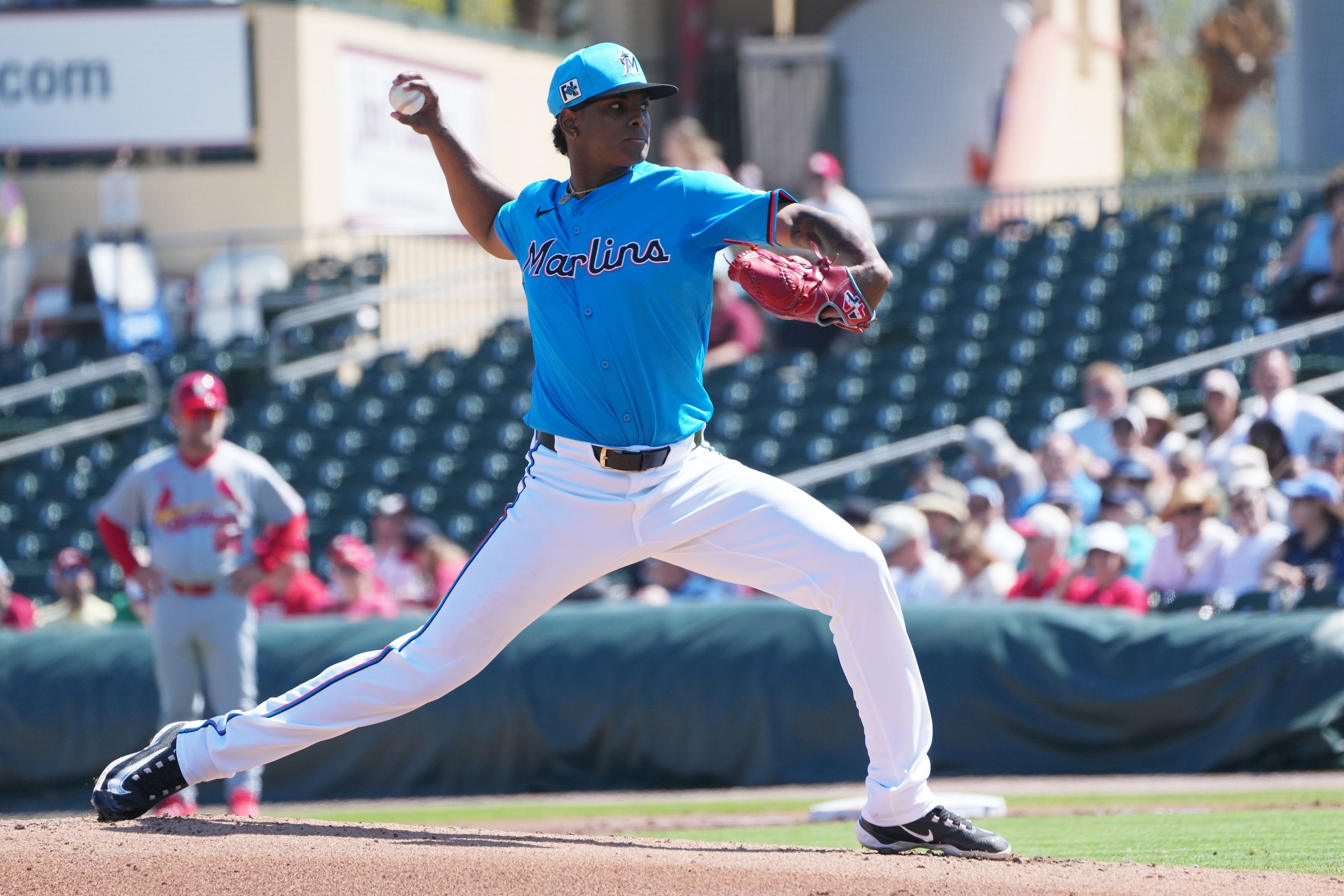 JUPITER, FL—The first start of the spring training for Edward Cabrera on February 25 proved a mixed bag. Looking at the glass half full, Nationals' hitters only had an average exit velocity of 85.4 mph in his one inning of work that day. On the other hand, that outing still saw him tagged for three runs and four hits. Fast forward to Sunday, March 2, and Cabrera found himself far more lucky in his second tune-up of camp. Though only allowing one run and two hits in his two innings of work in the Marlins' 5-3 Grapefruit League victory over the Cardinals, St. Louis hitters averaged 94.4 mph off the bat against the 26-year-old. "We just believe and trust in the quality of his stuff," noted manager Clayton McCullough. Encouraging was the quality of Cabrera's stuff, as his sinker topped out at 99, and the right-hander's seemingly improved command. Throwing strikes to six of the eight hitters faced on Sunday, Cabrera has yet to walk a hitter through his first two outings. Cabrera had some help behind him courtesy of Jared Serna when the second baseman robbed Nolan Arenado of extra bases with a leaping catch to end the top of the first. Acquired in the trade that sent Jazz Chisholm Jr. to the Yankees last July, Serna has impressed early, hitting .600 with a stolen base and no strikeouts in 8 plate appearances this spring. Serna also homered off 10-year veteran Steven Matz in his first at-bat of the day. Miami was aided in the winning effort by additional contributions from the likes of Connor Norby, slated to open the season as the team's everyday third baseman in 2025. Spring Training Notes - Catcher Nick Fortes, scratched from Saturday's game with back spasms, is expected to return to the lineup on Monday, per Clayton McCullough. - Jonah Bride went 2-for-3, including lacing the team's first triple of the spring in the bottom of the first. - Jesús Sánchez made his 2025 debut in center field recording two putouts and driving in a run at the plate on Sunday. McCullough recently noted Sánchez would see some time there during the season. Looking Ahead The Marlins (3-4-1) will continue their Grapefruit League schedule on Monday with a split-squad day. They host the Astros at Roger Dean with Max Meyer on the mound at 1:10 EST. Then, a separate group of players will meet the Mets for the third time in 2025. Connor Gillispie (0.00 ERA in 2.0 IP) will make his first start of camp for Miami as he faces off against Kodai Senga. First pitch from Clover Park in Port St. Lucie is set for 6:10.
- 1 comment
-
- 1
-
-
- edward cabrera
- jared serna
- (and 1 more)
-
Edward Cabrera continued to pound the strike zone in his second spring outing, getting help from Jared Serna in the process. JUPITER, FL—The first start of the spring training for Edward Cabrera on February 25 proved a mixed bag. Looking at the glass half full, Nationals' hitters only had an average exit velocity of 85.4 mph in his one inning of work that day. On the other hand, that outing still saw him tagged for three runs and four hits. Fast forward to Sunday, March 2, and Cabrera found himself far more lucky in his second tune-up of camp. Though only allowing one run and two hits in his two innings of work in the Marlins' 5-3 Grapefruit League victory over the Cardinals, St. Louis hitters averaged 94.4 mph off the bat against the 26-year-old. "We just believe and trust in the quality of his stuff," noted manager Clayton McCullough. Encouraging was the quality of Cabrera's stuff, as his sinker topped out at 99, and the right-hander's seemingly improved command. Throwing strikes to six of the eight hitters faced on Sunday, Cabrera has yet to walk a hitter through his first two outings. Cabrera had some help behind him courtesy of Jared Serna when the second baseman robbed Nolan Arenado of extra bases with a leaping catch to end the top of the first. Acquired in the trade that sent Jazz Chisholm Jr. to the Yankees last July, Serna has impressed early, hitting .600 with a stolen base and no strikeouts in 8 plate appearances this spring. Serna also homered off 10-year veteran Steven Matz in his first at-bat of the day. Miami was aided in the winning effort by additional contributions from the likes of Connor Norby, slated to open the season as the team's everyday third baseman in 2025. Spring Training Notes - Catcher Nick Fortes, scratched from Saturday's game with back spasms, is expected to return to the lineup on Monday, per Clayton McCullough. - Jonah Bride went 2-for-3, including lacing the team's first triple of the spring in the bottom of the first. - Jesús Sánchez made his 2025 debut in center field recording two putouts and driving in a run at the plate on Sunday. McCullough recently noted Sánchez would see some time there during the season. Looking Ahead The Marlins (3-4-1) will continue their Grapefruit League schedule on Monday with a split-squad day. They host the Astros at Roger Dean with Max Meyer on the mound at 1:10 EST. Then, a separate group of players will meet the Mets for the third time in 2025. Connor Gillispie (0.00 ERA in 2.0 IP) will make his first start of camp for Miami as he faces off against Kodai Senga. First pitch from Clover Park in Port St. Lucie is set for 6:10. View full article
-
Sandy Alcantara, Robby Snelling headline Marlins' visit to PSL
Louis Addeo-Weiss posted an article in Marlins
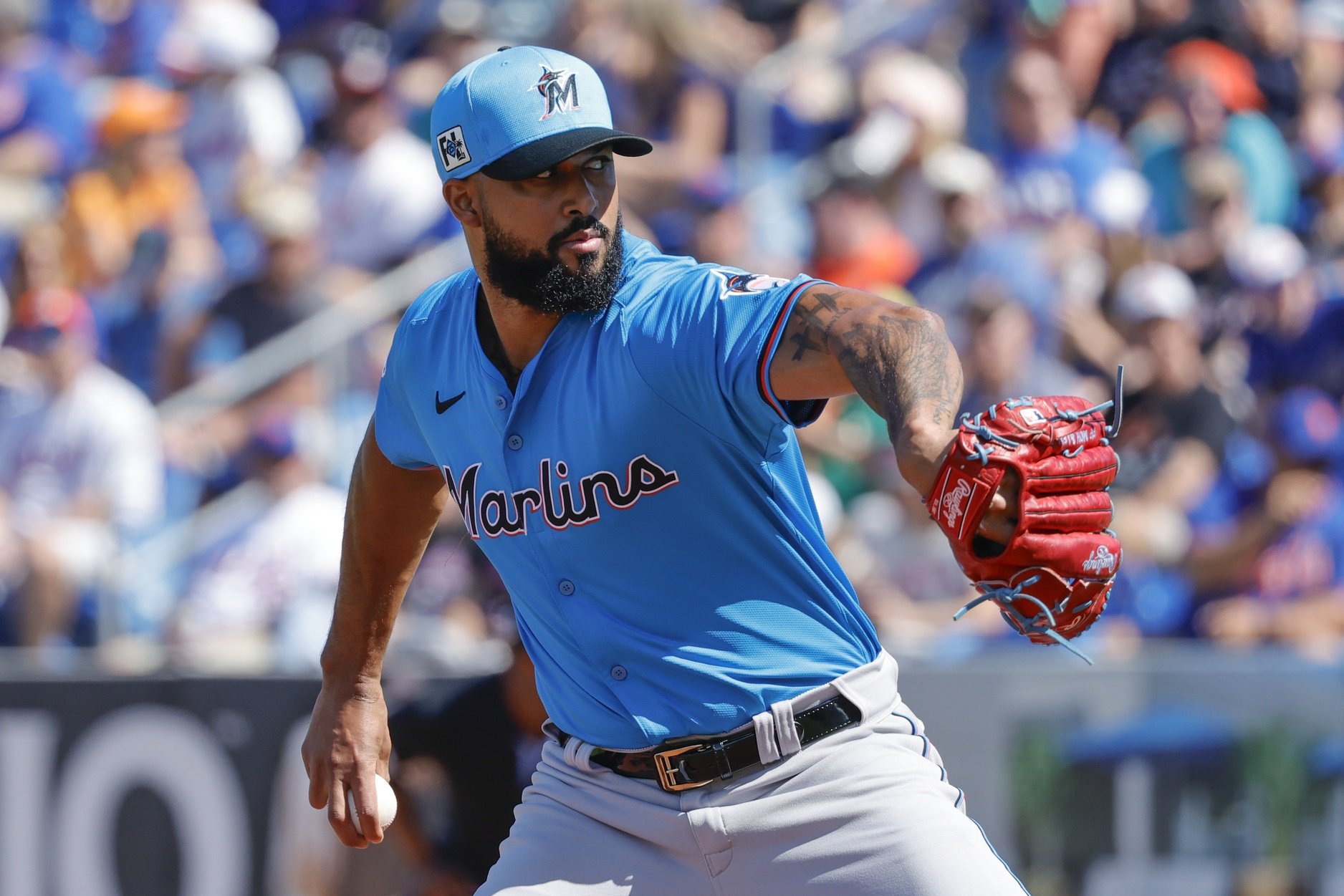 It had been 539 days since Sandy Alcantara last set foot on a big league mound. That drought ended on Sunday when the 2022 NL Cy Young Award winner, who missed all of 2024 after undergoing Tommy John surgery, started the Marlins' first game away from Roger Dean Chevrolet Stadium this spring, throwing one scoreless inning in a 1-1 tie against the division rival New York Mets. The two-time All-Star capped off his return to the mound with a strikeout of Jose Siri on a 99 mph fastball. Of his 17 pitches thrown on the day, 13 were fastballs from Alcantara, with his last one of the day being a sinker that registered at 98.7, per Statcast. Alcantara admitted postgame that he was "a little bit nervous" about finally returning to the mound in a game environment after such a long lay-off. Entering from the bullpen, he had some doubts about how well he'd be able to command his pitches, but he knew that his usual velocity was in there. "Today, my arm feels so good and I'm just trying to let it go." Of note, too, was the spring debut of left-hander Robby Snelling, who barely had to break a sweat in his seven-pitch scoreless bottom of the second. A former first-round pick of the San Diego Padres in 2022 and currently the 10th-ranked left-handed pitching prospect, according to MLB.com, Snelling sat 94-96 with his fastball Sunday, touching 96.7 at one point. Snelling will pitch all of 2025 at just 21 years old, not yet 22 until December 19. Next up on the Grapefruit League schedule, the Marlins will visit the Houston Astros on Monday at 1:05 p.m. Ryan Weathers gets the start.
-
- 2
-
-
- sandy alcantara
- robby snelling
- (and 1 more)
-
Alcantara and Snelling each threw scoreless innings in their spring debuts, lighting up the radar gun in the process. It had been 539 days since Sandy Alcantara last set foot on a big league mound. That drought ended on Sunday when the 2022 NL Cy Young Award winner, who missed all of 2024 after undergoing Tommy John surgery, started the Marlins' first game away from Roger Dean Chevrolet Stadium this spring, throwing one scoreless inning in a 1-1 tie against the division rival New York Mets. The two-time All-Star capped off his return to the mound with a strikeout of Jose Siri on a 99 mph fastball. Of his 17 pitches thrown on the day, 13 were fastballs from Alcantara, with his last one of the day being a sinker that registered at 98.7, per Statcast. Alcantara admitted postgame that he was "a little bit nervous" about finally returning to the mound in a game environment after such a long lay-off. Entering from the bullpen, he had some doubts about how well he'd be able to command his pitches, but he knew that his usual velocity was in there. "Today, my arm feels so good and I'm just trying to let it go." Of note, too, was the spring debut of left-hander Robby Snelling, who barely had to break a sweat in his seven-pitch scoreless bottom of the second. A former first-round pick of the San Diego Padres in 2022 and currently the 10th-ranked left-handed pitching prospect, according to MLB.com, Snelling sat 94-96 with his fastball Sunday, touching 96.7 at one point. Snelling will pitch all of 2025 at just 21 years old, not yet 22 until December 19. Next up on the Grapefruit League schedule, the Marlins will visit the Houston Astros on Monday at 1:05 p.m. Ryan Weathers gets the start. View full article
-
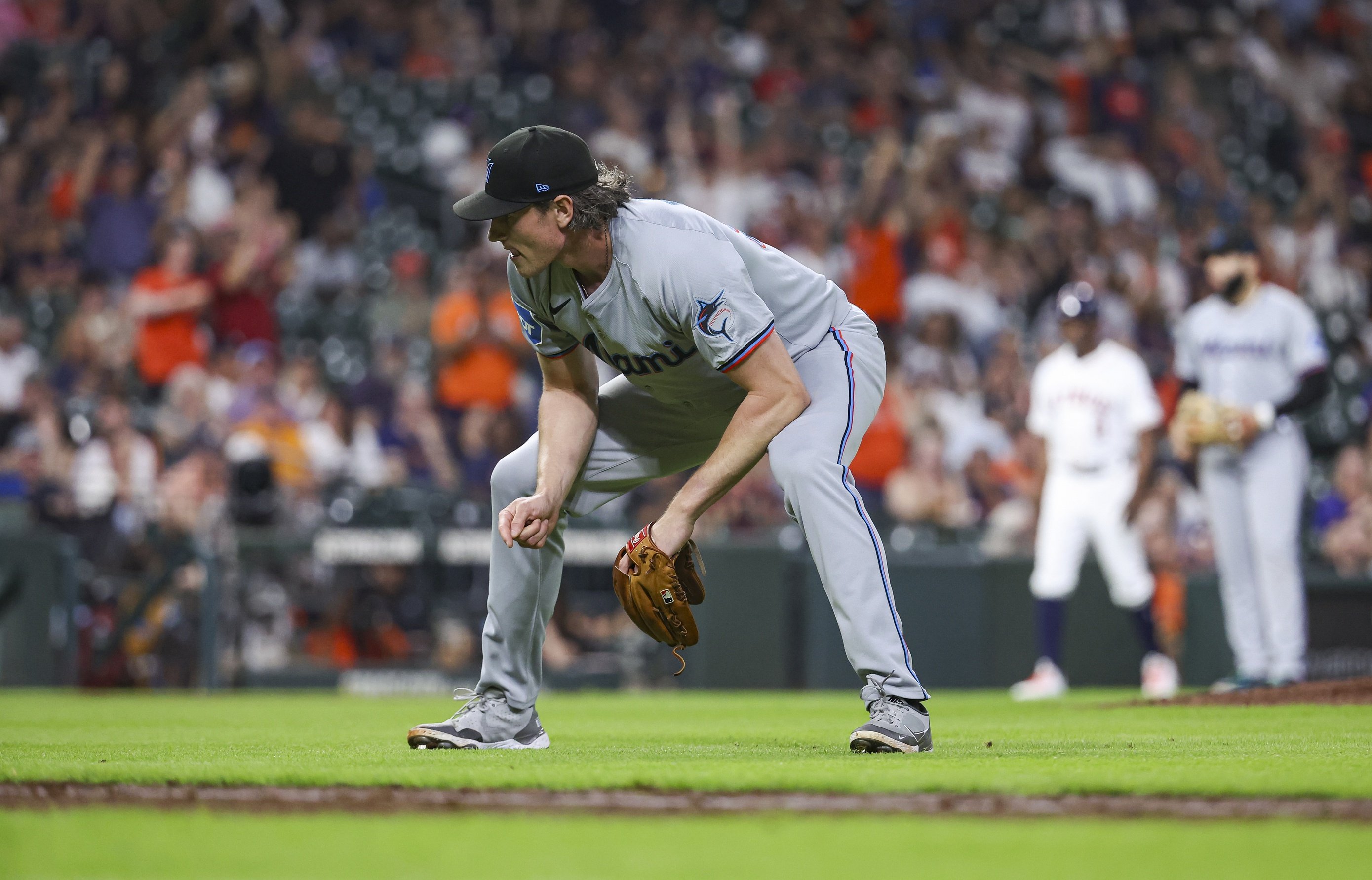 On the surface, Declan Cronin’s 2024 season was nothing to write home about, yet here we are. While Cronin’s 4.35 ERA was third-highest among the 37 MLB relievers to throw at least 70 innings, examining the right-hander through the lens of FIP (fielder independent pitching) paints him as the victim of incredible misfortune. If we go bigger picture and look at pitchers who threw at least 70 innings out of the bullpen in a single season since the start of the 21st century, Cronin’s gap between his ERA and FIP is the third-highest this millennium. “It’s not lost on myself or the pitching staff that a lot of the things that transpired and outings that didn’t go so well were kind of out of my control,” noted Cronin to our Kevin Barral. What factors contributed to Cronin’s historically lousy luck? The best place to start would be his profile. Despite his 6-foot-4, 225-lb build, Cronin doesn’t possess an overpowering fastball, with an average velocity of 93.4 mph placing him in the 38th percentile in that regard. Cronin’s sinking-two-seamer, a pitch he featured 40.6 percent of the time last season, wasn’t a pitch that made its living inducing swing-and-miss as evidenced by a 15.9-percent whiff rate. Opponents had a .340 batting average on the offering—only seven pitchers allowed hits more frequently on their sinker (min. 100 PA ending on the pitch), while only eight had a higher hard-hit rate than his 52.3 percent. Of the 35 hits he surrendered on sinkers last year, only four registered as barrels (a ball which leaves the bat at no less than 98 mph and with a launch angle between 26 and 30 degrees). Meanwhile, 14 of Cronin’s hits allowed on sinkers had a negative launch angle, indicating that 40 percent of those hits came on ground balls, a specialty of Cronin’s and the type of contact that major league defenses convert into outs the vast majority of the time. His 57.6 percent groundball rate overall put him in the 95th percentile across baseball. Accompanying that elite groundball rate is Cronin’s ability to limit the long ball. He and Kyle Barraclough (2016) are the only pitchers in Marlins history to face at least 300 hitters in a season while allowing fewer than two home runs and also averaging more than a strikeout per inning (9.2 K/9 in Cronin's case). Cronin, unfortunately, pitched in front of one of the sport’s worst defenses. The Marlins ranked 28th in team defensive efficiency at .681, well below the league average mark of .697. Similarly, they finished 27th in outs above average and 29th in range runs above average. No team made more than Miami’s 117 errors last season. Some improvement is expected in 2025, but concerns still linger. Xavier Edwards, expected to be the club’s everyday shortstop, graded out as one of the sport’s worst defenders, finishing in the first percentile in OAA while boasting 20th percentile arm. There’s also the Connor Norby of it all. He enters his first full season in the majors tasked with being Miami’s starting third baseman, a position that largely got the best of him upon coming over from Baltimore last summer (-6 OAA). Cronin induces a high volume of grounders to the left side of the infield, so their execution (or lack thereof) will largely influence his results. What can Cronin do individually to potentially change his fortunes? Alteration of his pitch mix and usage is something he’s already noted to be working on. “I haven’t really thrown a true, true sweeper in games since 2023, and even then it was somewhat limited usage,” said Cronin. Throwing the pitch just 5.1 percent of the time in his 11-inning cup of coffee debut season with the White Sox, Cronin featured the sweeper in less than one percent of total pitches thrown in 2024. “It was something (the Marlins) identified, and not just the pitch itself, but also to allow the rest of the arsenal play up.” Speaking of that arsenal, further implementation of his four-seam fastball, a pitch he threw just 7.2 percent of the time last year, could contribute to positive regression as well. Cronin throws his four-seamer a half-tick harder than his sinker and misses far more bats with it. The trade-off would be allowing a higher flyball rate, which, in turn, could see him give up a few more home runs than he did the prior year. That's a reasonable gamble when you consider how the pitch induced an average exit velocity of 88.4 mph compared to the 91.6 off his sinker. A more unpredictable pitch selection would benefit Cronin. A good example I found was this plate appearance against Atlanta’s Eddie Rosario on August 3 last season. Here’s the sequence: Pitch 1: Sinker outside, ball (1-0). Establishing his fastball to begin the PA. Pitch 2: Sinker middle-low, called strike (1-1). Needed to throw a strike with his heater before moving to offspeed. Pitch 3: Slider outside, ball (2-1). Finally flashes the breaking ball after two fastballs. Pitch 4: Sinker low and inside, fouled off (2-2). Threw a strike with the previous sinker, so went back to it in hopes of evening the count. Pitch 5: Slider up and outside, ball (3-2). He’s now attacked Rosario away on four of the five pitches he’s seen. There’s a fifty-percent chance Rosario correctly guesses what Cronin does next. Pitch 6: Sinker middle-low, fouled off (3-2). Similar location as Pitch 2, but Rosario stays alive on an early swing. Pitch 7: Sinker middle away, single to CF. A good fastball up is the best pitch in baseball. A good fastball that you’ve thrown too many times in the same spot is just muscle memory for a hitter’s eyes. 1.mp4 Expectations for Cronin should be considerably higher in 2025 than they were a year ago when he was an anonymous waiver claim. Even with opponents now being armed with more information about him, the 27-year-old won't be as easy to score upon if his luck starts to even out.
 -
Cronin's middling ERA in 2024 belies his true talent. Here's why he could be the Marlins' most effective reliever moving forward. On the surface, Declan Cronin’s 2024 season was nothing to write home about, yet here we are. While Cronin’s 4.35 ERA was third-highest among the 37 MLB relievers to throw at least 70 innings, examining the right-hander through the lens of FIP (fielder independent pitching) paints him as the victim of incredible misfortune. If we go bigger picture and look at pitchers who threw at least 70 innings out of the bullpen in a single season since the start of the 21st century, Cronin’s gap between his ERA and FIP is the third-highest this millennium. “It’s not lost on myself or the pitching staff that a lot of the things that transpired and outings that didn’t go so well were kind of out of my control,” noted Cronin to our Kevin Barral. What factors contributed to Cronin’s historically lousy luck? The best place to start would be his profile. Despite his 6-foot-4, 225-lb build, Cronin doesn’t possess an overpowering fastball, with an average velocity of 93.4 mph placing him in the 38th percentile in that regard. Cronin’s sinking-two-seamer, a pitch he featured 40.6 percent of the time last season, wasn’t a pitch that made its living inducing swing-and-miss as evidenced by a 15.9-percent whiff rate. Opponents had a .340 batting average on the offering—only seven pitchers allowed hits more frequently on their sinker (min. 100 PA ending on the pitch), while only eight had a higher hard-hit rate than his 52.3 percent. Of the 35 hits he surrendered on sinkers last year, only four registered as barrels (a ball which leaves the bat at no less than 98 mph and with a launch angle between 26 and 30 degrees). Meanwhile, 14 of Cronin’s hits allowed on sinkers had a negative launch angle, indicating that 40 percent of those hits came on ground balls, a specialty of Cronin’s and the type of contact that major league defenses convert into outs the vast majority of the time. His 57.6 percent groundball rate overall put him in the 95th percentile across baseball. Accompanying that elite groundball rate is Cronin’s ability to limit the long ball. He and Kyle Barraclough (2016) are the only pitchers in Marlins history to face at least 300 hitters in a season while allowing fewer than two home runs and also averaging more than a strikeout per inning (9.2 K/9 in Cronin's case). Cronin, unfortunately, pitched in front of one of the sport’s worst defenses. The Marlins ranked 28th in team defensive efficiency at .681, well below the league average mark of .697. Similarly, they finished 27th in outs above average and 29th in range runs above average. No team made more than Miami’s 117 errors last season. Some improvement is expected in 2025, but concerns still linger. Xavier Edwards, expected to be the club’s everyday shortstop, graded out as one of the sport’s worst defenders, finishing in the first percentile in OAA while boasting 20th percentile arm. There’s also the Connor Norby of it all. He enters his first full season in the majors tasked with being Miami’s starting third baseman, a position that largely got the best of him upon coming over from Baltimore last summer (-6 OAA). Cronin induces a high volume of grounders to the left side of the infield, so their execution (or lack thereof) will largely influence his results. What can Cronin do individually to potentially change his fortunes? Alteration of his pitch mix and usage is something he’s already noted to be working on. “I haven’t really thrown a true, true sweeper in games since 2023, and even then it was somewhat limited usage,” said Cronin. Throwing the pitch just 5.1 percent of the time in his 11-inning cup of coffee debut season with the White Sox, Cronin featured the sweeper in less than one percent of total pitches thrown in 2024. “It was something (the Marlins) identified, and not just the pitch itself, but also to allow the rest of the arsenal play up.” Speaking of that arsenal, further implementation of his four-seam fastball, a pitch he threw just 7.2 percent of the time last year, could contribute to positive regression as well. Cronin throws his four-seamer a half-tick harder than his sinker and misses far more bats with it. The trade-off would be allowing a higher flyball rate, which, in turn, could see him give up a few more home runs than he did the prior year. That's a reasonable gamble when you consider how the pitch induced an average exit velocity of 88.4 mph compared to the 91.6 off his sinker. A more unpredictable pitch selection would benefit Cronin. A good example I found was this plate appearance against Atlanta’s Eddie Rosario on August 3 last season. Here’s the sequence: Pitch 1: Sinker outside, ball (1-0). Establishing his fastball to begin the PA. Pitch 2: Sinker middle-low, called strike (1-1). Needed to throw a strike with his heater before moving to offspeed. Pitch 3: Slider outside, ball (2-1). Finally flashes the breaking ball after two fastballs. Pitch 4: Sinker low and inside, fouled off (2-2). Threw a strike with the previous sinker, so went back to it in hopes of evening the count. Pitch 5: Slider up and outside, ball (3-2). He’s now attacked Rosario away on four of the five pitches he’s seen. There’s a fifty-percent chance Rosario correctly guesses what Cronin does next. Pitch 6: Sinker middle-low, fouled off (3-2). Similar location as Pitch 2, but Rosario stays alive on an early swing. Pitch 7: Sinker middle away, single to CF. A good fastball up is the best pitch in baseball. A good fastball that you’ve thrown too many times in the same spot is just muscle memory for a hitter’s eyes. 1.mp4 Expectations for Cronin should be considerably higher in 2025 than they were a year ago when he was an anonymous waiver claim. Even with opponents now being armed with more information about him, the 27-year-old won't be as easy to score upon if his luck starts to even out. View full article
-
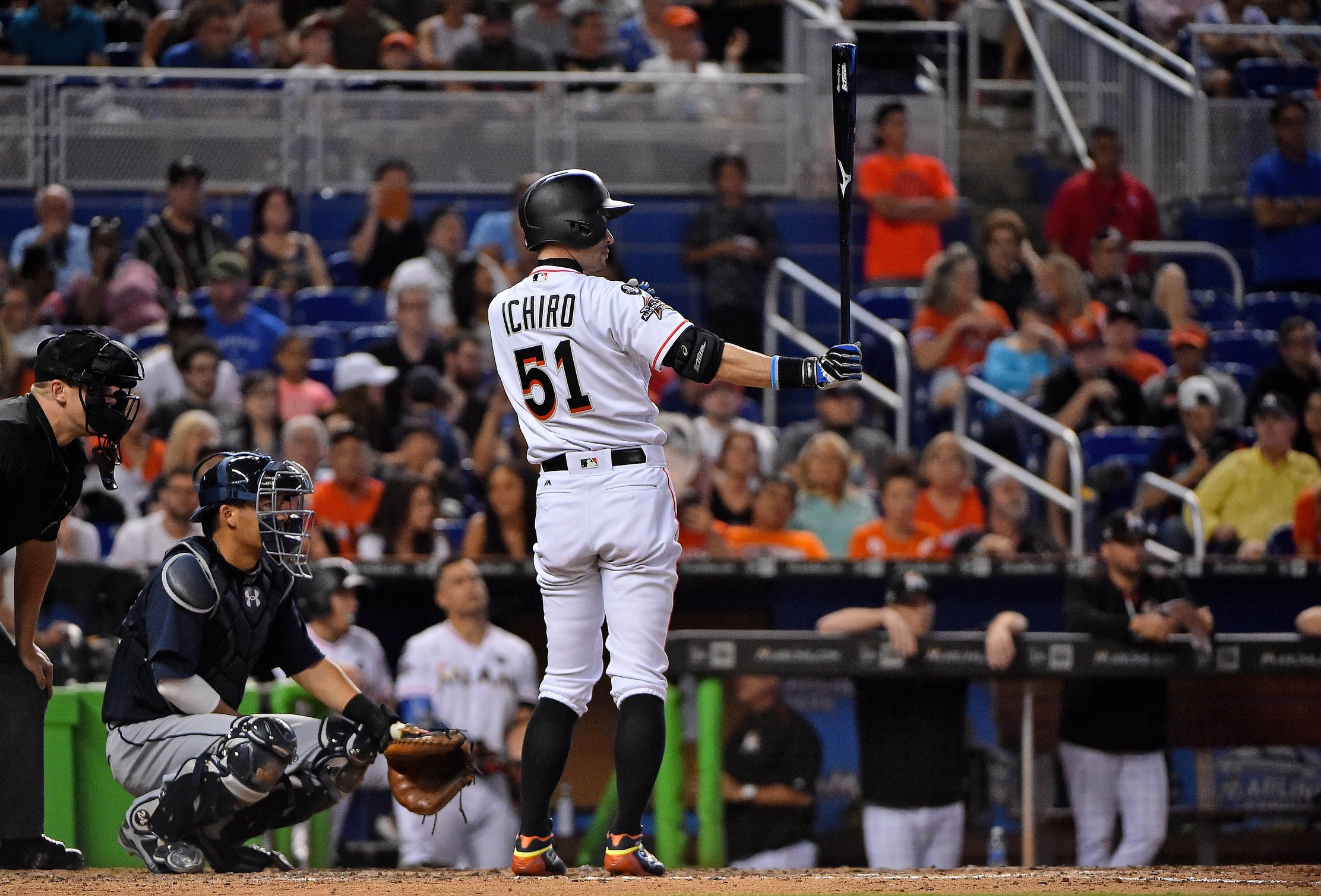 The National Baseball Hall of Fame has announced its selections for the 2025 class, highlighted by Ichiro Suzuki, selected on the first ballot just one vote shy of unanimity. Joining him is fellow first-timer CC Sabathia, a member of another elusive 3,000-club—the 3,000-strikeout club—and Billy Wagner, who makes it in his tenth and final year of eligibility. In regard to other former Marlins, Mark Buehrle—five-time All-Star and 214-game winner who put up 4.2 bWAR and won a Gold Glove in his lone season with Miami in 2012—received 11.4% of the vote in his fifth year on the ballot. First-timers Hanley Ramírez, Curtis Granderson and Fernando Rodney all failed to attain the necessary 5% to remain under consideration in the future. The BBWAA posted the full breakdown of voting percentages. Ramírez won NL Rookie of the Year honors in 2006 and made three consecutive All-Star teams from 2008-2010, capturing the 2009 NL batting title after hitting .342, ultimately finishing second to Albert Pujols in league MVP voting. To date, Ramírez remains the only player in franchise history to both hit 100-plus home runs and steal 100-plus bases, well exceeding both of those totals at 148 and 230, respectively. But back to Ichiro… Suzuki, who collected 3,089 hits after coming stateside in 2001, becomes the sixth player inducted to have played for the Florida/Miami Marlins, joining Andre Dawson (2010), Mike Piazza (2016), Tim Raines (2017), Iván Rodríguez (2017) and Trevor Hoffman (2018). Jim Leyland, elected in 2024 for his contributions as a manager, won his only World Series title at the helm of the 1997 Marlins. After collecting 1,278 hits in parts of nine seasons in Japan, Suzuki commenced his first decade in the North American Major Leagues with 10 consecutive AL All-Star appearances. He was named American League Rookie of the Year and MVP in his inaugural 2001 campaign. He collected no fewer than 206 hits in each of those first 10 seasons, including an MLB record 262 in 2004, to go along with 10 Gold Gloves, all done while a member of the Seattle Mariners. While well past his prime upon arriving in Miami before the 2015 season, Ichiro became a quick fan favorite in his parts of three seasons with the club, collecting his 3,000th hit on August 7, 2016, against the Colorado Rockies. He's the only player to reach that milestone in a Marlins uniform. Seen as somewhat of a late-career renaissance, Suzuki hit .291/.354/.376/.730 across 365 PA as a 42-year-old in 2016, good enough for a 102 OPS+ and 1.6 bWAR, the latter being his highest single-season total since 2013. Despite being an overall on-field liability in 2015 (-1.1 bWAR), Suzuki retained his acumen as a strong outfield defender, leading all NL right fielders in total zone runs (+13), and grading out at +16 for the season. Thanks to his plus-8 Rfield during his tenure with Miami, Ichiro became one of just five players to amass 10-plus runs of value on defense after turning 40, finishing at plus-11. From all of our staff here at Fish On First, we extend our sincerest congratulations to each of the newly elected Hall of Famers.
- 1 comment
-
- 3
-
-

-
- ichiro suzuki
- hanley ramirez
- (and 3 more)
-
Suzuki and CC Sabathia headline a 2025 class that includes Billy Wagner. The National Baseball Hall of Fame has announced its selections for the 2025 class, highlighted by Ichiro Suzuki, selected on the first ballot just one vote shy of unanimity. Joining him is fellow first-timer CC Sabathia, a member of another elusive 3,000-club—the 3,000-strikeout club—and Billy Wagner, who makes it in his tenth and final year of eligibility. In regard to other former Marlins, Mark Buehrle—five-time All-Star and 214-game winner who put up 4.2 bWAR and won a Gold Glove in his lone season with Miami in 2012—received 11.4% of the vote in his fifth year on the ballot. First-timers Hanley Ramírez, Curtis Granderson and Fernando Rodney all failed to attain the necessary 5% to remain under consideration in the future. The BBWAA posted the full breakdown of voting percentages. Ramírez won NL Rookie of the Year honors in 2006 and made three consecutive All-Star teams from 2008-2010, capturing the 2009 NL batting title after hitting .342, ultimately finishing second to Albert Pujols in league MVP voting. To date, Ramírez remains the only player in franchise history to both hit 100-plus home runs and steal 100-plus bases, well exceeding both of those totals at 148 and 230, respectively. But back to Ichiro… Suzuki, who collected 3,089 hits after coming stateside in 2001, becomes the sixth player inducted to have played for the Florida/Miami Marlins, joining Andre Dawson (2010), Mike Piazza (2016), Tim Raines (2017), Iván Rodríguez (2017) and Trevor Hoffman (2018). Jim Leyland, elected in 2024 for his contributions as a manager, won his only World Series title at the helm of the 1997 Marlins. After collecting 1,278 hits in parts of nine seasons in Japan, Suzuki commenced his first decade in the North American Major Leagues with 10 consecutive AL All-Star appearances. He was named American League Rookie of the Year and MVP in his inaugural 2001 campaign. He collected no fewer than 206 hits in each of those first 10 seasons, including an MLB record 262 in 2004, to go along with 10 Gold Gloves, all done while a member of the Seattle Mariners. While well past his prime upon arriving in Miami before the 2015 season, Ichiro became a quick fan favorite in his parts of three seasons with the club, collecting his 3,000th hit on August 7, 2016, against the Colorado Rockies. He's the only player to reach that milestone in a Marlins uniform. Seen as somewhat of a late-career renaissance, Suzuki hit .291/.354/.376/.730 across 365 PA as a 42-year-old in 2016, good enough for a 102 OPS+ and 1.6 bWAR, the latter being his highest single-season total since 2013. Despite being an overall on-field liability in 2015 (-1.1 bWAR), Suzuki retained his acumen as a strong outfield defender, leading all NL right fielders in total zone runs (+13), and grading out at +16 for the season. Thanks to his plus-8 Rfield during his tenure with Miami, Ichiro became one of just five players to amass 10-plus runs of value on defense after turning 40, finishing at plus-11. From all of our staff here at Fish On First, we extend our sincerest congratulations to each of the newly elected Hall of Famers. View full article
-
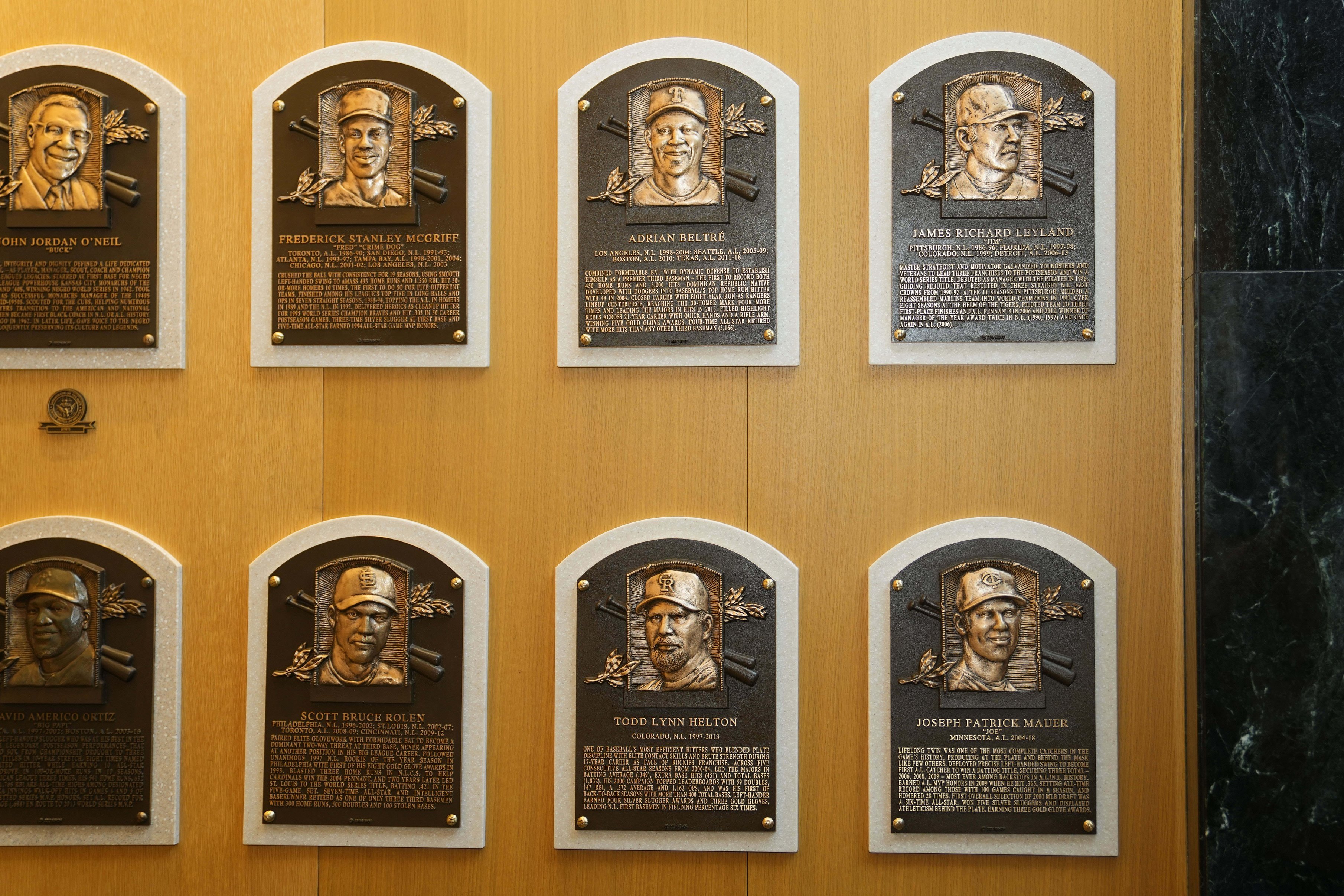 2025 is upon us, and for most baseball fans, the first major event surrounding the sport each year is the unveiling of the next class of National Baseball Hall of Fame inductees. On January 21, we'll learn which newcomers to the process earn first-ballot enshrinement and whether holdovers get much-needed boosts to push them over that coveted 75-percent threshold (or at least put them on track for future induction). Here, we will talk about all that and then some in a new annual tradition: the Fish On First Hall of Fame ballot. Through the process of gathering and sorting ballots from ten of our staffers, we’ve constructed a ballot reflective of the aggregate. Here’s a rundown of how the selection process worked: Voters were allotted to vote for the standard maximum of 10 players. Players named on at least five of the ten submitted ballots garnered entry into the collective ballot ("tie goes to the player," if you will). Players noted on at least three but no more than four ballots garnered an honorable mention blip with special exceptions made for those with otherwise compelling cases. Without further adieu, we present you our staff ballot. Honorable Mentions Andy Pettitte, SP: Ask a Yankee fan this question and you’re likely to get an unequivocal "yes" before receiving a rundown of his accomplishments: 256 wins and five World Series titles largely on the strength of the most playoff innings pitched in history. While Pettitte feels like a player many a voter would come around on in time (they only have three chances left after 2025), for now, only four of ten staffers included him, largely due to some of the red flags surrounding his case. If elected, his 3.85 ERA would trail only Jack Morris (3.90) for the highest such mark among enshrined pitchers. However, strength lies in his era-adjusted 117 ERA+, in line with first-timer CC Sabathia (116), as is his 60.2 bWAR to Sabathia’s 62.3. Félix Hernández, SP: The tragic tale of the man dubbed “King Félix” is similar to that of another Venezuelan native, Johan Santana. Like his native countryman, Hernández has a peak in line with many a Hall of Fame hurler, but a combination of injuries and poor late-career performance are enough to say not enough. Still, a major factor most consider when assessing a person’s place in Cooperstown is how good you were at your best, and only Clayton Kershaw put up more bWAR (46.6) between 2009-2015 than Hernández’s 37.9—a period in which the right-hander won a Cy Young award that drastically altered how we assess pitcher-worth—authored a perfect game, and garnered six AL All-Star selections. A win for him and most Mariner fans would be some corrective justice in service to the one-and-done Santana in garnering the minimum 5 percent needed to remain on the ballot for future consideration. Mark Buehrle, SP: I wouldn’t be the first to note the similarities between Pettitte and Buehrle, though dropping this hyperlink wouldn’t hurt. Buehrle’s biggest calling card is his durability, as evidenced by his 14 seasons of 200-plus innings pitched, 12 of which he was at or better than the league average by ERA+ (100). Buehrle’s 12 such seasons are tied with Hall of Famers Tom Glavine, Fergie Jenkins, and Christy Mathewson, and 15 of the 16 pitchers to accomplish the feat more than him are in the Hall of Fame with the lone exception being Roger Clemens. That has to count for something, right? While he may have never felt like a pitcher bound for Cooperstown when you watched him, Buehrle’s case is compelling to say the least, though only one of our staff felt compelling enough to include. Dustin Pedroia, 2B: First there was Tony Conigliaro, then there was Dustin Pedroia. The Red Sox have a history of these kinds of great, but fleeting star players. The American League David Wright with a different candor, Dustin Pedroia garnered universal respect for his hard style of play, winning Rookie of the Year and MVP honors in his first two full seasons of play en route to becoming a four-time All-Star and Gold Glove winner. Were it not for a highly contested slide by Manny Machado in 2017, Pedroia would have likely added to an already strong Hall of Fame case had his career not been derailed as a result. Without all of the compiling stats that would have accompanied a late-career regression, Pedroia’s career on its merits is very similar to another Hall of Fame Red Sox second baseman, Bobby Doerr, in terms of value a la WAR (51.9-to-51.4) and career OPS+ (113-to-115). He’s one of just three second baseman in history with at least 125 home runs, 125 stolen bases, and 90 runs from fielding (Rfield), but like Félix, there simply doesn’t appear enough to say yes. Ian Kinsler, 2B: Safe from a couple of Detroit and Arlington-covered voters, I think it’s a safe assumption that Ian Kinsler isn’t a name on too many people’s Hall of Fame radar (including no one on our staff). Despite this and the fact that a prospective "Mr. 2000" film centered on Kinsler’s career would likely prove less interesting than the late-Bernie Mac picture of similar lore (Kinsler retired with exactly 1,999 career hits), what he did on the Diamond at least merits mention. His 54.1 bWAR has him as the 21st-best second baseman in baseball history, his 246 home runs are tied for seventh with Hall of Famer Joe Gordon in games appeared at second, and he’s one of just seven players at the position with at least 200 home runs and 200 steals—a list that features four Hall of Famers, Kinsler, and Jose Altuve. Kinsler was also a protagonist on Texas Rangers teams that reached consecutive World Series in 2010 and 2011, a period in which he hit .293/.403/.474 across 32 playoff games. He’d be far from the worst player inducted, but it’ll likely be a short flirtation with forever for Kins. The Selections Bobby Abreu, RF (60.2 bWAR/59.7 fWAR) When I published my first Hall of Fame ballot piece three years ago, Bobby Abreu, then in his third year of eligibility, wasn’t on my ballot. Ever since, however, I have championed his case at every possible juncture. A career .291/.395/.475/.870 (128 OPS+) hitter, Abreu’s combination of power, speed, and plate discipline made him one of the better all-around offensive players of his era. At his best from 1998-2004, Abreu averaged 5.9 wins per season, with only six position players amassing more than his 41.6 bWAR, right in line with the 42.2 average for Hall of Fame right fielder’s seven-year peak. One of the knacks on Abreu’s case is the notion that he wasn’t considered a standout defender in right field, but he did rank within the top two in total zone runs at the position three times, leading the league with 28 in 1998. Even post-peak Abreu remained productive, putting up 18.7 bWAR thanks to 121 home runs, 189 stolen bases, and a 117 OPS+ from 2005-2012. More importantly, though, here’s a quick trivia nugget for you. There a three players in MLB history with at least 275 home runs, 400 steals, and a .395 or better on-base percentage: Barry Bonds, the late Rickey Henderson, and yes, Bobby Abreu. Carlos Beltrán, CF (70.1 bWAR/67.4 fWAR) Had he not been among the main architects of the 2017 Astros sign-stealing scandal, Carlos Beltrán would most certainly already be in the Hall of Fame (and potentially still be managing the New York Mets). However, due to his involvement, he finds himself returning to the ballot for a third year, though he may not have to wait much longer after appearing on 57.1 percent of votes cast in 2024. Transgression aside, Beltrán distinguished himself during his career for his power-speed combination along with a reputation as a stellar center field defender, totaling 103 fielding runs at the position en route to three Gold Glove awards. A nine-time All-Star, Beltrán is one of just five players with at least 400 home runs and 300 steals, with the other four being the aforementioned Bonds, Willie Mays, Andre Dawson, and Álex Rodríguez. Most impressive with regards to Beltrán’s baserunning is the efficiency at which he stole bases as his 86.4 percent success rate is the best such mark among any player with at least 350 stolen base attempts. There’s also the postseason of it all, and few were better in October than Beltrán, who hit .307/.412/.609/1.021 with 16 home runs and a perfect 11-for-11 in stolen base attempts in 65 playoff games. Among hitters with at least 250 postseason plate appearances, no one posted a higher OPS than Beltrán’s aforementioned 1.021. Sign-stealing aside, Beltrán, respected amongst many in and outside of the sport, had a career that should someday merit him a plaque in Cooperstown. Andruw Jones, CF (62.7 bWAR/67.0 fWAR) There are seven players in baseball history with at least 200 runs from defense; only one of them, Adrian Beltré (477) has more home runs than Andruw Jones’ 434. His 254 total zone runs are not only tops among outfielders, it’s the best such mark of any player in baseball history. While largely done as a productive player after age 30 like the above-mentioned Félix Hernández, Andruw Jones had a nine-year run from 1998-2006 that has him here on this list. In that span, Jones averaged 35 home runs at the plate and 21 runs from fielding a season. Among position players in that span, only Bonds and Rodríguez produced more value than Jones’ 54.5 bWAR, only those two and Vladimir Guerrero Sr. hit more than his 319 home runs, and no one came within 50 of Jones’ 192 runs saved on defense. Whether you go by seven-year peak (46.4-to-44.7) or JAWS (54.6-to-58.1), Jones is above or keeping company with other Hall of Fame center fielders. Wine about his career .254 batting average, and I’ll counter with Harmon Killebrew, a career .256 hitter who produced less value in 239 more games than Jones despite hitting 139 more home runs. Even as advanced metrics such as defensive runs saved coincided with the tail end and untimely erosion of his production, Jones still sat within the top 25 in DRS from 2003-2012 per Fielding Bible, saving 65 runs as his bat largely abandoned him. Manny Ramírez, LF (69.3 bWAR/66.3 fWAR) Like the entry to follow, there is a bit of yuck associated with this player. Maybe not the hottest baseball take to be delivered, but I’d posit that even without the use of performance-enhancing drugs, Manny Ramírez still winds up among the ten best right-handed hitters of all time. Only nine such hitters have a career OPS+ better than Ramírez’s 154 with a minimum of 9000 plate appearances, all of whom are in the Hall. Excluding handedness, Ramírez is one of just 13 players to take as many trips to the plate and finish with a .300/.400/.500 slash line and only 14 hitters have more than his 555 home runs. That being said, despite 12 All-Star appearances and nine Silver Slugger awards, after having not gotten more than 33.2 percent of the vote in any of his eight trips to the ballot, chances appear slim for Ramírez to make the necessary lead to the 75 percent required for induction. Álex Rodríguez, SS/3B (117.6 bWAR/113.6 fWAR) I had previously posited my support for A-Rod in the Hall as far back as 2022, though there’s some ick associated with doing so when you know of his multiple transgressions. Separating the man from the player, the player we saw over parts of 22 seasons was one of the best distillations of a player the game had ever seen. Only 11 players put up more than Rodríguez’s 117.6 bWAR and they’re among the inner circle greatest of all time. Consistently receiving between 34 and 35 percent of the vote in each of his first three seasons of eligibility, a similar showing for A-Rod in year four could prove an eventual fatal blow to his election as it did Barry Bonds and Roger Clemens, who treaded similar waters before ultimately not being selected in their 10 years of eligibility. But while our vote may not count, the three-time MVP and owner of 696 home runs has our vote, albeit begrudgingly. CC Sabathia, SP (62.3 bWAR/66.5 fWAR) After Randy Johnson won his 300th game in 2009, he became what in all likelihood would be the last-ever pitcher to join the 300-win club. So, when CC Sabathia struck out former teammate John Ryan Murphy to notch his 3,000th career strikeout on April 30, 2019, the argument can be made that a new gold standard for Hall of Fame starting pitchers had been set. What Sabathia has that plenty of future Hall of Fame starts will likely lack is volume. His 3,577 ⅓ innings pitched are the most for any pitcher since the beginning of the 21st century. While people may balk at electing a pitcher with a career 3.74 ERA, let us remember Mike Mussina was recently voted in despite a 3.68, and era-adjusted ERA+ still credits the two as being 16 and 23 percent better than average at preventing runs. While we could consider his less-than-stellar 4.28 ERA over 130 ⅓ postseason innings pitched as a thorn in an undoubtedly questionable case, Sabathia was the prized addition to a Yankees team that, after missing the postseason the previous year, claimed the title in 2009, a season in which he finished fourth in AL Cy Young voting. And to add to the latter, Sabathia does have said award in his trophy case, claiming AL Cy honors in 2007 when he went 19-7 with a 3.21 ERA and now-foreign-sounding 241 innings pitched. The left-hander would finish top-five in the voting five times between 2007-2011, a period where only Roy Halladay (34 bWAR) amassed more value than Sabathia’s 30.4 bWAR. Considering the body of work was enough for all ten of our participating staffers to include him on their respective ballots, Sabathia finds himself here, a deserving Hall of Famer. Ichiro Suzuki, RF (60.0 bWAR/57.5 fWAR) From a player in Sabathia who you could go either way on to someone who could incite a riot should he not be a unanimous selection, Ichiro is a singular figure in baseball history. Of the 33 members of the 3,000-hit club, no one was older than Suzuki’s 27 years and 162 days when making their big league debut. The next oldest, Wade Boggs, was 23 years and 299 days old when he debuted with the Boston Red Sox on April 10, 1982. And yet, despite being such a late arrival to stateside ball after hitting .353 and amassing 1,278 hits over nine seasons in NPB, Ichiro quickly showed that was age was, quite literally, just a number, as he became just the second player in baseball history to capture MVP honors in his first full season, joining Fred Lynn (1975). In his decade of dominance from 2001-2010, Ichiro would put up 10 consecutive 200-hit seasons—including the single-season record in 2004 with 262—capture 10 Gold Gloves, earn 10 consecutive All-Star selections, and a pair of batting titles. While we touched on the 10 Gold Glove awards, it’s important to highlight just how great a defender Ichiro was, as evidenced by his 106 DRS being the seventh best among all outfielders in the statistic’s tracking (since 2003). Some shielding of the eyes that accompanies his career 107 OPS+ is understood for a Hall of Famer, let us remember that Suzuki felt like a player out of a previous era, a la Tony Gwynn (who retired the year Ichiro debuted), prioritizing singles over swinging for the fences. If these two statistical fun facts are worth any consolation for that aforementioned metric, Ichiro is one of just seven members of the 3,000-hit club to steal more than 500 bases—and with the fourth-highest success rate of any player with at least 600 steal attempts (81.3%). He’s one of just 32 position players in the modern era (since 1901) to put up 60 WAR from the age of 27 onward, and there’s no denying Ichiro’s place as one of the game’s true immortals. And hey, it'd be the next closest thing to a former Marlin being inducted, right? Chase Utley, 2B (64.5 bWAR/61.5 fWAR) Late in 2023, as he was entering his first time on the ballot, I wrote an ode to why I felt Chase Utley was and is a deserving Hall of Famer. So, in honor of him returning to the ballot in 2025, I’d like to go ahead and share some nuggets from that piece. Though he received just 28.8 percent of the vote in 2024, I see no reason why he shouldn’t get a boost in year two, as he’s the 12th-best second baseman of all-time by bWAR, a testament to his well-rounded game. People will scoff at the lack of counting stats and accolades—1,885 hits and no Gold Gloves—but as outlined with my Ian Kinsler blurb, counting stats do little in determining a person’s Hall credibility in my eyes. With the use of revisionist history, Utley should have won multiple Gold Gloves given he led the position in total zone runs thrice and finished inside the top five an additional five times. For his career, his 126 runs saved at 2B are second by a hair to Mark Ellis’ 128. All of this without mentioning how good of a hitter he was, capturing four Silver Sluggers over a career that saw him hit 252 home runs. People like winners and Utley was undeniably the best player on a Phillies team that won five consecutive NL East titles and the World Series in 2008. In fact, during his prime from 2005-2010, only Albert Pujols (52.1) put up more WAR than Utley’s 45.5. Seven of the ten staffers are pro-Utley, and I certainly believe he’ll get the call he deserves in due time, but I don’t see 2025 being that time. Billy Wagner, RP (27.7 bWAR, 24.0 fWAR) Throughout this piece, I haven’t shied away from my use of WAR in making cases for players for Cooperstown, but I’ll acknowledge the metric as not being the be-all, end-all to which a player ought to be evaluated for the Hall. The career of Billy Wagner conforms to the latter. While WAR is cumulative and Wagner lacks the large cumulative totals—903 innings pitched being the prime example—it’s the quality of those innings that had nine of our staffers giving him the thumbs up. Of pitchers with at least 900 innings pitched, only Mariano Rivera (205) has a higher adjusted ERA+ than Wagner’s 187. I can excuse Wagner’s 11 ⅔ innings of postseason futility (he pitched to a 10.03 ERA in those innings) when the larger body of work is so overwhelmingly dominant. Wagner is the only pitcher with a season of at least 65 innings pitched and 13-plus K/9 at age 38 or older. Heck, no pitcher in his age bracket even averaged more than the 12.4 K/9 that 39-year-old David Robertson did in 2024, and that came in era when the league-wide strikeout rate was 22.6 percent when compared to the 18.5 percent it was when Wagner did his damage in 2010. Now, Rivera is in a class of his own with his 56.2 bWAR and near-stainless postseason track record helping him become the only player elected unanimously excluding a veteran’s committee’s intervention. While WAR may tell us Wagner was only half as valuable as Mo, half a Mo still made for one of the most dominant inning-for-inning pitchers the game had ever seen. After just missing election in 2024 with 73.8 percent of the vote, Wagner’s 10th and final year should be the one that seals his enshrinement.
 -
Here are the Hall of Fame candidates our staff would be voting for this year. 2025 is upon us, and for most baseball fans, the first major event surrounding the sport each year is the unveiling of the next class of National Baseball Hall of Fame inductees. On January 21, we'll learn which newcomers to the process earn first-ballot enshrinement and whether holdovers get much-needed boosts to push them over that coveted 75-percent threshold (or at least put them on track for future induction). Here, we will talk about all that and then some in a new annual tradition: the Fish On First Hall of Fame ballot. Through the process of gathering and sorting ballots from ten of our staffers, we’ve constructed a ballot reflective of the aggregate. Here’s a rundown of how the selection process worked: Voters were allotted to vote for the standard maximum of 10 players. Players named on at least five of the ten submitted ballots garnered entry into the collective ballot ("tie goes to the player," if you will). Players noted on at least three but no more than four ballots garnered an honorable mention blip with special exceptions made for those with otherwise compelling cases. Without further adieu, we present you our staff ballot. Honorable Mentions Andy Pettitte, SP: Ask a Yankee fan this question and you’re likely to get an unequivocal "yes" before receiving a rundown of his accomplishments: 256 wins and five World Series titles largely on the strength of the most playoff innings pitched in history. While Pettitte feels like a player many a voter would come around on in time (they only have three chances left after 2025), for now, only four of ten staffers included him, largely due to some of the red flags surrounding his case. If elected, his 3.85 ERA would trail only Jack Morris (3.90) for the highest such mark among enshrined pitchers. However, strength lies in his era-adjusted 117 ERA+, in line with first-timer CC Sabathia (116), as is his 60.2 bWAR to Sabathia’s 62.3. Félix Hernández, SP: The tragic tale of the man dubbed “King Félix” is similar to that of another Venezuelan native, Johan Santana. Like his native countryman, Hernández has a peak in line with many a Hall of Fame hurler, but a combination of injuries and poor late-career performance are enough to say not enough. Still, a major factor most consider when assessing a person’s place in Cooperstown is how good you were at your best, and only Clayton Kershaw put up more bWAR (46.6) between 2009-2015 than Hernández’s 37.9—a period in which the right-hander won a Cy Young award that drastically altered how we assess pitcher-worth—authored a perfect game, and garnered six AL All-Star selections. A win for him and most Mariner fans would be some corrective justice in service to the one-and-done Santana in garnering the minimum 5 percent needed to remain on the ballot for future consideration. Mark Buehrle, SP: I wouldn’t be the first to note the similarities between Pettitte and Buehrle, though dropping this hyperlink wouldn’t hurt. Buehrle’s biggest calling card is his durability, as evidenced by his 14 seasons of 200-plus innings pitched, 12 of which he was at or better than the league average by ERA+ (100). Buehrle’s 12 such seasons are tied with Hall of Famers Tom Glavine, Fergie Jenkins, and Christy Mathewson, and 15 of the 16 pitchers to accomplish the feat more than him are in the Hall of Fame with the lone exception being Roger Clemens. That has to count for something, right? While he may have never felt like a pitcher bound for Cooperstown when you watched him, Buehrle’s case is compelling to say the least, though only one of our staff felt compelling enough to include. Dustin Pedroia, 2B: First there was Tony Conigliaro, then there was Dustin Pedroia. The Red Sox have a history of these kinds of great, but fleeting star players. The American League David Wright with a different candor, Dustin Pedroia garnered universal respect for his hard style of play, winning Rookie of the Year and MVP honors in his first two full seasons of play en route to becoming a four-time All-Star and Gold Glove winner. Were it not for a highly contested slide by Manny Machado in 2017, Pedroia would have likely added to an already strong Hall of Fame case had his career not been derailed as a result. Without all of the compiling stats that would have accompanied a late-career regression, Pedroia’s career on its merits is very similar to another Hall of Fame Red Sox second baseman, Bobby Doerr, in terms of value a la WAR (51.9-to-51.4) and career OPS+ (113-to-115). He’s one of just three second baseman in history with at least 125 home runs, 125 stolen bases, and 90 runs from fielding (Rfield), but like Félix, there simply doesn’t appear enough to say yes. Ian Kinsler, 2B: Safe from a couple of Detroit and Arlington-covered voters, I think it’s a safe assumption that Ian Kinsler isn’t a name on too many people’s Hall of Fame radar (including no one on our staff). Despite this and the fact that a prospective "Mr. 2000" film centered on Kinsler’s career would likely prove less interesting than the late-Bernie Mac picture of similar lore (Kinsler retired with exactly 1,999 career hits), what he did on the Diamond at least merits mention. His 54.1 bWAR has him as the 21st-best second baseman in baseball history, his 246 home runs are tied for seventh with Hall of Famer Joe Gordon in games appeared at second, and he’s one of just seven players at the position with at least 200 home runs and 200 steals—a list that features four Hall of Famers, Kinsler, and Jose Altuve. Kinsler was also a protagonist on Texas Rangers teams that reached consecutive World Series in 2010 and 2011, a period in which he hit .293/.403/.474 across 32 playoff games. He’d be far from the worst player inducted, but it’ll likely be a short flirtation with forever for Kins. The Selections Bobby Abreu, RF (60.2 bWAR/59.7 fWAR) When I published my first Hall of Fame ballot piece three years ago, Bobby Abreu, then in his third year of eligibility, wasn’t on my ballot. Ever since, however, I have championed his case at every possible juncture. A career .291/.395/.475/.870 (128 OPS+) hitter, Abreu’s combination of power, speed, and plate discipline made him one of the better all-around offensive players of his era. At his best from 1998-2004, Abreu averaged 5.9 wins per season, with only six position players amassing more than his 41.6 bWAR, right in line with the 42.2 average for Hall of Fame right fielder’s seven-year peak. One of the knacks on Abreu’s case is the notion that he wasn’t considered a standout defender in right field, but he did rank within the top two in total zone runs at the position three times, leading the league with 28 in 1998. Even post-peak Abreu remained productive, putting up 18.7 bWAR thanks to 121 home runs, 189 stolen bases, and a 117 OPS+ from 2005-2012. More importantly, though, here’s a quick trivia nugget for you. There a three players in MLB history with at least 275 home runs, 400 steals, and a .395 or better on-base percentage: Barry Bonds, the late Rickey Henderson, and yes, Bobby Abreu. Carlos Beltrán, CF (70.1 bWAR/67.4 fWAR) Had he not been among the main architects of the 2017 Astros sign-stealing scandal, Carlos Beltrán would most certainly already be in the Hall of Fame (and potentially still be managing the New York Mets). However, due to his involvement, he finds himself returning to the ballot for a third year, though he may not have to wait much longer after appearing on 57.1 percent of votes cast in 2024. Transgression aside, Beltrán distinguished himself during his career for his power-speed combination along with a reputation as a stellar center field defender, totaling 103 fielding runs at the position en route to three Gold Glove awards. A nine-time All-Star, Beltrán is one of just five players with at least 400 home runs and 300 steals, with the other four being the aforementioned Bonds, Willie Mays, Andre Dawson, and Álex Rodríguez. Most impressive with regards to Beltrán’s baserunning is the efficiency at which he stole bases as his 86.4 percent success rate is the best such mark among any player with at least 350 stolen base attempts. There’s also the postseason of it all, and few were better in October than Beltrán, who hit .307/.412/.609/1.021 with 16 home runs and a perfect 11-for-11 in stolen base attempts in 65 playoff games. Among hitters with at least 250 postseason plate appearances, no one posted a higher OPS than Beltrán’s aforementioned 1.021. Sign-stealing aside, Beltrán, respected amongst many in and outside of the sport, had a career that should someday merit him a plaque in Cooperstown. Andruw Jones, CF (62.7 bWAR/67.0 fWAR) There are seven players in baseball history with at least 200 runs from defense; only one of them, Adrian Beltré (477) has more home runs than Andruw Jones’ 434. His 254 total zone runs are not only tops among outfielders, it’s the best such mark of any player in baseball history. While largely done as a productive player after age 30 like the above-mentioned Félix Hernández, Andruw Jones had a nine-year run from 1998-2006 that has him here on this list. In that span, Jones averaged 35 home runs at the plate and 21 runs from fielding a season. Among position players in that span, only Bonds and Rodríguez produced more value than Jones’ 54.5 bWAR, only those two and Vladimir Guerrero Sr. hit more than his 319 home runs, and no one came within 50 of Jones’ 192 runs saved on defense. Whether you go by seven-year peak (46.4-to-44.7) or JAWS (54.6-to-58.1), Jones is above or keeping company with other Hall of Fame center fielders. Wine about his career .254 batting average, and I’ll counter with Harmon Killebrew, a career .256 hitter who produced less value in 239 more games than Jones despite hitting 139 more home runs. Even as advanced metrics such as defensive runs saved coincided with the tail end and untimely erosion of his production, Jones still sat within the top 25 in DRS from 2003-2012 per Fielding Bible, saving 65 runs as his bat largely abandoned him. Manny Ramírez, LF (69.3 bWAR/66.3 fWAR) Like the entry to follow, there is a bit of yuck associated with this player. Maybe not the hottest baseball take to be delivered, but I’d posit that even without the use of performance-enhancing drugs, Manny Ramírez still winds up among the ten best right-handed hitters of all time. Only nine such hitters have a career OPS+ better than Ramírez’s 154 with a minimum of 9000 plate appearances, all of whom are in the Hall. Excluding handedness, Ramírez is one of just 13 players to take as many trips to the plate and finish with a .300/.400/.500 slash line and only 14 hitters have more than his 555 home runs. That being said, despite 12 All-Star appearances and nine Silver Slugger awards, after having not gotten more than 33.2 percent of the vote in any of his eight trips to the ballot, chances appear slim for Ramírez to make the necessary lead to the 75 percent required for induction. Álex Rodríguez, SS/3B (117.6 bWAR/113.6 fWAR) I had previously posited my support for A-Rod in the Hall as far back as 2022, though there’s some ick associated with doing so when you know of his multiple transgressions. Separating the man from the player, the player we saw over parts of 22 seasons was one of the best distillations of a player the game had ever seen. Only 11 players put up more than Rodríguez’s 117.6 bWAR and they’re among the inner circle greatest of all time. Consistently receiving between 34 and 35 percent of the vote in each of his first three seasons of eligibility, a similar showing for A-Rod in year four could prove an eventual fatal blow to his election as it did Barry Bonds and Roger Clemens, who treaded similar waters before ultimately not being selected in their 10 years of eligibility. But while our vote may not count, the three-time MVP and owner of 696 home runs has our vote, albeit begrudgingly. CC Sabathia, SP (62.3 bWAR/66.5 fWAR) After Randy Johnson won his 300th game in 2009, he became what in all likelihood would be the last-ever pitcher to join the 300-win club. So, when CC Sabathia struck out former teammate John Ryan Murphy to notch his 3,000th career strikeout on April 30, 2019, the argument can be made that a new gold standard for Hall of Fame starting pitchers had been set. What Sabathia has that plenty of future Hall of Fame starts will likely lack is volume. His 3,577 ⅓ innings pitched are the most for any pitcher since the beginning of the 21st century. While people may balk at electing a pitcher with a career 3.74 ERA, let us remember Mike Mussina was recently voted in despite a 3.68, and era-adjusted ERA+ still credits the two as being 16 and 23 percent better than average at preventing runs. While we could consider his less-than-stellar 4.28 ERA over 130 ⅓ postseason innings pitched as a thorn in an undoubtedly questionable case, Sabathia was the prized addition to a Yankees team that, after missing the postseason the previous year, claimed the title in 2009, a season in which he finished fourth in AL Cy Young voting. And to add to the latter, Sabathia does have said award in his trophy case, claiming AL Cy honors in 2007 when he went 19-7 with a 3.21 ERA and now-foreign-sounding 241 innings pitched. The left-hander would finish top-five in the voting five times between 2007-2011, a period where only Roy Halladay (34 bWAR) amassed more value than Sabathia’s 30.4 bWAR. Considering the body of work was enough for all ten of our participating staffers to include him on their respective ballots, Sabathia finds himself here, a deserving Hall of Famer. Ichiro Suzuki, RF (60.0 bWAR/57.5 fWAR) From a player in Sabathia who you could go either way on to someone who could incite a riot should he not be a unanimous selection, Ichiro is a singular figure in baseball history. Of the 33 members of the 3,000-hit club, no one was older than Suzuki’s 27 years and 162 days when making their big league debut. The next oldest, Wade Boggs, was 23 years and 299 days old when he debuted with the Boston Red Sox on April 10, 1982. And yet, despite being such a late arrival to stateside ball after hitting .353 and amassing 1,278 hits over nine seasons in NPB, Ichiro quickly showed that was age was, quite literally, just a number, as he became just the second player in baseball history to capture MVP honors in his first full season, joining Fred Lynn (1975). In his decade of dominance from 2001-2010, Ichiro would put up 10 consecutive 200-hit seasons—including the single-season record in 2004 with 262—capture 10 Gold Gloves, earn 10 consecutive All-Star selections, and a pair of batting titles. While we touched on the 10 Gold Glove awards, it’s important to highlight just how great a defender Ichiro was, as evidenced by his 106 DRS being the seventh best among all outfielders in the statistic’s tracking (since 2003). Some shielding of the eyes that accompanies his career 107 OPS+ is understood for a Hall of Famer, let us remember that Suzuki felt like a player out of a previous era, a la Tony Gwynn (who retired the year Ichiro debuted), prioritizing singles over swinging for the fences. If these two statistical fun facts are worth any consolation for that aforementioned metric, Ichiro is one of just seven members of the 3,000-hit club to steal more than 500 bases—and with the fourth-highest success rate of any player with at least 600 steal attempts (81.3%). He’s one of just 32 position players in the modern era (since 1901) to put up 60 WAR from the age of 27 onward, and there’s no denying Ichiro’s place as one of the game’s true immortals. And hey, it'd be the next closest thing to a former Marlin being inducted, right? Chase Utley, 2B (64.5 bWAR/61.5 fWAR) Late in 2023, as he was entering his first time on the ballot, I wrote an ode to why I felt Chase Utley was and is a deserving Hall of Famer. So, in honor of him returning to the ballot in 2025, I’d like to go ahead and share some nuggets from that piece. Though he received just 28.8 percent of the vote in 2024, I see no reason why he shouldn’t get a boost in year two, as he’s the 12th-best second baseman of all-time by bWAR, a testament to his well-rounded game. People will scoff at the lack of counting stats and accolades—1,885 hits and no Gold Gloves—but as outlined with my Ian Kinsler blurb, counting stats do little in determining a person’s Hall credibility in my eyes. With the use of revisionist history, Utley should have won multiple Gold Gloves given he led the position in total zone runs thrice and finished inside the top five an additional five times. For his career, his 126 runs saved at 2B are second by a hair to Mark Ellis’ 128. All of this without mentioning how good of a hitter he was, capturing four Silver Sluggers over a career that saw him hit 252 home runs. People like winners and Utley was undeniably the best player on a Phillies team that won five consecutive NL East titles and the World Series in 2008. In fact, during his prime from 2005-2010, only Albert Pujols (52.1) put up more WAR than Utley’s 45.5. Seven of the ten staffers are pro-Utley, and I certainly believe he’ll get the call he deserves in due time, but I don’t see 2025 being that time. Billy Wagner, RP (27.7 bWAR, 24.0 fWAR) Throughout this piece, I haven’t shied away from my use of WAR in making cases for players for Cooperstown, but I’ll acknowledge the metric as not being the be-all, end-all to which a player ought to be evaluated for the Hall. The career of Billy Wagner conforms to the latter. While WAR is cumulative and Wagner lacks the large cumulative totals—903 innings pitched being the prime example—it’s the quality of those innings that had nine of our staffers giving him the thumbs up. Of pitchers with at least 900 innings pitched, only Mariano Rivera (205) has a higher adjusted ERA+ than Wagner’s 187. I can excuse Wagner’s 11 ⅔ innings of postseason futility (he pitched to a 10.03 ERA in those innings) when the larger body of work is so overwhelmingly dominant. Wagner is the only pitcher with a season of at least 65 innings pitched and 13-plus K/9 at age 38 or older. Heck, no pitcher in his age bracket even averaged more than the 12.4 K/9 that 39-year-old David Robertson did in 2024, and that came in era when the league-wide strikeout rate was 22.6 percent when compared to the 18.5 percent it was when Wagner did his damage in 2010. Now, Rivera is in a class of his own with his 56.2 bWAR and near-stainless postseason track record helping him become the only player elected unanimously excluding a veteran’s committee’s intervention. While WAR may tell us Wagner was only half as valuable as Mo, half a Mo still made for one of the most dominant inning-for-inning pitchers the game had ever seen. After just missing election in 2024 with 73.8 percent of the vote, Wagner’s 10th and final year should be the one that seals his enshrinement. View full article
-
Making the case for Marlins to retire Miguel Cabrera's number
Louis Addeo-Weiss posted an article in Marlins
 Through 32 seasons of play, the Marlins have created many memories for their fans, but the celebratory occasions have been few and far between. Even including two World Series titles, they've totaled only eight seasons ending in records over .500 and zero divisional crowns. Winning hasn't been sustained and ownership has been unwilling to pay star-caliber players their commensurate salaries. As a byproduct of that comorbidity, few individuals are universally remembered as Marlins, and none of them officially have their number retired in honor of their Marlins tenure. Who has the credentials to end the drought? Giancarlo Stanton is an undeniably strong candidate, both literally and figuratively. The vast majority of MLB's retired numbers are associated with players who provided an influx of value to their respective clubs, and Stanton—the team's only league MVP—tops the franchise leaderboard in wins above replacement (35.7 bWAR). However, that likely wouldn’t come to pass until Stanton formally hangs up the spikes. With three guaranteed years left on his contract and still mashing crucial postseason home runs for his current club, he's a long way away from facing his baseball mortality. Narrowing our focus to inactive players, Hanley Ramírez ranks second to Stanton with 26.9 bWAR. Over the course of 10 seasons with the Fish, Luis Castillo set several records in counting stats that still belong to him nearly two decades later. Despite a much shorter stint, Miguel Cabrera makes up for lack of bulk with sheer production that put him on a future first-ballot Hall of Fame trajectory. Debuting with the team in June 2003, the then-20-year-old Cabrera—donning a uniform number that matched his age—hit a respectable .268/.325/.468/.793 as a rookie. The Marlins secured an improbable postseason berth, going 56-31 in games that he played (compared to 35-40 in games he didn't). In his 17 games that postseason, Cabrera hit four home runs, including a pivotal three-run blast off Roger Clemens in Game 4 of the World Series as Florida upset the dynastic New York Yankees. Over the next four seasons, Cabrera would wear No. 24 and establish himself as a superstar. He eclipsed 30 home runs thrice, drove in at least 112 runs every year, finished top five in NL MVP voting twice, and earned four consecutive All-Star nods. To this day, Cabrera and Stanton are the only two Marlins to make four All-Star teams while with Miami. Setting the minimum at 1,500 plate appearances, Cabrera’s 143 OPS+ (43% above league average) ranks third in Marlins history, trailing only Stanton (147) and Gary Sheffield (156). It's been 17 years since the Marlins traded Cabrera in a financially motivated move, but the South Florida community still has affection for him. A crowd of 32,936 (nearly a sellout) showed up at loanDepot park on a random Saturday in July to see him and the visiting Detroit Tigers during his farewell season. Is all of this enough to hang Cabrera’s number forever in the rafters? The change from 20 to 24 creates some awkwardness considering that the latter isn't directly associated with team success. Even without getting pedantic about that, his grand total of five seasons pales in comparison to typical number retirement subjects. The most relevant comp for Cabrera lies in the heart of the Lone Star State. Enter Nolan Ryan. Ryan distinguished himself by winning 244 games and striking out 4,282 hitters between his time with the California Angels and Houston Astros from 1972-1988. Still pitching at a high level entering his age-42 season in 1989, he jumped on the I-45 amid a contract dispute with Houston and headed north for Arlington to join the Texas Rangers. Ryan pitched five seasons for Texas through 1993. He continued to mow hitters down to the tune of 10.1 K/9 and 6.4 H/9, leading the AL in strikeouts twice and K/9 thrice, amassing 15.2 bWAR in the process. The Rangers retired his No. 34 in 1996. Like Cabrera, Ryan's high-level performance assuaged any possible gripes about his overall output with the franchise. Even if the Marlins were to move forward with bestowing this honor upon Cabrera, it'd be bittersweet. He will be remembered first and foremost as a Tiger and inducted into Cooperstown as such when eligible. In retirement, he remains affiliated with Detroit as a special assistant to the president of baseball operations. Like most things with the Marlins franchise, you’re simply left wanting more.
 -
The uniform retirement remains an elusive milestone for this franchise. Cabrera deserves strong consideration despite being an unconventional candidate. Through 32 seasons of play, the Marlins have created many memories for their fans, but the celebratory occasions have been few and far between. Even including two World Series titles, they've totaled only eight seasons ending in records over .500 and zero divisional crowns. Winning hasn't been sustained and ownership has been unwilling to pay star-caliber players their commensurate salaries. As a byproduct of that comorbidity, few individuals are universally remembered as Marlins, and none of them officially have their number retired in honor of their Marlins tenure. Who has the credentials to end the drought? Giancarlo Stanton is an undeniably strong candidate, both literally and figuratively. The vast majority of MLB's retired numbers are associated with players who provided an influx of value to their respective clubs, and Stanton—the team's only league MVP—tops the franchise leaderboard in wins above replacement (35.7 bWAR). However, that likely wouldn’t come to pass until Stanton formally hangs up the spikes. With three guaranteed years left on his contract and still mashing crucial postseason home runs for his current club, he's a long way away from facing his baseball mortality. Narrowing our focus to inactive players, Hanley Ramírez ranks second to Stanton with 26.9 bWAR. Over the course of 10 seasons with the Fish, Luis Castillo set several records in counting stats that still belong to him nearly two decades later. Despite a much shorter stint, Miguel Cabrera makes up for lack of bulk with sheer production that put him on a future first-ballot Hall of Fame trajectory. Debuting with the team in June 2003, the then-20-year-old Cabrera—donning a uniform number that matched his age—hit a respectable .268/.325/.468/.793 as a rookie. The Marlins secured an improbable postseason berth, going 56-31 in games that he played (compared to 35-40 in games he didn't). In his 17 games that postseason, Cabrera hit four home runs, including a pivotal three-run blast off Roger Clemens in Game 4 of the World Series as Florida upset the dynastic New York Yankees. Over the next four seasons, Cabrera would wear No. 24 and establish himself as a superstar. He eclipsed 30 home runs thrice, drove in at least 112 runs every year, finished top five in NL MVP voting twice, and earned four consecutive All-Star nods. To this day, Cabrera and Stanton are the only two Marlins to make four All-Star teams while with Miami. Setting the minimum at 1,500 plate appearances, Cabrera’s 143 OPS+ (43% above league average) ranks third in Marlins history, trailing only Stanton (147) and Gary Sheffield (156). It's been 17 years since the Marlins traded Cabrera in a financially motivated move, but the South Florida community still has affection for him. A crowd of 32,936 (nearly a sellout) showed up at loanDepot park on a random Saturday in July to see him and the visiting Detroit Tigers during his farewell season. Is all of this enough to hang Cabrera’s number forever in the rafters? The change from 20 to 24 creates some awkwardness considering that the latter isn't directly associated with team success. Even without getting pedantic about that, his grand total of five seasons pales in comparison to typical number retirement subjects. The most relevant comp for Cabrera lies in the heart of the Lone Star State. Enter Nolan Ryan. Ryan distinguished himself by winning 244 games and striking out 4,282 hitters between his time with the California Angels and Houston Astros from 1972-1988. Still pitching at a high level entering his age-42 season in 1989, he jumped on the I-45 amid a contract dispute with Houston and headed north for Arlington to join the Texas Rangers. Ryan pitched five seasons for Texas through 1993. He continued to mow hitters down to the tune of 10.1 K/9 and 6.4 H/9, leading the AL in strikeouts twice and K/9 thrice, amassing 15.2 bWAR in the process. The Rangers retired his No. 34 in 1996. Like Cabrera, Ryan's high-level performance assuaged any possible gripes about his overall output with the franchise. Even if the Marlins were to move forward with bestowing this honor upon Cabrera, it'd be bittersweet. He will be remembered first and foremost as a Tiger and inducted into Cooperstown as such when eligible. In retirement, he remains affiliated with Detroit as a special assistant to the president of baseball operations. Like most things with the Marlins franchise, you’re simply left wanting more. View full article
-
 Greatness, in any medium, has tiers. Greatness encapsulated for long enough generally merits acknowledgment of the highest honor. In baseball, that highest honor is election into the National Baseball Hall of Fame in Cooperstown. The recently released 2025 Hall of Fame ballot includes first-timers whose respective cases could afford them a congratulatory call in January (Ichiro Suzuki, CC Sabathia); holdovers who have received mixed support in previous years due to past transgressions (Carlos Beltrán, Alex Rodriguez, Manny Ramírez); the sabermetric darlings (Billy Wagner, Andruw Jones, Chase Utley, Bobby Abreu); and a mix of injury-related what-ifs (Troy Tulowitzki, Félix Hernández, Dustin Pedroia, David Wright). We’re not going to talk about any of those names here. For the first four years of his Marlins tenure, ballot newcomer Hanley Ramírez was one of the premier players in baseball, churning out highlights and earning accolades. However, he'd be fortunate to collect even a single Hall of Fame vote. Originally signed by the Boston Red Sox as an amateur free agent in 2000, Ramírez quickly adapted stateside, posting a .949 OPS in 67 games between rookie ball and Low-A in 2002. He gradually climbed up the minor league ladder from there. The reigning World Series champion Red Sox gave him the call-up on September 20, 2005, where he struck out in his only two big league plate appearances that season. During the subsequent offseason, Ramírez would serve as the centerpiece coming back to the then-Florida Marlins in a deal that sent 2003 World Series MVP Josh Beckett and future World Series MVP Mike Lowell to Boston (they went one-and-done on the 2020 and 2016 HOF ballots, respectively). Included in the package too was Aníbal Sánchez, who would throw a no-hitter and pitch to a 111 ERA+ in parts of seven seasons with the Marlins. Opening the 2006 season as the club’s starting shortstop, Ramírez put forth a .292/.353/.480/.833 batting line, slugging 17 home runs and stealing 51 bases en route to capturing NL Rookie of the Year honors. His 4.9 rWAR paced MLB rookie position players. Ramirez’s 304 total bases still serve as a franchise record among rookies, with no other Marlin even exceeding 256 since 2010. Fortunately for the Marlins' sake, 2006 was just a glimpse of the player Ramírez would soon become. The 23-year-old had his full-fledged breakout in 2007. He hit 29 home runs, replicated his 51 stolen bases, and bumped his OPS up 115 points to a robust .948. Had it not been for a dismal defensive season (minus-28 fielding runs, -2.0 dWAR), it is likely Ramírez finishes much higher than 10th in NL MVP voting. For the year, Ramirez hit .332/.386/.562, putting up 4.4 rWAR. Entering 2008 with the aim of shoring up his defense at short, Ramírez authored a legitimate Hall of Fame-caliber year. Despite leading all MLB position players in errors (22), Ramírez showed overall improvement with the glove (-3 Rfield) while continuing to be a force at the plate, hitting .301 with a career-best 33 home runs and 35 stolen bases. He became one of just two Marlins to ever go 30-30 while also scoring a league-leading, career-best 125 runs thanks to an infield that featured two other 30-plus home run bats (Mike Jacobs and Dan Uggla had 32 each) and Jorge Cantú, who fell one short at 29. It would be his first of three consecutive All-Star appearances. Despite this and the 6.7 rWAR that netted him the first of two Silver Sluggers, Ramírez finished 11th in NL MVP voting for an 84-win team. The Marlins, recognizing Ramírez’s full blossoming into superstardom, awarded him a then-franchise record 6-year/$70M extension in May of that season. If 2007 and 2008 were great, 2009 was the complete distillation of what Hanley Ramírez could be. Posting positives in DRS and Rfield for the first time in his career, Ramírez also won the NL batting title at a .342 clip, earning another All-Star selection and Silver Slugger in the process. Finishing second to Albert Pujols in the NL MVP race, Ramirez’s 7.3 rWAR ranked fourth, ultimately representing a career high. This was also Hanley's fourth consecutive season of at least 20 home runs and 20 stolen bases. In MLB history, only three players had more 20-20 seasons through age 26 than him: Mike Trout, Darryl Strawberry and Vada Pinson, who each had five. a1adffed-062f363f-e144c1b3-csvm-diamondx64-asset_1280x720_59_4000K.mp4 While still proving productive in 2010, hitting .300 for a fourth consecutive season and securing a fifth 20-20 season, Ramírez’s defense regressed to its typically poor standards and he plummeted to 2.8 rWAR, the fourth-best mark on his own team. Aggravating his elbow in a September 15 game against the Phillies sidelined him for 15 of the team’s last 17 games. Inarguably, the moment that defined his 2010 season came in a May 17 game against the Diamondbacks. A Tony Abreu blooper bounced off Ramírez’s foot and he nonchalantly jogged down the left field line in pursuit of it. Two runs scored in the process, calling into question the superstar's hustle. Manager Fredi Gonzalez would lift Ramírez from that game and sit him the following night. Posting his first truly “down” year in 2011, Ramírez hit just .243 with 10 home runs in 92 games in a season that ended prematurely when he injured his shoulder on August 2, not appearing in another game after that date. With the signing of a fellow shortstop José Reyes to a 6-year/$106M deal, Ramírez would see himself changing positions in 2012 for the first time in his career, moving to the hot corner, third base. Boasting an .813 OPS as late as June 9 in what looked like a potential bounce-back, Ramírez hit just .218 with a .631 OPS over his next 34 games. On July 25 that season, with the team seven games under .500, Ramírez would be traded to the Los Angeles Dodgers, hitting .271 with a .774 OPS the rest of the way, while starting a majority of games there at his more familiar shortstop. Playing for the Dominican Republic in the World Baseball Classic in 2013, it was revealed that Ramírez had sustained a torn thumb ligament, requiring surgery that would keep him out until the end of April. Just three games into his return, a hamstring injury put Ramirez back on the shelf, this time costing him all of May before returning on June 4. When he did play in 2013, though, Ramírez was among the game’s best hitters, hitting .345 with a 1.040 OPS. His 5.2 rWAR was tied for 18th despite playing in just 86 games, and his 189 OPS+ was second only to eventual AL MVP and former Marlins teammate, Miguel Cabrera, among hitters to take at least 300 plate appearances that season. Ramírez initially made the most of his first taste of postseason baseball, hitting .500 with a 1.618 OPS in the 2013 NLDS before being held to a 2-for-15 line in the Dodgers' NLCS loss to the Cardinals. Untitled.mp4 Healthier though still hampered by injury in 2014, Ramírez hit .283 with a 133 OPS+ in 128 games. Like his 2010 gaffe in the field, 2014 included another infamous defensive highlight, as his throwing error was the lone blemish in Clayton Kershaw’s 15-strikeout, no-walk, no-hitter against the Rockies on June 18 that season. With concerns over his still-poor glove (-8 Rfield) and durability, the Dodgers chose to let Ramirez test free agency. Going back to where it all started, the Red Sox gave Ramirez a 4-year/$88M deal and announced their intentions to have him as their everyday left fielder. That experiment went about as well as one would envision, costing the Red Sox 14 runs on defense that season. By September, the Red Sox had abandoned any further prospect of using Ramírez in the outfield again, this time announcing their plans to use him at first base come 2016. His -0.7 rWAR, .291 OBP, and 89 OPS+ would prove career worsts as the Red Sox finished last in the AL East. 2016 would be Ramírez’s final season as a productive big leaguer, as he played 140-plus games for the first time since 2012, hitting 30 home runs and driving in a career-best 111 for a Red Sox team that found their way into the playoffs for the first time since winning the World Series in 2013. Though he’d hit 23 home runs in 2017, Ramírez played just 18 games in the field, starting a majority of his games as the heir to David Ortiz at the DH position. Ramírez would hit well in the playoffs, though, batting .571 in the team’s ALDS loss to the Astros. After hitting .254 in 44 games to begin the 2018 season, the Red Sox designated Ramírez for assignment on May 25, ultimately being released by that year’s eventual World Series victors. Ramírez would attempt a comeback in 2019, signing a minor league deal with the Cleveland Guardians in spring training. He hit just .184 in 16 big league games. The final chapter of his professional career came with Tigres del Licey during the 2021-22 Dominican Winter League season. Exiting the game with a career .289/.360/.486/.847 slash line and 271 home runs, Ramírez amassed 38.0 rWAR/41.8 fWAR. By Baseball-Reference’s version of WAR, Ramírez’s 26.9 wins as a Marlin rank second in franchise history, trailing only Giancarlo Stanton (35.7). In his peak from 2006-2009, Ramírez’s 23.3 rWAR ranked fourth among all position players. The number is tied with Hall of Famer Lou Boudreau for 8th-most in a shortstop’s age-22-25 seasons. Ramírez is one of just seven shortstops in baseball history with three separate 7 oWAR seasons, with the other six being Hall of Famers and Alex Rodriguez. Routinely regarded as one of the poorer defenders during his playing career, Ramírez’s negative-112 fielding runs are the 13th worst in MLB history while his negative-103 defensive runs saved are the 7th-worst. Even if he were a career neutral in the field, Ramírez would remain a fringe HOF case despite his 49.6 oWAR. His poor work with the leather proves his ultimate downfall. Regardless of his shortcomings and knowing that he’ll almost certainly be a classic one-and-done on the ballot, at his best, it was hard to argue there were better than Hanley Ramírez.
 -
Though he may be a classic one-and-done candidate, we look back at the fascinating and occasionally brilliant career of Hanley Ramírez. Greatness, in any medium, has tiers. Greatness encapsulated for long enough generally merits acknowledgment of the highest honor. In baseball, that highest honor is election into the National Baseball Hall of Fame in Cooperstown. The recently released 2025 Hall of Fame ballot includes first-timers whose respective cases could afford them a congratulatory call in January (Ichiro Suzuki, CC Sabathia); holdovers who have received mixed support in previous years due to past transgressions (Carlos Beltrán, Alex Rodriguez, Manny Ramírez); the sabermetric darlings (Billy Wagner, Andruw Jones, Chase Utley, Bobby Abreu); and a mix of injury-related what-ifs (Troy Tulowitzki, Félix Hernández, Dustin Pedroia, David Wright). We’re not going to talk about any of those names here. For the first four years of his Marlins tenure, ballot newcomer Hanley Ramírez was one of the premier players in baseball, churning out highlights and earning accolades. However, he'd be fortunate to collect even a single Hall of Fame vote. Originally signed by the Boston Red Sox as an amateur free agent in 2000, Ramírez quickly adapted stateside, posting a .949 OPS in 67 games between rookie ball and Low-A in 2002. He gradually climbed up the minor league ladder from there. The reigning World Series champion Red Sox gave him the call-up on September 20, 2005, where he struck out in his only two big league plate appearances that season. During the subsequent offseason, Ramírez would serve as the centerpiece coming back to the then-Florida Marlins in a deal that sent 2003 World Series MVP Josh Beckett and future World Series MVP Mike Lowell to Boston (they went one-and-done on the 2020 and 2016 HOF ballots, respectively). Included in the package too was Aníbal Sánchez, who would throw a no-hitter and pitch to a 111 ERA+ in parts of seven seasons with the Marlins. Opening the 2006 season as the club’s starting shortstop, Ramírez put forth a .292/.353/.480/.833 batting line, slugging 17 home runs and stealing 51 bases en route to capturing NL Rookie of the Year honors. His 4.9 rWAR paced MLB rookie position players. Ramirez’s 304 total bases still serve as a franchise record among rookies, with no other Marlin even exceeding 256 since 2010. Fortunately for the Marlins' sake, 2006 was just a glimpse of the player Ramírez would soon become. The 23-year-old had his full-fledged breakout in 2007. He hit 29 home runs, replicated his 51 stolen bases, and bumped his OPS up 115 points to a robust .948. Had it not been for a dismal defensive season (minus-28 fielding runs, -2.0 dWAR), it is likely Ramírez finishes much higher than 10th in NL MVP voting. For the year, Ramirez hit .332/.386/.562, putting up 4.4 rWAR. Entering 2008 with the aim of shoring up his defense at short, Ramírez authored a legitimate Hall of Fame-caliber year. Despite leading all MLB position players in errors (22), Ramírez showed overall improvement with the glove (-3 Rfield) while continuing to be a force at the plate, hitting .301 with a career-best 33 home runs and 35 stolen bases. He became one of just two Marlins to ever go 30-30 while also scoring a league-leading, career-best 125 runs thanks to an infield that featured two other 30-plus home run bats (Mike Jacobs and Dan Uggla had 32 each) and Jorge Cantú, who fell one short at 29. It would be his first of three consecutive All-Star appearances. Despite this and the 6.7 rWAR that netted him the first of two Silver Sluggers, Ramírez finished 11th in NL MVP voting for an 84-win team. The Marlins, recognizing Ramírez’s full blossoming into superstardom, awarded him a then-franchise record 6-year/$70M extension in May of that season. If 2007 and 2008 were great, 2009 was the complete distillation of what Hanley Ramírez could be. Posting positives in DRS and Rfield for the first time in his career, Ramírez also won the NL batting title at a .342 clip, earning another All-Star selection and Silver Slugger in the process. Finishing second to Albert Pujols in the NL MVP race, Ramirez’s 7.3 rWAR ranked fourth, ultimately representing a career high. This was also Hanley's fourth consecutive season of at least 20 home runs and 20 stolen bases. In MLB history, only three players had more 20-20 seasons through age 26 than him: Mike Trout, Darryl Strawberry and Vada Pinson, who each had five. a1adffed-062f363f-e144c1b3-csvm-diamondx64-asset_1280x720_59_4000K.mp4 While still proving productive in 2010, hitting .300 for a fourth consecutive season and securing a fifth 20-20 season, Ramírez’s defense regressed to its typically poor standards and he plummeted to 2.8 rWAR, the fourth-best mark on his own team. Aggravating his elbow in a September 15 game against the Phillies sidelined him for 15 of the team’s last 17 games. Inarguably, the moment that defined his 2010 season came in a May 17 game against the Diamondbacks. A Tony Abreu blooper bounced off Ramírez’s foot and he nonchalantly jogged down the left field line in pursuit of it. Two runs scored in the process, calling into question the superstar's hustle. Manager Fredi Gonzalez would lift Ramírez from that game and sit him the following night. Posting his first truly “down” year in 2011, Ramírez hit just .243 with 10 home runs in 92 games in a season that ended prematurely when he injured his shoulder on August 2, not appearing in another game after that date. With the signing of a fellow shortstop José Reyes to a 6-year/$106M deal, Ramírez would see himself changing positions in 2012 for the first time in his career, moving to the hot corner, third base. Boasting an .813 OPS as late as June 9 in what looked like a potential bounce-back, Ramírez hit just .218 with a .631 OPS over his next 34 games. On July 25 that season, with the team seven games under .500, Ramírez would be traded to the Los Angeles Dodgers, hitting .271 with a .774 OPS the rest of the way, while starting a majority of games there at his more familiar shortstop. Playing for the Dominican Republic in the World Baseball Classic in 2013, it was revealed that Ramírez had sustained a torn thumb ligament, requiring surgery that would keep him out until the end of April. Just three games into his return, a hamstring injury put Ramirez back on the shelf, this time costing him all of May before returning on June 4. When he did play in 2013, though, Ramírez was among the game’s best hitters, hitting .345 with a 1.040 OPS. His 5.2 rWAR was tied for 18th despite playing in just 86 games, and his 189 OPS+ was second only to eventual AL MVP and former Marlins teammate, Miguel Cabrera, among hitters to take at least 300 plate appearances that season. Ramírez initially made the most of his first taste of postseason baseball, hitting .500 with a 1.618 OPS in the 2013 NLDS before being held to a 2-for-15 line in the Dodgers' NLCS loss to the Cardinals. Untitled.mp4 Healthier though still hampered by injury in 2014, Ramírez hit .283 with a 133 OPS+ in 128 games. Like his 2010 gaffe in the field, 2014 included another infamous defensive highlight, as his throwing error was the lone blemish in Clayton Kershaw’s 15-strikeout, no-walk, no-hitter against the Rockies on June 18 that season. With concerns over his still-poor glove (-8 Rfield) and durability, the Dodgers chose to let Ramirez test free agency. Going back to where it all started, the Red Sox gave Ramirez a 4-year/$88M deal and announced their intentions to have him as their everyday left fielder. That experiment went about as well as one would envision, costing the Red Sox 14 runs on defense that season. By September, the Red Sox had abandoned any further prospect of using Ramírez in the outfield again, this time announcing their plans to use him at first base come 2016. His -0.7 rWAR, .291 OBP, and 89 OPS+ would prove career worsts as the Red Sox finished last in the AL East. 2016 would be Ramírez’s final season as a productive big leaguer, as he played 140-plus games for the first time since 2012, hitting 30 home runs and driving in a career-best 111 for a Red Sox team that found their way into the playoffs for the first time since winning the World Series in 2013. Though he’d hit 23 home runs in 2017, Ramírez played just 18 games in the field, starting a majority of his games as the heir to David Ortiz at the DH position. Ramírez would hit well in the playoffs, though, batting .571 in the team’s ALDS loss to the Astros. After hitting .254 in 44 games to begin the 2018 season, the Red Sox designated Ramírez for assignment on May 25, ultimately being released by that year’s eventual World Series victors. Ramírez would attempt a comeback in 2019, signing a minor league deal with the Cleveland Guardians in spring training. He hit just .184 in 16 big league games. The final chapter of his professional career came with Tigres del Licey during the 2021-22 Dominican Winter League season. Exiting the game with a career .289/.360/.486/.847 slash line and 271 home runs, Ramírez amassed 38.0 rWAR/41.8 fWAR. By Baseball-Reference’s version of WAR, Ramírez’s 26.9 wins as a Marlin rank second in franchise history, trailing only Giancarlo Stanton (35.7). In his peak from 2006-2009, Ramírez’s 23.3 rWAR ranked fourth among all position players. The number is tied with Hall of Famer Lou Boudreau for 8th-most in a shortstop’s age-22-25 seasons. Ramírez is one of just seven shortstops in baseball history with three separate 7 oWAR seasons, with the other six being Hall of Famers and Alex Rodriguez. Routinely regarded as one of the poorer defenders during his playing career, Ramírez’s negative-112 fielding runs are the 13th worst in MLB history while his negative-103 defensive runs saved are the 7th-worst. Even if he were a career neutral in the field, Ramírez would remain a fringe HOF case despite his 49.6 oWAR. His poor work with the leather proves his ultimate downfall. Regardless of his shortcomings and knowing that he’ll almost certainly be a classic one-and-done on the ballot, at his best, it was hard to argue there were better than Hanley Ramírez. View full article
-
Why Marlins should be eyeing bounce-back candidate John Brebbia
Louis Addeo-Weiss posted an article in Marlins
 With the historically frugal Miami Marlins coming off a 100-loss season, realistic expectations need to be set regarding how much they will spend in free agency. You'll recall that last year, the Marlins waited all the way until late February to sign somebody to a guaranteed major league deal (Tim Anderson), and that was under the guise that the team might actually be competitive. Now clearly amid a rebuild, spending will only be along the margins. Think of short-term reclamation projects (as previously covered here, here and here) capable of performing well enough to parlay into the potential acquisition of prospects at the trade deadline who could prove cogs in the team’s future. Should the Marlins spend any money this offseason, a good place to start would be the bullpen. On the surface, the Marlins bullpen was among the club’s few strengths, ranking second in fWAR (7.0) and fourth in FIP (3.60). This comes with a couple of caveats, though. Of the 652 ⅓ innings thrown by Marlins relievers in 2024, 76 were authored by Tanner Scott and A.J. Puk, who combined to post a 1.54 ERA before being dealt at the deadline. Puk would be dealt to Arizona on July 25, with Scott following suit to San Diego five days later. Without the pair’s contributions, Miami’s 4.50 bullpen ERA would have ranked 27th of 30 teams. Even with several productive arms being retained, there is a lot of volatility in year-to-year bullpen performance, particularly when you're leaning on pitchers with limited MLB track records. This is where a name like John Brebbia enters the picture. Among the 136 relievers to throw 90 innings since the start of 2023, Brebbia’s 5.09 ERA and 1.6 HR/9 rank 132nd and 133rd, respectively. He spent most of this past season with the abysmal Chicago White Sox. His slider ranked as the second-worst pitch in baseball according to Baseball Savant’s Run Value statistic (-18 RV). Against that pitch, the league hit like Bobby Witt Jr., batting .322 with a .587 slugging percentage. The previous two years have also seen Brebbia plagued by the injury bug, missing time with a right lat strain in 2023 before sustaining an injury to his right calf in 2024. Enough to suggest a pass on services, right? We’ll give Brebbia the benefit of the doubt here and put more stock in the body of work he put forth at the outset of his career. He was one of just 26 relievers with at least 250 innings pitched and a 120 ERA+ or better from 2017-2022. There is enough in the right-hander’s recent peripherals to suggest a healthy Brebbia could return to effective status in 2025. For starters, Brebbia’s 4.28 FIP looks much better than his 5.09 ERA. He struck out 28.3% of hitters during that span. The Marlins bullpen, for context, struck out 23.5% (and that was buoyed by the since-departed Scott and Puk). Even in what was a down 2024, Brebbia registered a 32% chase rate, his highest such mark since his rookie year of 2017 in St. Louis. The x-factor in a potential Brebbia resurgence is the status of his slider mentioned above. In 2023, the league slugged .511 with a 42.9% hard-hit rate and 91.2 mph average exit velocity against it. When completely imploding in 2024, Brebbia did a better job managing quality of contact, evidenced by the league posting a 30.2% hard-hit rate and 87.8 mph average exit velocity despite a .421 wOBA and whiff rate that held constant year-over-year (25.6% vs. 25.5%). We can reasonably forecast some positive regression. Beyond the statistical narrative of it all comes with it a familiarity factor. Brebbia pitched under Gabe Kapler in San Francisco from 2021-2023. Kapler, then manager of the Giants, currently serves as Miami's assistant general manager. What Would it Cost? Brebbia’s recent struggles and injury history have affected what his services will fetch, so much so that even the reluctant-to-spend Marlins would have to entertain the idea. A baseline comparison could be the 1-year/$2.25M deal that former Marlin Dylan Floro received from the Washington Nationals this past season. Between 2017-2022, Brebbia and Floro had an almost Parent Trap-like performance before falling victim to some bad FIP luck between 2023-2024. Set to turn 35 next May, Brebbia’s advanced age by big league standards make it urgent for him to find solutions to his run prevention woes in order to extend his career. Even if going to a team without playoff aspirations, he has all the motivation he needs right there. The uptick in swing-and-miss and ample experience in high-leverage situations should still net him a major league deal for 2025.
 -
Derailed by a combination of injuries and bad luck, here's what makes Brebbia an intriguing buy-low option this offseason. With the historically frugal Miami Marlins coming off a 100-loss season, realistic expectations need to be set regarding how much they will spend in free agency. You'll recall that last year, the Marlins waited all the way until late February to sign somebody to a guaranteed major league deal (Tim Anderson), and that was under the guise that the team might actually be competitive. Now clearly amid a rebuild, spending will only be along the margins. Think of short-term reclamation projects (as previously covered here, here and here) capable of performing well enough to parlay into the potential acquisition of prospects at the trade deadline who could prove cogs in the team’s future. Should the Marlins spend any money this offseason, a good place to start would be the bullpen. On the surface, the Marlins bullpen was among the club’s few strengths, ranking second in fWAR (7.0) and fourth in FIP (3.60). This comes with a couple of caveats, though. Of the 652 ⅓ innings thrown by Marlins relievers in 2024, 76 were authored by Tanner Scott and A.J. Puk, who combined to post a 1.54 ERA before being dealt at the deadline. Puk would be dealt to Arizona on July 25, with Scott following suit to San Diego five days later. Without the pair’s contributions, Miami’s 4.50 bullpen ERA would have ranked 27th of 30 teams. Even with several productive arms being retained, there is a lot of volatility in year-to-year bullpen performance, particularly when you're leaning on pitchers with limited MLB track records. This is where a name like John Brebbia enters the picture. Among the 136 relievers to throw 90 innings since the start of 2023, Brebbia’s 5.09 ERA and 1.6 HR/9 rank 132nd and 133rd, respectively. He spent most of this past season with the abysmal Chicago White Sox. His slider ranked as the second-worst pitch in baseball according to Baseball Savant’s Run Value statistic (-18 RV). Against that pitch, the league hit like Bobby Witt Jr., batting .322 with a .587 slugging percentage. The previous two years have also seen Brebbia plagued by the injury bug, missing time with a right lat strain in 2023 before sustaining an injury to his right calf in 2024. Enough to suggest a pass on services, right? We’ll give Brebbia the benefit of the doubt here and put more stock in the body of work he put forth at the outset of his career. He was one of just 26 relievers with at least 250 innings pitched and a 120 ERA+ or better from 2017-2022. There is enough in the right-hander’s recent peripherals to suggest a healthy Brebbia could return to effective status in 2025. For starters, Brebbia’s 4.28 FIP looks much better than his 5.09 ERA. He struck out 28.3% of hitters during that span. The Marlins bullpen, for context, struck out 23.5% (and that was buoyed by the since-departed Scott and Puk). Even in what was a down 2024, Brebbia registered a 32% chase rate, his highest such mark since his rookie year of 2017 in St. Louis. The x-factor in a potential Brebbia resurgence is the status of his slider mentioned above. In 2023, the league slugged .511 with a 42.9% hard-hit rate and 91.2 mph average exit velocity against it. When completely imploding in 2024, Brebbia did a better job managing quality of contact, evidenced by the league posting a 30.2% hard-hit rate and 87.8 mph average exit velocity despite a .421 wOBA and whiff rate that held constant year-over-year (25.6% vs. 25.5%). We can reasonably forecast some positive regression. Beyond the statistical narrative of it all comes with it a familiarity factor. Brebbia pitched under Gabe Kapler in San Francisco from 2021-2023. Kapler, then manager of the Giants, currently serves as Miami's assistant general manager. What Would it Cost? Brebbia’s recent struggles and injury history have affected what his services will fetch, so much so that even the reluctant-to-spend Marlins would have to entertain the idea. A baseline comparison could be the 1-year/$2.25M deal that former Marlin Dylan Floro received from the Washington Nationals this past season. Between 2017-2022, Brebbia and Floro had an almost Parent Trap-like performance before falling victim to some bad FIP luck between 2023-2024. Set to turn 35 next May, Brebbia’s advanced age by big league standards make it urgent for him to find solutions to his run prevention woes in order to extend his career. Even if going to a team without playoff aspirations, he has all the motivation he needs right there. The uptick in swing-and-miss and ample experience in high-leverage situations should still net him a major league deal for 2025. View full article
-
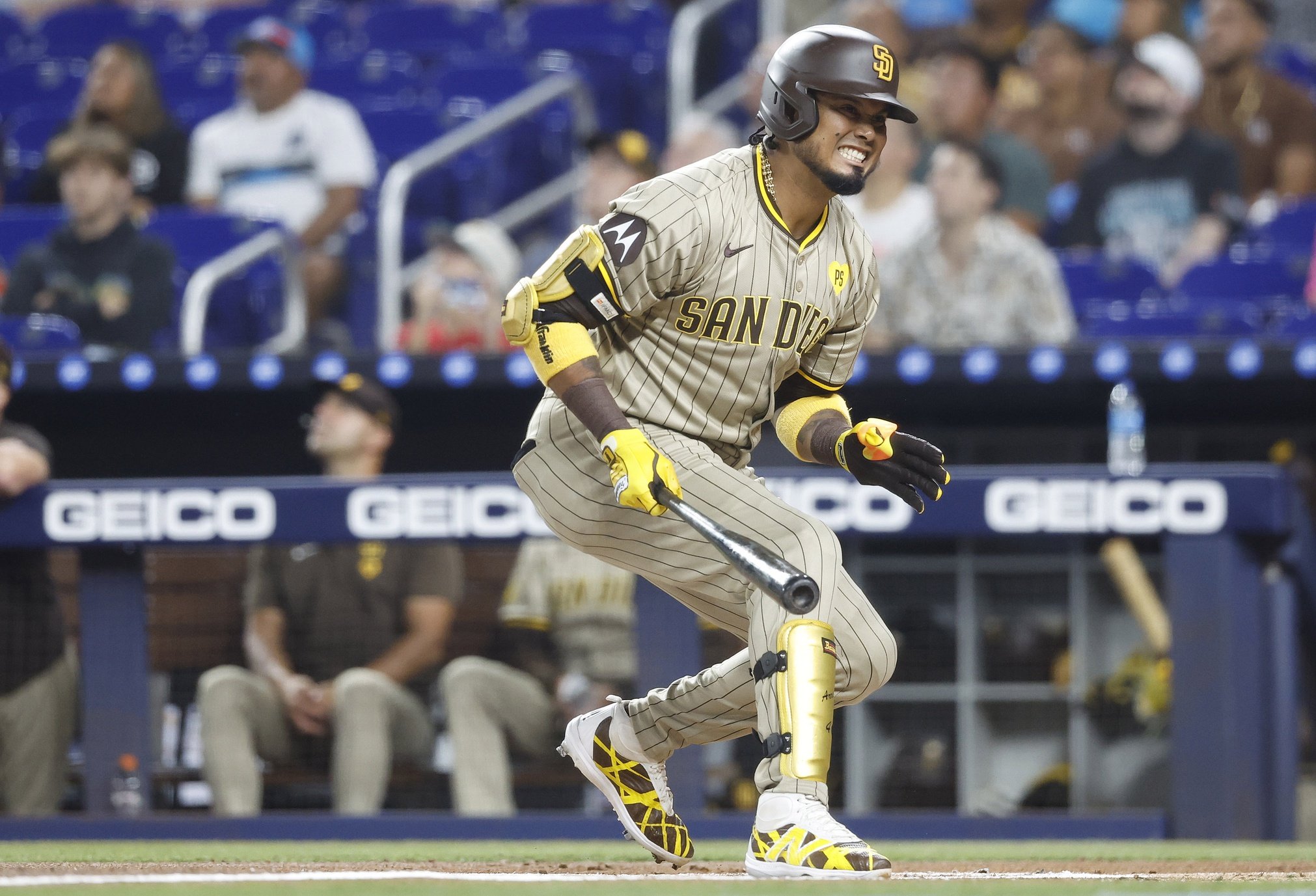 Batting average: the most ubiquitous individual statistic in baseball. For years, a hitter’s worth was largely predicated on their ability to hit for average. Some of the game’s most beloved stars—Ty Cobb, Tris Speaker, Pete Rose, Rod Carew, Wade Boggs, Tony Gwynn and Ichiro Suzuki—left an indelible mark on the sport given their knack for compiling hits. And now, it is Luis Arráez's turn. His .343 batting average in parts of two seasons with the Marlins from 2023-2024 ranks first among the 78 players in franchise history to take a minimum of 750 plate appearances. That skill quickly made him a fan favorite in Miami. As has become the case, 2024 proved a relatively standard affair for Arráez. He collected 200 hits for the second consecutive season, hit over .300 for the fifth time in his six seasons, struck out less often than anyone in the sport, and picked up his third consecutive All-Star appearance, winning his third consecutive batting title in the process. On the surface, a great season, right? To that, I say, “Not so fast, boomer.” With time, the game has evolved, and by proxy, so has the lens through which we assess players. The same way Star Wars fans have George Lucas to thank for having an excuse to dress up in Vader and Leia garb to lug themselves off to some yearly convention, baseball obsessives owe their debts to the likes of Bill James, Tom Tango and Jay Jaffe for presenting new metrics that richly detail how players impact wins and losses, plus how they compare to their predecessors. While Arraez led the National League in the frequency of hits relative to at-bats, his 2024 season was otherwise unremarkable. Taking all aspects of the game into account, his Baseball-Reference WAR was just 1.1. Why is this significant enough to merit discussion? That is less than one-quarter of the value he provided in his lone full-length Marlins campaign (4.9 rWAR). Of the 308 MLB hitters to win a batting title since 1871—the first year in which official statistics were tracked—Arráez’s 1.1 rWAR and minus-1.0 WAA (Wins Above Average) are the lowest marks; only 1980 Bill Buckner (1.5 rWAR and -0.6 WAA) was even in the same ballpark. There have been 13,170 seasons where MLB hitters put up more than Arráez’s 1.1 rWAR despite failing to hit .300. Producing runs involves much more than simply stringing singles together. There’s power and plate discipline, knowing what pitches to swing at and to not swing at. Juan Soto only hit .288, but no one is going to argue with a .989 OPS courtesy of his 18.1% walk rate and 76 extra-base hits. The combination of Soto's all-around production and age is certain to make him one of MLB's highest-paid players next year. What about Arráez’s season merited such little value? It starts with a .122-point drop-off in OPS, from .861 in 2023 to .739 in 2024. Although his BA still began with a three, he didn't accrue hits in bunches to nearly the same extent. He also became aggressive to a fault, often going multiple weeks between drawing walks. Despite setting a career high in stolen bases, he offset that by making more outs as a runner. Then there's the defensive component. Arráez, a fringy second baseman with a spotty defensive track record, proved below-average at the position this past season, posting minus-3 defensive runs saved over 42 games there. First base, a position Arráez had seen time at in 2022 and 2023, was something he did a lot more of upon his May 4 trade to the San Diego Padres, starting 61 games there for the rest of the season where he also graded out at minus-3 defensive runs saved. Statcast had a similar perspective on his glovework, estimating him at minus-12 outs above average (OAA). Even putting the quality of his defense aside, it hurt Arráez to drop to the bottom of the defensive spectrum, as quantified in this 2015 FanGraphs piece. When not at first base, he served as designated hitter more frequently (46 starts) than at any other point of his career. Players relegated to 1B/DH generally lack mobility, but compensate for it with their size and strength. They are relied upon to hit the ball over the fence, something Arráez doesn’t do all too often. Of the 29 hitters with at least 600 plate appearances as a first baseman since 2022, Arráez’s 9 home runs rank fewest among the group. As articulated above and also here by Ben Clemens of FanGraphs, Arraez took a significant step back. While the Padres thrived with him serving as their everyday leadoff hitter, there's no statistical indicator that they thrived because of him—for that, you'd have to turn to anecdotal evidence (via The Athletic's Dennis Lin). But perhaps it is unfair to fixate too much on his most recent season? To reiterate, Arráez was a genuine star-caliber player in 2023. However, he sustained a left thumb injury this past year on June 25 and played through it without an IL stint. Although his bat-to-ball prowess was not impacted, it wouldn't be surprising if the discomfort hampered his quality of contact. He underwent surgery to repair the torn ligament on October 16. The Padres expect him to be a full participant come spring training, and in the meantime, they are "expected to consider a potential extension," per Dennis Lin. Arráez’s limited defensive profile, lack of baserunning acumen, and largely powerless approach cast a polarizing picture of his future. The Padres have been no stranger to handing out eight- and nine-figure contracts in recent years, but is it prudent in this case? Batting champion? Sure. Valuable? That's debatable.
 -
Compared to his two previous seasons and those of every batting champ who came before him, the 2024 version of Arráez had a limited direct impact on his team's success. Batting average: the most ubiquitous individual statistic in baseball. For years, a hitter’s worth was largely predicated on their ability to hit for average. Some of the game’s most beloved stars—Ty Cobb, Tris Speaker, Pete Rose, Rod Carew, Wade Boggs, Tony Gwynn and Ichiro Suzuki—left an indelible mark on the sport given their knack for compiling hits. And now, it is Luis Arráez's turn. His .343 batting average in parts of two seasons with the Marlins from 2023-2024 ranks first among the 78 players in franchise history to take a minimum of 750 plate appearances. That skill quickly made him a fan favorite in Miami. As has become the case, 2024 proved a relatively standard affair for Arráez. He collected 200 hits for the second consecutive season, hit over .300 for the fifth time in his six seasons, struck out less often than anyone in the sport, and picked up his third consecutive All-Star appearance, winning his third consecutive batting title in the process. On the surface, a great season, right? To that, I say, “Not so fast, boomer.” With time, the game has evolved, and by proxy, so has the lens through which we assess players. The same way Star Wars fans have George Lucas to thank for having an excuse to dress up in Vader and Leia garb to lug themselves off to some yearly convention, baseball obsessives owe their debts to the likes of Bill James, Tom Tango and Jay Jaffe for presenting new metrics that richly detail how players impact wins and losses, plus how they compare to their predecessors. While Arraez led the National League in the frequency of hits relative to at-bats, his 2024 season was otherwise unremarkable. Taking all aspects of the game into account, his Baseball-Reference WAR was just 1.1. Why is this significant enough to merit discussion? That is less than one-quarter of the value he provided in his lone full-length Marlins campaign (4.9 rWAR). Of the 308 MLB hitters to win a batting title since 1871—the first year in which official statistics were tracked—Arráez’s 1.1 rWAR and minus-1.0 WAA (Wins Above Average) are the lowest marks; only 1980 Bill Buckner (1.5 rWAR and -0.6 WAA) was even in the same ballpark. There have been 13,170 seasons where MLB hitters put up more than Arráez’s 1.1 rWAR despite failing to hit .300. Producing runs involves much more than simply stringing singles together. There’s power and plate discipline, knowing what pitches to swing at and to not swing at. Juan Soto only hit .288, but no one is going to argue with a .989 OPS courtesy of his 18.1% walk rate and 76 extra-base hits. The combination of Soto's all-around production and age is certain to make him one of MLB's highest-paid players next year. What about Arráez’s season merited such little value? It starts with a .122-point drop-off in OPS, from .861 in 2023 to .739 in 2024. Although his BA still began with a three, he didn't accrue hits in bunches to nearly the same extent. He also became aggressive to a fault, often going multiple weeks between drawing walks. Despite setting a career high in stolen bases, he offset that by making more outs as a runner. Then there's the defensive component. Arráez, a fringy second baseman with a spotty defensive track record, proved below-average at the position this past season, posting minus-3 defensive runs saved over 42 games there. First base, a position Arráez had seen time at in 2022 and 2023, was something he did a lot more of upon his May 4 trade to the San Diego Padres, starting 61 games there for the rest of the season where he also graded out at minus-3 defensive runs saved. Statcast had a similar perspective on his glovework, estimating him at minus-12 outs above average (OAA). Even putting the quality of his defense aside, it hurt Arráez to drop to the bottom of the defensive spectrum, as quantified in this 2015 FanGraphs piece. When not at first base, he served as designated hitter more frequently (46 starts) than at any other point of his career. Players relegated to 1B/DH generally lack mobility, but compensate for it with their size and strength. They are relied upon to hit the ball over the fence, something Arráez doesn’t do all too often. Of the 29 hitters with at least 600 plate appearances as a first baseman since 2022, Arráez’s 9 home runs rank fewest among the group. As articulated above and also here by Ben Clemens of FanGraphs, Arraez took a significant step back. While the Padres thrived with him serving as their everyday leadoff hitter, there's no statistical indicator that they thrived because of him—for that, you'd have to turn to anecdotal evidence (via The Athletic's Dennis Lin). But perhaps it is unfair to fixate too much on his most recent season? To reiterate, Arráez was a genuine star-caliber player in 2023. However, he sustained a left thumb injury this past year on June 25 and played through it without an IL stint. Although his bat-to-ball prowess was not impacted, it wouldn't be surprising if the discomfort hampered his quality of contact. He underwent surgery to repair the torn ligament on October 16. The Padres expect him to be a full participant come spring training, and in the meantime, they are "expected to consider a potential extension," per Dennis Lin. Arráez’s limited defensive profile, lack of baserunning acumen, and largely powerless approach cast a polarizing picture of his future. The Padres have been no stranger to handing out eight- and nine-figure contracts in recent years, but is it prudent in this case? Batting champion? Sure. Valuable? That's debatable. View full article


