

Marlins Video
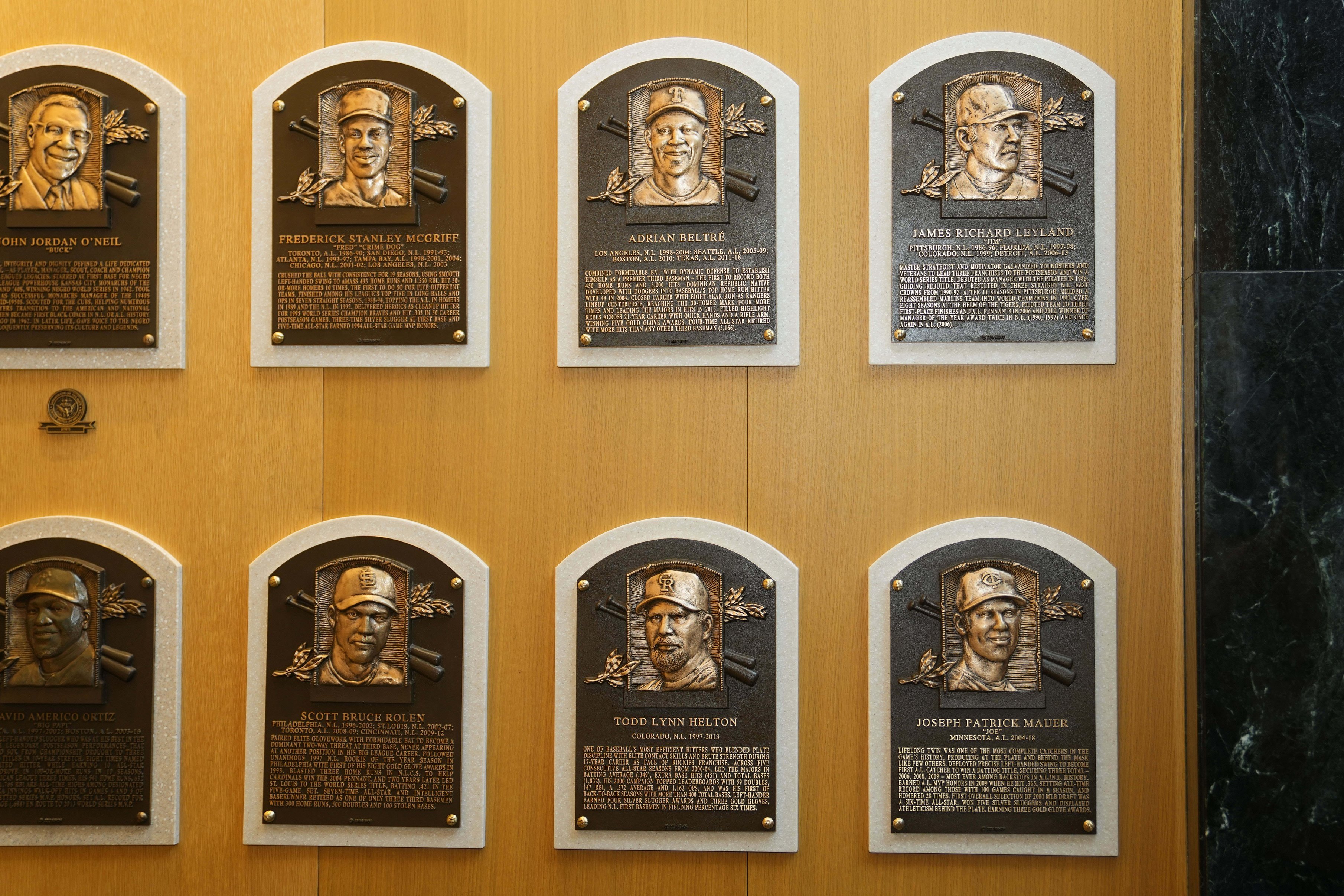
2025 is upon us, and for most baseball fans, the first major event surrounding the sport each year is the unveiling of the next class of National Baseball Hall of Fame inductees. On January 21, we'll learn which newcomers to the process earn first-ballot enshrinement and whether holdovers get much-needed boosts to push them over that coveted 75-percent threshold (or at least put them on track for future induction).
Here, we will talk about all that and then some in a new annual tradition: the Fish On First Hall of Fame ballot.
Through the process of gathering and sorting ballots from ten of our staffers, we’ve constructed a ballot reflective of the aggregate.
Here’s a rundown of how the selection process worked:
- Voters were allotted to vote for the standard maximum of 10 players.
- Players named on at least five of the ten submitted ballots garnered entry into the collective ballot ("tie goes to the player," if you will).
- Players noted on at least three but no more than four ballots garnered an honorable mention blip with special exceptions made for those with otherwise compelling cases.
Without further adieu, we present you our staff ballot.
Honorable Mentions
- Andy Pettitte, SP: Ask a Yankee fan this question and you’re likely to get an unequivocal "yes" before receiving a rundown of his accomplishments: 256 wins and five World Series titles largely on the strength of the most playoff innings pitched in history. While Pettitte feels like a player many a voter would come around on in time (they only have three chances left after 2025), for now, only four of ten staffers included him, largely due to some of the red flags surrounding his case. If elected, his 3.85 ERA would trail only Jack Morris (3.90) for the highest such mark among enshrined pitchers. However, strength lies in his era-adjusted 117 ERA+, in line with first-timer CC Sabathia (116), as is his 60.2 bWAR to Sabathia’s 62.3.
- Félix Hernández, SP: The tragic tale of the man dubbed “King Félix” is similar to that of another Venezuelan native, Johan Santana. Like his native countryman, Hernández has a peak in line with many a Hall of Fame hurler, but a combination of injuries and poor late-career performance are enough to say not enough. Still, a major factor most consider when assessing a person’s place in Cooperstown is how good you were at your best, and only Clayton Kershaw put up more bWAR (46.6) between 2009-2015 than Hernández’s 37.9—a period in which the right-hander won a Cy Young award that drastically altered how we assess pitcher-worth—authored a perfect game, and garnered six AL All-Star selections. A win for him and most Mariner fans would be some corrective justice in service to the one-and-done Santana in garnering the minimum 5 percent needed to remain on the ballot for future consideration.
- Mark Buehrle, SP: I wouldn’t be the first to note the similarities between Pettitte and Buehrle, though dropping this hyperlink wouldn’t hurt. Buehrle’s biggest calling card is his durability, as evidenced by his 14 seasons of 200-plus innings pitched, 12 of which he was at or better than the league average by ERA+ (100). Buehrle’s 12 such seasons are tied with Hall of Famers Tom Glavine, Fergie Jenkins, and Christy Mathewson, and 15 of the 16 pitchers to accomplish the feat more than him are in the Hall of Fame with the lone exception being Roger Clemens. That has to count for something, right? While he may have never felt like a pitcher bound for Cooperstown when you watched him, Buehrle’s case is compelling to say the least, though only one of our staff felt compelling enough to include.
- Dustin Pedroia, 2B: First there was Tony Conigliaro, then there was Dustin Pedroia. The Red Sox have a history of these kinds of great, but fleeting star players. The American League David Wright with a different candor, Dustin Pedroia garnered universal respect for his hard style of play, winning Rookie of the Year and MVP honors in his first two full seasons of play en route to becoming a four-time All-Star and Gold Glove winner. Were it not for a highly contested slide by Manny Machado in 2017, Pedroia would have likely added to an already strong Hall of Fame case had his career not been derailed as a result. Without all of the compiling stats that would have accompanied a late-career regression, Pedroia’s career on its merits is very similar to another Hall of Fame Red Sox second baseman, Bobby Doerr, in terms of value a la WAR (51.9-to-51.4) and career OPS+ (113-to-115). He’s one of just three second baseman in history with at least 125 home runs, 125 stolen bases, and 90 runs from fielding (Rfield), but like Félix, there simply doesn’t appear enough to say yes.
- Ian Kinsler, 2B: Safe from a couple of Detroit and Arlington-covered voters, I think it’s a safe assumption that Ian Kinsler isn’t a name on too many people’s Hall of Fame radar (including no one on our staff). Despite this and the fact that a prospective "Mr. 2000" film centered on Kinsler’s career would likely prove less interesting than the late-Bernie Mac picture of similar lore (Kinsler retired with exactly 1,999 career hits), what he did on the Diamond at least merits mention. His 54.1 bWAR has him as the 21st-best second baseman in baseball history, his 246 home runs are tied for seventh with Hall of Famer Joe Gordon in games appeared at second, and he’s one of just seven players at the position with at least 200 home runs and 200 steals—a list that features four Hall of Famers, Kinsler, and Jose Altuve. Kinsler was also a protagonist on Texas Rangers teams that reached consecutive World Series in 2010 and 2011, a period in which he hit .293/.403/.474 across 32 playoff games. He’d be far from the worst player inducted, but it’ll likely be a short flirtation with forever for Kins.
The Selections

Bobby Abreu, RF (60.2 bWAR/59.7 fWAR)
When I published my first Hall of Fame ballot piece three years ago, Bobby Abreu, then in his third year of eligibility, wasn’t on my ballot. Ever since, however, I have championed his case at every possible juncture. A career .291/.395/.475/.870 (128 OPS+) hitter, Abreu’s combination of power, speed, and plate discipline made him one of the better all-around offensive players of his era. At his best from 1998-2004, Abreu averaged 5.9 wins per season, with only six position players amassing more than his 41.6 bWAR, right in line with the 42.2 average for Hall of Fame right fielder’s seven-year peak. One of the knacks on Abreu’s case is the notion that he wasn’t considered a standout defender in right field, but he did rank within the top two in total zone runs at the position three times, leading the league with 28 in 1998. Even post-peak Abreu remained productive, putting up 18.7 bWAR thanks to 121 home runs, 189 stolen bases, and a 117 OPS+ from 2005-2012. More importantly, though, here’s a quick trivia nugget for you. There a three players in MLB history with at least 275 home runs, 400 steals, and a .395 or better on-base percentage: Barry Bonds, the late Rickey Henderson, and yes, Bobby Abreu.
Carlos Beltrán, CF (70.1 bWAR/67.4 fWAR)
Had he not been among the main architects of the 2017 Astros sign-stealing scandal, Carlos Beltrán would most certainly already be in the Hall of Fame (and potentially still be managing the New York Mets). However, due to his involvement, he finds himself returning to the ballot for a third year, though he may not have to wait much longer after appearing on 57.1 percent of votes cast in 2024. Transgression aside, Beltrán distinguished himself during his career for his power-speed combination along with a reputation as a stellar center field defender, totaling 103 fielding runs at the position en route to three Gold Glove awards. A nine-time All-Star, Beltrán is one of just five players with at least 400 home runs and 300 steals, with the other four being the aforementioned Bonds, Willie Mays, Andre Dawson, and Álex Rodríguez. Most impressive with regards to Beltrán’s baserunning is the efficiency at which he stole bases as his 86.4 percent success rate is the best such mark among any player with at least 350 stolen base attempts. There’s also the postseason of it all, and few were better in October than Beltrán, who hit .307/.412/.609/1.021 with 16 home runs and a perfect 11-for-11 in stolen base attempts in 65 playoff games. Among hitters with at least 250 postseason plate appearances, no one posted a higher OPS than Beltrán’s aforementioned 1.021. Sign-stealing aside, Beltrán, respected amongst many in and outside of the sport, had a career that should someday merit him a plaque in Cooperstown.
Andruw Jones, CF (62.7 bWAR/67.0 fWAR)
There are seven players in baseball history with at least 200 runs from defense; only one of them, Adrian Beltré (477) has more home runs than Andruw Jones’ 434. His 254 total zone runs are not only tops among outfielders, it’s the best such mark of any player in baseball history. While largely done as a productive player after age 30 like the above-mentioned Félix Hernández, Andruw Jones had a nine-year run from 1998-2006 that has him here on this list. In that span, Jones averaged 35 home runs at the plate and 21 runs from fielding a season. Among position players in that span, only Bonds and Rodríguez produced more value than Jones’ 54.5 bWAR, only those two and Vladimir Guerrero Sr. hit more than his 319 home runs, and no one came within 50 of Jones’ 192 runs saved on defense. Whether you go by seven-year peak (46.4-to-44.7) or JAWS (54.6-to-58.1), Jones is above or keeping company with other Hall of Fame center fielders. Wine about his career .254 batting average, and I’ll counter with Harmon Killebrew, a career .256 hitter who produced less value in 239 more games than Jones despite hitting 139 more home runs. Even as advanced metrics such as defensive runs saved coincided with the tail end and untimely erosion of his production, Jones still sat within the top 25 in DRS from 2003-2012 per Fielding Bible, saving 65 runs as his bat largely abandoned him.
Manny Ramírez, LF (69.3 bWAR/66.3 fWAR)
Like the entry to follow, there is a bit of yuck associated with this player. Maybe not the hottest baseball take to be delivered, but I’d posit that even without the use of performance-enhancing drugs, Manny Ramírez still winds up among the ten best right-handed hitters of all time. Only nine such hitters have a career OPS+ better than Ramírez’s 154 with a minimum of 9000 plate appearances, all of whom are in the Hall. Excluding handedness, Ramírez is one of just 13 players to take as many trips to the plate and finish with a .300/.400/.500 slash line and only 14 hitters have more than his 555 home runs. That being said, despite 12 All-Star appearances and nine Silver Slugger awards, after having not gotten more than 33.2 percent of the vote in any of his eight trips to the ballot, chances appear slim for Ramírez to make the necessary lead to the 75 percent required for induction.
Álex Rodríguez, SS/3B (117.6 bWAR/113.6 fWAR)
I had previously posited my support for A-Rod in the Hall as far back as 2022, though there’s some ick associated with doing so when you know of his multiple transgressions. Separating the man from the player, the player we saw over parts of 22 seasons was one of the best distillations of a player the game had ever seen. Only 11 players put up more than Rodríguez’s 117.6 bWAR and they’re among the inner circle greatest of all time. Consistently receiving between 34 and 35 percent of the vote in each of his first three seasons of eligibility, a similar showing for A-Rod in year four could prove an eventual fatal blow to his election as it did Barry Bonds and Roger Clemens, who treaded similar waters before ultimately not being selected in their 10 years of eligibility. But while our vote may not count, the three-time MVP and owner of 696 home runs has our vote, albeit begrudgingly.
CC Sabathia, SP (62.3 bWAR/66.5 fWAR)
After Randy Johnson won his 300th game in 2009, he became what in all likelihood would be the last-ever pitcher to join the 300-win club. So, when CC Sabathia struck out former teammate John Ryan Murphy to notch his 3,000th career strikeout on April 30, 2019, the argument can be made that a new gold standard for Hall of Fame starting pitchers had been set. What Sabathia has that plenty of future Hall of Fame starts will likely lack is volume. His 3,577 ⅓ innings pitched are the most for any pitcher since the beginning of the 21st century. While people may balk at electing a pitcher with a career 3.74 ERA, let us remember Mike Mussina was recently voted in despite a 3.68, and era-adjusted ERA+ still credits the two as being 16 and 23 percent better than average at preventing runs. While we could consider his less-than-stellar 4.28 ERA over 130 ⅓ postseason innings pitched as a thorn in an undoubtedly questionable case, Sabathia was the prized addition to a Yankees team that, after missing the postseason the previous year, claimed the title in 2009, a season in which he finished fourth in AL Cy Young voting. And to add to the latter, Sabathia does have said award in his trophy case, claiming AL Cy honors in 2007 when he went 19-7 with a 3.21 ERA and now-foreign-sounding 241 innings pitched. The left-hander would finish top-five in the voting five times between 2007-2011, a period where only Roy Halladay (34 bWAR) amassed more value than Sabathia’s 30.4 bWAR. Considering the body of work was enough for all ten of our participating staffers to include him on their respective ballots, Sabathia finds himself here, a deserving Hall of Famer.
Ichiro Suzuki, RF (60.0 bWAR/57.5 fWAR)
From a player in Sabathia who you could go either way on to someone who could incite a riot should he not be a unanimous selection, Ichiro is a singular figure in baseball history. Of the 33 members of the 3,000-hit club, no one was older than Suzuki’s 27 years and 162 days when making their big league debut. The next oldest, Wade Boggs, was 23 years and 299 days old when he debuted with the Boston Red Sox on April 10, 1982. And yet, despite being such a late arrival to stateside ball after hitting .353 and amassing 1,278 hits over nine seasons in NPB, Ichiro quickly showed that was age was, quite literally, just a number, as he became just the second player in baseball history to capture MVP honors in his first full season, joining Fred Lynn (1975). In his decade of dominance from 2001-2010, Ichiro would put up 10 consecutive 200-hit seasons—including the single-season record in 2004 with 262—capture 10 Gold Gloves, earn 10 consecutive All-Star selections, and a pair of batting titles. While we touched on the 10 Gold Glove awards, it’s important to highlight just how great a defender Ichiro was, as evidenced by his 106 DRS being the seventh best among all outfielders in the statistic’s tracking (since 2003). Some shielding of the eyes that accompanies his career 107 OPS+ is understood for a Hall of Famer, let us remember that Suzuki felt like a player out of a previous era, a la Tony Gwynn (who retired the year Ichiro debuted), prioritizing singles over swinging for the fences. If these two statistical fun facts are worth any consolation for that aforementioned metric, Ichiro is one of just seven members of the 3,000-hit club to steal more than 500 bases—and with the fourth-highest success rate of any player with at least 600 steal attempts (81.3%). He’s one of just 32 position players in the modern era (since 1901) to put up 60 WAR from the age of 27 onward, and there’s no denying Ichiro’s place as one of the game’s true immortals. And hey, it'd be the next closest thing to a former Marlin being inducted, right?
Chase Utley, 2B (64.5 bWAR/61.5 fWAR)
Late in 2023, as he was entering his first time on the ballot, I wrote an ode to why I felt Chase Utley was and is a deserving Hall of Famer. So, in honor of him returning to the ballot in 2025, I’d like to go ahead and share some nuggets from that piece. Though he received just 28.8 percent of the vote in 2024, I see no reason why he shouldn’t get a boost in year two, as he’s the 12th-best second baseman of all-time by bWAR, a testament to his well-rounded game. People will scoff at the lack of counting stats and accolades—1,885 hits and no Gold Gloves—but as outlined with my Ian Kinsler blurb, counting stats do little in determining a person’s Hall credibility in my eyes. With the use of revisionist history, Utley should have won multiple Gold Gloves given he led the position in total zone runs thrice and finished inside the top five an additional five times. For his career, his 126 runs saved at 2B are second by a hair to Mark Ellis’ 128. All of this without mentioning how good of a hitter he was, capturing four Silver Sluggers over a career that saw him hit 252 home runs. People like winners and Utley was undeniably the best player on a Phillies team that won five consecutive NL East titles and the World Series in 2008. In fact, during his prime from 2005-2010, only Albert Pujols (52.1) put up more WAR than Utley’s 45.5. Seven of the ten staffers are pro-Utley, and I certainly believe he’ll get the call he deserves in due time, but I don’t see 2025 being that time.
Billy Wagner, RP (27.7 bWAR, 24.0 fWAR)
Throughout this piece, I haven’t shied away from my use of WAR in making cases for players for Cooperstown, but I’ll acknowledge the metric as not being the be-all, end-all to which a player ought to be evaluated for the Hall. The career of Billy Wagner conforms to the latter. While WAR is cumulative and Wagner lacks the large cumulative totals—903 innings pitched being the prime example—it’s the quality of those innings that had nine of our staffers giving him the thumbs up. Of pitchers with at least 900 innings pitched, only Mariano Rivera (205) has a higher adjusted ERA+ than Wagner’s 187. I can excuse Wagner’s 11 ⅔ innings of postseason futility (he pitched to a 10.03 ERA in those innings) when the larger body of work is so overwhelmingly dominant. Wagner is the only pitcher with a season of at least 65 innings pitched and 13-plus K/9 at age 38 or older. Heck, no pitcher in his age bracket even averaged more than the 12.4 K/9 that 39-year-old David Robertson did in 2024, and that came in era when the league-wide strikeout rate was 22.6 percent when compared to the 18.5 percent it was when Wagner did his damage in 2010. Now, Rivera is in a class of his own with his 56.2 bWAR and near-stainless postseason track record helping him become the only player elected unanimously excluding a veteran’s committee’s intervention. While WAR may tell us Wagner was only half as valuable as Mo, half a Mo still made for one of the most dominant inning-for-inning pitchers the game had ever seen. After just missing election in 2024 with 73.8 percent of the vote, Wagner’s 10th and final year should be the one that seals his enshrinement.
Should the Marlins keep Brian Navarreto as Joe Mack's backup entering the 2027 season?

When will 2027 Opening Day take place?

Follow Fish On First For Miami Marlins News & Analysis



Think you could write a story like this? Fish On First wants you to develop your voice and find an audience. We recruit our paid front page writers from our users blogs section. Start a blog today!
More From Fish On First
— Latest Marlins coverage from our writers
— Recent Marlins discussion in our forums
— Become a Fish On First SuperSub


Recommended Comments
Create an account or sign in to comment
You need to be a member in order to leave a comment
Create an account
Sign up for a new account in our community. It's easy!
Register a new accountSign in
Already have an account? Sign in here.
Sign In Now