



Ely Sussman
-
Posts
3,994 -
Joined
-
Last visited
-
Days Won
296
Content Type
Profiles
Miami Marlins Videos
2026 Miami Marlins Top Prospects Ranking
Miami Marlins Free Agent & Trade Rumors, Notes, & Tidbits
Guides & Resources
News
2025 Miami Marlins Draft Pick Tracker
2026 Miami Marlins Draft Tracker: Picks & Bonuses
Forums
Blogs
Events
Store
Downloads
Gallery
Everything posted by Ely Sussman
-
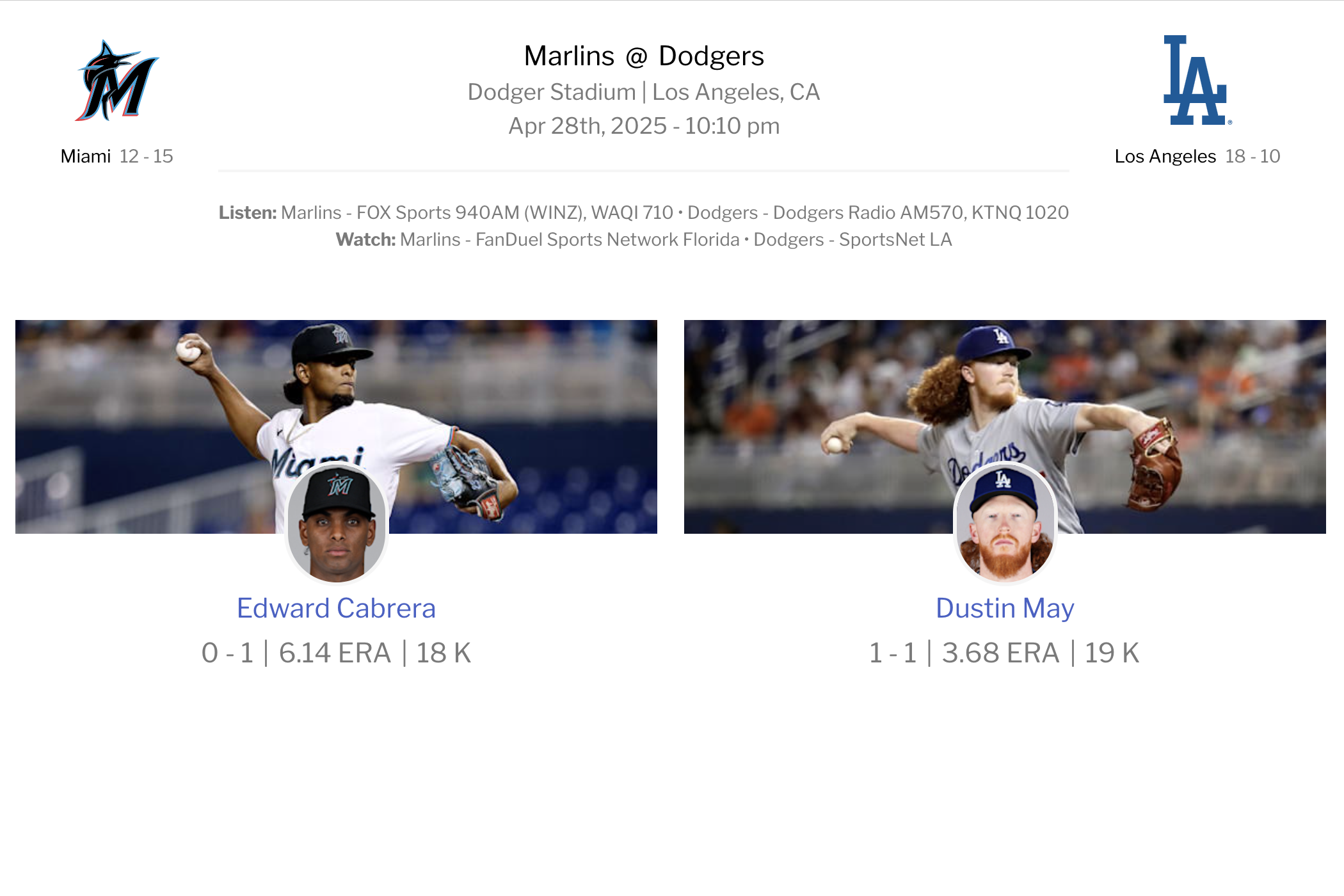 Here are the latest Miami Marlins game notes, produced by the Marlins communications department and relayed to our loyal readers. These notes apply to the first game of Miami's road series against the Los Angeles Dodgers. Starting Lineup SS Xavier Edwards (S) CF Jesús Sánchez (L) LF Eric Wagaman C Agustín Ramírez RF Kyle Stowers (L) 1B Matt Mervis (L) 2B Otto Lopez DH Ronny Simon (S) 3B Graham Pauley (L) P Edward Cabrera Click HERE to download the full game notes (preview below)
 -
Player status updates, insightful stats and more information to fully equip you for today's Marlins game. Here are the latest Miami Marlins game notes, produced by the Marlins communications department and relayed to our loyal readers. These notes apply to the first game of Miami's road series against the Los Angeles Dodgers. Starting Lineup SS Xavier Edwards (S) CF Jesús Sánchez (L) LF Eric Wagaman C Agustín Ramírez RF Kyle Stowers (L) 1B Matt Mervis (L) 2B Otto Lopez DH Ronny Simon (S) 3B Graham Pauley (L) P Edward Cabrera Click HERE to download the full game notes (preview below) View full article
-
 On Monday episodes of the Small Pod, we will be shining a spotlight on notable prospects from each of the Miami Marlins' minor league affiliates. Ely Sussman's featured players this week: INF/OF Andrew Salas (Jupiter), C Ryan Ignoffo (Beloit), LHP Adam Laskey (Pensacola) and RHP Adam Mazur (Jacksonville).
-
- 1
-

-
- andrew salas
- ryan ignoffo
- (and 2 more)
-
On Monday episodes of the Small Pod, we will be shining a spotlight on notable prospects from each of the Miami Marlins' minor league affiliates. Ely Sussman's featured players this week: INF/OF Andrew Salas (Jupiter), C Ryan Ignoffo (Beloit), LHP Adam Laskey (Pensacola) and RHP Adam Mazur (Jacksonville). View full video
-
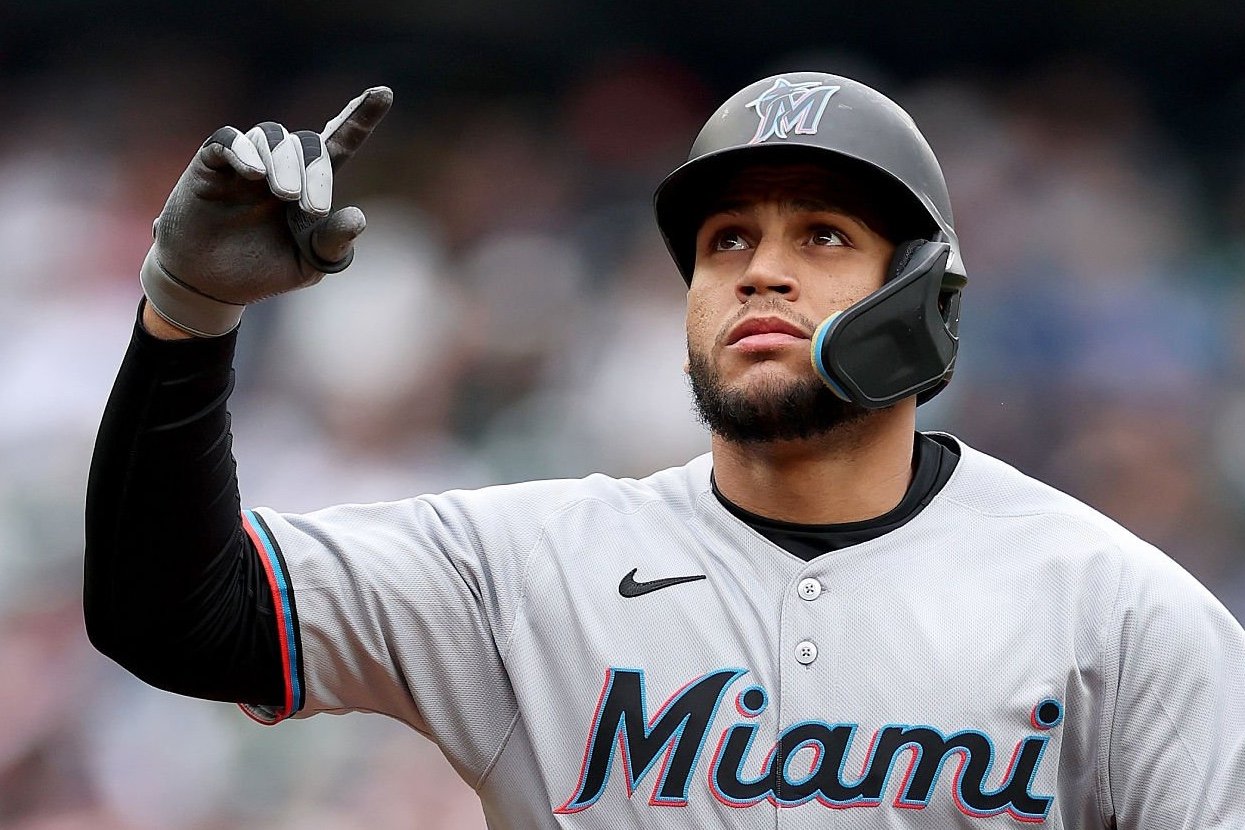 The Miami Marlins allowed a season-worst 25 runs during their series against the Seattle Mariners...and still came very close to winning two out of the three games. Agustín Ramírez capped off his otherworldly debut week by homering twice on Sunday. Connor Norby drove in three runs with his first long ball of the season. Max Meyer's control was lousy throughout the day (4.0 IP, 5 H, 5 ER, 4 BB, 6 K, 86 pitches/51 strikes) as the Mariners held on for a 7-6 victory. Ramírez has accrued 0.6 fWAR in five games, tied with Kyle Stowers for the team lead among position players (Stowers has played in 26 games). He's up to seven extra-base hits, which tops the combined total of all other Marlins catchers. His batted ball data largely backs up his production—Ramírez's .796 expected slugging percentage is above Aaron Judge (.764 xSLG) or any other qualified MLB hitter. And he earns style points in the process, edging out Jesús Sánchez for Miami's highest average bat speed. Down on the farm, Triple-A Jacksonville won, 3-2. A few days after I wrote about his lack of home runs this season, Deyvison De Los Santos drilled a walk-off solo shot. Joe Mack posted a 1.057 OPS during his first week with the Jumbo Shrimp. Jack Winkler is quietly thriving at the plate, slashing .333/.370/.510 and settling in as the team's main third baseman. Double-A Pensacola lost, 7-4. Josh Zamora went 3-for-3 with a walk. High-A Beloit won, 4-3. Garret Forrester made his first start of the season at catcher and drove in two runs. Low-A Jupiter won, 3-2. Ryan Weathers (left flexor muscle strain) was perfect in his three-inning rehab start, striking out six and pitching with the same velocity he previously had during spring training. Victor Mesa Jr. played another partial game in center field—his rehab assignment figures to continue into the next series. The Hammerheads came three outs away from a combined no-hitter. More Marlins news and content below: 🔷 There is a vacancy in the Marlins starting rotation while Weathers continues to build up his pitch count. Connor Gillispie, who had only one effective outing in six attempts, was optioned to Jacksonville. Luarbert Arias was recalled in a corresponding move to help out the bullpen for the rest of the road trip. He's just a stopgap until Gillispie's old rotation spot comes up again on Friday. The most sensible replacement is Adam Mazur, Fish On First's 11th-ranked prospect. In 13 Triple-A appearances since being acquired by the Marlins last summer, Mazur has a 3.71 ERA and 4.18 FIP in 63 innings pitched. He's been especially effective here in 2025 by leaning more heavily on his signature slider. 🔷 One-sixth of the way through the Marlins season, they still have never reused a batting order. The Chicago White Sox are the only other team in the majors to constantly tinker to that extent. 🔷 Hector Rodriguez did a prospect profile on Kayson Cunningham, an undersized though exceptional pure hitter who'll come off the board early during the 2025 MLB Draft. 🔷 Congrats to Stephanie and Andrew Nardi on the birth of their daughter, Elouise May. 🔷 The Prediction Time leaderboard has been updated through the first nine series. @Gabriel Revilla had perfect picks for the Mariners series. Become a SuperSub and we'll keep track of your predictions all season long! 🔷 Elsewhere around baseball, the New York Mets blew a 7-1 lead in their loss to the Washington Nationals, though they still own the best record in MLB (19-9). They've just called up old friend José Ureña. The Mets will be the sixth different MLB team that Ureña has pitched for in four-plus seasons since his Marlins tenure ended. The league-worst Colorado Rockies have lost 14 of their last 15 games. 🔷 Today's MLB game: the Marlins (probable starter RHP Edward Cabrera) visit the mighty Los Angeles Dodgers (RHP Dustin May). The Marlins have a 31.0% chance to win, per FanGraphs. First pitch at 10:10 p.m. ET. 🔷 Prior to the game, Fish On First LIVE will preview the series beginning at 6:00 p.m. ET. FOF LIVE is presented by About The Fans. Check out our new merchandise collection (coupon code fof10 for 10% off). Marlins podcast episodes
 -
Today's news roundup also includes a great development for a rehabbing Marlins starter. The Miami Marlins allowed a season-worst 25 runs during their series against the Seattle Mariners...and still came very close to winning two out of the three games. Agustín Ramírez capped off his otherworldly debut week by homering twice on Sunday. Connor Norby drove in three runs with his first long ball of the season. Max Meyer's control was lousy throughout the day (4.0 IP, 5 H, 5 ER, 4 BB, 6 K, 86 pitches/51 strikes) as the Mariners held on for a 7-6 victory. Ramírez has accrued 0.6 fWAR in five games, tied with Kyle Stowers for the team lead among position players (Stowers has played in 26 games). He's up to seven extra-base hits, which tops the combined total of all other Marlins catchers. His batted ball data largely backs up his production—Ramírez's .796 expected slugging percentage is above Aaron Judge (.764 xSLG) or any other qualified MLB hitter. And he earns style points in the process, edging out Jesús Sánchez for Miami's highest average bat speed. Down on the farm, Triple-A Jacksonville won, 3-2. A few days after I wrote about his lack of home runs this season, Deyvison De Los Santos drilled a walk-off solo shot. Joe Mack posted a 1.057 OPS during his first week with the Jumbo Shrimp. Jack Winkler is quietly thriving at the plate, slashing .333/.370/.510 and settling in as the team's main third baseman. Double-A Pensacola lost, 7-4. Josh Zamora went 3-for-3 with a walk. High-A Beloit won, 4-3. Garret Forrester made his first start of the season at catcher and drove in two runs. Low-A Jupiter won, 3-2. Ryan Weathers (left flexor muscle strain) was perfect in his three-inning rehab start, striking out six and pitching with the same velocity he previously had during spring training. Victor Mesa Jr. played another partial game in center field—his rehab assignment figures to continue into the next series. The Hammerheads came three outs away from a combined no-hitter. More Marlins news and content below: 🔷 There is a vacancy in the Marlins starting rotation while Weathers continues to build up his pitch count. Connor Gillispie, who had only one effective outing in six attempts, was optioned to Jacksonville. Luarbert Arias was recalled in a corresponding move to help out the bullpen for the rest of the road trip. He's just a stopgap until Gillispie's old rotation spot comes up again on Friday. The most sensible replacement is Adam Mazur, Fish On First's 11th-ranked prospect. In 13 Triple-A appearances since being acquired by the Marlins last summer, Mazur has a 3.71 ERA and 4.18 FIP in 63 innings pitched. He's been especially effective here in 2025 by leaning more heavily on his signature slider. 🔷 One-sixth of the way through the Marlins season, they still have never reused a batting order. The Chicago White Sox are the only other team in the majors to constantly tinker to that extent. 🔷 Hector Rodriguez did a prospect profile on Kayson Cunningham, an undersized though exceptional pure hitter who'll come off the board early during the 2025 MLB Draft. 🔷 Congrats to Stephanie and Andrew Nardi on the birth of their daughter, Elouise May. 🔷 The Prediction Time leaderboard has been updated through the first nine series. @Gabriel Revilla had perfect picks for the Mariners series. Become a SuperSub and we'll keep track of your predictions all season long! 🔷 Elsewhere around baseball, the New York Mets blew a 7-1 lead in their loss to the Washington Nationals, though they still own the best record in MLB (19-9). They've just called up old friend José Ureña. The Mets will be the sixth different MLB team that Ureña has pitched for in four-plus seasons since his Marlins tenure ended. The league-worst Colorado Rockies have lost 14 of their last 15 games. 🔷 Today's MLB game: the Marlins (probable starter RHP Edward Cabrera) visit the mighty Los Angeles Dodgers (RHP Dustin May). The Marlins have a 31.0% chance to win, per FanGraphs. First pitch at 10:10 p.m. ET. 🔷 Prior to the game, Fish On First LIVE will preview the series beginning at 6:00 p.m. ET. FOF LIVE is presented by About The Fans. Check out our new merchandise collection (coupon code fof10 for 10% off). Marlins podcast episodes View full article
-
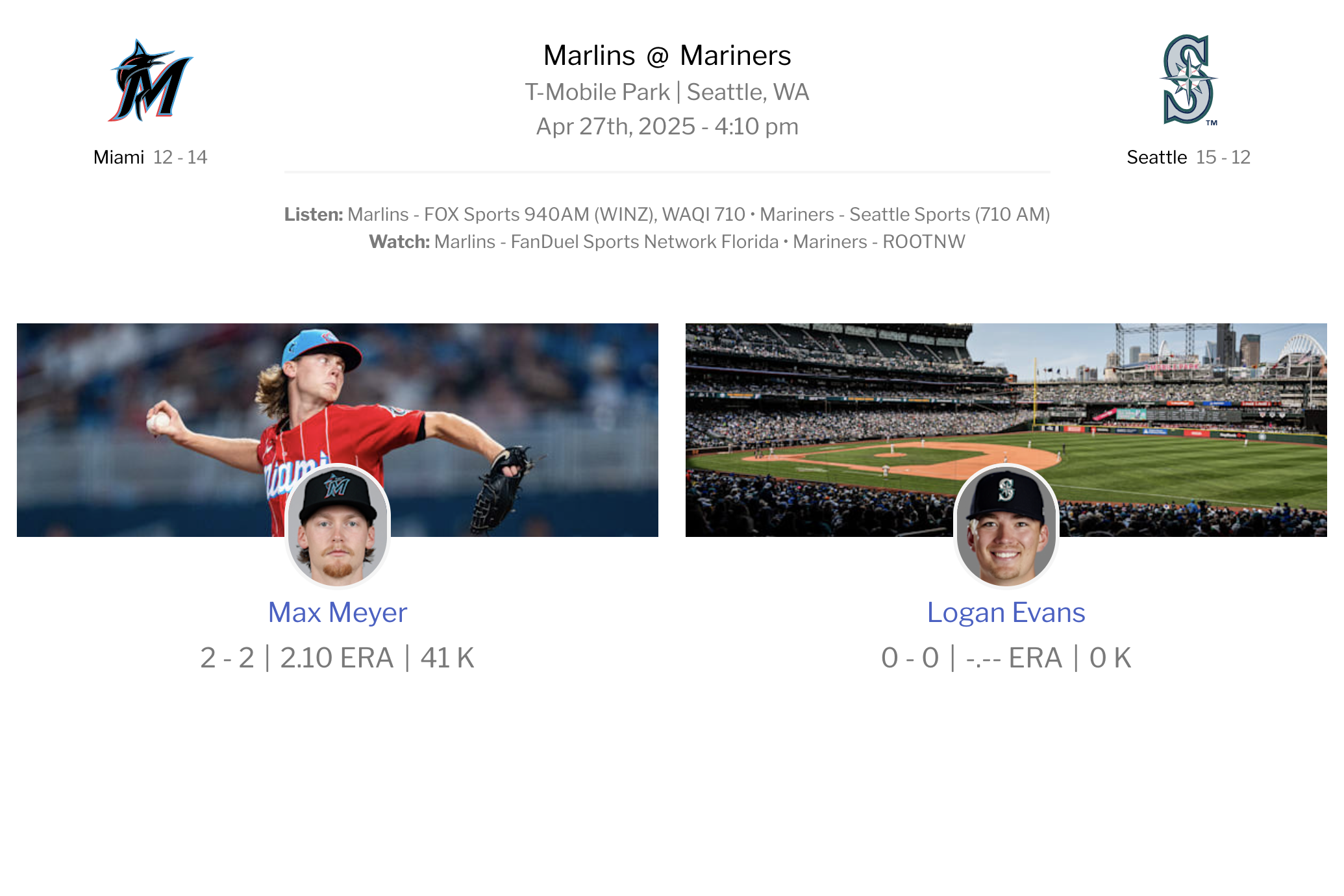 Here are the latest Miami Marlins game notes, produced by the Marlins communications department and relayed to our loyal readers. These notes apply to the third and final game of Miami's road series against the Seattle Mariners. Starting Lineup SS Xavier Edwards (S) CF Jesús Sánchez (L) DH Agustín Ramírez LF Eric Wagaman RF Kyle Stowers (L) 1B Matt Mervis (L) 3B Connor Norby C Liam Hicks (L) 2B Otto Lopez P Max Meyer Click HERE to download the full game notes (preview below)
 -
Player status updates, insightful stats and more information to fully equip you for today's Marlins game. Here are the latest Miami Marlins game notes, produced by the Marlins communications department and relayed to our loyal readers. These notes apply to the third and final game of Miami's road series against the Seattle Mariners. Starting Lineup SS Xavier Edwards (S) CF Jesús Sánchez (L) DH Agustín Ramírez LF Eric Wagaman RF Kyle Stowers (L) 1B Matt Mervis (L) 3B Connor Norby C Liam Hicks (L) 2B Otto Lopez P Max Meyer Click HERE to download the full game notes (preview below) View full article
-
Watch all 19 pitches that Miami Marlins right-hander Eury Pérez threw while rehabbing with the Low-A Jupiter Hammerheads on Saturday. Pérez faced four batters, allowing a single and recording two strikeouts in his scoreless inning of work.
-
Watch all 19 pitches that Miami Marlins right-hander Eury Pérez threw while rehabbing with the Low-A Jupiter Hammerheads on Saturday. Pérez faced four batters, allowing a single and recording two strikeouts in his scoreless inning of work. View full video
-
If it ain't broke, keep fixing it? The ever-changing Marlins batting order
Ely Sussman posted an article in Marlins
.jpg.3fb1e4715269e11d1036915743ea97e7.jpg) It's generally a bad sign when your team has something in common with the Chicago White Sox. Well, the Miami Marlins do. Entering Sunday, these are the only two MLB teams that have yet to repeat a batting order during the 2025 season. In the 26 games that the Marlins have played, they have deployed 26 different lineup configurations, making daily changes to the position players they're using, how they're sequenced one through nine in the order, or both. Here are all 26, courtesy of Baseball-Reference: This isn't specifically a Clayton McCullough thing, a Peter Bendix thing or an example of analytics going too far. The 2023 Marlins, who were managed by Skip Schumaker and overseen by Kim Ng, used 151 different batting orders. The single-season franchise record was set in 2022—Don Mattingly used 154 combinations during the final year of his managerial tenure. Prior to the implementation of the universal designated hitter, Marlins batting orders almost always included a starting pitcher in the No. 9 spot. That new rule has unlocked more plausible batting order permutations. Kyle Stowers and Dane Myers have been the ultimate batting order nomads, making starts in six different spots through the first month of the season. So far in 2025, the availability of key players has been the main driver of the incessant lineup shake-ups. The Marlins entered the season with Connor Norby and Jesús Sánchez sidelined by oblique strains, both of whom they had planned to start the vast majority of the time. Platoons were prevalent at third base and in the outfield during their absences. A few days before Norby and Sánchez were reinstated from the injured list, primary catcher Nick Fortes went down, coincidentally with the same diagnosis. It's still surprising that the streak of unique batting orders has lasted this long considering the stability at the top with Xavier Edwards occupying the leadoff spot every single game. In addition to Stowers, Norby, Sánchez and Edwards, Otto Lopez is a platoon-proof regular. Recently recalled Agustín Ramírez seems to be on his way to joining them. There are only so many ways to shuffle the deck when most of the names are constants. While the White Sox own MLB's lowest OPS and rank near the bottom of most other offensive categories, the Marlins have defied projections to be respectable at the plate. Their offense is just a smidge below league average in terms of wRC+, on pace to be the franchise's best since 2017. A Marlins batting order I hope will be reused in the near future was the one that debuted on April 22: What has been your favorite batting order of the season?
It's generally a bad sign when your team has something in common with the Chicago White Sox. Well, the Miami Marlins do. Entering Sunday, these are the only two MLB teams that have yet to repeat a batting order during the 2025 season. In the 26 games that the Marlins have played, they have deployed 26 different lineup configurations, making daily changes to the position players they're using, how they're sequenced one through nine in the order, or both. Here are all 26, courtesy of Baseball-Reference: This isn't specifically a Clayton McCullough thing, a Peter Bendix thing or an example of analytics going too far. The 2023 Marlins, who were managed by Skip Schumaker and overseen by Kim Ng, used 151 different batting orders. The single-season franchise record was set in 2022—Don Mattingly used 154 combinations during the final year of his managerial tenure. Prior to the implementation of the universal designated hitter, Marlins batting orders almost always included a starting pitcher in the No. 9 spot. That new rule has unlocked more plausible batting order permutations. Kyle Stowers and Dane Myers have been the ultimate batting order nomads, making starts in six different spots through the first month of the season. So far in 2025, the availability of key players has been the main driver of the incessant lineup shake-ups. The Marlins entered the season with Connor Norby and Jesús Sánchez sidelined by oblique strains, both of whom they had planned to start the vast majority of the time. Platoons were prevalent at third base and in the outfield during their absences. A few days before Norby and Sánchez were reinstated from the injured list, primary catcher Nick Fortes went down, coincidentally with the same diagnosis. It's still surprising that the streak of unique batting orders has lasted this long considering the stability at the top with Xavier Edwards occupying the leadoff spot every single game. In addition to Stowers, Norby, Sánchez and Edwards, Otto Lopez is a platoon-proof regular. Recently recalled Agustín Ramírez seems to be on his way to joining them. There are only so many ways to shuffle the deck when most of the names are constants. While the White Sox own MLB's lowest OPS and rank near the bottom of most other offensive categories, the Marlins have defied projections to be respectable at the plate. Their offense is just a smidge below league average in terms of wRC+, on pace to be the franchise's best since 2017. A Marlins batting order I hope will be reused in the near future was the one that debuted on April 22: What has been your favorite batting order of the season? -
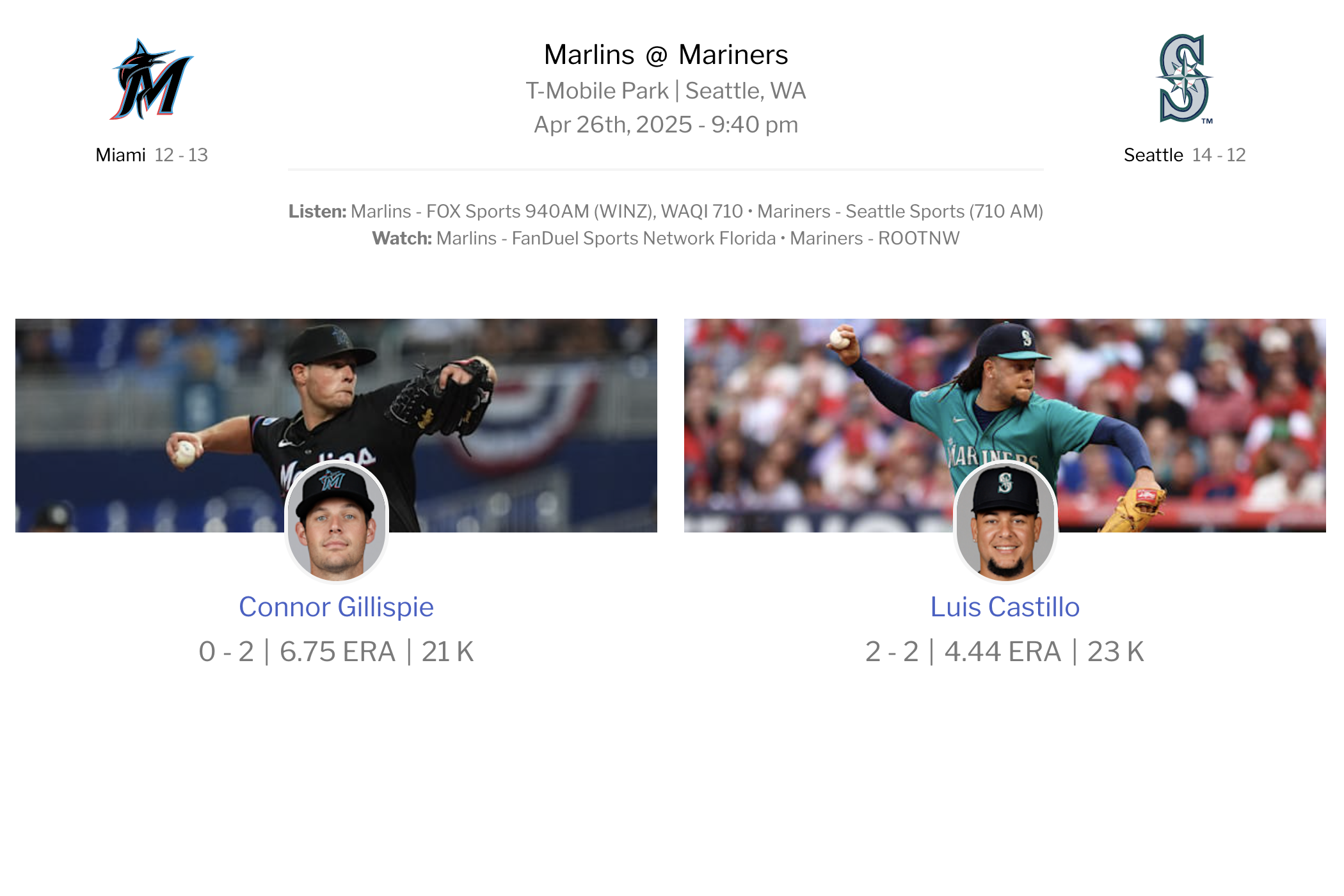 Here are the latest Miami Marlins game notes, produced by the Marlins communications department and relayed to our loyal readers. These notes apply to the second game of Miami's road series against the Seattle Mariners. Starting Lineup SS Xavier Edwards (S) RF Jesús Sánchez (L) C Agustín Ramírez LF Kyle Stowers (L) 1B Eric Wagaman 2B Otto Lopez DH Matt Mervis (L) 3B Connor Norby CF Dane Myers P Connor Gillispie Click HERE to download the full game notes (preview below)
 -
Player status updates, insightful stats and more information to fully equip you for today's Marlins game. Here are the latest Miami Marlins game notes, produced by the Marlins communications department and relayed to our loyal readers. These notes apply to the second game of Miami's road series against the Seattle Mariners. Starting Lineup SS Xavier Edwards (S) RF Jesús Sánchez (L) C Agustín Ramírez LF Kyle Stowers (L) 1B Eric Wagaman 2B Otto Lopez DH Matt Mervis (L) 3B Connor Norby CF Dane Myers P Connor Gillispie Click HERE to download the full game notes (preview below) View full article
-
I hope Agustín can prove me wrong and settle in as a decent defensive player. He is a foundational piece for his bat alone, but it opens up more roster construction possibilities if he doesn't clog up the DH spot. I think the Marlins would only see him as a long-term extension candidate if grows a bit on that side of the ball.
-
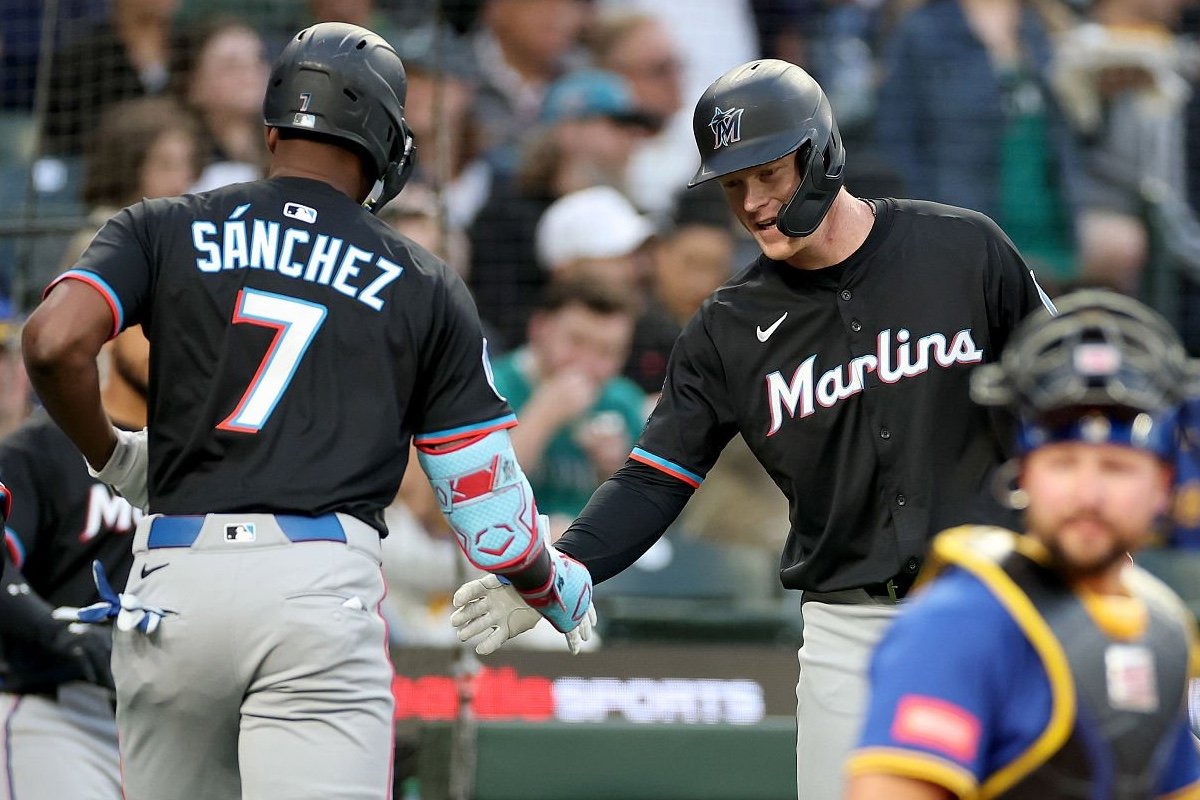 Matt Mervis slammed his bat in frustration. Given the green light in a 3-0 count, Seattle Mariners right-hander Casey Lawrence served up a center-cut, 88 mph fastball, and Mervis wasted it by hitting a routine grounder to second baseman Dylan Moore for the final out of the inning...or so he thought. Mervis briefly looked away from the play while jogging down the line, only to find out that the ball had somehow gotten behind Moore. The Miami Marlins still had life in the top of the fifth and made it count. The Marlins went on to score six runs—all of them unearned—before the inning actually ended, ultimately defeating the Mariners at T-Mobile Park, 8-4. Through the first three innings, it was hard to fathom a scenario where the Fish would put up eight runs. Logan Gilbert mowed down their lineup on just 29 total pitches. They caught a massive break when Gilbert exited the game due to right forearm tightness. The Mariners had taken the lead on Moore's solo home run in the bottom of the second. To Cal Quantrill's credit, that was his only blunder early on. Entering the fifth, every other Seattle batter had been retired. Quantrill was staying away from their lefties with pitches on the outer third of the strike zone and they helped him out in a few instances by expanding a few inches off of the plate. He was extremely efficient as a result (12 outs on 48 total pitches). Quantrill's catcher, Liam Hicks, was the first Marlin to exploit Moore's miscue. He blooped a single off the end of the bat into left-center field to tie the game. Javier Sanoja and Xavier Edwards followed with singles of their own to make it a 4-1 lead. Jesús Sánchez brought home two more runs by clobbering a Lawrence sweeper deep to right field for his first homer since returning from the injured list. The Marlins have scored 54.4% of their runs this season when there are two outs in an inning, which is by far the highest percentage among MLB teams. Clayton McCullough kept Quantrill in for the sixth inning, a decision he would quickly regret. The Mariners pulled to within 6-4 when Jorge Polanco blasted a three-run bomb on a misplaced cutter. Quantrill continues to struggle when facing opponents for the third time in a game. Miami's bullpen put out the fire. Jesús Tinoco, Calvin Faucher and Ronny Henriquez combined for 3 ⅓ scoreless innings. The final frames were much less stressful thanks to the prodigious bat of Agustín Ramírez. With Lawrence still pitching in the top of the eighth, the designated hitter extended the Marlins' lead to 8-4 with his first career homer. agustin MIA @ SEA _ Highlights _ MLB Research Tool.mp4 Ramírez's numbers since being called up earlier this week are extraordinary and possibly unprecedented. He has a slash line of .700/.750/1.400 with a 461 wRC+ (100 represents league average). He has mashed five extra-base hits and none of them have been cheapies—exit velocities above 100 mph on all them, including 106.9 mph on the round-tripper. Nobody's been able to strike him out yet. Since the start of the 20th century, there is no record of a player compiling seven hits including five extra-base hits through their first three career games, according to MLB.com's Sarah Langs. Saturday's starting pitching matchup is another mismatch on paper with former waiver claim Connor Gillispie and three-time All-Star Luis Castillo taking the mound for the Marlins and Mariners, respectively. Expect Ramírez to catch Gillispie. First pitch is again scheduled for 9:40 p.m. ET.
- 2 comments
-
- 1
-

-
- agustin ramirez
- jesus sanchez
- (and 1 more)
-
After an error extended the fifth inning, Miami took full advantage. Agustín Ramírez continued his phenomenal debut week by later adding insurance runs with his first career homer. Matt Mervis slammed his bat in frustration. Given the green light in a 3-0 count, Seattle Mariners right-hander Casey Lawrence served up a center-cut, 88 mph fastball, and Mervis wasted it by hitting a routine grounder to second baseman Dylan Moore for the final out of the inning...or so he thought. Mervis briefly looked away from the play while jogging down the line, only to find out that the ball had somehow gotten behind Moore. The Miami Marlins still had life in the top of the fifth and made it count. The Marlins went on to score six runs—all of them unearned—before the inning actually ended, ultimately defeating the Mariners at T-Mobile Park, 8-4. Through the first three innings, it was hard to fathom a scenario where the Fish would put up eight runs. Logan Gilbert mowed down their lineup on just 29 total pitches. They caught a massive break when Gilbert exited the game due to right forearm tightness. The Mariners had taken the lead on Moore's solo home run in the bottom of the second. To Cal Quantrill's credit, that was his only blunder early on. Entering the fifth, every other Seattle batter had been retired. Quantrill was staying away from their lefties with pitches on the outer third of the strike zone and they helped him out in a few instances by expanding a few inches off of the plate. He was extremely efficient as a result (12 outs on 48 total pitches). Quantrill's catcher, Liam Hicks, was the first Marlin to exploit Moore's miscue. He blooped a single off the end of the bat into left-center field to tie the game. Javier Sanoja and Xavier Edwards followed with singles of their own to make it a 4-1 lead. Jesús Sánchez brought home two more runs by clobbering a Lawrence sweeper deep to right field for his first homer since returning from the injured list. The Marlins have scored 54.4% of their runs this season when there are two outs in an inning, which is by far the highest percentage among MLB teams. Clayton McCullough kept Quantrill in for the sixth inning, a decision he would quickly regret. The Mariners pulled to within 6-4 when Jorge Polanco blasted a three-run bomb on a misplaced cutter. Quantrill continues to struggle when facing opponents for the third time in a game. Miami's bullpen put out the fire. Jesús Tinoco, Calvin Faucher and Ronny Henriquez combined for 3 ⅓ scoreless innings. The final frames were much less stressful thanks to the prodigious bat of Agustín Ramírez. With Lawrence still pitching in the top of the eighth, the designated hitter extended the Marlins' lead to 8-4 with his first career homer. agustin MIA @ SEA _ Highlights _ MLB Research Tool.mp4 Ramírez's numbers since being called up earlier this week are extraordinary and possibly unprecedented. He has a slash line of .700/.750/1.400 with a 461 wRC+ (100 represents league average). He has mashed five extra-base hits and none of them have been cheapies—exit velocities above 100 mph on all them, including 106.9 mph on the round-tripper. Nobody's been able to strike him out yet. Since the start of the 20th century, there is no record of a player compiling seven hits including five extra-base hits through their first three career games, according to MLB.com's Sarah Langs. Saturday's starting pitching matchup is another mismatch on paper with former waiver claim Connor Gillispie and three-time All-Star Luis Castillo taking the mound for the Marlins and Mariners, respectively. Expect Ramírez to catch Gillispie. First pitch is again scheduled for 9:40 p.m. ET. View full article
-
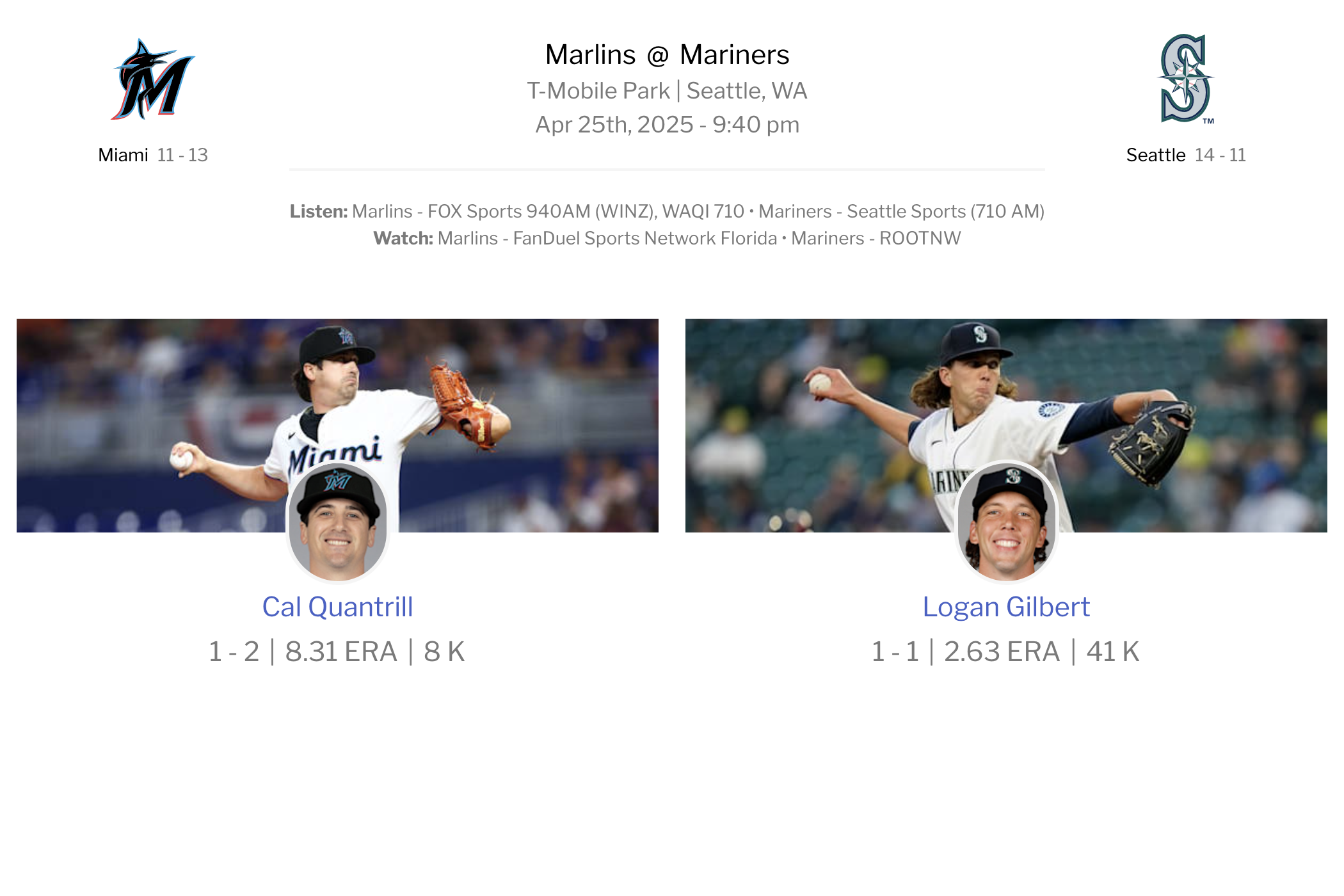 Here are the latest Miami Marlins game notes, produced by the Marlins communications department and relayed to our loyal readers. These notes apply to the first game of Miami's road series against the Seattle Mariners. Starting Lineup SS Xavier Edwards (S) CF Jesús Sánchez (L) LF Eric Wagaman DH Agustín Ramírez RF Kyle Stowers (L) 3B Connor Norby 1B Matt Mervis (L) C Liam Hicks (L) 2B Javier Sanoja P Cal Quantrill Click HERE to download the full game notes (preview below)
 -
Player status updates, insightful stats and more information to fully equip you for today's Marlins game. Here are the latest Miami Marlins game notes, produced by the Marlins communications department and relayed to our loyal readers. These notes apply to the first game of Miami's road series against the Seattle Mariners. Starting Lineup SS Xavier Edwards (S) CF Jesús Sánchez (L) LF Eric Wagaman DH Agustín Ramírez RF Kyle Stowers (L) 3B Connor Norby 1B Matt Mervis (L) C Liam Hicks (L) 2B Javier Sanoja P Cal Quantrill Click HERE to download the full game notes (preview below) View full article
-
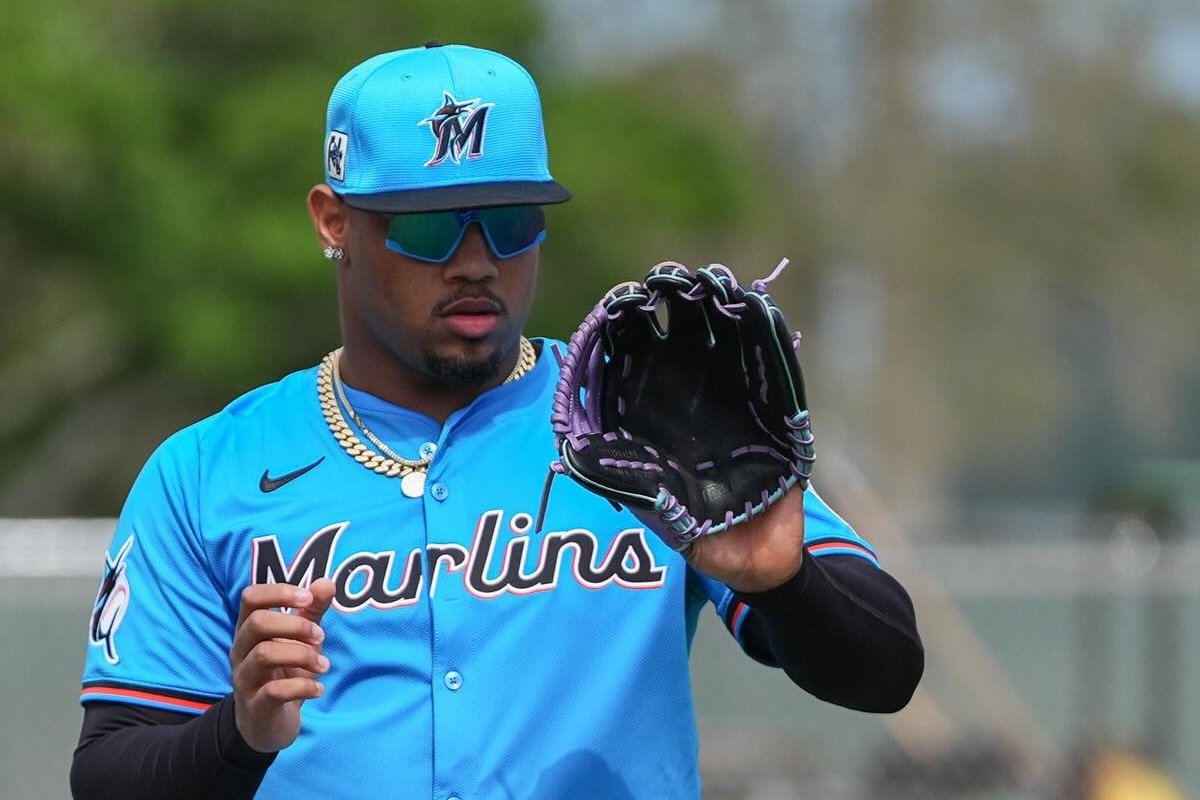 The man who led Minor League Baseball in home runs last season is currently tied for seventh on his own team in that category. It has been a weird start to the 2025 season for Deyvison De Los Santos, though not necessarily a bad one. De Los Santos was homerless in 17 consecutive games to begin the season. That was the second-longest home run drought of his minor league career, trailing only a 33-gamer in 2021 when he was a teenager making the leap from rookie ball to Low-A. He snapped out of it on April 19, and even that one barely eluded the grasp of the opposing outfielder. Entering play on Friday, however, Fish On First's seventh-ranked prospect is getting on base at a substantially higher rate than he did when facing Triple-A pitching last year. Accounting for the ultra-hitting-friendly conditions that juiced his numbers during a stint in the Pacific Coast League, De Los Santos is actually a better offensive player in his current form. De Los Santos at AAA in 2024 (99 G): .264/.311/.523, 26 HR, 0 SB, 102 wRC+ De Los Santos at AAA in 2025 (22 G): .305/.363/.416, 1 HR, 3 SB, 118 wRC+ The quality of contact that De Los Santos has been making is still excellent. His 56.4% hard-hit rate is good for 17th out of the 264 players who have at least 50 plate appearances at Triple-A, according to Baseball Savant. He is virtually tied with newly promoted Athletics top prospect Nick Kurtz in that category. Elevating the ball is important for a below-average runner like De Los Santos and he is continuing to chip away at his career-long ground ball issue. His GB% rate has dropped from 57.0% in 2021 to 54.8% in 2022 to 52.8% in 2023 to 49.6% in 2024 to 41.8% so far in 2025. Also (and perhaps most importantly), De Los Santos has tweaked his plate approach to be more selective. During his first taste of Triple-A, he swung at 45.6% of pitches outside the strike zone, a chase rate which would've been the second-highest among qualified major leaguers in 2024. That was not going to be sustainable for somebody who is already vulnerable to whiffing on pitches in the zone. So far in 2025, his chase rate is 32.2%—for context, that's in the same ballpark as Otto Lopez and Kyle Stowers. You might assume that De Los Santos is getting unlucky to have only one home run to this point, but he frankly hasn't been coming close to clearing the fences. While the lineout below would've been gone to other parts of the field, that is the lone exception. All of his other batted balls have had estimated distances of 353 feet or less. eHlQOE1fV0ZRVkV3dEdEUT09X0F3QlhVd0JYVmdRQVhsRlRCd0FIQXdWUUFBTURCVllBQVZjTUJRY0FVbEVHQ0FSVg==.mp4 If anything, luck has been on DDLS' side. His batting average on balls in play is a sky-high .444. That will not hold up regardless of how many sharp line drives he produces. So yeah, it's been a mixed bag for Deyvison De Los Santos. The Marlins will take their time letting the 21-year-old incubate in Jacksonville until he puts it all together. Between Matt Mervis, Eric Wagaman and Agustín Ramírez, first base and designated hitter are occupied at the big league level, anyway. (As a footnote, De Los Santos has been starting once per series at third base to offer a shred of defensive versatility. He looks like an emergency option there at best due to lack of arm strength, but to his credit, he's been making all of the routine plays.)
 -
Offishial News: Marlins bullpen reinforcements just a phone call away
Ely Sussman posted an article in Marlins
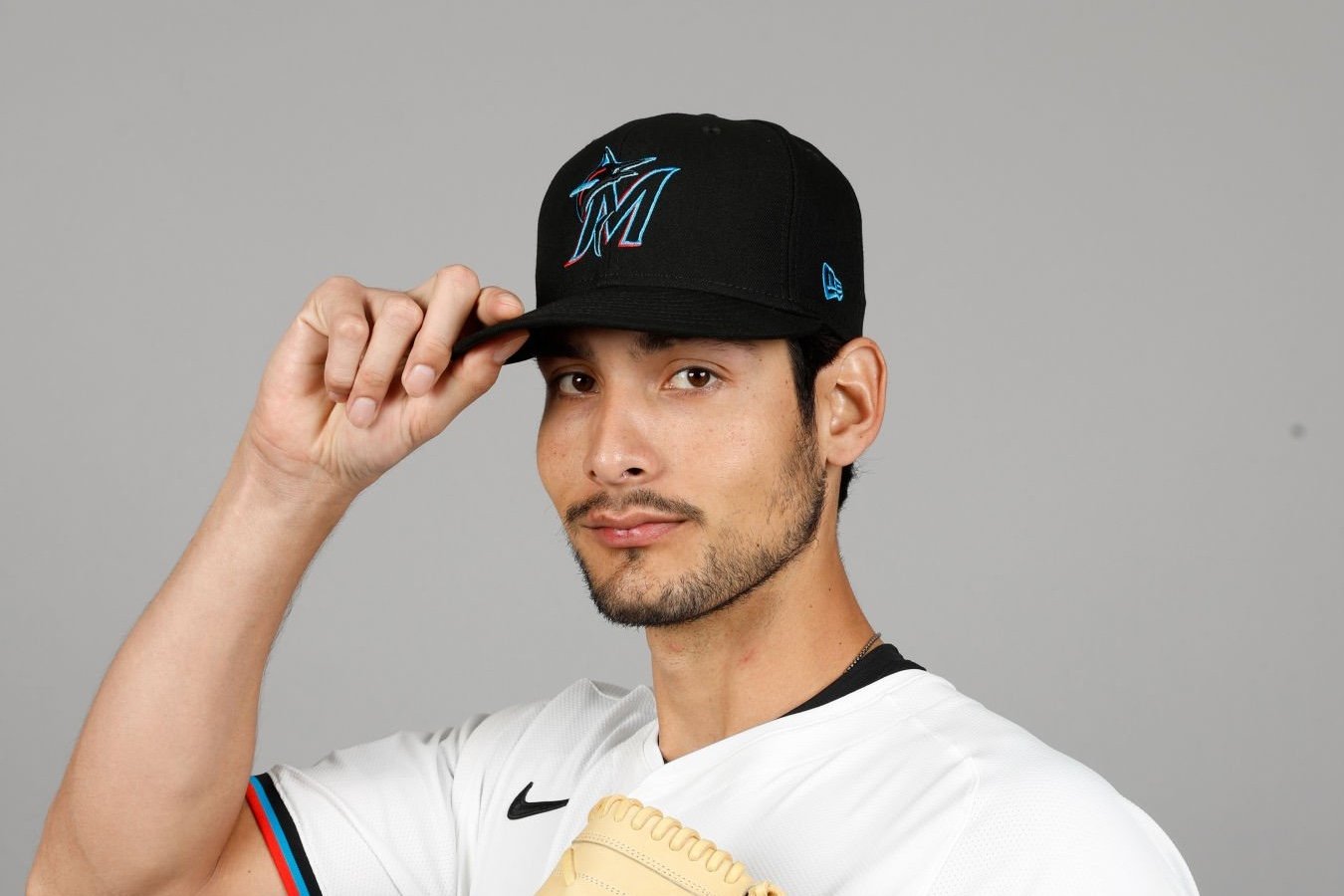 There are a handful of player photos that I could've used to complement this article title. The Triple-A Jacksonville pitching staff, despite being thin on highly ranked Miami Marlins prospects, has been outstanding in 2025. I decided on right-hander Freddy Tarnok just because he started on Thursday, going five scoreless innings to lower his ERA to 3.26 with a fastball that topped out at 98 mph. Tarnok ranks second on the team with 22 strikeouts this season. But more than half of the active Jumbo Shrimp pitching staff has a call-up case right now. As discussed on Fish On First LIVE, there are two obvious weak links in the Marlins bullpen: George Soriano and Tyler Phillips. Even low-leverage arms like theirs find themselves pitching in important situations due to the lack of length that the starters are providing, so Miami cannot afford to be complacent. Whether it's Tarnok, lefty breaking ball specialist Josh Simpson, Cade Gibson (who's already on the 40-man) or somebody else, the Marlins should be proactive about auditioning different arms in place of Soriano and Phillips. Down on the farm, Triple-A Jacksonville won, 9-1. Jakob Marsee stole his 17th and 18th bases. Jacksonville's home winning streak is up to 11 games. Double-A Pensacola won, 3-0. All three of Evan Fitterer's starts this season have been scoreless. His latest one was his longest one yet (6.0 IP,3 H, 0 R, 2 BB, 6 K, 86 pitches/50 strikes) and lowered his ERA to 0.87. High-A Beloit won, 3-0. Low-A Jupiter lost, 5-4. Andrew Salas, the youngest player to appear in a minor league game this season, raised his on-base percentage to .511. More Marlins news and content below: 🔷 Patrick Monteverde cleared waivers and was outrighted to Jacksonville. 🔷 Alex Carver reports on the new pitch-calling process that's been implemented throughout the Marlins farm system. Pitchers are being told to rely heavily on breaking balls and largely disregard the location of them. 🔷 Major League Baseball announced that the Marlins' have the seventh-largest bonus pool for this year's MLB Draft. Their $15,187,400 pool is the largest in franchise history and a 45.5% increase from their 2024 draft pool. Already looking ahead to the 2026 international signing period (opening on January 15), they'll have $7,357,100 in pool money—that's similar to what they had this year ($7,555,500). 🔷 The Prediction Time leaderboard has been updated through the first eight series. I'm doing so poorly, I don't even show up on the top-20 screenshot despite dutifully making predictions for every matchup. Become a SuperSub and we'll keep track of your predictions all season long! 🔷 Elsewhere around baseball, the Colorado Rockies dropped to an MLB-worst 4-20 record after being swept in a doubleheader. 🔷 Today's MLB game: the Marlins (probable starter RHP Cal Quantrill) begin their west coast trip against the Seattle Mariners (RHP Logan Gilbert). The Marlins have a 31.8% chance to win, per FanGraphs. First pitch at 9:40 p.m. ET. 🔷 Today's MiLB schedule: Triple-A Jacksonville vs. Gwinnett, 7:05 p.m. ET Double-A Pensacola vs. Knoxville, 7:05 p.m. ET High-A Beloit at South Bend, 7:05 p.m. ET Low-A Jupiter vs. Palm Beach, 6:30 p.m. ET Marlins podcast episodes
 -
Today's news roundup also includes a detailed report on how pitch-calling is being handled for Marlins minor league affiliates. There are a handful of player photos that I could've used to complement this article title. The Triple-A Jacksonville pitching staff, despite being thin on highly ranked Miami Marlins prospects, has been outstanding in 2025. I decided on right-hander Freddy Tarnok just because he started on Thursday, going five scoreless innings to lower his ERA to 3.26 with a fastball that topped out at 98 mph. Tarnok ranks second on the team with 22 strikeouts this season. But more than half of the active Jumbo Shrimp pitching staff has a call-up case right now. As discussed on Fish On First LIVE, there are two obvious weak links in the Marlins bullpen: George Soriano and Tyler Phillips. Even low-leverage arms like theirs find themselves pitching in important situations due to the lack of length that the starters are providing, so Miami cannot afford to be complacent. Whether it's Tarnok, lefty breaking ball specialist Josh Simpson, Cade Gibson (who's already on the 40-man) or somebody else, the Marlins should be proactive about auditioning different arms in place of Soriano and Phillips. Down on the farm, Triple-A Jacksonville won, 9-1. Jakob Marsee stole his 17th and 18th bases. Jacksonville's home winning streak is up to 11 games. Double-A Pensacola won, 3-0. All three of Evan Fitterer's starts this season have been scoreless. His latest one was his longest one yet (6.0 IP,3 H, 0 R, 2 BB, 6 K, 86 pitches/50 strikes) and lowered his ERA to 0.87. High-A Beloit won, 3-0. Low-A Jupiter lost, 5-4. Andrew Salas, the youngest player to appear in a minor league game this season, raised his on-base percentage to .511. More Marlins news and content below: 🔷 Patrick Monteverde cleared waivers and was outrighted to Jacksonville. 🔷 Alex Carver reports on the new pitch-calling process that's been implemented throughout the Marlins farm system. Pitchers are being told to rely heavily on breaking balls and largely disregard the location of them. 🔷 Major League Baseball announced that the Marlins' have the seventh-largest bonus pool for this year's MLB Draft. Their $15,187,400 pool is the largest in franchise history and a 45.5% increase from their 2024 draft pool. Already looking ahead to the 2026 international signing period (opening on January 15), they'll have $7,357,100 in pool money—that's similar to what they had this year ($7,555,500). 🔷 The Prediction Time leaderboard has been updated through the first eight series. I'm doing so poorly, I don't even show up on the top-20 screenshot despite dutifully making predictions for every matchup. Become a SuperSub and we'll keep track of your predictions all season long! 🔷 Elsewhere around baseball, the Colorado Rockies dropped to an MLB-worst 4-20 record after being swept in a doubleheader. 🔷 Today's MLB game: the Marlins (probable starter RHP Cal Quantrill) begin their west coast trip against the Seattle Mariners (RHP Logan Gilbert). The Marlins have a 31.8% chance to win, per FanGraphs. First pitch at 9:40 p.m. ET. 🔷 Today's MiLB schedule: Triple-A Jacksonville vs. Gwinnett, 7:05 p.m. ET Double-A Pensacola vs. Knoxville, 7:05 p.m. ET High-A Beloit at South Bend, 7:05 p.m. ET Low-A Jupiter vs. Palm Beach, 6:30 p.m. ET Marlins podcast episodes View full article
-
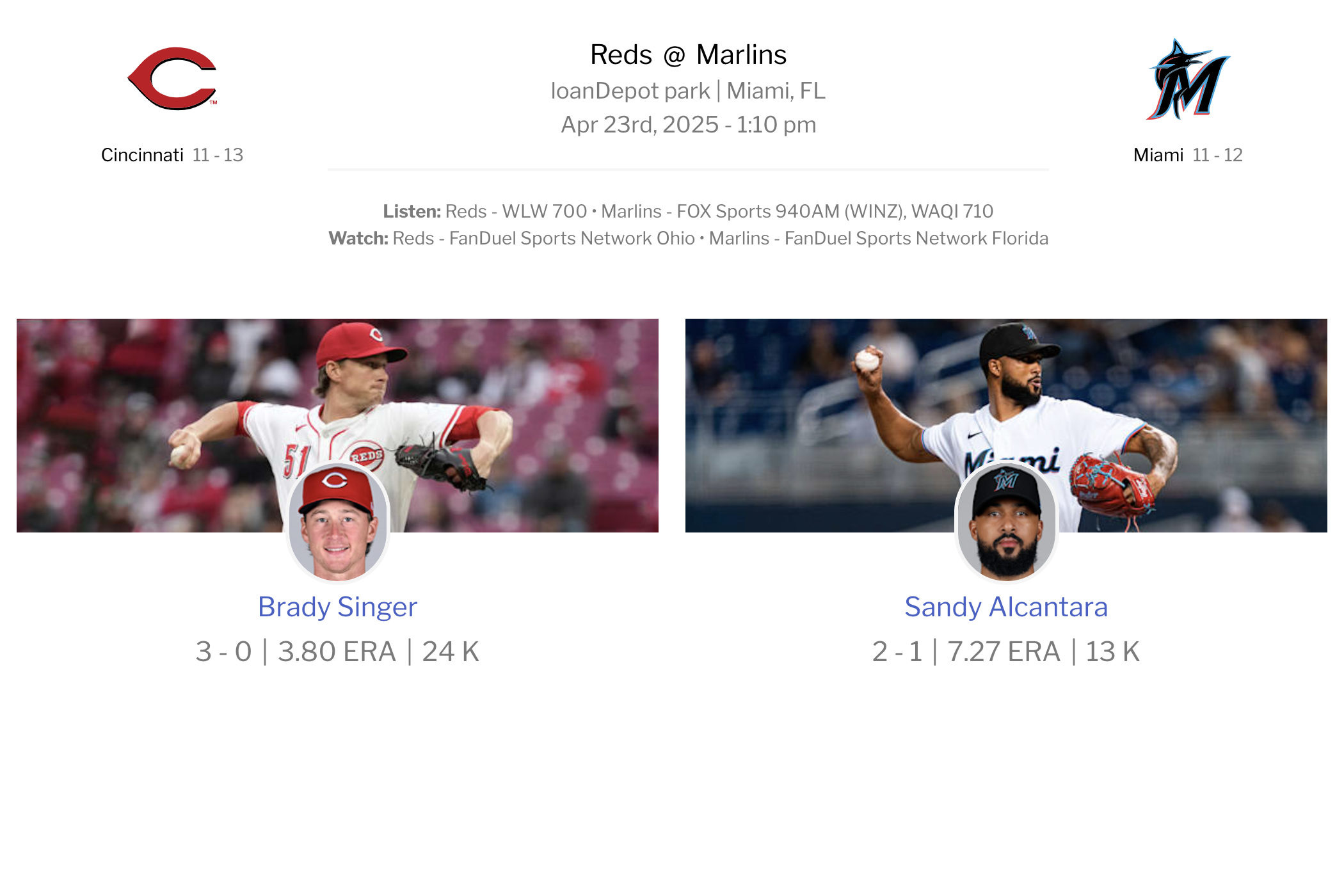 Here are the latest Miami Marlins game notes, produced by the Marlins communications department and relayed to our loyal readers. These notes apply to the third and final game of Miami's home series against the Cincinnati Reds. Starting Lineup SS Xavier Edwards (S) CF Jesús Sánchez (L) 1B Eric Wagaman DH Matt Mervis (L) RF Kyle Stowers (L) 2B Otto Lopez C Liam Hicks (L) LF Ronny Simon (S) 3B Graham Pauley (L) P Sandy Alcantara Click HERE to download the full game notes (preview below)
 -
Player status updates, insightful stats and more information to fully equip you for today's Marlins game. Here are the latest Miami Marlins game notes, produced by the Marlins communications department and relayed to our loyal readers. These notes apply to the third and final game of Miami's home series against the Cincinnati Reds. Starting Lineup SS Xavier Edwards (S) CF Jesús Sánchez (L) 1B Eric Wagaman DH Matt Mervis (L) RF Kyle Stowers (L) 2B Otto Lopez C Liam Hicks (L) LF Ronny Simon (S) 3B Graham Pauley (L) P Sandy Alcantara Click HERE to download the full game notes (preview below) View full article
-
Offishial News: Agustín Ramírez has hit the ground running (and hitting)
Ely Sussman posted an article in Marlins
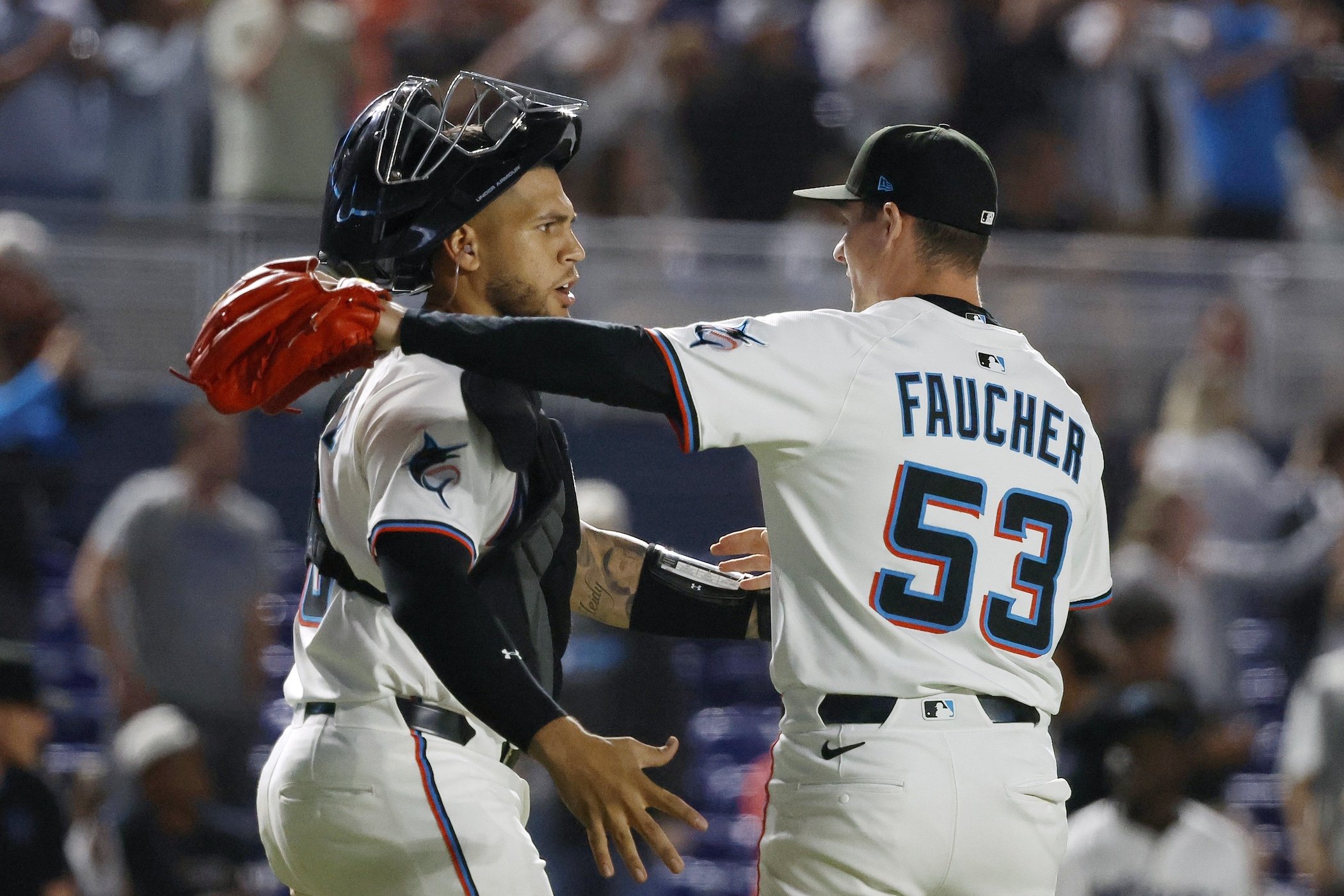 Two games into his major league career, the Miami Marlins inserted Agustín Ramírez into the cleanup spot of their lineup on Tuesday against the Cincinnati Reds, even with a right-handed starter on the mound. Get used to it. Ramírez went 3-for-3 with a pair of doubles and a walk, included the team's two hardest-hit balls, playing a key role in their 4-3 victory. Nothing against Liam Hicks, but Ramírez has matched his extra-base hit total for the season in a single series. The quality of his contact and his takes have been as good as advertised. Prior to the Ramírez call-up, this was already shaping up to be the best Marlins offense of the Bruce Sherman era. As long as he sticks on the active roster moving forward, that should definitely be the case. Down on the farm, Triple-A Jacksonville won, 6-5. Joe Mack went 0-for-4 with a walk in his Triple-A debut. Deyvison De Los Santos went 4-for-5 with a stolen base. The reigning MiLB home run king has gone deep only once this season, but he's still make lots of loud contact and leading the Marlins farm system with 23 hits. Remember Seth Martinez? The 30-year-old reliever who was outrighted to the minors last month has been outstanding for the Jumbo Shrimp, striking out 14 batters in 7 ⅓ innings without surrendering any earned runs. Double-A Pensacola lost, 2-1. High-A Beloit lost, 8-5. Ryan Ignoffo homered and caught two runners attempting to steal. Low-A Jupiter lost, 7-5. In his season debut, PJ Morlando hit his first professional home run. anik2l_1.mp4 More Marlins news and content below: 🔷 Starlyn Caba, Fish On First's second-ranked prospect, has landed on the 7-day injured list with a left thumb sprain. The 19-year-old shortstop owns an impressive 114 wRC+ for Jupiter this season, but his 28.8% walk rate is doing the heavy lifting. There has been only one deep fly ball off his bat through 52 plate appearances. 🔷 Patrick Monteverde remains in DFA limbo. 🔷 Kevin Barral and I checked in on how each team involved in the Luis Arraez trade tree is feeling about their side of it. Legitimately has the potential to be a win-win-win scenario. 🔷 Published before his 14-strikeout performance, Thomas Nestico detailed the pitch characteristics and usage changes that had been fueling Max Meyer's hot start. 🔷 The Marlins are still accepting applications for baseball analyst and senior data scientist positions in their baseball research department. 🔷 Elsewhere around baseball, the New York Mets have won six in a row to pull even with the San Diego Padres for MLB's best record (17-7). Their pitching staff has an unfathomable 2.37 ERA, thanks to limiting opponents to only 10 homers through 24 games. One of baseball's best hitting prospects, Nick Kurtz, will debut for the Athletics today. 🔷 Today's MLB game: the Marlins (probable starter RHP Sandy Alcantara) will try to sweep the Cincinnati Reds (RHP Brady Singer). The Marlins have a 56.1% chance to win, per FanGraphs. Agustín Ramírez is expected to be absent from the starting lineup, but available to rake off the bench if the situation presents itself. First pitch at 1:10 p.m. ET. 🔷 Today's MiLB schedule: Triple-A Jacksonville vs. Gwinnett, 7:05 p.m. ET Double-A Pensacola vs. Knoxville, 7:05 p.m. ET High-A Beloit at South Bend, 7:05 p.m. ET Low-A Jupiter vs. Palm Beach, 6:30 p.m. ET Marlins podcast episodes
 -
Today's news roundup also includes injury updates on Marlins prospects PJ Morlando and Starlyn Caba. Two games into his major league career, the Miami Marlins inserted Agustín Ramírez into the cleanup spot of their lineup on Tuesday against the Cincinnati Reds, even with a right-handed starter on the mound. Get used to it. Ramírez went 3-for-3 with a pair of doubles and a walk, included the team's two hardest-hit balls, playing a key role in their 4-3 victory. Nothing against Liam Hicks, but Ramírez has matched his extra-base hit total for the season in a single series. The quality of his contact and his takes have been as good as advertised. Prior to the Ramírez call-up, this was already shaping up to be the best Marlins offense of the Bruce Sherman era. As long as he sticks on the active roster moving forward, that should definitely be the case. Down on the farm, Triple-A Jacksonville won, 6-5. Joe Mack went 0-for-4 with a walk in his Triple-A debut. Deyvison De Los Santos went 4-for-5 with a stolen base. The reigning MiLB home run king has gone deep only once this season, but he's still make lots of loud contact and leading the Marlins farm system with 23 hits. Remember Seth Martinez? The 30-year-old reliever who was outrighted to the minors last month has been outstanding for the Jumbo Shrimp, striking out 14 batters in 7 ⅓ innings without surrendering any earned runs. Double-A Pensacola lost, 2-1. High-A Beloit lost, 8-5. Ryan Ignoffo homered and caught two runners attempting to steal. Low-A Jupiter lost, 7-5. In his season debut, PJ Morlando hit his first professional home run. anik2l_1.mp4 More Marlins news and content below: 🔷 Starlyn Caba, Fish On First's second-ranked prospect, has landed on the 7-day injured list with a left thumb sprain. The 19-year-old shortstop owns an impressive 114 wRC+ for Jupiter this season, but his 28.8% walk rate is doing the heavy lifting. There has been only one deep fly ball off his bat through 52 plate appearances. 🔷 Patrick Monteverde remains in DFA limbo. 🔷 Kevin Barral and I checked in on how each team involved in the Luis Arraez trade tree is feeling about their side of it. Legitimately has the potential to be a win-win-win scenario. 🔷 Published before his 14-strikeout performance, Thomas Nestico detailed the pitch characteristics and usage changes that had been fueling Max Meyer's hot start. 🔷 The Marlins are still accepting applications for baseball analyst and senior data scientist positions in their baseball research department. 🔷 Elsewhere around baseball, the New York Mets have won six in a row to pull even with the San Diego Padres for MLB's best record (17-7). Their pitching staff has an unfathomable 2.37 ERA, thanks to limiting opponents to only 10 homers through 24 games. One of baseball's best hitting prospects, Nick Kurtz, will debut for the Athletics today. 🔷 Today's MLB game: the Marlins (probable starter RHP Sandy Alcantara) will try to sweep the Cincinnati Reds (RHP Brady Singer). The Marlins have a 56.1% chance to win, per FanGraphs. Agustín Ramírez is expected to be absent from the starting lineup, but available to rake off the bench if the situation presents itself. First pitch at 1:10 p.m. ET. 🔷 Today's MiLB schedule: Triple-A Jacksonville vs. Gwinnett, 7:05 p.m. ET Double-A Pensacola vs. Knoxville, 7:05 p.m. ET High-A Beloit at South Bend, 7:05 p.m. ET Low-A Jupiter vs. Palm Beach, 6:30 p.m. ET Marlins podcast episodes View full article

.jpg.3fb1e4715269e11d1036915743ea97e7.jpg)

