



Alex Carver
-
Posts
459 -
Joined
-
Last visited
-
Days Won
16
Content Type
Profiles
Miami Marlins Videos
2026 Miami Marlins Top Prospects Ranking
Miami Marlins Free Agent & Trade Rumors, Notes, & Tidbits
Guides & Resources
News
2025 Miami Marlins Draft Pick Tracker
2026 Miami Marlins Draft Tracker: Picks & Bonuses
Forums
Blogs
Events
Store
Downloads
Gallery
Everything posted by Alex Carver
-
 View full article
 -
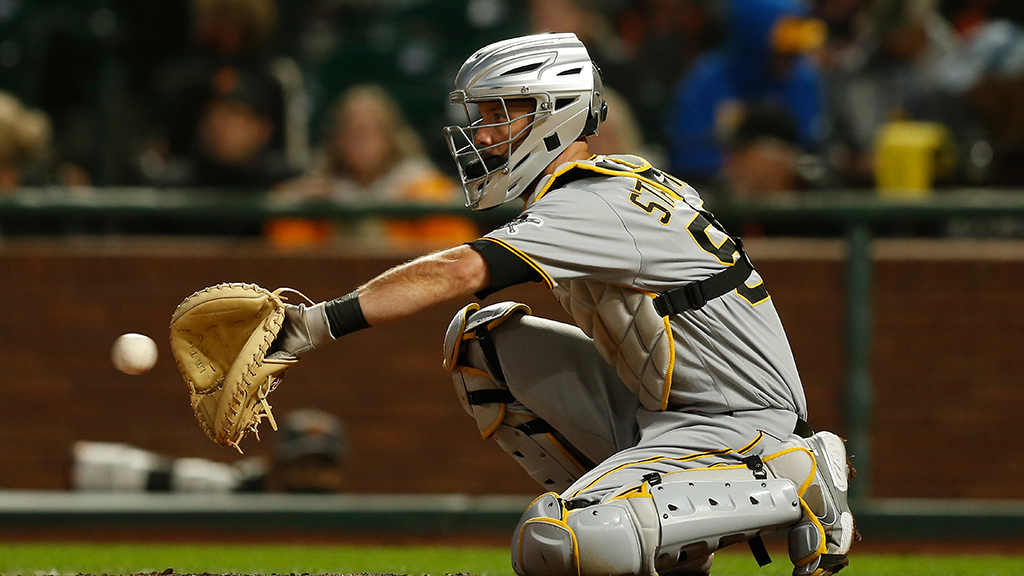 Jacob Stallings (Photo by Lachlan Cunningham/Getty Images) Derek Jeter is used to winning. So when the fourth year of his ownership reign of the Miami Marlins ended with 67-95 record, he and Bruce Sherman were determined to become competitive. The club took a big step in that direction pre-lockout, making multiple moves to improve the major league roster for 2022. The biggest of these moves happened last week. Back in 2019, the Marlins believed they had JT Realmuto’s heir apparent in Jorge Alfaro, especially after he hit .262/.312/.425 while tossing out 33% of his runners. But after hitting a combined .240/.282/.343 over the COVID-stricken 2020 season and an injury hampered 2021 while being a bottom of the barrel framer and far and away the league leader in passed balls in his age 27-28 seasons and with no prospects close to a major league ready berth, catcher clearly became the biggest gaping hole on the Marlins’ 40-man roster. In a thin market that is only getting thinner as baseball evolves around the catching position, the Marlins hit a home run by acquiring Jacob Stallings, a 31-year-old Gold Glove winner with three years of control remaining on his contract. Headed to the Pittsburgh Pirates are RHP Zach Thompson, OF Connor Scott (Fish on the Farm’s #13 prospect) and RHP Kyle Nicolas (#18). Stallings comes to the Marlins less than a month away from his 32nd birthday. Drafted by the Pirates in the seventh round in 2012 out of the University of North Carolina where he hit .293/.396/.437 over two seasons, Stallings’ MiLB career was a rags-to-riches story. Never ranked a top 30 prospect by MLB Pipeline, Stallings was still grinding it out in AAA into his age 28 season and he successfully passed through waivers twice. But in 2019, things started clicking for Stallings. Serving as the Pirates backup catcher, he stuck with the MLB team the entire year and performed well above his career MiLB numbers. In 71 games, Stallings hit .262/.325/.382 with six homers and held his K rate under 20%. Above his offense though, the backstop begun proving his defensive prowess at the big league level, posting a 1.4 dWAR. This season, after the shortened 2020, Stallings got the starting nod and played in by far the most baseball games he has ever played in a single season. At the back end of the lineup, Stallings was frustrating for opposing pitchers whom he made earn their outs and stretched their arms out. His 11.5% walk rate ranked 13th among 68 qualified catchers and was a primary factor for his respectable .335 OBP. On defense, Stallings was otherworldly; the best catcher in the NL and one of the best defenders in all of baseball. From behind the plate, Stallings saved a total of 21 runs, second to only Rockies’ infielder Ryan McMahon. In addition, he did not allow a single passed ball , the only catcher that played over 500 innings to accomplish that feat an extending a streak that spans nearly two calendar years. Per Statcast, he ranked 17th out of 59 catchers in pitch framing efficiency. In Stallings, the Marlins get an experienced player who is an absolute wizard behind the plate, who knows how to handle a young pitching staff and who does more at the plate than the league average catcher. He will be under team control until 2026. So, in addition to Zach Thompson who came up in one of the Marlins’ multiple moments of rotational need and impressed, what did a Gold Glove backstop cost in terms of prospects? RHP Kyle Nicolas 2021 Stats (A+-AA): 99 IP, 4.18 ERA, 1.30 WHIP, 136/49 K/BB Nicolas, a soon-to-be 23 year old, is a product of the shortened 2020 Draft from Ball State University. After beginning the 2021 season with the A+ Beloit Snappers, the 6’4”, 223 specimen got his call up to AA at a pretty precarious time: right after his worst career start. While he was thought to be joining the Blue Wahoos to fill in for Jake Eder and Max Meyer who were participating in the MLB Futures Game at All-Star Weekend, Nicolas stuck with the AA team for the rest of the season and performed well by overall metrics. In five starts and 25.2 IP with the Wahoos, Nicolas tossed to a 2.10 ERA via a 31/13 K/BB and 50/25 K/BB. Nicolas is prized for his heavy fastball velocity that is capable of triple digits but he also has a nasty primary breaker. He also owns a decent budding changeup. So what still needs to be done? Nicolas and his big frame and levers did show he is prone to losing the zone from start to start. He also showed that his velo can dip as he gets later into innings and the changeup, although usable, has some ground to make up on his other two offerings. Nicolas ended the year on a very strong note, tossing his longest career outing of 6.2 IP on August 24th. With size, heat and a good mix, Nicolas is a few adjustments away from proving he can stick as a big league rotational piece. At the very least, his high floor is that of a dominant high leverage reliever. OF Connor Scott 2021 Stats (A+): .276/.333/.446, 10 HR, 41 XBH, 92/31 K/BB Since being in the organization since 2017 through a down year in 2019 and a lost 2020, people have forgotten the name Connor Scott. In 2021, the Florida native and Plant High School alum proved he is just getting started. Connor Scott is still just a recently turned 22 year old. People forget that. Playing against competition nearly a year and a half older than him on average in the High A ranks, Scott had an impressive season. He began making impressions by showing up to camp quite a bit visibly larger than his 6’3”, 187 listed size. He also looked like he knew how to use the added mass with a stronger swing that had a more straight through line drive inducing action. The improved size and swing were a major catalyst for Scott that he carried through the entire season. Scott began 2021 with the A+ Snappers. After missing two weeks beginning at the end of May with a foot injury, Scott struggled through June and most of July. Starting late in July though, Scott’s numbers began to spike. From July 25th through the end of the season, he hit .322/.356/.557 with a 144 wRC+ while keeping his strikeout rate at a manageable 22%. After playing in just 27 games in 2019 and of course missing all of 2020, Scott is a guy who’s career has been very disjointed. To see him come back in the best physical shape of his career, remain healthy for most of the season and play his best baseball at the highest level he’s ever played at while still facing off against hitters nearly a year and a half older than him on average was very encouraging and a potential turning point in his minor league career. Scott joins a Pirates organization in the midst of a rebuild but also a system that holds a cornerstone center fielder at the big league level in Bryan Reynolds as well as several near major league ready outfield prospects in Travis Swaggerty and Scott clone, Calvin Mitchell. With Scott still at least a year away from the majors, the Pirates have the freedom to take their time was Scott and assure carry over from his strong finish at A+ last year to the upper minors beginning in 2022. If he can, Scott, who holds elite sprint speed and a plus glove, still has the potential for all five tools and could stick as a starting center fielder at the next level. As the old adage goes, you need to give up value to get value and both clubs did both of those things in this trade. The Marlins filled the biggest hole on their roster, not just at the big league level but throughout the entire organization with one of the best backstops in baseball and the rebuilding Pirates bolstered their outfield with a youthful potential five tool prospect. Sometimes, trades are mutually beneficial for both sides. The Pirates and Marlins matched up perfectly and executed a very reciprocal deal.
 -
View full article
-
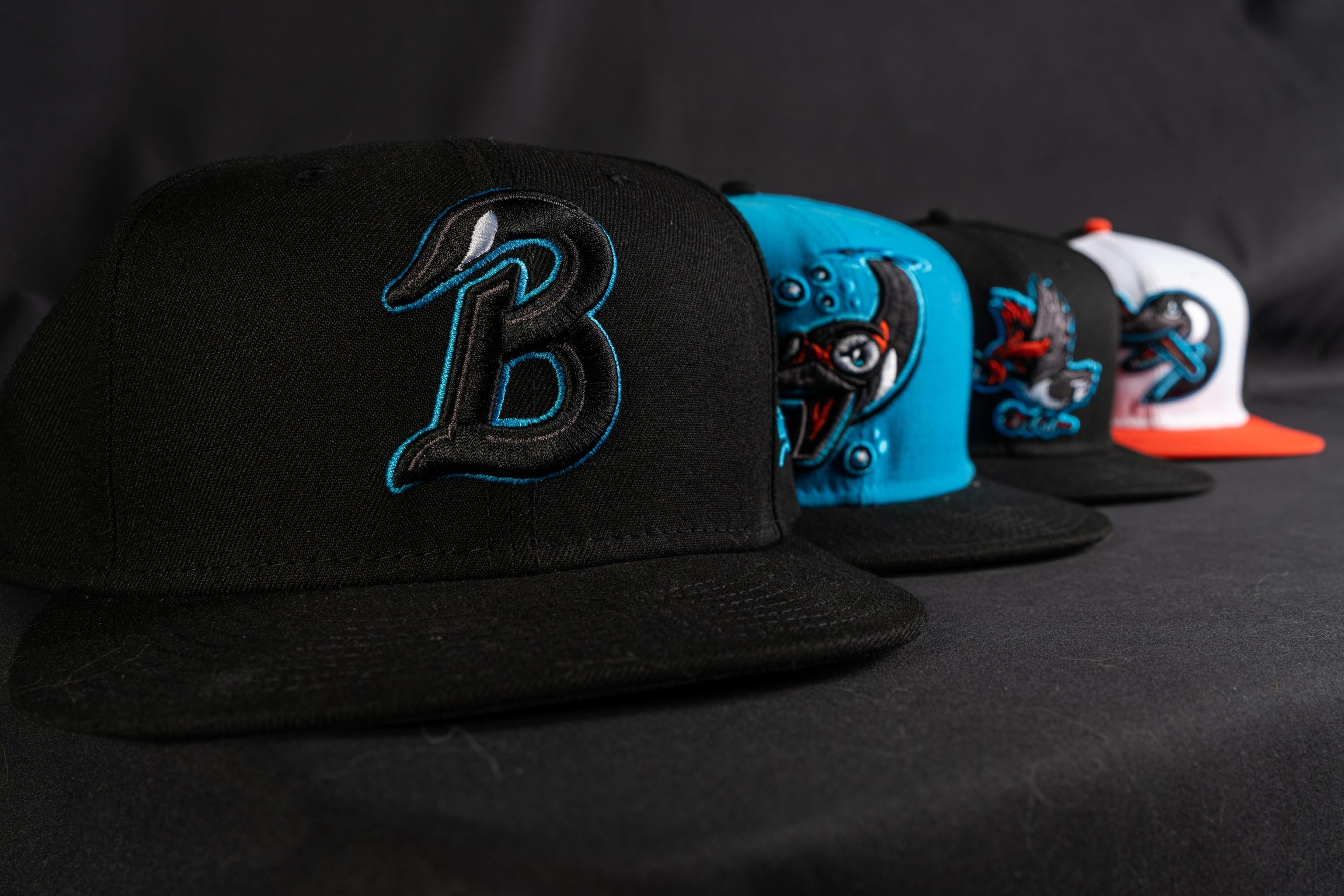 Photo by Beloit Sky CarpAhead of their first full season in their brand new ballpark, the Beloit baseball club has been renamed to honor long-time residents of the city that have now become the team’s newest and closest neighbors along the Rock River. Introducing the Beloit Sky Carp. On Monday afternoon, the club debuted its new moniker that was selected by fans out of five possible choices. The new name was one of over 1,000 submitted by fans and won the fan vote among five finalists by a small margin. Coming in second by a small margin of less than 50 total votes was the Supper Clubbers. Cheeseballs, Polka Pike and Moo rounded out the fan vote in that order. The on field product features four jerseys and caps designed by Brandiose, the same minds behind the creative branding of clubs such as the Amarillo Sod Poodles, Hartford Yard Goats and Rocket City Trash Pandas. At the unveiling on Monday which was done by elementary school scholars, in place of players modeling the team’s new colors, community leaders were given the honor of being the first individuals to publicly don Sky Carp uniforms. The unveiling this week was the last step in the process. But from the very beginning of the two year long process, Studer assured the team would be remade for the city of Beloit by the city of Beloit. The term sky carp is slang for a goose — but not just any goose. Indigenous to lower Wisconsin, the sky carp, unlike many other breeds of waterfowl, do not migrate from the region during the winter months. Like the good majority of their season ticket holders, sky carp are full-time Beloit residents. Two of the four jerseys that will be worn by the Sky Carp have an uncommon characteristic: they both are emblazoned with the name of the home city. One of these is the traditional road gray; the other is an alternate jersey that can be worn either at home or on the road. Giving the Sky Carp the ability to honor their home city at ABC Supply Stadium was an important inclusion aspect for ownership. Another sign of Quint Studer and his team’s commitment to the city of Beloit appears in the Sky Carp’s primary and third cap logo. One of the most aesthetically striking aspects of the rebrand, the wrench lends itself to the history of Beloit. The logo outlined in ‘Rock River Blue’ features the wrench being both clutched and bitten by the goose, figuratively paying homage to Beloit, a city that was made by blue collar workers and a city that is still building towards a more prosperous future. The wrench is modeled after one made by a local area manufacturer, Fairbanks Morse. Within the Sky Carp’s third cap logo, their underwater goose emblem, the Sky Carp promote inclusion and honor one of the most prolific moments in Beloit history. The goose can be seen wearing aviator style goggles which honor a local icon, Bessica Raiche, the first woman to pilot an airplane on a solo mission in 1907. Raiche’s story is also becoming of the industrial background of Beloit: Raiche and her husband built her craft in their living room, utilizing a piano bench as a workspace. In order to get the craft, made out of bamboo, silk and wire to launch, the couple removed the front of their home. As big as Monday was and as pleased as the team is to adopt a new name, there is still work to do in terms of adopting a new mascot. For that, the Beloit branding team will once turn once again to the same people responsible for bringing the Sky Carp name to Beloit: fans. Over the course of the next several weeks, Rock County schools will be asked to draw their version of the Sky Carp mascot, complete with a new name the club hopes to finalize before Opening Day 2022. Although the club will be replacing a long-time stalwart in the Beloit community, Snappy the Turtle will not be completely gone. As Studer told us at the beginning of the season, the Beloit club will maintain the trademark to the Snappers allowing them to utilize the name on special occasions. As a bonus to their hopeful connection to their home city, the new color scheme for the Sky Carp which was put in motion well before Beloit’s affiliation with the Miami Marlins should allow the club to connect with fans of the parent club’s popular 2019 rebrand. This is a breaking story that will be updated shortly
 -
View full article
-
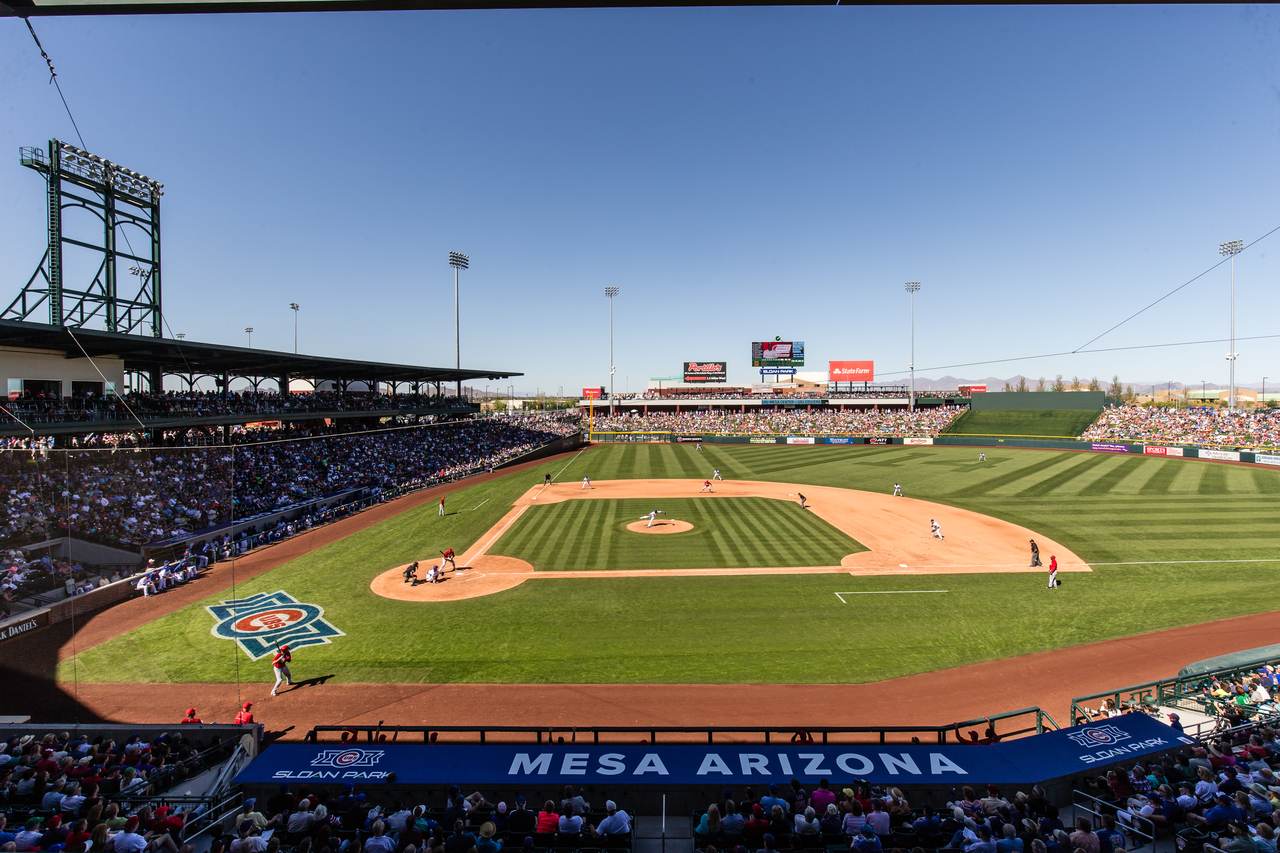 Sloan Park (Photo by VisitMesa.com) With the return of MiLB in 2021 comes the return of the fall and winter leagues this offseason. The pinnacle of these leagues is the Arizona Fall League where clubs traditionally send older prospects for a longer look after the regular season and for more reps and experience in order to fill holes in different areas of need. After five years of playing for the Salt River Rafters, this season, Marlins’ prospects will once again join the Mesa Solar Sox who play their home games at Sloan Park. They will share the dugout with prospects from Orioles, Cubs, Athletics and Blue Jays systems. Miami’s participants will be: RHP Justin Evans RHP Evan Fitterer LHP Josh Simpson LHP Jefry Yan C Will Banfield INF Troy Johnston OF JJ Bleday OF Kameron Misner Here is a closer look at each of these players and the ‘why’ behind their assignment. RHP Justin Evans 2021 Stats (A-AA) - 34 G, 45 IP, 6.40 ERA, 1.64 WHIP, 53/24 K/BB Evans is a Marlins’ 2018 19th round pick out of Columbus State University. As a collegiate player, Evans both pitched and played the infield. He hit .281/.382/.445 in 474 ABs but Miami took stock in his future as a reliever where he had a 3.27 ERA in 22 IP, including 11.2 IP of one run ball (0.77 ERA) in which he posted a 14/2 K/BB in his junior year. Since his selection, Evans’ pro career has been marred by injury. He did not pitch in the pros in his draft year and did not pitch in 2019. 2021 was the first time he saw an affiliated mound. During his time with Jupiter, he showed some flashes including a heater up to 96 and a curveball with spin above 2600 RPMs. The Marlins are using the AZFL to allow Evans to make up for lost time and to gauge where to assign this victor of three levels going in to 2022. RHP Evan Fitterer 2021 Stats (Rk-A) - 18 G, 53 IP, 3.40 ERA, 1.40 WHIP, 52/22 K/BB Fitterer is a 2019 fifth round prep pick out of Aliso Niguel High School in Southern California who broke into pro ball by tossing 22.2 innings worth of 2.38 ERA, 1.41 ERA, 19/12 K/BB ball in the GCL. After the missed 2020 season, Fitterer began the 2021 season on the extended spring training injured list. After two rehab outings, Fitterer received his call up to A Jupiter on July 24th. Appearing in seven games (six starts) for the Hammerheads, the 21-year-old righty tossed 25.2 IP worth of 4.56 ERA, 1.40 ERA ball. His K/BB stood out (27/6) as did his impressive pitch repertoire. A tosser of four pitches, Fitterer showed a fastball up to 96 (sitting 92-94). with a curveball in the high 70s-low 80s capable of a 3000 RPM spin rate. He also showed a usable slider. Fitterer, a 6’3”, 192 pound righty, joins the AZFL as the youngest member of the Marlins’ invitees (21) with the intention of making up for lost reps and the hope of building his arsenal and showing he can compete against older competitors. LHP Josh Simpson 2021 Stats (Rk/A+) - 45.2 IP, 5.91 ERA, 1.29 WHIP, 62/19 K/BB Simpson, the Marlins’ final pick of the 2019 draft, impressed in his first showing in pro ball that season. Assigned to short season Batavia after just a single inning in the GCL, the lefty tossed 23 innings worth of six run ball by way of a 1.08 WHIP and 26/6 K/BB, earning himself a spot in the New York Penn League’s postseason All-Star Game. This season, Simpson was assigned to A+ Beloit where he started the season strong out of the Snappers’ pen, giving up just two runs in his first 15.1 IP. After allotting 15 earned runs in four less innings in June though, Simpson was placed on the IL with an injury that would cost him nearly two full months. The 6’2”, 190 pound southpaw made it back up to Beloit after a rehab stint in the FCL and the Snappers put him in the rotation for four starts. On September 14, he finished the season strong by totaling single game career highs in innings pitched with five and strikeouts with nine while allowing three runs. Simpson has a two pitch combo. His mostly straight fastball that sits 93-95 but he can add a bit more to if needed. His overwhelming issue with that pitch has been its command. When placing it on the lower half, it can help contribute to his great 30% K rate and good 54% ground ball rate but it also had its part in his allotment of six homers and 20% line drive rate. Simpson’s best pitch is a mid-80s slider with late tilt that he can use on both sides of the zone and get in on the back foot of opposite side hitters with wipeout dive. He owns a high 70s curveball as well that he uses as a mix in. Simpson, who just turned 24 last month, heads to Arizona to take on the most advanced hitters he’s ever faced in his pro career with the intent of gauging his talent level against upper minors competition and making up for time lost to injury in 2021. His velo and ability to spin the slider from the left side make him an intriguing arm. The lack of a third pitch and his limited size will likely relegate his big league ceiling to the bullpen but he could make a good living there as a guy who can provide multiple innings if needed. LHP Jefry Yan 2021 Stats (A/AA) - 31 IP, 2.61 ERA, 1.58 WHIP, 51/25 K/BB The oldest Marlin invited to Arizona, Yan is a 25-year-old lefty who has had quite the interesting career path. Selected by the Angels as a 17-year-old in 2014, Yan threw in two Dominican Summer League seasons including an impressive 34.2 IP, 1.56 ERA, campaign as an 18 year old in 2015 before getting assigned stateside. According to Francys Romero, Yan suffered an injury in extended spring training that year and was placed on the restricted list when he refused to go back to the DR to rehab. The injury also forced him to miss all of 2017 and he was released a year later. The Marlins took a flier on Yan after watching him throw in semi-pro ball. Already up to the high 80s when he was signed by LA seven years ago, Yan grew advantageously into his then lanky frame and is now able to hit the mid-upper 90s regularly with his moving four seamer which sits 93-95 and can touch 97. He also throws a low 90s two seamer that he uses for tunnel and to change eye levels. Yan’s secondary is a big sweeping slider in the mid-80s that shows spin rates in the upper 2200 RPM range with wipe out action. Yan spent the summer making hitters look silly with that pitch, both in A ball and in his first taste of the upper minors AA. Yan is also quite the showman. A guy who has come a very long way all after missing extended time to start his career, Yan is an intriguing lefty to watch. While he still owns quirky mechanics and an explosive delivery that has levers exploding at hitters, it looks much cleaner when compared to reports when he was signed and he is transformed physically. Yan has a high leverage ceiling. And, going on 25, it may not be that far away. He joins the Solar Sox in a similar capacity as Simpson and Evans: more innings to make up for lost time. Keep an eye on how he performs against these top tier prospects. If he shows well and starts his 2022 season similarly to how 2021 ended, he will be a phone call away. A spring training invite also isn’t out of the question. C Will Banfield 2021 Stats (A+) - .180/.258/.308, 6 HR, 42 RBI, 95 K, 25 BB Unfortunately, Banfield is becoming another prime example of how extremely volatile prep catchers are. The Marlins’ competitive balance round B pick from 2018 came into the league with his MLB Pipeline report reading this way: “Banfield’s signature tool is his well-above-average arm strength—though it has been down a tick at times this year—and he gets the most out of it with a quick transfer and fine accuracy on his throws. His receiving and framing skills are solid, and he’s agile behind the plate. He also exhibits the desired leadership skills for his position. While his defense overshadows his offense and he struggled at times on the showcase circuit last summer when he tried to do too much, Banfield offers some upside with the bat as well. With his strong build, solid bat speed and loft in his right-handed swing, he has at least above-average raw power. He hasn’t shown as much feel for the barrel this spring as he has with the past, so it’s unclear how much he’ll be able to tap into his pop.” Three years (minus the lost season) into his pro career, that same report can be used to describe Banfield now. This season, while he showed off his defensive prowess receiving well and throwing out 30% of potential base stealers, it came at the expense of — there is no getting around it — porous offensive stats. Among all players at the A+ level with at least 250 ABs, Banfield had the seventh lowest batting average, the fifth lowest OBP and the eighth lowest wRC+ (57). Banfield’s only slight saving grace a the plate was his infrequently shown power potential. Though very sporadically, Banfield did show off 55 grade raw strength, managing a .128 ISO, in the 33rd percentile in all of A+ and in the 38th percentile in the A+ Central. In order to tap into that more, Banfield has a lot of simplification to do to in terms of approach and swing path. With just average bat speed, Banfield’s lack of ability to shorten up and get hands to the ball as well as his susceptibility to chase bad pitches makes him, at current, nothing more than a career backup. There is hope, though: Banfield is still just 21 and offensive prowess is always the last thing to come from any catcher, let alone a prep pick. Banfield also missed the final month of the minor league season with a minor injury. While by now, we would have liked to see it come out more, Banfield heads to Arizona as the Marlins’ eighth man. He will start the season on the taxi squad but should be able to be added to the roster at any time and continue to garner needed reps and experience. Based on his defensive prowess, there is a floor big league future here as a backup catcher but, day by day, the ceiling is growing lower. INF Troy Johnston 2021 Stats (A-A+) - .300./.399/.468, 15 HR, 85 RBI, 103 K, 68 BB, 140 wRC+ Earlier this year, during an interview on Swimming Upstream, Johnston self-proclaimed himself a “cage rat” that would spend nearly every available moment of his high school and collegiate days with a bat in his hands. That mindset and hours spent perfecting his craft paid off in full this season. After breaking in to pro ball with a .277/.373/.399 59 game campaign in Batavia in 2019, this season, Johnston was able to add the only missing link to his bat: power. While maintaining the same great patience he showed at Gonzaga and the same simple mechanics which allotted him a great average and OBP both in college and in his that pro showing, the 6’, 210 lefty hitter was the third best slugging player in the Marlins’ system. While playing a full schedule of 120 games, most in the organization between two levels, he led the system in wRC+. Among 984 qualified MiLB players, he ranked 90th in that same metric. From a split stance, Johnston approaches from the back of the box and uses his best tools, vision and bat speed, to get his bat on the baseball. The simplistic, shortened approach which he has held his entire career coupled with his magnificent hitter’s eye gave him the build of a plus average and OBP guy. But how did he come by more power without sacrificing either one of those across two levels this year? Here is what Troy said back in June: “I always had to work against leaking and sliding forward a little bit. That “a-ha” moment for me was when I realized how much I can kind of preset my back hip and just get into my legs a little bit more. And then just have a nice easy swing where I could just explode off of that back hip a little bit more.” Adding power to his already advanced and balanced approach and ability to work at bats has us placing Troy is looking an awful lot like Carlos Gonzalez, a .285/.343/.500 career hitter. Another comparison: former Marlin Cliff Floyd, a .278/.358/.482 career bat while playing both outfield and first base. Like Cliff, Troy started his career as an outfielder before making the shift to first base. Johnston’s invite to the AZFL is for two reasons: allotting him more reps at first while also garnering him looks against upper minors talent for the first time before he likely begins 2022 at the AA level. With a good showing this fall and during his first stint in the upper minors to start next season, Troy’s big league debut is visible on the horizon, especially upon the likely institution of the DH in the National League. OF JJ Bleday 2021 Stats (AA) - .212/.323/.373, 12 HR, 22 2B, 54 RBI, 101/64 K/BB Up until this season, it was pretty good being JJ Bleday. Then 2021 happened. After a .326/.449/.553 collegiate career including 2019 in which he led the Vanderbilt Commodores to the College World Series title, Bleday had a decent .257/.311/.379 38-game showing in A+ Jupiter to begin his career. After the washed out 2020 campaign, this season in AA Pensacola, Bleday hit his first true and extensive bump in the road, one that lasted for most of the season. While there were a few positives to his 2021 tenure including the posting of a walk rate near 14% tied for 15th highest among all qualified AA hitters, and the fact that he looked capable of playing all three outfield spots, Bleday’s overall offensive production was very inconsistent. Per his own admission from back in July, Bleday had been working on his mechanics constantly. “I’ve been trying to overdo it, be someone I’m not. I’m trying to take a step back, relax, and try to put together some good ABs. I’ve been tinkering all year long. Over these past several weeks, I’ve been able to make some adjustments. I’ve got to go back to what’s natural to me as a player.” Though there were pockets of production in which he looked to be putting it all together, it never stuck. Clearly, per his walk rate, the issue does not lie in pitch recognition. About halfway through the year, Bleday was showing a much different setup at the plate in terms of the distance of his arms from his body, the placement of his hands on the bat and the distance in his stance. He was also using much more weight on his back leg, making the stance pre-loaded. The mechanically transformed Bleday was better in the second half of the season (.200/.304/.344, 84 wRC+ vs .223/.340/.401, 108 wRC+). This included a .311/.382/.444 month of September. The changes allowed him to avoid getting jammed while also allowing him to step to the ball and get extended on pitches on the outer half. Bleday heads to Arizona to continue to feel out the new utilization of his levers and to get more reps against upper minors pitching before likely heading to his third spring training and then being assigned presumably to AAA in 2022. OF Kameron Misner 2021 Stats (A+-AA) - .253/.355/.433, 12 HR, 29 2B, 59 RBI, 136/57 K/BB Out of the same draft as Bleday whom he played against in the SEC, Misner has put himself very close to or possibly even past Bleday in terms of prospect pedigree. Misner, 24, started the season in A+ Beloit and, after an overall slow first month and a half of the year, Misner began to find it, going 16 for 55 from June 15th through 30th. A little over a month later, Kam reached base via a single against the Peoria Chiefs. It was the start of what would become a 16 game hit streak and 30 game on base streak. Over that span, he hit .322/.403/.570. The final four games of Kam’s remarkable streak came after his promotion to the AA level. His first taste of the upper minors didn’t seem to phase him. In 14 games with Pensacola, Misner hit .309/.387/.491. Speaking during our interview with him on Swimming Upstream, Misner described the jump in competition level. “It’s not that the pitches are nastier or anything like that; it’s the location. The pitchers are able to spot up whatever pitches they want. In high A, there would be guys with good stuff but not always can they throw where they want. It seems like the last couple weeks I’ve up here, these guys have had good stuff and they’ve been able to place it where they want to place it. That’s one of the biggest changes I’ve seen is the overall control of the pitching staffs. They all put it where they want and you just have to capitalize on their mistakes.” Looking at Misner mechanically, he draws comparisons to a Marlins All-Star mortgaged during the Jeter era rebuild. On top of the capability for 20+ doubles and 20+ homers, Misner is also a threat on the bases. While he doesn’t have the most blazing speed in the world, he has a strategy. “When you’re stealing bases, you don’t steal off the catcher, you steal off the pitcher. I got told that in college and I’ve really honed into it. There’s ways of stealing off the pitcher,” Misner said. “If I get to the 13 foot mark number which is usually around the cutoff, if I get there before the pitcher releases the ball, it’s mathematically impossible for any catcher to throw me out.” Above all, Misner is a scientific player who has a mind made for baseball in every facet. Where Yelich held a .782 OPS at age 23 at the MLB level, Misner held down a .788 OPS in his first full season pro. Kam heads to Arizona for more reps against upper minors pitching. Discussions will be and are being had amongst who from the outfield minor league outfield depth the Marlins will/should trade in exchange for established talent. Misner would be at the bottom of our list because he could become a 4/5 tool big league talent. And soon.
 -
View full article
-
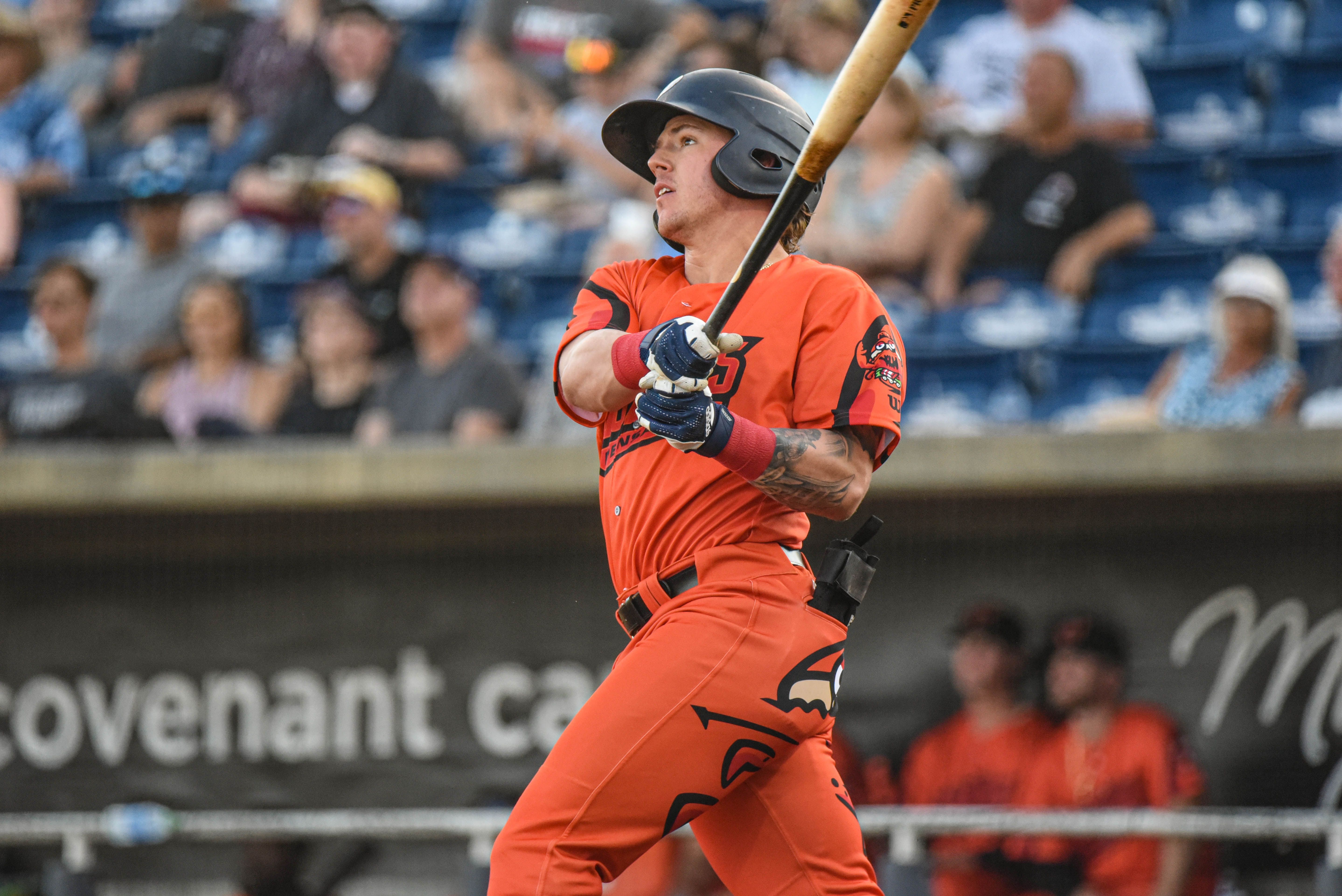 In his second season pro, Peyton Burdick has made it to the top of the minor league ranks. On September 21st, it was announced the 24-year-old outfielder was selected from the Marlins' Double-A affiliate, the Pensacola Blue Wahoos, to head east on I-10 to join the Triple-A Jacksonville Jumbo Shrimp. This season in Double-A, Burdick made waves by knocking out a total of 23 home runs setting a franchise record for the Blue Wahoos. While in Pensacola, Burdick slashed .231/.376/.472. At first glance he may appear to hold an average line, but his game reveals flashes of greatness-- flashed present even in his budding Triple-A career. As a Blue Wahoo, Burdick made up part of an outfield brigade consisting of JJ Bleday, Griffin Conine, and Kameron Misner. Each of those names garnered plenty of media attention between the MLB Draft and prospect reporting of the past couple years. However, over the course of the 2021 Minor League season Bleday has cooled down offensively (.212/.323/.373). Meanwhile, Misner and Conine have spent this season getting reps in Double-A since both advanced this midseason from High-A Beloit. So what is it that makes Burdick standout? In a recent interview conducted by Fish Stripes, Baseball America editor-in-chief JJ Cooper provided some insights on the up-and-coming outfielder. Cooper candidly admitted to being "a fan" of Burdick since he was drafted in the 3rd round of the 2019 MLB Draft by the Marlins. He continued by commenting, "he's most confident in Burdick['s]" development as a more well-rounded player. There is much to be impressed by with the 24-year old outfielder. His athletic build and composure in play provide him the traits of a quintessential ball player. Burdick has at least one naysayer. In a September 28 article published by the Miami Herald, Barry Jackson interviewed an anonymous baseball scout who offered some dubious observations on various Marlins' prospects. The assertions made by the veteran scout were glib and curt. In regards to Burdick's performance, the comments pointed mostly at the outfielder's strikeout rate (currently averaging around ~30%K) and base running awareness. What should be considered is the source from which these impressions came— exclusively from Double-A games in Pensacola. A week prior to Jackson's report, another article in the Herald by Jordan McPherson offered a more pragmatic analysis of the Marlins' prospects throughout the 2021 Minor League season. McPherson noted how Burdick struggled early in the season "with his batting average dipping to .077 in the first two weeks." Despite the initial slump Burdick was able to turn it around to .249 by the time of his advance to Triple-A. On September 21, Burdick made his Triple-A debut for Jacksonville against the Memphis Redbirds. In his first at bat of his first game, a strikeout swinging; his second at bat, a walk that allowed him to come in and earn a run. He had to ardently wait until his second game to earn his first Triple-A hit— a double to the wall in right-center field. Burdick played eight games splitting his time between left and center field. Overall in his cup of coffee at the AAA level, he went 4-28 with three of those hits being doubles. The 6' outfielder appeared poised ready to field every ball that came his way and attentive in every at bat (though always swinging for power). Burdick may have his doubter(s), but it will be easy for him to block them out with all of the bling he took home on Sunday afternoon at loanDepot park. The .257/.382/.490, 130 wRC+ hitter who led the organization in walks and set a Blue Wahoos' franchise record in homers with 23, was named both the Double-A MVP and Minor League Player of the Year, an award previously won by the likes of JT Realmuto, Brian Anderson and others. According to Marlins’ general manager Kim Ng, the plan is for Burdick to begin 2022 back in Jacksonville. If he continues to develop his tools and persevere as well as he did while playing Double-A with Pensacola, a bright future awaits for him on the horizon, possibly as soon as late next season.
 -
View full article
-
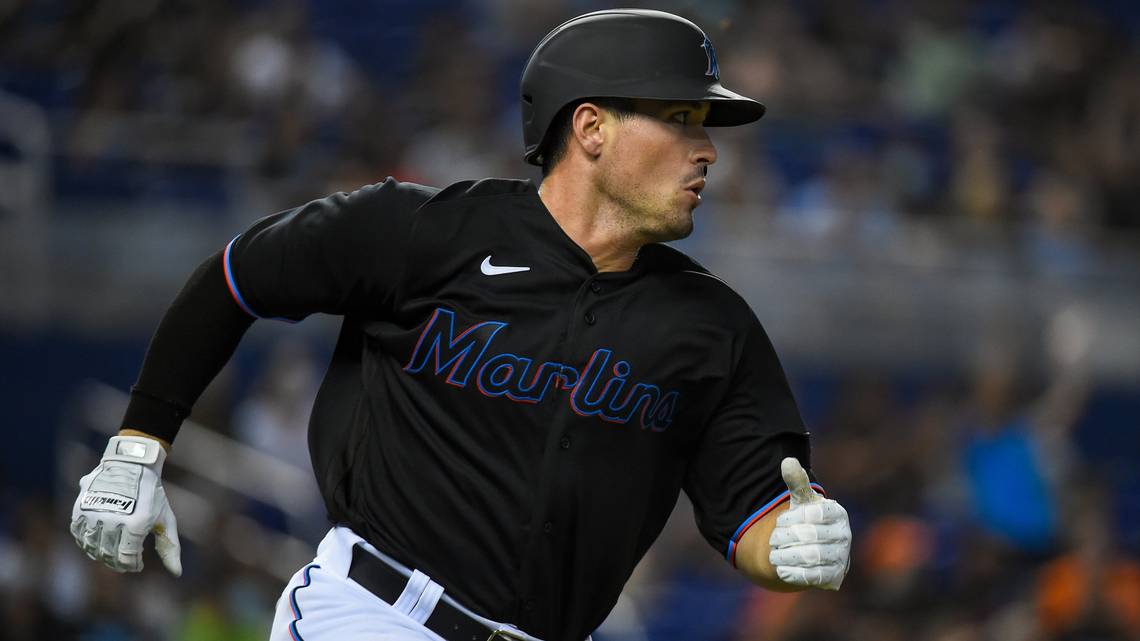 Nick Fortes (Photo by Eric Espada/Getty Images)This preseason, manager Don Mattingly said the Miami Marlins are through handing opportunities to players who haven’t earned them. It took the franchise the entire season, but on Thursday, the club made roster moves becoming of that mindset. Before their series opener against the Pirates at loanDepot park, the Marlins officially sent infielder Isan Diaz to AAA, placed catcher (and new left fielder/first baseman) Jorge Alfaro on the IL and promoted catchers Payton Henry and Nick Fortes from Jacksonville. Henry, who was acquired at the deadline for John Curtiss and Fortes, a 2018 fourth round pick, will now both be protected from the rule 5 draft this winter. The additions of Henry and Fortes give the Marlins four catchers on their 28 man roster. After the moves, Mattingly told the media at loanDepot park that Miami will go with a catcher rotation for the rest of the season. That format proved to be true during the Marlins’ most recent series against the Pirates as the team started a different backstop in each game. The first game went to Henry, a Brewers’ 2016 sixth round pick out of Pleasant Grove High School in Utah. He is the second overall player and first position player from that school to make an MLB appearance. He also became the first player ever from the state of Utah to play for the Marlins’ organization. Henry had an interesting upbringing in athletics. While many players grow up within or at least around the game, he grew up in another world: the world of competitive wrestling. Through his upbringing, raw strength was always a foregone conclusion for Henry and it has parlayed into 60 grade raw power, an attribute rarely found in backstops. Henry has put his muscle on display often in his minor league career, slugging 37 homers and 70 doubles in 369 career minor league games. The power potential showed up again on Thursday night in Miami when Henry drilled a pitch off the center field wall for his first MLB hit. In addition to the power, Henry also sees pitching pretty well and works quality at bats. In his tenure with the Shrimp, the batting average was down but he walked at a 12.5% clip. On the year as a whole between AA and two AAA squads, the figure is still in double digits. He also has held slightly high but manageable K rates under 30%, on average. On the other side of the ball, Henry had a lot less raw tools and therefore a lot of growing to do when he began his career. The main focal point was his lack of agility and ability to move laterally and block pitches. In his first four seasons pro, Henry allowed 29 passed balls. However, he’s done a ton of work on that area of his game and the stats this year have proven it. In 61 games, he allowed just four passed balls. His arm has come along as well. After only catching 7 of 34 runners in 2016 and 16 of 58 in 2017, Henry has thrown out 113 of his last 286 potential base stealers (39.5%). " Definitely still have room to grow and room to improve just like anybody, but I've been seeing the ball well," Henry said of his recent production. "Just trying to stay in the middle of the field and keep it simple. I give myself queues like "hit it forward," things like that. Just keep baseball simple. That's been my main focus and my main goal." The kind of thump Henry can provide is not often found at the catcher position. If his receiver skills and pitch blocking can persist while handing big league stuff, Henry is a viable and powerful backup catcher off the bench with the ability to slot in as a DH or, given the Marlins’ front office’s liking for making players multi-faceted, perhaps a first baseman. Also recalled was Friday’s starter at catcher, Nick Fortes. Fortes was a Marlins fourth round pick in 2018 out of Mississippi. Where Henry has been known for his offensive prowess and had to develop his defense, Fortes is the polar opposite. Since his time with the Hammerheads, Fortes’ teammates have raved about his game calling abilities. They were echoed by Edward Cabrera after Cabrera was partnered with Fortes on Saturday night. "He's a good catcher. He managed the game very well," Cabrera said. "I feel very comfortable with him behind the plate." Due to injuries limiting his 2019 season to 76 games and the pandemic wiping out the 2020 MiLB season, 2021 has been Fortes’ first full year of on field participation. During it, Fortes has shown some stark improvement on the offensive side of the ball, particularly in the second month of the season. He started the year in AA Pensacola and after a .224 month of May, broke out for a .299/.365/.442 June. Fortes was promoted to AAA Jacksonville in late July and recorded three hits in his debut with the Jumbo Shrimp. In his MLB debut, Fortes recorded a single for his first pro hit and followed it up by belting his first homer. According to Fortes, he has advantageously transformed his skillset this season. "It's been a lot of work, that's for sure. Looking back to 2018 when I was drafted to now, I'm a completely different player. in my opinion. Different swing, different defensive abilities and mechanics," Fortes said. "Seeing to where I've grown to now from where I've been it's kind of crazy but that's just a credit to all the coaches I've met along the way and anybody who has had an input on my game. It's been a crazy ride so far but I'm just going to keep working hard." It is extremely encouraging to see Fortes handle upper minors pitching with more consistency especially after such an interrupted career in the lower minors. His game calling and receiving skills, the most important trait in a backup catcher, are what set him apart. As he proved on Saturday when he threw out the only runner that challenged him, he also has a strong arm and good vertical pop that should play better as he handles MLB stuff. If the bat can continue to prove prove it is capable of handling major league pitching, he should be able to fill that role very sufficiently. It took them longer to do so than expected, but the Marlins have finally proven they are willing to at least start following a mantra that was set forth in spring training: stop handing out opportunities, move on from experiments and begin to gauge what they have in fringe MLB ready prospects at the back end of the roster. When it comes to the backup catcher position in particular, both Henry and Fortes are in a great position to make a good first impression and give themselves a leg up in what should be a roster battle this coming spring.
 -
View full article
-
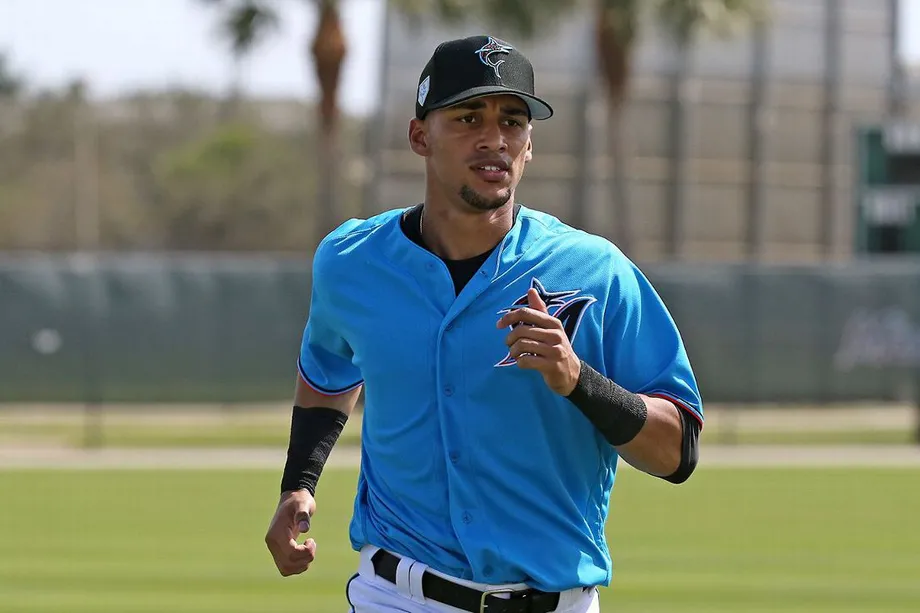 In October of 2018, the Miami Marlins struck a deal with two international free agents that sent a jolt of energy throughout the organization. Victor Victor Mesa and Victor Mesa Jr. both agreed to contracts to kick off the Marlins 2018-2019 off-season. These moves were not only a big boost for the farm system, they also showed that new ownership was willing to spend internationally, an area that previous ownership had somewhat neglected. Victor Victor Mesa, age 22 at the time, was the top ranked international free agent in the 2018 class according to MLB Pipeline. He agreed to a deal with Miami worth $5.25 million. His younger brother, Victor Jr., was only 17 at the time of the signing, and agreed to a smaller deal worth $1 million. The Marlins beat out other teams like the Baltimore Orioles for the Mesa brothers, and Victor Victor immediately slotted in as the #1 prospect in their system (although he was bumped to #2 shortly after when Sixto Sanchez was acquired as a part of the JT Realmuto trade). Despite all of the hype surrounding Mesa, his younger brother, Mesa Jr., is now viewed as a better prospect. Victor Victor has failed to live up to expectations, and his struggles began immediately during the 2019 minor league season. He was never expected to be a massive power threat, even when performing at his highest level. MLB Pipeline only gave him a measly 40 power grade on their 20-80 scale in 2018 when he originally signed. Mesa's hit tool in general was always a very average tool, as it only graded out as a 50 by MLB Pipeline in 2018. What Mesa graded out good, or even great in was his speed tool (65), arm tool (65), and fielding tool (60). These three categories combined with a lack of power, caused him to draw comparisons to former Chicago Cub and current New York Met's outfielder, Albert Almora. Because of this, when Mesa finished his first Minor League season between High-A and AA with very minimal power numbers, it was a not a complete shock to the organization or fans. In 464 at-bats, he only slugged .263, with an OPS of .537, and he hit zero home runs with just 10 extra base hits (seven doubles and three triples). While the low power numbers were not a surprise, the area that raised concern was that his batting average was only .235 coupled with the fact that he only stole 18 bags in 116 games. Mesa's best tool offensively is his speed, and he was not able to hit enough to utilize that speed on the base paths. While 18 stolen bases in 116 games is not necessarily a bad number (Jazz Chisolm has 18 in 99 games with the Marlins as of Tuesday's game against the Mets), it is not good enough for a player that has no power and has to rely on his speed and defense in order to make a serious impact. By the end of the 2019 season, Victor Victor Mesa had dropped from being Miami's #2 prospect all the way to number #13. Mesa was one of many Minor League players that lost a full season of games during the COVID shortened 2020 season. Along with the lost games, by the start of the 2021 season he had also lost his status as a top 30 prospect in the Marlins system. While this was partially due to the influx of new talent in the system, it was also because of his lack of performance in 2019. Mesa started out the 2021 season in AA where his struggles continued. In 21 games and 75 at-bats he slashed .093/.231/.109 with zero home runs, one double, and zero stolen bases. This quickly earned him a demotion back down to High-A. After being sent down, Mesa started to show some signs of life. While Victor Victor's days of being a top Marlins prospect are probably gone, he has slowly turned his game around since the demotion. Through Monday, September 6th, Mesa has played in 39 games with 159 at-bats for Miami's High-A affiliation, the Beloit Snappers. He is slashing .327/.379/.472 with four home runs and eight stolen bases. His OPS is up to .851, and he has also produced nine doubles and one triple. The increase in production has come without a massive increase in his strikeout rate as he has just 27 in the 159 at bats (he had 64 in 464 at bats in 2019). One can make a valid argument that because Victor Victor is 25 years old and playing in High-A that he is just tearing up younger competition. While this would be fair, there is one very interesting stat to pay attention to during this recent hot stretch. All but 10 of Mesa's at-bats in AA this year came in the leadoff spot where he only slashed .108/.244/.123. In High-A, he has only had 13 at-bats in the leadoff spot, albeit with some success. Out of those 13 at-bats, he has four hits and his batting average is .308. While he has had a small sample size of success with his average from the leadoff spot in High-A, all four hits were singles, which lead to just a .615 OPS (MLB League Average in 2021 is .725 according to Baseball Reference). The numbers from the top spot in the order during Mesa's career have been, at best, below average. Despite this, Mesa's numbers from the second spot in the batting order have been exceptional this season. In 142 at-bats hitting second for High-A Beloit, Mesa is slashing .331/.389./.493 with an OPS of .882. All four of his home runs in High-A have come from the second spot in the order, as well as all 10 of his extra base hits. He also has 17 RBI's in those 142 at-bats which is a massive improvement from 2019 when he only had 29 in 464 at-bats. Another key stat from this, is that all eight of his stolen bases in the 2021 season have come while batting second. This is important because it shows that Mesa is not losing his most dynamic tool by slotting down one spot in the batting order. Despite the success, Mesa has enjoyed a little bit of luck while in Beloit as his BABIP is .372 compared to his batting average being .327. That being said, a .045 difference in BABIP to batting average is not a reason to get overly concerned. For example, Starling Marte is batting .316 this season with a .380 BABIP (.073 difference). No one is overreacting to that. Yes, it probably means some regression is coming, but it does not indicate that he is bound to return to the awful hitter he was before being optioned to High-A. Sure, Mesa is an older player for the High-A level, but offensive success is not something we have seen him have in the MiLB before, and he has done this for an extended period of time now. Maybe moving to the second spot in the batting order is just a coincidence, but maybe Victor Victor Mesa is starting to turn a corner in his professional career. It is time for him to be promoted to a higher level, and see if this recent success is real.
 -
View full article
-
Minor League Players Living Barely Above Poverty Line
Alex Carver posted an article in FOF Prospects
 Photo by Joseph Guzy/Miami MarlinsFair and competitive compensation for Minor League Baseball players has been an issue that has been brooding for quite some time. Now, in 2021, accentuated by a burgeoning housing crisis, the matter is about to boil over. Though wages slightly increased this season (through a class action lawsuit), players are facing new challenges when it comes to finding affordable lodging within many minor league markets, especially those in smaller towns. The severity of the issue has been illustrated in a series of posts by Advocates for Minor Leaguers over the course of the last few months. This week, anonymous Marlins players at three levels of the system communicated their experiences to the source. In AA Pensacola, players are spending all of their income to keep a hotel roof over their heads. “The housing situation this year… was terrible. I say that because I couldn’t find a place to stay within a half hour of the stadium so I was essentially forced to stay in a hotel which cost me thousands of dollars a month (way more than my salary).” In A Jupiter, some players have resorted to even lesser ideal circumstances. “I have had some issues this year with housing with the Marlins. Right after spring training finished, I had to start paying $55 a night to split a hotel room. That’s over $1,700 per month. We don’t make that much after taxes. So I was losing money. I said, “that is ridiculous” so about a month ago, I moved out of the hotel and am now spending 1/3 of my paycheck to sleep on a couch.” In A Beloit, being able to live somewhat comfortably literally came down to the luck of the draw. “Eight guys drew a lucky straw and are saving some money by sharing a three bedroom/one bath house, splitting up a $2,500 monthly fee. Most of the rest of the team is living in expensive apartments, literally making somewhere between $40 to $75 per paycheck after rent.” Things are even more grim for international signees, most of which didn’t garner a lucrative signing bonus. “The worst part is some of our Latin teammates are sleeping four guys to a hotel room to split expenses, rotating between sleeping in the bed and making beds on the ground. The hotel is easiest for them to live in because they don’t have cars and it at least has a shuttle to the field.” How did we get here? One main reason is the erasure of host family programs. In year’s past, most minor league clubs would enlist the assistance of nearby residents that have the capacity to house a player over the course of the minor league season. In return, the family would be formally recognized by the team and would have the chance to make a lasting relationship with the athlete assigned to them. But amidst a global pandemic, these programs have been halted by the league. Another culprit for the lack of available affordable housing has been due to the lack of residents relocating amidst the pandemic. With the bulk of the middle class feeling the financial affects of the pandemic and with a national eviction ban in place for the majority of this season and still active in seven states (and the District of Colombia), a qualifying residence matching the wage of a even several minor league renters has been very hard to come by. Thus, here we are. While these conditions would be unacceptable for full time employees in many lines of work, these young athletes are being subjected to the physical detriments of sleeping on floors and couches and being unable to afford good diets as well as the mental hardship surrounding the uncertainty and frailty of their living situations all while being expected to remain in top physical condition in order to improve in their line of work. The simple situation is, as a great majority of minor league players don’t belong to the Major League Baseball Players’ Association, that the league step in and mandate that owners cover 50-75% of livable expenses during the MiLB season. However, as political economy expert and JustBaseball.com contributor Ron Cox tells us, the owners, not the league are the string pullers that will not allow this to happen in order to continue to line their own pockets. “The owners operate the league as a cartel, and with their anti-trust protection, have unilateral power over the minor league system, which has been extended after the recent MLB consolidation over minor league restructuring, which minor league teams could do nothing to stop. MLB owners are interested in streamlining costs and maximizing control over the minor league structure, not any kind of power sharing, even over wages and working conditions. The only way that happens is for minor league players to come together to make it happen, ideally with the support of MLBPA.” This winter, the “league” and the MLBPA will work to finalize a new collective bargaining agreement. In this instance or any involving owners spending money without an immediate return on investment, MLB, cannot be counted on to stand up for minor league players. So that leaves the Players’ Association which MiLB players do not officially belong to. Can developing players count on Tony Clark and company to stand up for MiLB players this winter? According to Cox, it doesn’t look good. “This is highly unlikely in the short term, because the minor league players are focused on gaining their own individual promotions and are divided by prospect status and bonuses, and the MLBPA already faces divisions in its ranks between veterans and young players, and are not willing to take on additional representation that is perceived as complicating their existing member representation.” The commissioner could stand up for Minor League players and mandate their lodging and cost of living be paid for. It won’t. The MLBPA could stand up for Minor League players and demand the mandate. It probably won’t. And as the two parties squabble over issues such as a salary floor by way of an increased luxury tax threshold and new salary arbitration rules, this very human issue will again very likely be tossed by the wayside. It comes down to a simple fact: Minor League Baseball players need and deserve their own representation group to protect not only their interests but their well being. The old “rite of passage” rhetoric that they need to suffer to earn their way to the big leagues is so tired and has always been wrong, now especially as these young men struggle through poverty. That adage that has already led to the far too early termination of many minor league careers and, in a changed political climate amidst a pandemic, is threatening to do so twofold. So what can be done? In the short term, independent groups have done yeoman’s work in bringing awareness to the hardships minor league players face and have worked to privately fundraise and garner monetary support from independent sources. These include the aforementioned Advocates for Minor Leaguers, a 501©(3) nonprofit organization as well as Adopt A Minor Leaguer, another NPO which seeks out seasonal sponsors that contribute to individual players on a weekly basis. Donating to organizations such as these are the best way fans can get involved in alleviating the effects of a very broken system. If you wish to donate, links can be found at the bottom of this post. Since the initiation of the Derek Jeter and Bruce Sherman era, the Marlins’ organization has vowed to stay committed to developing prospects internally and becoming a feeder system. It has stayed true to that promise by making them very hard to come by in the offseason and the trade deadline. Imagine the condition of that system if the players could afford to house and feed themselves. Other owners are in the same position but they refuse to do the right thing. The MLBPA won’t intervene. Imagine a car on a road with no turns. MLB owners are driving. The league is in the backseat. And this issue remains in the trunk. — Donate to Advocates for Minor Leaguers here and follow them on Twitter at @MiLBadvocates Donate to Adopt a Minor Leaguer here and follow them on Twitter for sponsorship opportunities @adoptaminorleaguer
 -
View full article
-
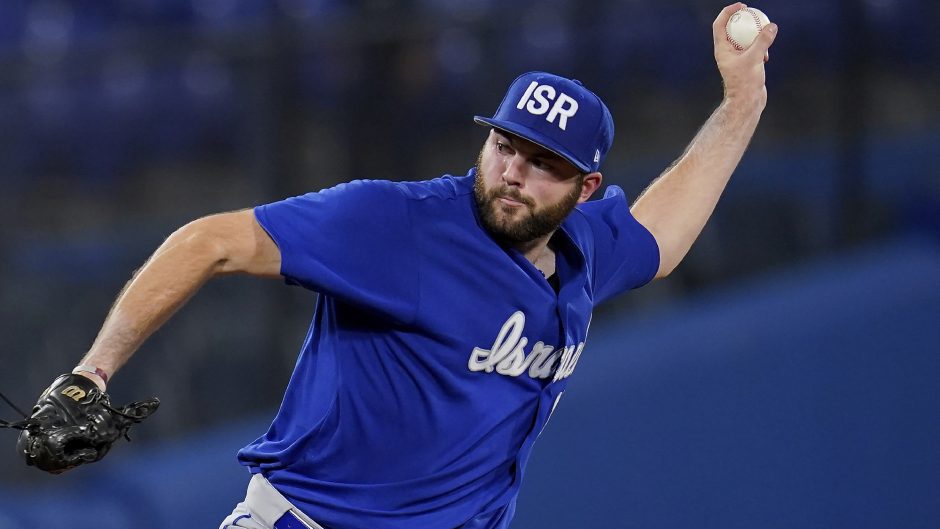 As August comes to a close, one prospect who had the opportunity to double dip in baseball this month is Jake Fishman. While Jacksonville Jumbo Shrimp teammate Eddy Alvarez generated much conversation for his historic double-medaling for Team USA (Baseball, 2020 Tokyo Summer Olympics; Speed Skating, 2014 Sochi Winter Olympics), Fishman represented Team Israel in baseball. (Alongside, another familiar name, catcher Ryan Lavarnway who had a brief stint with the Marlins in 2020). Despite Team Israel ending up with a win-loss record of 1-4, they made a respectable efforts as one of the six baseball teams competing for gold. Jake Fishman's Olympic career may not be as splashy, but the 26-year old pitcher has not exactly settled back to quieter waters either. Since his August return, he has a recorded 3.27 ERA with two win decisions for the month. The southpaw has been primarily pitching relief in a bullpen platoon setup. His most recent performance last Thursday (August 26) against the Norfolk Tides showcased his easy and deceptive approach— a style that allows batters to make contact (Norfolk garnered four hits), but not necessarily a contact that is productive. In the three middle-innings pitched by Fishman, outfielders Corey Bird and Dustin Fowler along with first baseman Lewin Diaz provided plenty of defensive support. The Jumbo Shrimp beat the Tides 4-3; Fishman earned the win. The way Fishman creates a sleight of hand with the baseball does not exactly trick a batter. There is no secret. It is possible to hit off him. But again, the contact is not always auspicious. The beauty of his pitching lies in the deception he creates with the motion of his body and with the speed placed on the ball. His movement suggests the 6'3'' pitcher may be hurling off the mound with the ball; the ball's speed (low 80s breaking balls and low 90s fastball) bares witness of the illusion— Fishman's body will not indeed be flying into the batter's box for the strike. If Fishman can master his own magic, the Marlins could add an effective arm to the bullpen in 2022. Currently, Fishman holds an overall 3.72 ERA with a 4-1 record for the 2021 MiLB season.
 -
View full article
-
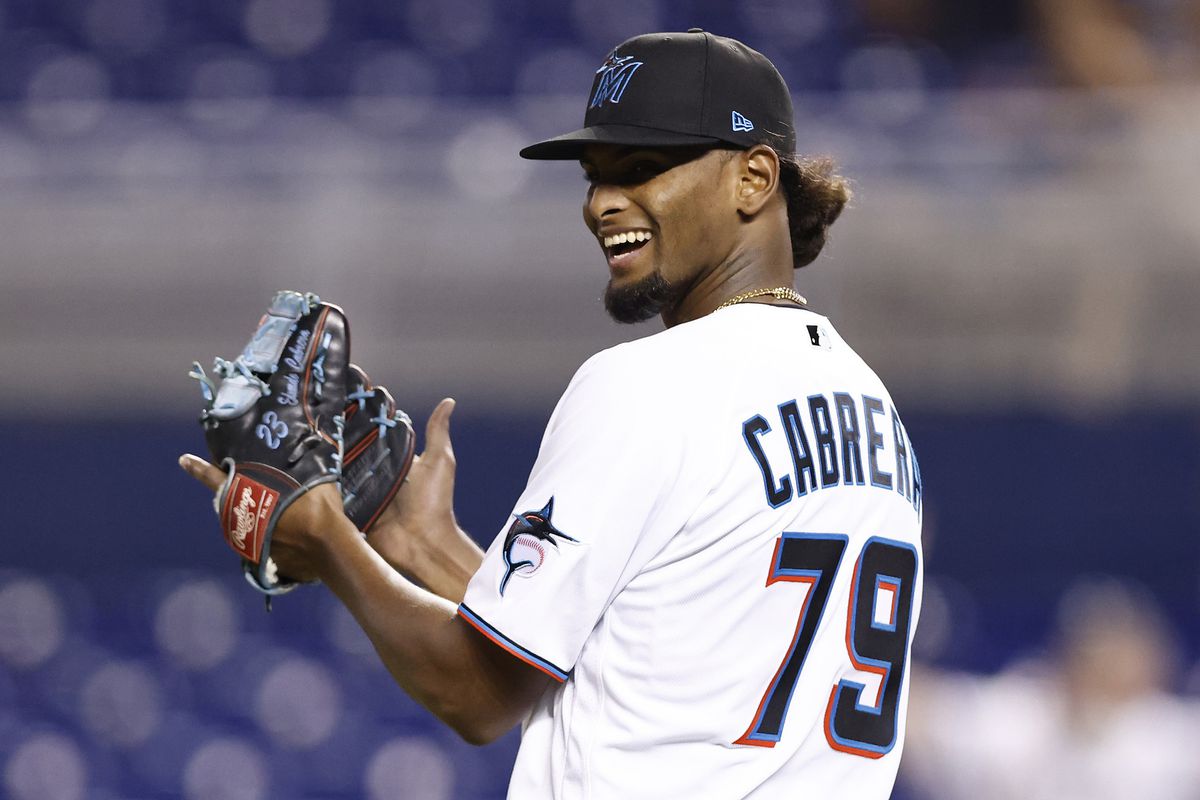 Edward Cabrera (Photo by Michael Reaves/Getty Images) Despite his status as the 30th best prospect in baseball, like every player who grows up with the game, Edward Cabrera was just another kid with a dream. That dream has became reality. “I woke up this morning with a lot of confidence. I had it in my mind, "You're here."", Cabrera said through a translator. "But last night, I was thinking a lot about the dream, of making my MLB debut," On Wednesday night in Miami, just over 700 miles from where it all began in Santiago, Dominican Republic, the 23-year-old fireballing righty made his major league debut. He didn’t disappoint. Cabrera worked 6.1 quality innings on four hits, and three earned runs while striking out two and walking three. Though the big K numbers Cabrera has come to be known for were not there, he pitched much better than his stat line on his way to becoming the first Marlins pitcher to throw a quality start in his debut since Jordan Yamamoto in 2019. According to Cabrera, he hoped his family was as pleased with his outing as he was. "All of this, I do it mostly for my family," Cabrera said. "All of the sacrifices and everything I do is for them." Any jitters Cabrera may have been suffering from in his career defining moment were partially quelled very early when Brian Anderson made a great play and cross-body throw to get leadoff hitter Lane Thomas to ground out. Anderson is making it a trend to back young starters making their debuts with incredible plays. Last season, he provided Braxton Garrett with a play that left Garrett in disbelief. Cabrera was also the beneficiary of the latest jaw-dropping defense from Bryan De La Cruz, this time in center field. A ball that would have been a home run in 11/30 MLB parks was somehow snagged by the Marlins’ trade deadline return piece for Yimi Garcia. Cabrera went on to have an eight pitch inning and did not throw a ball. In the second inning, he recorded his first career strikeout on an 83 mph slider that was left up but still froze the eight hole hitter, Riley Adams. Cabrera followed that up by striking out the opposing pitcher Josiah Gray on a bunt foul out. Those were the only two Ks recorded in the start by Cabrera which is unconventional for him. But in place of the strikeouts, he was extremely economical with his pitches and through six innings, extremely stingy when it came to allowing base runners. Headed into the 7th inning, he was just one batter over the minimum and had thrown just 56 pitches. Twelve of his 18 outs recorded were quick outs. "I was attacking the zone. That's one of the things that was working -- they were swinging at it. I said, if they were swinging, maybe put the ball in the zone," Cabrera said. "That's what you have to do: if they want to get themselves out, you have to let the batters get those outs." Cabrera made few mistakes on the night as a whole but two came in a very short time frame in the 7th inning. He bounced back from a leadoff walk by retiring Juan Soto on a flyout (he retired Soto all three times he faced him) but then had his changeup sail out over the plate. Josh Bell didn’t miss. A batter later, Cabrera showed confidence in the pitch by immediately going back to it but it also stayed flat and was crushed by Yadiel Hernandez. Up until the 7th, Cabrera was twirling a gem, locating all four pitches for strikes with his usual fiery velo. His fastball topped at 99 and his changeup at 93. There were a few bad locations mixed in and he gave up some hard contact but overall, this was a very encouraging start and great building block for Edward. Though the strikeouts weren’t there, it was moving and very encouraging to see Cabrera have the maturity to notice aggressive hitters attacking early, challenging them with supreme confidence in his stuff, saying "here it is, come get it" and get the job done in that capacity, however unorthodox it might have been for him. After he got back to the dugout following his removal, Cabrera could be seen on the bench breaking down the outing with Marlins’ leader (and a very similar pitcher, should Edward reach his ceiling), Sandy Alcantara. The pair carried a conversation for an inning and a half. "He told me congratulations and how good I did. He explained to me that it was great that I attacked the zone, some of the pitches some of the locations," Cabrera said. "Having him there is just a blessing: having him there and chatting the game with him. As we know, Sandy is truly the GOAT." Edward Cabrera is here, he’s mixing well, throwing all of his pitches for strikes, he’s already effective on the mound and he’s beginning to building relationships with Alcantara, Mel Stottlemyre and the rest of his teammates as the Marlins look towards being competitive again in 2022. The floor is very high and the sky is the limit for this young star whom we compare to Zack Wheeler.
 -
View full article
-
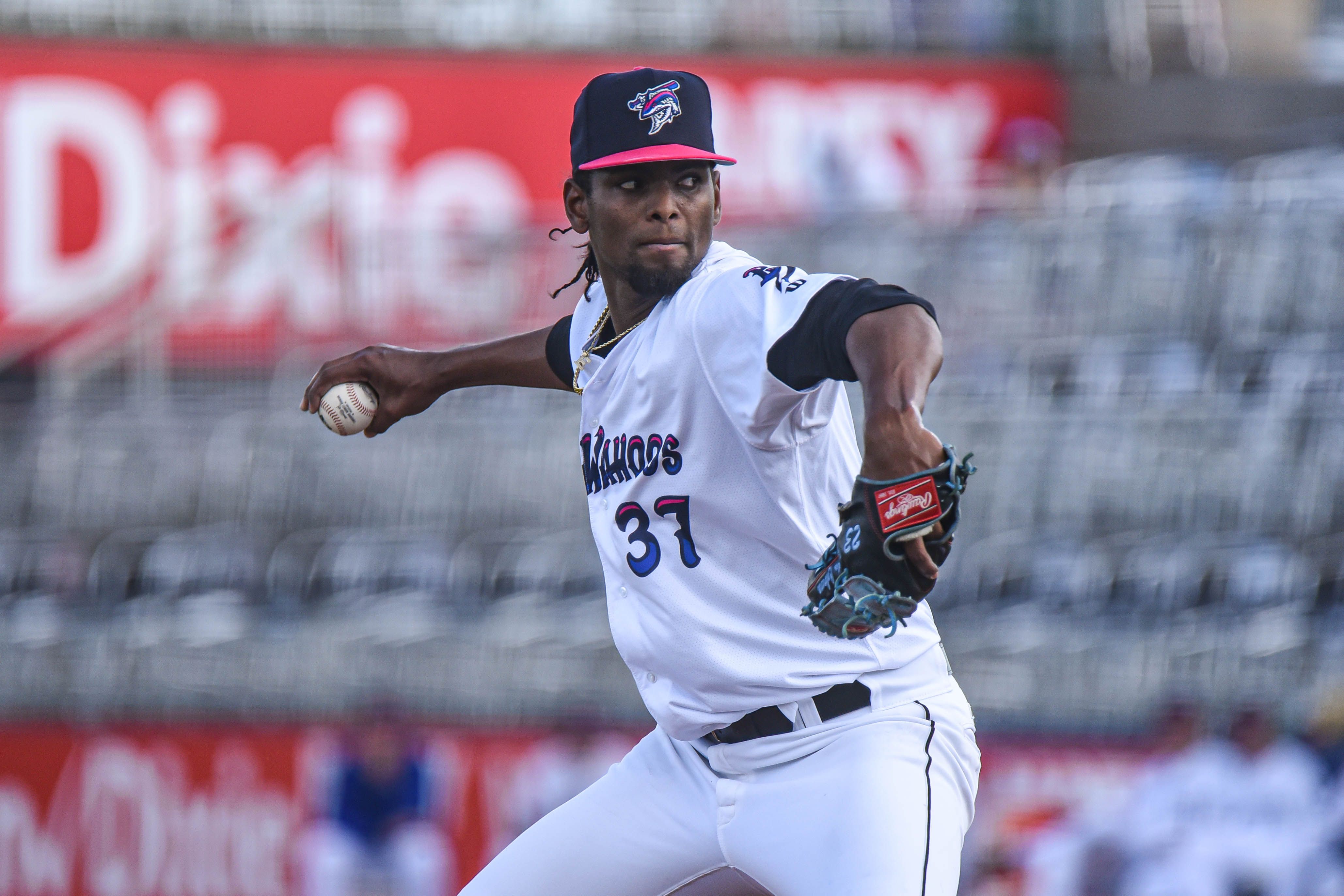 Edward Cabrera (Photo by Pensacola Blue Wahoos)The Edward Cabrera era is about to begin in Miami. On Monday afternoon, the Marlins made a blockbuster announcement: the man considered by many outlets (including ours) to be the top prospect in the organization is being called up from AAA to make his Major League debut this coming Wednesday at loanDepot park. The Marlins announced the move by posting Cabrera’s reaction to hearing the news from Jacksonville Jumbo Shrimp head coach Al Pedrique. Edward’s reaction was one of pure elation. For some, Cabrera’s promotion came as a bit of a surprise, a week before MLB rosters expand to 28. But with two empty spots in their rotation and Cabrera absolutely dealing in AAA, Kim Ng and the Marlins saw no reason not to give Cabrera the extra start on Wednesday night. After missing spring training and starting the year on the IL, Cabrera, who has battled arm multiple arm injuries in his professional tenure, was assigned to A Jupiter on a rehab assignment before being sent to AA Pensacola. There, he threw to a 2.77 ERA via a 33/6 K/BB and 0.96 WHIP, he was promoted to AAA. In a similar amount of innings with the Shrimp, Cabrera had a 3.68 ERA by way of a 1.40 WHIP and 48/19 K/BB. From July 30th through August 19th, he struck out 41, including 11+ in three straight outings and walked just 13. Growing up next to Sixto Sanchez in the Marlins’ organization, there was much debate about whose ceiling is higher. Since Sixto's latest injury, Cabrera has made moves to push himself ahead of Sanchez. If health permits and he translates well to big league action, Edward will solidify himself as the top pitching prosect in the Marlins' organization. Cabrera’s stuff is absolutely electric. He couples a heater up as high as the triple digits and two seam sinker in the low-mid 90s with a mid-high 80s power slider that can steal opposing hitters’ souls. His low 80s curve has 11-5 action and tunnels off the slider well. He also mixes in an improving changeup that can reach the low 90s. Because of the level of effort he throws with, Cabrera can get a bit wild at times leading to walks and pitches staying up for hard contact. That accounted for most of the damage he allowed in AAA this season. But when Cabrera is on, he’s nearly unhittable. Now under the tutelage of Mel Stottlemyre, Cabrera’s should be able to polish off his changeup and his repeatability. If so, he has ace potential. For a ceiling comparison, look to Phillies’ ace Zack Wheeler who has similar size, stuff and velo and all from a similar arm slot. With the team limping to the end of the year, Marlins fans need something to get excited about. They will have it tonight when the top prospect in the organization according to many outlets (ours included) takes the hill for the first time. Had the Marlins waited until September 1st, that outing likely would have come on the road in New York where Miami is scheduled to play four games against the Mets. After housing a crowd of just over 5,000 on Tuesday, the thinnest of the year since loanDepot park returned to capacity, that number should be well improved tonight. If you haven’t already, get your ticket to the Eddy show. It’s going to be a good one.
 -
View full article
-
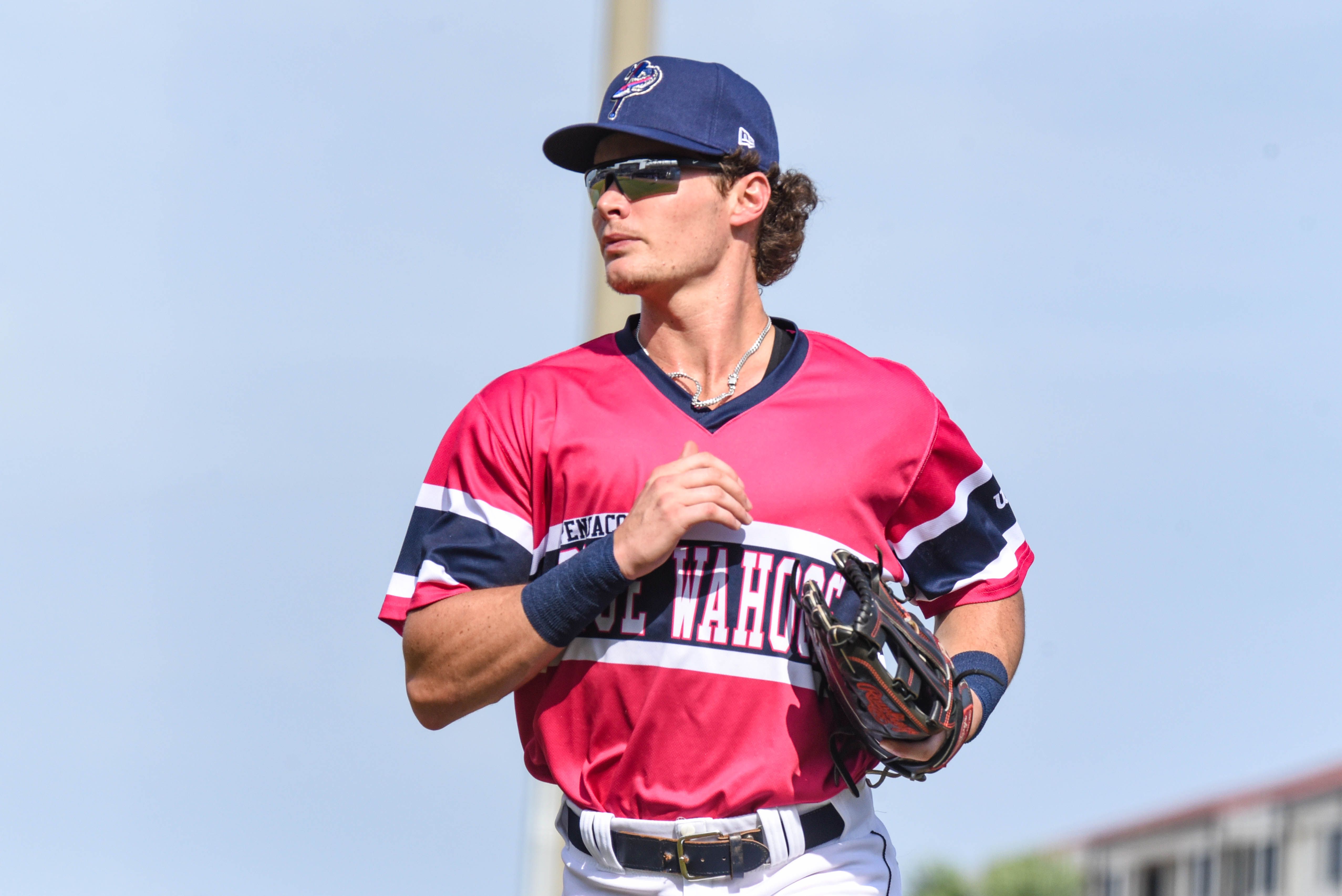 After the COVID-19 pandemic wiped out the entirety of the 2020 Minor League Baseball season, young players were forced to fend for themselves. During that time, Marlins’ AA outfielder Griffin Conine relied on the expertise and guidance of one person. “Just me and the pop.” The father Griffin speaks of is none other than Mr. Marlin himself, two time World Series champion Jeff Conine. According to Griffin, he and Jeff threw it back to the days of when he was growing up tripping no further than the batting cage in his own backyard. Months later, Griffin, his dad and his mother Cindy were reunited in Pensacola this weekend where Griffin was competing as the reigning MiLB home run leader. With mom and dad looking on, Griffin added to his home run total by going yard three times in three total at bats. “They’ve had a lot of fun being part of such a cool environment,” Griffin said of his parents’ visit upstate. “And obviously it was cool to put a few out while they’re here, too.” For Dad, not only was he treated to watching his son succeed, he was treated to a secondary special moment just before Conine’s first Sunday night homer. During Griffin’s first AB, the Blue Angels, flying out of NAS Pensacola, treated the crowd at Blue Wahoos Stadium to a full formation flyover. "My dad, he's a plane junkie. Fighter jets, he got to fly in," Griffin said. "He was asking me, because he knows the the Naval base close by, "Do they ever fly over the field?" and I was like, "No, its never happened." And then sure enough today, I heard people murmuring, they started to fly over and I was like, no way, they're flying over!" A pitch after the spectacle, Conine provided one of his own, depositing his 33rd homer of the year into Pensacola Bay. Three innings later, Griffin did it again, going to almost the same exact spot of the field for number 34. Opposite field power has been a regular thing for Griffin this season. In fact, it’s been the most regular thing. In his 29 games in Pensacola, Conine has gone in that direction over 45% of the time. Before this season, at any level, he had never gone that direction more than 30% of the time. “In college I can’t remember many ever going that way. That’s just the way my swing has developed,” Conine said. “Left center is kind of my money zone. “That’s where it feels the cleanest.” According to Conine, aiming for where his power is easiest will allow him to begin to cut down on his strikeout rate. “A lot of pitchers like to go away. They’ll show you in and that’s when I think I’ve gotten into a bit of trouble just because I’m so locked in going the other way that it’s kind of hard to cover both sides,” Conine added. “But that’s the way my swing works and when it’s going good, it’s effortless that way.” Along with adjusting his approach, Conine is also adjusting to pitching at the AA level. His second multi-homer game of August came one month and one day into his tenure with the Wahoos and capped a three homer weekend. All month, Conine has face some of the top pitching development systems in baseball in Tampa Bay and Milwaukee. “Montgomery especially, they have a very very specific plan on how to pitch guys. Biloxi, the same. Everyone has the ways they pitch guys and I think they gets more clear as you rise levels,” Conine said. “In Beloit they might have the same mentality but the guys aren’t as good at executing. Once you rise levels, they get really consistent with how they execute those plans.” As an offensive player, Conine believes the trick is to avoid showing any weaknesses and being as complete a hitter as possible as he faces the same staffs so often. “If you show them a hole, they’re going to hammer they hole in your swing and your approach and they’re not going to miss,” Conine said. “The best thing we can do as hitters is just to avoid showing them any holes and if we do early on in the series, know that that’s what they’re going to be coming after.” A guy who spent time studying the inner intricacies of the swings of Barry Bonds and other top performers of the recent era during the shutdown, Conine has become the first Marlins prospect to hit 30+ home runs since Giancarlo Stanton in 2008. If he can hit six more in his last 24 games, he will become the first prospect league wide since 2016 to hit 40+. More importantly, he is learning to close avoid exposing weaknesses in his swing and to close them completely by swinging to his strengths. Overall, the Marlins’ second-time draft target that avoided by one selection in 2018 only took join them for the rental of Jonathan Villar in 2020 is making himself right at home and then some with his hometown organization. The recently turned 24-year-old is working to become a more complete hitter. If he is able to drop his K rate and improve his batting average as he polishes off, he becomes a dangerous everyday threat at either a corner outfield spot where he has a great arm or as a designated hitter. Through recent work done and the support system he has around him, that ceiling is well within sight.
 -
View full article
-
 Photo by Beloit Snappers At ages 18 and 19 entering their first professional seasons, many were surprised to see righty Eury Perez and lefty Dax Fulton assigned as high as the full season ranks to begin 2021. The teenage twin towers have risen to the task. Now, they are being challenged again. On Monday, Craig Mish of the Miami Herald reported that the 6’8” righty Eury Perez and the 6’7” lefty Dax Fulton have been promoted from A Jupiter to A+ Beloit. The amount of growth both Perez and Fulton have shown in such a short period of time in their very young careers despite some unique individual circumstances is not often seen at this level of competition. Eury PerezRHP Eury Perez 56 IP, 1.61 ERA, 0.95 WHIP, 82/21 K/BB A 2019 international signee at age 17, Perez inked with the Marlins for $200K. According to MLB Pipeline, he first began to garner attention when he participated in the instructional league last year as he was effective against older competition. That attention grew during spring training this season. In May, Perez made his pro debut against the St Lucie Mets as the youngest player in all of Minor League Baseball. Facing off against competition four years older than him on average, Perez has been very difficult for the Low A Southeast to handle. In 56 innings, he has a ridiculously minuscule 1.61 ERA 0.95 WHIP, 163 BAA and 82/21 K/BB. Among players with at least 50 IP, Perez’s ERA ranks second in all of MiLB. Additionally, within the Marlins organization his WHIP also ranks second. His 27.5% K/BB% leads all Miami pitchers. As good as Perez has been all year long, he’s really come on of late. In his last four starts, Eury hasn’t allowed a run in 18 IP. On August 7th, he struck out a career high 11, attributing to a 32/5 K/BB. Over that span, he only gave up one single hit. There has been one major mechanical adjustment to thank for Perez’s recent run of dominance that led up to his call to Beloit. Earlier this year, we noticed a considerable difference in Perez’s level of effort depending on which pitch he is throwing. While Eury has always repeated his arm slot and release points well, he had a tendency to throw with a considerably large amount of intent behind his heater, a middling amount behind his change up and a very soft amount behind his breaking pitch. While his plus plus stuff was able to keep him effective in the low A ranks, higher level competition would have been able to pick up on Eury’s tips and time him. Watching Eury in person during the aforementioned 11 strikeout performance, this hole seems to have been closed. Here is Eury's delivery of his fastball, changeup and curveball in May compared to the aforementioned no-hit performance: Masking his arm speed and repeating his delivery more consistently has been a huge cog for Perez as he has continued to improve through more prolific dominance. When you’re 6’8”, there are a ton of levers and a lot of body to get to work in unison at the same time. The fact Perez is doing so 56 innings into his pro career and making his long limbs unravel and fly at hitters with much better repetition, thereby cleaning up one of few present weaknesses and should have him as a top 10 organizational prospect immediately and a top 100 prospect in baseball in very short order. Perez, whose numbers very early on in his pro career are drawing comparisons to some of the brightest young teenage stars to ever grace the Miami Marlins organization, will join the Beloit rotation for what project to be a handful of starts before he reaches his innings limit. Dax Fulton (Photo by MiLB.com)LHP Dax Fulton 58.2 IP, 4.30 ERA, 1.36 WHIP, 66/30 K/BB Fulton, 19, receives his promotion after an abbreviated start to spring training. After undergoing Tommy John in his senior year of high school before being selected by Miami in the second round of 2020, the Marlins were cautions with Fulton but he was still able to convince the front office he deserved the promotion to full season ball to begin 2021. Truth be told, it wasn’t a great start to Fulton’s minor league career as he gave up 10 earned runs in his first 13.2 innings in the month of May. June was a bit kinder to Dax as he worked 15 innings on the same amount of damage. In July, Fulton finished five innings for the first time in his career, a great confidence booster, but he still embarked on the month of August with an overall 5.22 ERA by way of a 1.62 WHIP, a 48/40 K/BB and quite a bit to figure out. In August, Fulton has been a completely different animal. Each of his first two starts in the second-to-last month of the season have been nearly identical and just as spectacular. In each outing, he worked five innings, allowed just one hit. He struck out a combined 18 and, after allowing 20 walks in his 28.2 IP, did not walk a single hitter. So what has been the difference for Dax? It can be broken down to two things: consistency in control and in his stuff and, like Eury, better knowledge, control and incorporation of his body. At the start of the year, Dax’s fastball was sitting 90-93 with the ability to ramp up to 95. There was room for more heat if he could incorporate his lower half into his delivery more. That has happened lately. In his 10 K performance, Dax sat 93 and hit 96. On top of the velocity, the placement of the pitch has been much better of late and he’s been consistently hitting his spots. He’s also showing the confidence to elevate it for strikes. Fulton’s primary breaker has become a vicious power curve that has natural shape and bend due to a supremely high release point. He’s improved the vertical movement on that pitch as the year has gone on: at the start of the year, his average spin rate was in the 2500 range. Lately, he has been spinning up in the 2600s on average and, per Ian Smith of ProspectsLive who has seen him throw in person frequently, has been up over 3000. He can both place the pitch on the corners for strikes and bury it in the dirt out of the zone with intent and get guys (such as Jasson Dominguez) to look foolish with it. Fulton’s third pitch is a high 80s changeup that has the ability to touch 90. He has done a ton of work with that pitch season, building it up from a pure mix-in pitch at the start of the year to a pure weapon. Via a better feel and much easier release than seen previously, Fulton can paint with this pitch and its late two plane fade. While Fulton has always had the blueprint for really good stuff, it has improved because of his ability to begin to incorporate his legs into his delivery more lately, stepping downhill with a longer stride to shorten the distance to the plate more advantageously and turning his front leg into his delivery more. He’s also learning how to push off his plant leg better which has been the catalyst for the added velo. Overall, though Fulton is less polished than his younger teammate Perez, he has his arm built up and his legs are starting to follow suit. Though it was a bit more surprising to see this promotion, Dax, like Eury, has made stark improvements in a short period of time al following a comeback Tommy John surgery. If he can continue to learn how to put his entire frame behind his pitches, polish off his finish and maintain the consistency we have seen lately against A+ competition, there’s capacity for Fulton’s stuff to play even better and for him to become a top tier prospect both organizationally and league wide. Fulton, like Perez, is 58.2 IP into a likely 75-100 IP limit.
 -
View full article
