



Alex Carver
-
Posts
459 -
Joined
-
Last visited
-
Days Won
16
Content Type
Profiles
Miami Marlins Videos
2026 Miami Marlins Top Prospects Ranking
Miami Marlins Free Agent & Trade Rumors, Notes, & Tidbits
Guides & Resources
News
2025 Miami Marlins Draft Pick Tracker
2026 Miami Marlins Draft Tracker: Picks & Bonuses
Forums
Blogs
Events
Store
Downloads
Gallery
Everything posted by Alex Carver
-
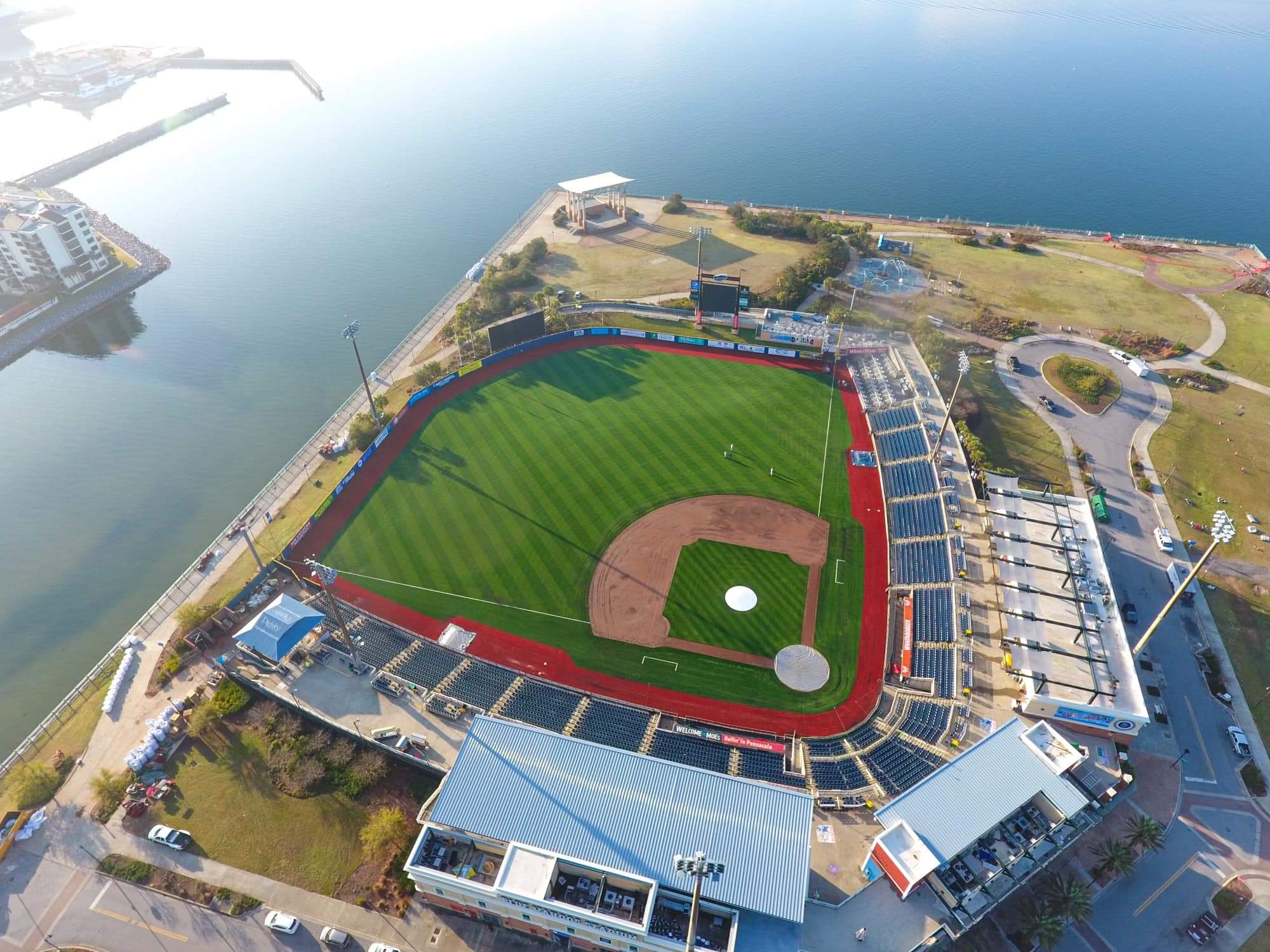 Photo by Alabama Aerial Perspective From dominant pitching performances to a new single season club home run record mixed in with Blue Angel flyovers, mullet Thursdays and an occasional chase of a man dressed as a cockroach, it was quite an exciting first season of affiliation for the Marlins and the Pensacola Blue Wahoos. With home plate just yards away from Pensacola Bay, the Blue Wahoos enter the second year in partnership with Miami. Even though their relationship is still so young, majority owner Quint Studer has made two adjustments to Blue Wahoos Stadium that should aid in prospects’ path to loanDepot park. Firstly, the Wahoos made a lighting upgrade swapping out old lamps for LED lamps. Secondly, the playing surface was given a major overhaul. As they do at the new ABC Supply Stadium in Beloit at the A+ level, Marlins prospects at the AA level will be playing on the same synthetic turf used in Miami. Leading the Wahoos onto their newly remodeled field will once again be Kevin “Smoke” Randel. Smoke, a Marlins’ draftee in 2002, played at every level of the minor league ranks and has now managed at three different levels, starting at A Greensboro in 2014 followed by A+ Jupiter in 2016. He’s been at the helm of the AA level since 2018. Randel also served as a Marlins’ MiLB hitting coach from 2009-2013. “He’s a really laid back guy,” . ”It helped a lot going to AA. It’s overwhelming going from high A to AA obviously. He treats everyone light in a way. He’s not super hands on. He doesn’t take anything too seriously. He helped me in that way that he kind of let me figure it out on my own.”Projected Lineup C Will Banfield 2021 Stats (A+): .181/.258/.308, 6 HR, 42 RBI, 95/25 K/BB Banfield, the Marlins’ second round pick in the 2018 draft, was a highly prized commodity out of high school and got paid as such. The then-18-year-old made $1.8 million, twice more than his slot value. Since then, Banfield’s spectacular defensive skills have stagnated. Pitchers rave about his game calling and receiving skills and he’s posted a 39% caught stealing rate all while playing against older league average competition. But as great as the defense has been, the bat has severely lagged behind. Through his first 207 career games, Banfield is a sub-.200 hitter, slashing .199/.263/.322. He also owns a 259/61 K/BB. On occasion, Banfield has shown good raw power, but he lacks much of an approach. He is very pull heavy and his line drive and hard hit rates are minuscule. Banfield has also always posted ground ball rates over or very close to the 40% range. Because he is still just 22, the ceiling is still that of a starting catcher, but it is lowering by the day. 2022 will be a huge year for Banfield as he is forced up to the AA level because of a wealth of catchers with less experience coming up behind him. This season will be a tipping point for Banfield. Something to note is that Banfield has not been seen yet at minor league camp. In his stead, undrafted free agent Paul McIntosh has been doing of the catching on the AA field and has looked good doing it. After an impressive showing with the A Hammerheads last year especially in terms of his power potential, McIntosh, 24, could be the backup plan in Pensacola. 1B Troy Johnston 2021 Stats (A-A+): .300/.399/.468, 15 HR, 85 RBI, 103/68 K/BB Johnston personifies late round lightning in a bottle and DJ Svihlik’s mastery. A 17th round draft pick in 2019 out of Gonzaga, the 24-year-old lefty was the epitome of two terms: scientific and simplistic. A self proclaimed ‘cage rat’ during his younger years, Johnston spent much of his time studying the intricacies of handling a baseball bat. This paved the way for him to become a .312/.387/.515 three year collegiate hitter (and a .300/.346/.403 bat during a showing in the wood bat summer leagues after his freshman year). Johnston’s natural bat to ball skills translated well to his first showing in pro ball in 2019 when he hit .277/.373/.399 with Batavia. Only one thing was missing: power. This past season in Beloit, the power found him. After beginning the season in A Jupiter where he hit an insane .349/.427/.446, Johnston slashed .289/.393/.473 in 96 games for the Beloit Snappers. By unlocking more of his lower half, he cranked out a total of 15 home runs (14 with Beloit), the most he’s ever hit over the course of a full season at any level. Johnston led full season Marlins' organizational players in many metrics including batting average, RBIs and wRC+ (140). He finished his 2021 calendar year by going 21/71 (.296) with a .383 OBP in 18 Arizona Fall League games. Defensively, Johnston was drafted as an outfielder. This past season, the Marlins brought him in to play first base. There, Johnston has shown good lateral movement, a good feel for the bag and for his new glove. With the ability to position himself properly and to make difficult plays including stretches and diving grabs, Johnston is a natural athlete who can make a difference on both sides of the ball. As good as he has been, a big challenge approaches for Johnston as he presumably makes the trip up to the AA level. Should his hit tool persist there, he’s not far away from big league readiness. 2B Chris Torres Torres is a 24-year-old acquired infielder acquired by the Marlins in their trade of Dee Gordon to the Seattle Mariners. Torres was rated as the 18th best prospect in the 2014 international signing class. Unfortunately, since coming to the Marlins, playing time has come at a premium for the 5’11”, 170 pound switch hitter. After playing 37 games between short season ball and low A, Torres got in his only full season to date in 2019 with the A Clinton LumberKings. There, Torres showed an advanced approach but the bat to ball skills lagged behind limiting his average. In 112 games, he hit .234/.347/.317 with a 141/75 K/BB. What seemed like a good building block season would not be built upon at all due to the pandemic followed by injury. Following the idle 2020 season, Torres missed all of 2021 due to injury. Torres comes into 2022 as a bit of a wild card with a lot of questions surrounding him, questions he was thought to have the capability to sufficiently answer when he was selected. What kind of physical shape will he be in? Can he make a 50 grade hit tool come to fruition? And can he come by a bit more power? While that remains to be seen, what Torres has shown so far is a plus approach from both sides of the plate, good patience, great speed, and defensive versatility. At 24 and with a wealth of younger infield talent behind him, Torres will — like Banfield — get a big challenge to the AA level. But if he can come back healthy and physically recharged, there is the potential for the Marlins to get even more out of the Gordon trade that has already spurned big league contributors Pablo Lopez and Nick Neidert. 3B Cobie Vance SS Ynmanol Marinez LF Griffin Conine 2021 Stats (A+-AA): .218/.330/.531, 36 HR, 84 RBI, 185/58 K/BB In 2018, the name Conine being back on a Marlins’ affiliated jersey eluded Miami by one single draft pick. At the trade deadline in 2020, the Fish ensured the next wave of Conine would come through South Florida when they traded infielder Jonathan Villar to the Blue Jays for Griffin’s services. Conine, a graduate of Pine Crest Academy in Boca Raton, had a year of extremes in his initial tenure with his hometown organization. After hitting .247/.382/.587 with 23 homers in 66 A+ games, Conine got the call to AA Pensacola. In his first 42 games with the Wahoos, Griffin came way back down to earth, hitting .176/.243/.447. While the power was still prevalent (13 of his 18 hits went over the fence), his strikeout rate soared to an unprecedented 47%. The variance in those stats from A+ to AA shows just how big that jump in level is. More often than not, Conine looked very overmatched. That said, the entirety of Conine’s 2021 season came after he missed half of 2019 due to suspension (for Ritalin) and of course the entirety of 2020. With unprecedented 70-grade raw power and good outfield tools fit for either corner and with the disjointedness of his recent career, there is still room for this recently turned 24-year-old lefty to build an approach and catch his hit tool up enough to turn in to the next Conine (albeit a very different one) who makes an impact for the Marlins. But, with the outfield depth in the Marlins’ system, that clock starts ticking this season. CF JD Orr RF Thomas Jones DH Bubba Hollins Projected Rotation RHP Zach McCambley 2021 Stats (A+-AA): 97 IP, 4.36 ERA, 1.23 WHIP, 120/26 K/BB Max Meyer and Jake Eder, challenged to the AA level to begin their careers in 2021, flew out of the gate, showed the Marlins’ organization they were up for the challenge and proved they were both very close to being big league ready. In 2022, another name and another member of the 2020 draft class has a very legitamite chance at reaching a similar level of development: Zach McCambley. McCambley, the Marlins’ third rounder in 2020 out of Coastal Carolina is a 6’2”, 220 pounder. After tossing mostly as a reliever for his first two seasons with the Chanticleers, McCambley took a trip to the well known Cape Cod summer league following the 2019 season. There, in five starts, McCambley really started to make his name well known to scouts. In 20.2 IP, McCambley held down a 1.74 ERA via a 24/7 K/BB. He returned to Conway, SC in 2020 and was off to a fantastic 25 IP, 1.80 ERA, 32/7 K/BB start to his junior year before the COVID cancelation. Considering he could have gone much higher had a full 2020 NCAA season been played, the Marlins got McCambley on a bargain at pick 75 overall McCambley began his 2021 season at the A+ level and proved just how much of a steal he can be. Against A+ competition nearly a year and a half older than him on average, the 6’2”, 220 pound specimen’s extremely advanced stuff allowed him to hold down a 3.79 ERA via a 1.018 WHIP. The most glaring stat McCambley posted with Beloit: a ridiculous 73/6 K/BB. McCambley made the jump up to AA just after the midseason mark. There, in his first taste against the high levels of MiLB (in his first season pro), McCambley discovered he would need to challenge a bit more to remain effective. In his first 40 IP with Pensacola, his ERA inflated to 5.18 and his walk rate from 0.95 to 4.50. This week, McCambley showed back up to Marlins camp spotting his stuff this way. His 70-grade sharp biting power curveball is the difference maker. One of the best pitches in the organization and potentially in all of MiLB (it’s that good), McCambley shows the ability to challenge to both sides of the plate and to bury it for whiffs in pitcher friendly counts. In first looks at McCambley, better fastball command early in counts and his knack to change eye levels has given him a better plan of attack. Moreover, McCambley is gaining a better feel for his blueprint changeup, improving it’s status from mix-in to usable. Should McCambley’s command continue to improve and should his changeup continue to gain polish (something that is almost a guarantee within this pitching development system), McCambley could one day approach the ceiling of James Shields. At the bare minimum he will be a major league reliever and could fill that role right now. Entering his age 23 season, McCambley should return to AA to begin 2022 but may not be there for too long. LHP Antonio Velez 2021 Stats (A+-AA): 99 IP, 2.55 ERA, 0.86 WHIP, 93/11 K/BB Continuing with the theme of Svihlik-discovered potential gems in the rough, Velez is a soon-to-be 25-year-old lefty out of Florida State University that went undrafted in the shortened 2020 draft. Velez came in to the Marlins organization and was immediately thrust up to the A+ level. There, Velez began as a reliever but soon entered the Snappers’ rotation. In his first 20 career games (11 starts) Velez managed an even 3.00 ERA via a 0.877 WHIP and outrageous control numbers including a 75/9 K/BB. These accolades earned the lefty a call to AA late in the season. In three starts with the Blue Wahoos, Velez allowed just one earned run while the control and command consisted to the tune of a 18/2 K/BB. Overall, Velez’s 2021 strikeouts to walks ratio was 8.45, tops in the Marlins’ organization. What Velez lacks in the way of fiery velocity (sitting 92, up to 94), he will make up for with incredible command and control over three pitches: an arm-side running fastball, a very advanced two plane changeup and a sweeping slider that he can spot on both sides of the plate. Since his high school days, Velez was always been a late bloomer and he’s become a breakout candidate. Velez’s sudden success story born from obscurity makes him very easy to root for. RHP George Soriano 2021 Stats (A-A+): 89.1 IP, 3.43 ERA, 1.35 WHIP, 114/37 K/BB Soriano is another under the radar piece who has recently started to make his name known. A 2015 international signing by the Marlins (which makes him one of the longest tenured players in the system), the Dominican is a 22-year-old righty made his minor league debut as a 17 year old in 2016. After missing the entirety of 2017 due to injury, Soriano came stateside in 2019 where he made an impression mostly as a reliever. In 2019, Soriano had a solid first full season with Clinton as a rotational piece, holding down a 3.91 ERA via a 1.32 WHIP and 99/50 K/BB. Soriano got a bit of a late start to 2021 due to another arm injury. The Marlins built Sorinao up in low A before sending him to Beloit in early July. In 55 innings with the Snappers, Soriano had a 3.74 ERA via a 1.39 WHIP and 67/19 K/BB. Soriano is another pitcher who won’t overpower guys with velocity. He normally sits around 94 with the ability to pump up to 96. What sets him apart are advanced breaking pitches, anchored by a plus slider. Soriano can also throw a changeup that currently grades at 40 with decent sink and tilt. While it is still a third pitch for him, he shows enough feel and command to make it a decisive offering. While Soriano has three pitches and one major league ready one, his overwhelming best tool is his control and his bulldog mentality to challenge hitters. What can get him in trouble at times is his command and catching too much zone which has lead to quite a bit of hard contact. That said, Soriano, another guy with an extremely disjointed recent MiLB career, is still 22 with time to iron that out and continue to ramp up to better velo. He should enter AA baseball with a ton of tools that give him the ability to stick as a back end starter. RHP MD Johnson RHP Bryan Hoeing LHP Zach King
 -
View full article
-
Photo by @GoHammerheads/TwitterAs the hot stove rages on and the shortened MLB spring training draws nearer, the Marlins are still expected to make some moves to fill holes at center field and in the bullpen, whether it be through free agency or through trade. One name any potential deal will not involve is 18-year-old star prospect Eury Perez. On Sunday afternoon, Marlins insider Craig Mish put all Perez fans’ minds at ease by breaking the news: Perez will not be going anywhere. Perez was discovered by the Marlins via ex-international scouting director Fernando Seguignol as part of the 2019-20 international signing class. A combination of size and stuff, the 6’8”, 200 pound specimen with plenty of room for more physical projection, has quickly made his name known and taken the system by storm. Despite being innings limited by the organization and never throwing past the fifth inning in any of his starts, Perez overmatched competition at two levels despite being at least four years older than his league average competition. After holding down the lowest ERA (1.61) and an 82/21 K/BB across 56 Low A Southeast innings, Perez was promoted to A+ Beloit. Eury began his A+ tenure by disallowing an earned run across five innings of work. His overall line with Beloit: 22 IP, 2.88 ERA, 0.73 WHIP, 26/5 K/BB. Scouts and talent evaluators alike are all in on Perez’s very high floor and even higher ceiling. A free and easy thrower who repeats smooth mechanics and shortens the distance to the plate as well as anyone, Perez is already easily sitting 96-97 with the ability to hold his velo through all five innings he has pitched. He throws the fastball with conviction in all four quadrants and with purpose outside of the zone for whiffs, particularly climbing the ladder from his short and high arm slot. Eury separates velocity by throwing a 78-83 mph power curve/slurve with sharp break down to his spot which he hits consistently on both sides of the plate. He can play with the shape of the pitch and also bend it outside of the strikezone and garner regular chases. Perez also owns the beginnings of a high 80s changeup that flashes plus. With general manager Kim Ng tentatively looking on, Perez threw two innings against mostly AA talent this past Saturday. After allowing a run early in the 1st, Perez came back to strike out the side. He did so again in his second inning of work before departing. According to Mish’s report, he believes Perez could make his debut at age 19. Eury will turn 19 on April 15th, meaning he is projected to make his MLB debut by Opening Day 2023. Not since Jose Fernandez has the Marlins’ system seen anything like Eury Perez. A potential big leaguer after as little as 1 1/2 years in the minors, Perez is more than deserved of immovability. The fact that he has been deemed the only untouchable prospect in the organization should solidify his status as the team’s number one overall prospect.
-
View full article
-
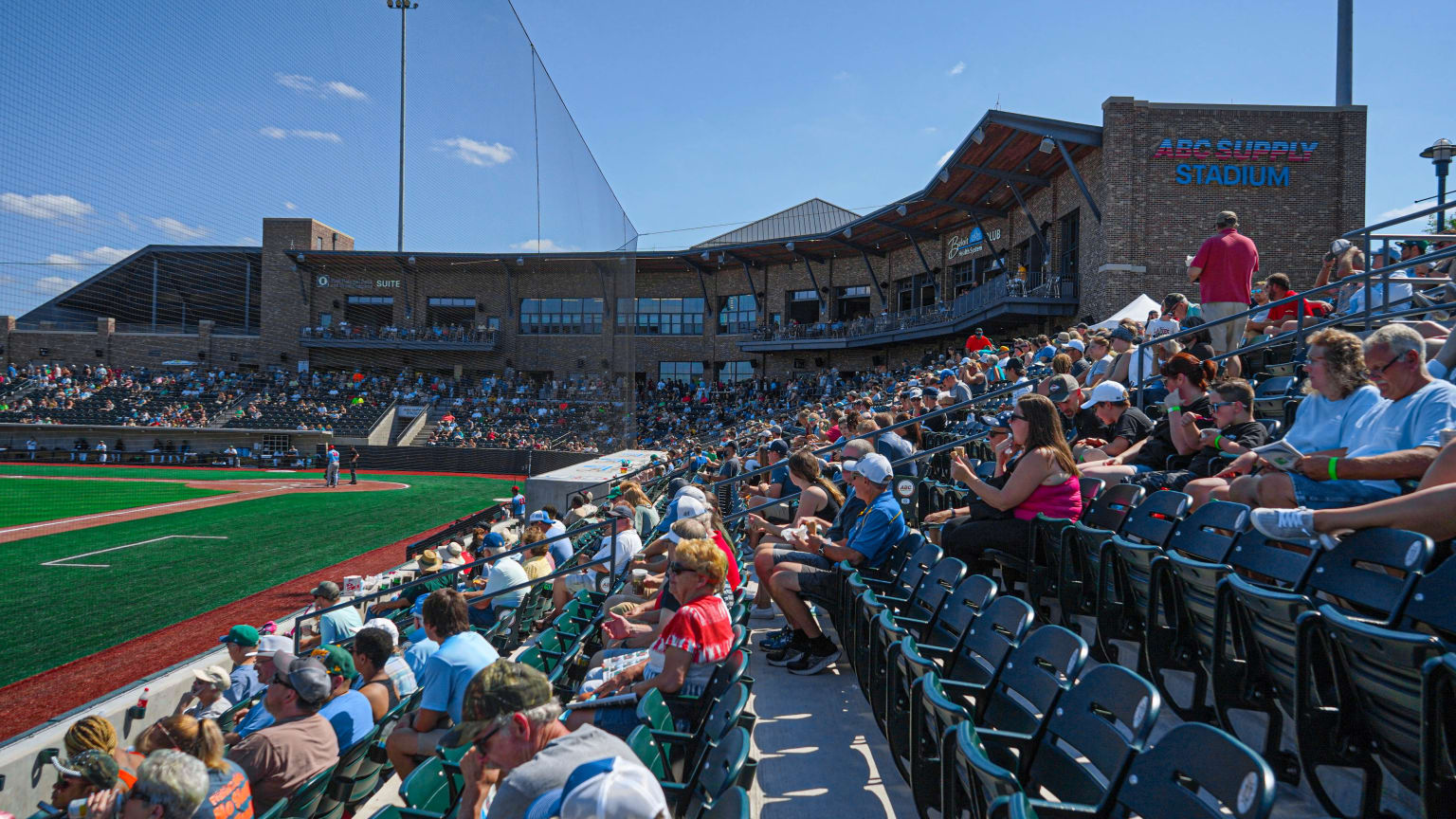 The Beloit Snappers enjoyed a long history as a premier Class A franchise, spending almost four decades in that division with three different affiliates. Beloit was treated to appearances from solid future big leaguers such as Paul Molitor, Prince Fielder, Matt Garza, and Matt Chapman, to name a few. Now rebranded as the Sky Carp, they are prepared to start their first full season in the beautiful new ABC Supply Stadium. This is a new age for the Beloit franchise, and just their second year as an affiliate with the Marlins in High-A. With the amount of talent that is filtering through this lower level of the Minors, it would be no surprise to see Beloit have their first season above .500 since 2013. With fans buzzing around the new park, there would be no better season to do that in. Beloit fans will be treated to the talents of Eury Perez, one of the fastest rising pitching prospects in the sport, and electric offensive talents in Nasim Nunez and Osiris Johnson. In conducting this preview, what stood out most in the projected Beloit roster was speed and athleticism. That should make for an exciting product to see for those in the area of the Wisconsin-Illinois border town. Managing the team in their inaugural season as the Sky Carp will be Jorge Hernandez. Hernandez has spent over a decade working with the Marlins in various positions as a coach and manager in the lower minor league levels. He was most recently the manager with Jupiter, spending just this past season there. That should make Hernandez's transition to Beloit a seamless one, as he managed Nunez, Victor Mesa Jr, Johnson, Perez, and others just last season. Having experience with the most talented players expected to be in Beloit should only help their development, as they gain comfort while traveling from the cozy confines of Florida all the way up to Wisconsin. Hernandez has further managing experience in the Gulf Coast League from 2009-2012, and also in the now defunct New York-Penn League in 2018. This all came with the Marlins, so it is good to see a long time trooper in the organization get promoted. Ensuring that your coaches at all levels, from the Majors to the Minors, are on the same page with the organization's overall goals is a common theme for the best teams. Hernandez has clearly shown he is a quality developer of young players, so here is to hoping his first season in Beloit will be fruitful. C Bennett Hostetler 2021 Stats (A-A+): .319.367/.486, 5 HR, 33 RBI, 38/36 K/BB Converting to catcher from the infield gives Hostetler the opportunity to improve his value if he can play the position well. He has done nothing but hit since his senior year at North Dakota State, although Hostetler did strike out a concerning amount in his professional debut this past season. 1B Tanner Allen 2021 Stats (FCL-A): .183/.257/.275, 2 HR, 10 RBI, 11/3 K/BB Already 23 years old, Allen will be under a lot of pressure to start moving up the levels of the minors this season. The SEC Player of the Year in 2021, Allen has raw power and a line drive approach. He is an above average athlete, but did not play the outfield particularly well. Ultimately, to profile at first base, where he played a bit in college, Allen will need to hit more. 2B Federico Polanco 3B Cody Morissette 2021 Stats (A): .204/.308/.299, 1 HR, 10 XBH, 10 RBI, 38/20 K/BB Morissette has good contact skills and a solid approach at the plate that made him one of the top college hitters in the country. His short swing and gap-to-gap power drew a Joey Wendle comp from FanGraphs, and this is before the Marlins traded for Wendle. Morissette’s versatility, as he could play second base as well, contributes to that comp and his lack of arm strength is probably meant more for second base. Not having enough raw power holds Morissette back from being a better prospect and limits his ceiling. SS Nasim Nunez 2021 Stats (A): .243/.366/.265, 3 XBH, 10 RBI, 46/35 K/BB, 35/10 SB/CS Nunez has played just over one hundred minor league games now, and has over sixty stolen bases. His speed and defense will be what gets him to the Majors, although some scouts remain optimistic about his ability to hit. As a switch hitter, Nunez has shown more promise from the left side and has barreled some balls. Added strength has also improved his exit velocities, but Nunez still has more to put on his frame. His approach at the plate should be appreciated, as Nunez knows his strength is his speed. As a result, he has prioritized getting on base despite his lack of power; a .243/.366/.265 line in A-Ball in 2021 shows this, to go along with 33 stolen bases. Scouts seem to agree that he will be able to stick at shortstop and be a good one. LF Victor Mesa Jr 2021 Stats (A): .266/.316/.402, 5 HR, 37 XBH, 71 RBI, 102/33 K/BB The brother of Victor Victor Mesa, Victor Jr. has clearly emerged as the better prospect out of the two despite what scouts initially expected. What he lacks in raw power is made up for with a decent approach at the plate and an ability to make solid contact consistently. Mesa has a sweet swing from the left side, and does have some muscle, but is not expected to tack on much more power. Scouts doubt if he has the speed to play center field in the big leagues, but he is a high IQ player who undoubtedly would be an adequate corner outfielder. The ceiling is not terribly high, but everything is there for him to be at least a contact-oriented fourth outfielder. CF Osiris Johnson 2021 Stats (FCL-A): .219/.294/.373, 11 HR, 30 XBH, 55 RBI, 104/34 K/BB Johnson was tearing up the Complex League before earning a promotion to A-Ball in 2021, but struggled from that point on. This is understandable considering Johnson missed all of 2019 due to an elbow injury, so 2021 was his first live action since 2018. Johnson has impressive bloodlines, as the son of a former big leaguer and the cousin of Jimmy Rollins. He has displayed impressive minor league exit velocities, and scouts are optimistic that he can keep getting stronger. A better approach at the plate will be needed, and his stocky frame has many thinking that he will be better in the infield. The Marlins have tried him at all three outfield spots, plus shortstop, second, and third. FanGraphs expects he will stick at second or third base, and MLB puts a Howie Kendrick comp on him due to his frame and surprising pop. He should get a chance at Beloit to show that his ability to hit the ball hard can translate to a better slash line in 2022. RF Davis Bradshaw DH Paul McIntonsh Projected Rotation RHP Eury Perez 2021 Stats (A-A+): 78 IP, 1.96 ERA, 0.885 WHIP, 108/26 K/BB Perez was not a huge prospect when signing, but has grown four inches since then and his fastball has increased in velocity as a result. Scouts are now optimistic that this rapidly rising prospect could sit in the mid-nineties with the heater, and he reportedly topped out at 97 during the 2021 season in the minors. That is all very promising, and makes Perez very projectible as a prospect. He already had very good feel for the curveball and changeup, which is impressive considering his age. That helps explain why Perez has had some success already as he has progressed through the minors, despite still being so young. His control was even improved in games, and this was his first time pitching professionally due to the pandemic. Perez should continue leaping up prospect lists if he continues his success, and keeps jumping levels in 2022. LHP Dax Fulton 2021 Stats (A-A+): 78.1 IP, 4.60 ERA, 1.391 WHIP, 84/38 K/BB Fulton missed the end of his senior year in high school due to TJS, and the Marlins still took him high. He was the top rated prep left handed pitcher, and was able to finally get on the mound in a professional setting in 2021. The fastball has the potential to keep adding on a few ticks, considering Fulton’s age and size. It already has a ton of downward movement, and he generated a lot of ground balls with it last year. The curveball also has a lot of movement, and is more of the swing and miss pitch. He does have a repeatable delivery, and the changeup is starting to develop so Fulton should be able to remain a starter. Staying healthy, cutting down on the walks, and continuing to work on his third pitch will all be crucial for super-athletic Fulton in 2022. RHP Evan Fitterer 2021 Stats (A): 30.1 IP, 4.15 ERA, 1.385 WHIP, 33/10 K/BB Fitterer projects as a potential back end starter due to a decent four pitch mitch. All four pitches project as average eventually, and the fastball has sinking action that results in a lot of ground balls. A little more velocity would make that pitch more interesting, and there is a chance for that considering Fitterer’s age and size. His control greatly improved in 2021, with a very low BB rate. That came in a small sample size, but it would be a great sign for Fitterer if that continued considering he lacks a truly dominant out pitch. He was described by MLB Pipeline as looking similar to Kyle Hendricks, with better raw stuff, which is obviously high praise. RHP Matt Givin RHP Chris Mokma LHP Luis Palacios 2021 Stats (A): 65 IP, 3.88 ERA, 0.985 WHIP, 66/16 K/BB Prospects are rarely judged much on minor league statistics, nor should they be. But, some prospects have to be put on the radar because of the way they dominate the lower levels. That is what Palacios has done, despite stuff that does not put him on many scouts radars. He is very deceptive with his low velocity, and has superb control already. Palacios is not a ground ball pitcher, but gets a ton of infield fly balls. The deceptive delivery can only help there. If he wants to be more than a depth starter, he will need to add some velocity. That is still possible considering the age and size, but it better come soon.
 -
View full article
-
Photo by @RDCstadium/Twitter In 2021, the winds changed just offshore of Jupiter Inlet. Within the township of Abacoa, for the first time, the Jupiter Hammerheads competed as a A affiliate of the Miami Marlins. While the redrawing of the lines in Minor League Baseball sent the Sharks down a peg on the minor league ladder, it provided fans with the ability to see more of the organization’s freshest prospects. Jupiter fielded a club record 85 players and a melting pot of international prospects making their stateside debuts as well as those coming out of the 2021 MLB Draft, forming an overall roster very becoming of the culture their home club is trying to build. This coming April to begin the 25th minor league season played at Roger Dean Chevrolet Stadium, those two aspects will once again join to form what projects to be an exciting Opening Day roster and a glimpse at the next wave of of the Miami Marlins’ system. And it all starts with a new skipper. Joining the Hammerheads as manager is long time organizational man Angel Espada. Espada, a former Braves late round draft pick and independent league standout infielder, joined the Marlins coaching staff as GCL hitting coach in 2009. After serving as hitting coach in AAA and short season ball, Espada helped bridge the gap from Jamestown to Batavia, making his managerial debut as the Jammers’ manager in their final season as a Marlins’ affiliate in 2012 followed by the Muckdogs in their first three seasons with Miami from 2013-2016. From 2017-2018, Espada served as a defensive coach with the A Greensboro Grasshoppers. He comes to the Hammerheads after a two year stint overseas with the DSL Marlins. Espada managed the Dominican club in 2019 and served as field coordinator in 2021. The 46 year old, who boasts over 25 years of experience in professional baseball as both a player and a coach in a variety of roles, helped develop many current big leaguers such as Brian Anderson, Jordan Holloway and Cody Poteet and current prospects Cristhian Rodriguez, Yoelvis Sanchez and Breidy Encarnacion, all of whom should be under his watch again this season in Jupiter. Projected Lineup 2B Ian Lewis 2021 Stats (FCL): .302/.354/.497, 3 HR, 18 XBH, 27 RBI, 24/11 K/BB, 9/4 SB/CS Lewis was part of the Marlins’ impeccable 2019-20 international signing class. The 16 year old was deemed to be the Bahamas’ top export and earned the signing bonus becoming of such a title: $950,000 made him the third most lucrative Marlins signing in the class. Coming into pro ball, Lewis was touted for his ability to put the ball in play effectively from both sides, his plus-plus speed and his quick reads in the field that should allow him to stick in the middle infield. However, there were doubts surrounding the lanky 5’10”, 177 specimen’s power projection. This past summer, Nunez began to those questions. After showing up to minor league spring training with added muscle mass, Lewis, playing against competition nearly two years older than him on average, had 18 of his 45 hits go for extra bases. Lewis has been acquainted with Marlins’ infielder Jazz Chisholm Jr since childhood when the pair played little league together. Chisholm Jr has stated that he knew Lewis was going to be a big leaguer from a very young age. This year, as Lewis comes to Jupiter, his stock is as high as its ever been. While there will always be more average than power in his bat, he has begun to bring those two aspects much closer as he’s migrated stateside. With speed bordering on 70 grade and a hit tool that could approach 60, Lewis is a great athlete with a ton of upside who won’t turn 20 until 2023. Place his future ceiling around the likes of Orlando Hudson. SS Kahlil Watson 2021 Stats (FCL): .394/.524/.606, 5 XBH, 7/8 K/BB Watson is the Marlins’ highly heralded first round draft pick out of last year’s class. An 18-year-old prep out of North Carolina, Watson was MLB Pipeline’s fourth overall rated talent but fell to the Marlins at 16 overall due to signability concerns. Those concerns became reality as Watson went without a contract for most of last summer. Finally though, the Marlins got Watson to put pen to paper on August 2nd. His $4,540,790 completely exhausted the rest of the Marlins’ allotted draft pool and was $786,290 over slot value. Watson can be very good and he knows it. So when he fell in the draft, the chip on his shoulder got a bit bigger evident by the fact that he was heard in one of his first interviews telling his brand new boss, former Marlins CEO Derek Jeter to “give him his money”. As the summer days went by, excitement grew to a fever pitch for the days Watson would take the field in a Marlins uniform. The first day finally came on August 16th but there would be just eight more occasions after that as Watson suffered a grade 2 hamstring strain, ending his FCL season. A 5’11”, 170 pound lefty, Watson checks many boxes at the ripe age of 18. Watson’s best offensive tool is his 60-grade raw power stemming from vicious physicality and bat speed. As he grows physically and gets reps, translation to in game power is evident. Annual 20/20 potential is very real. Watson also owns incredible running speed that should allot him 20+ stolen bases. In the field, Watson has the athletic ability to dazzle and take hits off the board with good range to both sides. His quickness and accurate cross-body arm give him a long-term home at shortstop. If there were weaknesses in Watson’s high school game, they came in the form of struggling against plus breaking stuff and the tendency to try to pull pitches on the outer half rather than go with them to the opposite field. While he handled the inside part of the plate very well, this lead to weak contact from opposing pitchers that back-doored him, limiting the current grade of his hit tool, but with experience and pro coaching, there is a ton of room for both natural progression as well as growth and improvement. The only other potential weakness for Watson could lie in his head. A player who has been elite and been set on his destiny for his entire amateur career, it will be intriguing to see how Watson handles his first taste of failure if and when it comes against the most advanced pitching he’s ever faced in a pitcher friendly environment at Roger Dean Chevrolet Stadium and across most of the old Florida State League circuit. With the ability to limit strikeouts, destroy pitches on the inner half, turn anything into extra bases and take away bases on the infield, Watson is the kind of quick-twitch guy both amateur and international scouting in the Marlins’ organization have salivated over and for good reason. He will come back to Jupiter and to the main field at Roger Dean Chevrolet Stadium in 2022 as quite possibly the most anticipated prospect available for viewing both within the organization and within the lower levels of the minor leagues. 3B Jose Salas 2021 Stats (FCL-A): .305/.391/.405, 2 HR, 14 2B, 19 RBI, 51/22 K/BB, 14/5 SB/CS From one quick-twitch athlete to another, Jose Salas is another new adult who defines the term. Salas, the 10th ranked prospect in that year’s class, earned the highest bonus handed out by the Marlins: $2.8 million. At the time, Pipeline called Salas the most advanced hitter in the class and stated he could become a 30-30 annual threat. That potential was on full display as Salas came stateside to the FCL last season. In his first taste of stateside ball, Salas hit .370/.458/.511 before being promoted to the Hammerheads in mid-August. With the Sharks, Salas hit .250/.333/.315. We expect the soon-to-be 19 year old will return to the Hammerheads this summer. At age 18, Salas is 6’2”, 190 and already showing huge power potential from both sides of the plate. As his projectable frame grows, even more power should come and he shouldn’t have any trouble getting his 60-grade raw power translate to equally imposing game power. Salas is selective and shows a good knowledge for the zone but he does have a bit of loop in his swing which could pave the way for more strikeouts as he grows through the levels and adjusts to his growing body. Even more so than Watson, Salas is a very pull heavy hitter that will struggle with plus pitches on the outer half. In his first showing last season between the FCL and A, over 50% of Salas’ contact was to his pull side. There are some gaps in the offensive approach but Salas should be able to continue to hit for enough power to overlook them as he continues to grow through the system. In addition to the power, Salas dazzles with his speed, currently rated at 60 grade. When he isn’t putting balls over fences, he has the intuition and readability to turn any ball put past infielders into extra bases and should threaten for 20+ steals a season. Salas was signed as a shortstop but he has spent time at other positions. Given his current frame and how much more size he will grow into, the power pedigree and 55+ grade throwing arm, we expect Salas to move off of the crowded shortstop position to third base. With potential for four of five plus tools, fantastic athleticism and a ton of time to grow, Salas is one of the more exciting prospects in the Marlins’ organization. Already bordering on many top evaluators’ top 100 lists, the ingredients are in place for him to make some major noise in 2022, potentially make it up to A+ and start having his name mentioned nationally. 1B Cristhian Rodriguez RF Yoelvis Sanchez C Joe Mack 2021 Stats (FCL): .132/.373/.208, 2 XBH, 22/20 K/BB Mack is the Marlins’ competitive balance pick from 2021 out of Williamsville East High School in East Amherst, New York. Another early round prep pick by DJ Svihlik, Mack commanded a $2.5 million signing bonus, slightly over slot but surprisingly not as high as expected considering the Clemson commit was labeled the third best catching prospect in the nation by PerfectGame and the fourth best catching prospect in the draft according to most outlets. New York isn’t necessarily a baseball breeding ground and as the Marlins have learned with other prep catchers through the years, they are very volatile. However, Mack has a very good chance to crack both of those molds. A 6’1”, 210 figure, the newly turned 19-year-old who will maintain that age for all of the 2022 playing season, received high marks for many of his tools as he competed in prep showcases leading into the draft. According to scouts that viewed Mack, he has the tools to become an impact player on both sides of the ball. Defensively, Mack boasts a 60-grade arm with elite pop and home-to-second clock times in the 1.8 range which is considered elite. The only questions surrounding Mack’s defense surround his ability to call and receive, a common issue for prep backstops and something Mack has the raw athleticism and IQ to clean up quickly as he spends time with pro pitchers and coaches. Offensively, Mack is known as an aggressive hitter early in counts but selective late further complementing his baseball IQ. Evaluators say Mack is more of an on-base threat than base circler long term. Those variables were on display in Mack’s first 19 career affiliated games. For the FCL Marlins last year against competition two years older than him on average, he hit .132/.373/.208 with a 22/20 K/BB. As he grows, it isn’t out of the question that Mack can grow into a bit more power (especially if he is taught to employ his lower half more) but it will never be a big part of his game. That said, Mack could make a very good career as an elite defensive catcher and a tough out that works counts and works his way on base in multiple ways. A Joe Mauer-light type ceiling is not out of the question here if everything goes his way. CF Brady Allen Allen is another 2021 Marlins’ draftee, selected in the 5th round out of the University of South Carolina. A Florida native, Allen spent three years with the Gamecocks in which he hit .255/.372/.471 and mixed in two wood bat summer league showings in which he managed a .297/.416/.441 slash line. Allen would probably be challenged to a higher level had he made his pro debut in 2021. However, the 21-year-old underwent Tommy John surgery shortly before the draft, stunting his ranking and preventing him from taking the field for the Marlins’ organization as of yet. Allen, who will turn 22 before the end of the minor league season, will begin the year in Jupiter and with results, could be quickly promoted to higher levels. Allen, 6’1”, 220, was highly lauded for his ability to create contact as a high schooler but as a collegiate player, he struggled in that regard, racking up high ground ball rates, especially against plus breakers and better locations on the lower half. While Allen has shown a good feel for the zone allowing him to limit whiffs, due to missed time, his floor is equally limited. Still, he has 50-grade raw power and athleticism that could allow him to make up for lost time offensively. Defensively, Allen owns average tools but could stick long term as a right fielder. View Allen, an under slot signee, as a guy who needs raw offensive tools to permeate quickly as he begins his first season with the Marlins’ organization this summer in Jupiter. LF Javeon Cody DH Diowill Burgos Projected Rotation RHP Breidy Encarnacion 2021 Stats (FCL): 22 IP, 8.18 ERA, 21/18 K/BB, 1.955 WHIP Encarnacion is a member of the Marlins’ 2019-20 signing class out of the DR. After spending most of their pool on the Mesas, he came to the organization for a paltry $30,000. However, the 18 year old made a good first impression when he held down a 1.91 ERA and had a 57/11 K/BB for the DSL squad. This past season, Encarnacion’s projection was stunted by a throwing arm injury which held him out of action until July. Even after returning, building back his arm was a slow process as he pitched almost exclusively in long relief for the FCL Marlins and didn’t surpass four innings in any appearance. Breidy should return to action full time this coming season. A 6’3”, 180 pound 19-year-old, Encarnacion tops at 93 with his fastball but with good separation from a low 70s 12-6 curve and a solid changeup in the low-mid 80s. With a very loose wind and delivery though, there is certainly room for Encarnacion to build into more explosiveness and a higher arm speed. What currently excites about Encarnacion’s stuff are well above average spin rates that have the ability to make the opposition look foolish. Take his stats as he built back from injury this past year with a grain of salt and look more closely at his results as he comes back at 100% with the Hammerheads this season. RHP Jesse Bergin LHP Sandro Bargallo RHP Luis Vizcaino 2021 Stats (FCL): 49.1 IP, 2.92 ERA, 51/24 K/BB, 1.196 WHIP Vizcaino is a member of the Marlins’ 2018-2019 signing class and Encarnacion’s fellow graduate of the Dominican academy in 2020. This past season, the 19-year-old made it stateside where he held down a 2.92 ERA by way of a 1.20 WHIP and 51/24 K/BB in 49.1 IP. Listed at 6’4”, 199, Vizcaino earns top marks for his hammer breaking ball, a low 70s curve. His heat, which currently sits in the low 90s, holds a 45 grade future value. He lacks much of a third pitch and has spotty command which lead to a lot of line drive contact during his FCL showing last season paving the way to a 5.08 FIP. Vizcaino has peripherals that will continue to allow him to limit free passes but he will need to catch his fastball up and develop a third pitch is he hopes to stick as a starter. That work starts this season with Jupiter. LHP Mario Doble RHP Delvis Alegre
-
View full article
-
Photo by Michael Reaves/Getty ImagesEarly Monday afternoon, Craig Mish of the Miami Herald broke a major piece of news that overshadowed the CBA talks taking place in Jupiter. Marlins CEO and partial owner, Hall of Famer Derek Jeter is stepping down from his position within the organization, selling his shares to the team and moving on. Jeter, who entered the Marlins organization in 2018 next to Sherman, was a 4% stakeholder in the club. He was entering the final year of a five year deal as CEO. 2022 would have been a huge year for Jeter and his future with the club as winning at the major league level right now has become of paramount importance. The Marlins had already committed to spend upwards of $109 million on two players, their star pitcher Sandy Alcantara and outfielder Avisail Garcia and had plans to spend even more before the current lockout. So why now? Why was February 28th, 2022 the right time for Jeter to move on? — From the beginning, Jeter, a natural born winner who is used to success, preached and stuck to his plan of building a sustainable winning franchise. The first few years were rough on both fans and those surrounding Jeter, including players and staff. After firing all the club’s special advisors including Jeff Conine, Jack McKeon, Tony Perez and Andre Dawson, Jeter hired Gary Denbo as VP of Player Development and Scouting, replacing the recently released Marc DelPiano. Denbo was considered Jeter’s first major hire. In an equally heralded move, Jeter dismissed longtime amateur scouting director Stan Meek from his role and replaced him with another Yankees’ supplant, DJ Svihlik. Meek remained with the Marlins in an advisory role before his retirement in 2020. From there, Jeter turned his attention to the big league roster and put all his faith in Denbo and Svihlik to build a sustainable long term winning franchise by way of an elite feeder system. In the winter of 2017-18, Jeter executed a set of very well known trades designed to bolster the minor league system at the expense of proven major league talent. At the winter meetings, the Marlins were very active: they dealt slugger and fan favorite Giancarlo Stanton along with most of his remaining $295 million contract to the New York Yankees for Starlin Castro, Jorge Guzman and Jose Devers. The Marlins followed up days later by dealing Marcell Ozuna to the St. Louis Cardinals in exchange for Alcantara, Zac Gallen, Daniel Castano and Magneuris Sierra. Miami then cleared out the entire 2017 outfield in January by dealing Christian Yelich to the Brewers for Lewis Brinson, Monte Harrison, Isan Diaz and Jordan Yamamoto. In the face of all of this, catcher JT Realmuto requested a trade from the Marlins. In mid-February of 2019, Jeter obliged sending Realmuto and two years of club control to the divisional rival Phillies for their second best prospect (according to Baseball America) Sixto Sanchez and their eighth best prospect Jorge Alfaro. Entering the 2018 season, the Marlins’ Opening Day payroll was down from $115 mil to $99 mil and the full scale rebuild was on. In 2019, payroll fell to $71.9 mil. In 2020, the Marlins, who had COVID-19 wipe out 18 games, somehow made the playoffs during a 60 game spring, giving Jeter his first taste of the postseason as an owner and executive. During this time on the player development side, two things happened: Svihlik succeeded in the draft, putting together several highly lauded classes and Denbo and Co, though they had great success developing pitching. However, they have continuously struggled to develop offense. As Alcantara became a star and the current leader of the Marlins’ staff, 2017 first round pick Trevor Rogers was developed into a 2021 Rookie of the Year candidate and Pablo Lopez became one of the best command and control artist, the likes of trade returns Alfaro, Brinson, Diaz and Sierra as well as highly touted top draftees such as Connor Scott, Will Banfield, JJ Bleday and others have so far overall had trouble getting their offensive tools to translate to the minors. Shortly after the Miracle Marlins’ 2020 season, Jeter fired the individual largely responsible, 19-year organizational man Michael Hill and made national headlines by hiring Kim Ng, making her the first female general manager in MLB history. Ng had been working in baseball operations for more than 30 years. But her hiring came with a caveat: all roster decisions would need to be approved by Jeter and Denbo. This proved to be a punitive approach. Due to very suspect roster construction, the 2021 Marlins limped their way to a 67-95 season, marking the third straight full season in which Miami lost at least 90 games. After the club failed to retain Starling Marte (a decision they would later recount) and after pulling off a last minute deadline deal that sent Adam Duvall and his remaining year of control to the eventual World Series champion Atlanta Braves for the return of catcher Alex Jackson, Jeter’s record as Marlins CEO ran to where it sits today: 218-327. In an odd case of irony, CBA negotiations continued to flare on the home front at the spring home of the Marlins, Roger Dean Chevrolet Stadium. On Monday afternoon, around the same time the Jeter news was broken, it was announced that owners would be willing to sacrifice up to a month of games if the two sides could not come to a quick agreement. With sizable gaps between the tipping points including the competitive balance tax, regular season baseball is very much in jeopardy. With the very real prospect of lost revenue for the small market Marlins in sight, this report from MLB insider Joel Sherman, who was well connected to Jeter throughout his career, was born: Today, Jeter leaves the Marlins organization after forfeiting his salary for the 2020 season. He also leaves his salary for 2022 on the table. As such, Jeter’s tenure with Miami, which he bought into for $25 million, wasn’t very lucrative. In simple terms though and as Miguel Rojas stated, Jeter was sick of losing and didn’t see a path towards immediate improvement for the Marlins who still need to make multiple additions to the big league roster in order to be competitive in 2022. In the midst of CBA negotiations, Jeter’s departure was championed on social media by multiple members of the MLBPA including Rojas, Justin Turner and Francisco Lindor. But Jeter’s departure isn’t all gray skies for the Marlins organization. In fact, some positives could be born from it. Per reports, Ng will in the interim serve as Jeter’s heir apparent on the baseball operations side and COO Caroline O’Connor will handle financial responsibilities. When Jeter is eventually replaced, Ng is expected to still maintain the ability to make all roster movement decisions. For the first time, Ng will work without a buffer and without the need to run her decisions by someone else. As such, the promotion of prospects to sit on the bench and the continuous experimentation of failed projects should cease. Marlins fans and the organization will finally see her full influence and potential. Jeter’s tenure with the Marlins is proof that on-field magnificence does not always immediately permeate to front office prowess. One of the greatest leaders and the most clutch performers in the game during his playing days, Jeter should still have a place in baseball. While that will not be with the Marlins, the fruitful seeds he was able to plant in Miami will continued to be nurtured. The positive impacts he made will continue to be felt by the organization and the negatives will be overcome. But now, it is Kim Ng’s time to truly lead this organization with one voice. How that voice echoes within the organization and within the baseball world remains to be seen, but the peripherals are in place for brighter days ahead at loanDepot park.
-
View full article
-

Why The Marlins Farm System is Not Bringing in Expert Consensus
Alex Carver posted an article in FOF Prospects
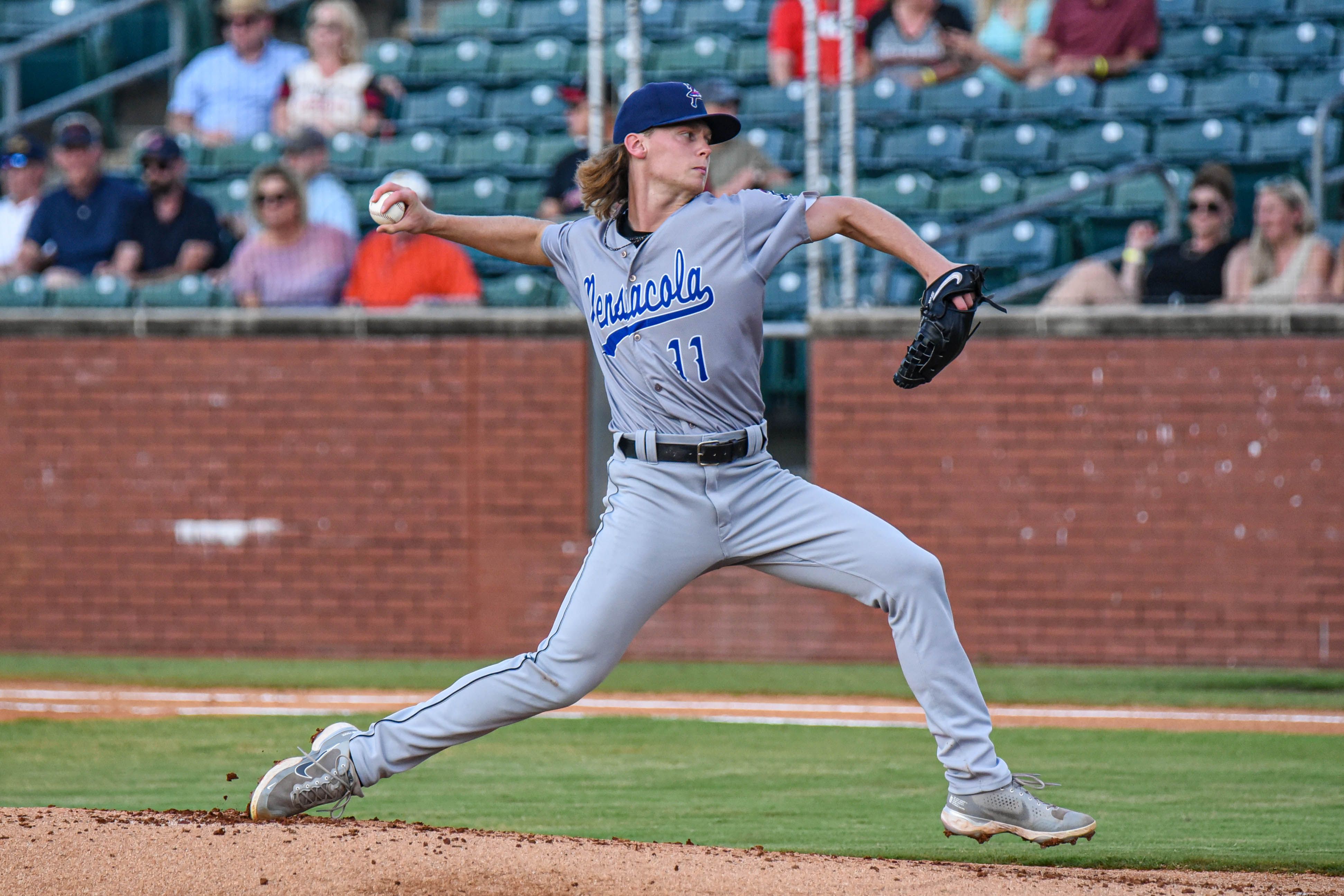 In the past few weeks, Marlins fans have gone through the full gauntlet of emotions when it comes to reading prospects reports on their favorite team. After The Athletic's Keith Law controversially did not include Max Meyer in his Top 100 Prospects (or his just missed list), he then ranked the Marlins system as just the fourteenth best in the sport. This came after a fourth place ranking last season, so Law sees this system as taking a step back from where they were. Of course, that was partially due to hyped prospects like Trevor Rogers and Jazz Chisholm Jr. graduating out of prospect eligibility. Shortly after Law’s list was published, ESPN’s Kiley McDaniel released his own Top 100 Prospects rankings. His list was far more Marlins-friendly, with seven Marlins included in it. That interestingly included Meyer as his top Marlins prospect, showing the lack of consensus that exists among experts on this pitcher. Furthermore, McDaniel ranked the Marlins system as the fourth best in the league, citing the elite talent at the top of their system. Law and McDaniel are not the only two experts to diverge in their opinions of the Marlins entire system. Baseball America recently ranked the system even lower than Law did, at twentieth best in the Majors. Baseball Prospects, on the other hand, was more aligned with McDaniel’s thinking in ranking the Marlins system as the sixth best. This is not to say that one expert is right, while another is wrong, but instead to show just how different opinions are and how volatile prospect rankings can be. Still, there is quite a bit of consensus in the way the experts stack up most team’s farm systems. For instance, Law and McDaniel had seven of the same ten teams in their respective top ten, albeit in different orders. Ultimately, the scouts seem to agree on which teams have the most high end talent and depth in their system, and can then differ on their opinions in exactly how good some of the top-end players are. So, what gives with the Marlins? Why is this system being viewed so differently by a variety of sources? The answer comes down to pitching. Much has been made of how unique this Marlins system is; few teams have ever had this hoard of pitching depth, but the Marlins do not possess the hitting talent to match it. That explains why there have been various rumors surrounding Miami potentially swapping some of that pitching for hitting. Trading Zac Gallen to Arizona for Chisholm Jr. a few seasons ago was the kind of deal that many view as being mutually beneficial for the Marlins and a potential trade partner again. We will see if that ultimately comes to fruition, but the point here is that the Marlins are well known around the league right now for having so many exciting pitching prospects in their minor leagues. Look no further for the answer to why there is such a difference of opinions regarding the Marlins system. Pitching is notoriously volatile, and not easy to predict. McDaniel wrote in his 2020 book, co-authored with Eric Longenhagan of Fangraphs, titled Future Value, about the difficulty in projecting young pitchers: While we think pitching is a little easier to scout, it’s harder to predict. Who will get hurt? Who will throw harder as they enter their physical prime? Who will retain that velocity into advanced age? Whose command or secondary pitches will improve? These are slippery central questions for which we still only have vague, perhaps apocryphal answers that apply across the pitching population as a whole, partially because, now more than ever, so many of those answers are dependent on player development. While McDaniel and Longenhagan do not go so far as to agree with the old adage that “pitchers are not prospects,” they do recognize that the lack of certainty with pitchers still leads many to value hitters over them. In his recent Top 100 rankings, McDaniel seemed to be leaning even more in this direction, with his top six prospects all being hitters. He even noted in his blurb about the top pitching prospect, Baltimore’s Grayson Rodriguez, that the industry has struggled in ranking pitchers in recent years. Looking at Baseball Prospectus’ top pitching prospect for the last decade, one can see that McDaniel is on to something here: YearPitcherCareer fWAR2011Julio Teheran12.92012Matt Moore8.22013Gerrit Cole35.52014Taijuan Walker7.92015Lucas Giolito11.02016Lucas Giolito11.02017Lucas Giolito11.02018Alex Reyes1.62019Forrest Whitley0.02020MacKenzie Gore0.0This exercise was simply done not to show that the top pitching prospects are not often successful; after all, the traits that get one ranked this high are inherently good. Throwing hard, having multiple plus breaking pitches, and quality command get a pitching prospect up to the top ranking. Instead, this just shows what McDaniel and Longenhagan were saying a few years ago: pitching is nearly impossible to predict. Cole and Giolito are star-level pitchers now, but for each of those there is a Matt Moore or Taijuan Walker who just cannot put all of the pieces together. Health seems to be one of the main reasons for that, although Julio Teheran was a highly durable pitcher for the entire decade and never lived up to the hype either. Compared to the top hitting prospects, the pitchers do not compare in projectability. Even looking at the last two names from that table, Whitley and Gore, one sees the danger in overvaluing pitching prospects. Both pitchers were drafted in the first round out of high school. High school pitching is the most risky demographic to select from, an issue that has been researched extensively by Law and others. Many of the Marlins top pitching prospects come from the international signing market, as opposed to the amateur draft, but many are still around the same age as these draft picks right out of high school stateside. Eury Perez would have only just been eligible for last year's draft, and would have certainly been a top pick, hypothetically, based on his talent. However, he is no more easily predictable just because he has already been in the Marlins system for a few years. The Marlins feature an impressive treasure chest of pitching spread across various levels, but the young pitchers are exceptionally hard to expect any particular thing out of. Therefore, it is not surprising that we are seeing such different opinions on the Marlins system. Some still have the mindset, and justifiably so, that pitching prospects are harder to project and therefore not as valuable as hitters. The Marlins could counter that by saying that their pitching prospects are so talented that at least a few of them will end up being top line starters. The result is a lack of consensus in how certain pitchers, like Meyer and Edward Cabrera, are viewed. Since these guys make up the top of the Marlins system, the system as a whole can be viewed quite differently depending on who you are listening to.
 -
View full article
-
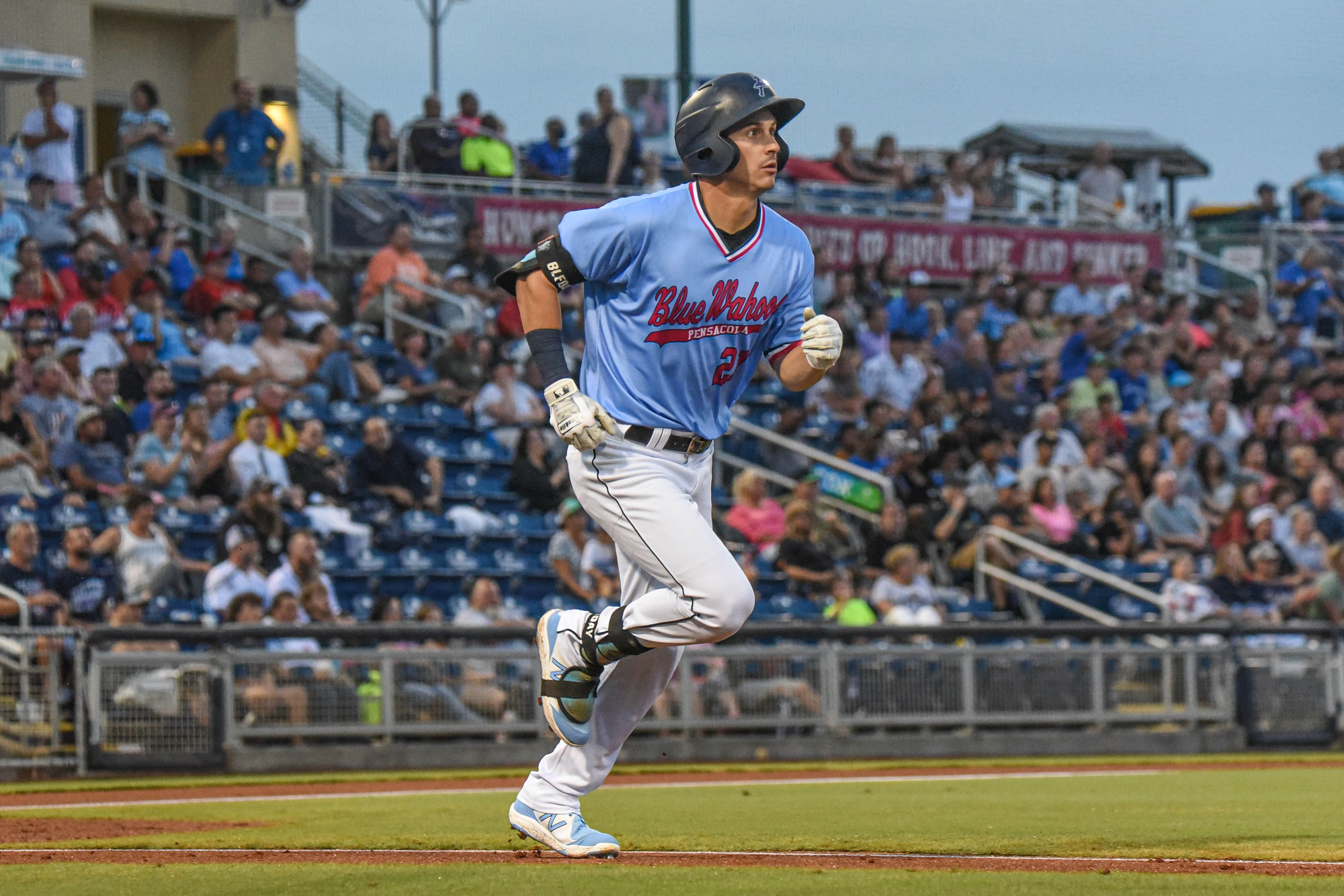 JJ Bleday (Photo by Pensacola Blue Wahoos) At the end of each professional season, each club has at least a few names that surpass expectations and cause the phrases 'who is that?' or 'where did that come from?' to be rhetorically spoken before those names become household fixtures. In 2021, it was Eury Perez, Jake Eder, Troy Johnston and Anthony Bender among others. Who will it be this year and how will they make their mark on 2022 and beyond? Herein, we provide our predictions.*Predictions labeled with SH were made by Sam Hemenway **Predictions labeled with AC were made by Alex Carver -- Bryan De La Cruz hits 20 HR as the Marlins' starting center fielder De La Cruz was a pleasant surprise for the 2021 Marlins, coming over after the trade deadline to little fanfare and playing well enough to project as a starter going into next season. De La Cruz is one of those guys who never had the advantage of having a "top prospect" billing attached to his name, but he has performed at a higher level as he has matured. Combined between AAA (in the Astros organization) and MLB, De La Cruz hit a career high seventeen homeruns in 2021. That was an increase from the eight he hit in 2019, and the first time that he had ever reached double digits in a single season. De La Cruz hit the ball hard at the Major League level, and while his BABIP indicates he was probably a bit lucky on contact, the power is real. If he can keep his strikeouts in check, than De La Cruz could lock in the starting center fielder spot and show some real power over the entire season. Moreover, he would become the first Marlins center fielder to hit 20 home runs in a season since Marcell Ozuna did it back in 2016. De La Cruz could do that while playing far more acceptable defense in center than Ozuna was able to do. Edward Cabrera makes 20+ starts, holds ERA under 4.00, contends for team lead in strikeouts Cabrera had a dazzling minor league career with theMarlins. Selected as an 18 year old in the 2016-17 international signing period, Cabrera flew through the levels, making it stateside his second year pro and all the way up to AA in 2019. Despite the lack of minor league baseball in 2020, Cabrera continued to turn heads at the Marlins’ alternate training site and was on taxi squads late in the season and during the postseason as a candidate to potentially make his debut. Despite a delayed start to 2021 due to an inflamed nerve issue in his biceps, Cabrera returned to the mound in June seemingly no worse for the wear. After two starts in Jupiter, a handful in Pensacola and six in Jacksonville, Cabrera made his MLB debut on August 25th and turned in a 6.1 IP, 3 ER quality start. The rest of Cabrera’s major league tenure was a mixed bag for a couple reasons. For the bulk of his minor league career, Cabrera’s success stemmed from his fiery heat coupled with knee-bending slider, like so: However, as a major leaguer, Cabrera broke out his third pitch changeup much more frequently. In fact, in three of his seven starts, Edward threw the changeup more than his anchor heater that can touch triple digits and that sits at 95-97. While puzzling, the most plausible reason for his increased usage is that Cabrera’s feel for the pitch was being analyzed by coaching against major league pitching during the back end of a lost season. Cabrera’s time with the Marlins gave the staff a better knowledge of where he is his stuff and the work to improve has already begun at the big league level. Looking at Trevor Rogers, Pablo Lopez, Sandy Alcantara and others, Mel Stottlemyre Jr has the ability to fully develop a changeup in the blink of an eye. And Cabrera’s was already useable and further ahead than some of those names as he came out of AAA. With a fully healthy 2022 preseason campaign and spring training, considering what the Marlins’ system does with changeups and with Gold Glover Jacob Stallings joining the fray as the Marlins’ primary catcher, we anticipate Cabrera will pop immediately to begin 2022, defending himself as the top prospect in the organization and as a guy who could one day challenge Alcantara as the long term ace of this staff. Cabrera can be that good. Nick Fortes emerges as one of the best backup catchers in MLB Like De La Cruz, Fortes emerged as a pleasant surprise in his 2021 cup of coffee despite being unheralded as a prospect. His .677 slugging percentage in the Majors is the definition of unsustainable, especially considering it came in just thirty-four plate appearances, but think about the lack of quality hitting that exists at the catching position right now. Look no further than Miami, where Sandy Leon was given 220 PA, at a horrible .183/.237/.267, last season. That is the worst offensive season, by wRC+, for any Marlins catcher with a minimum of 200 plate appearances in club history. It just goes to show the lack of offensive options at the position around the league, and how much defense is prioritized while there are still human beings calling balls and strikes. The Marlins have some options at backup catcher, which should be a fun battle to watch if there is a normal spring training that emerges when the lockout concludes. Fortes had more success than his competitors, Alex Jackson and Payton Henry, at the Major League level and should be the favorite for the job. His ability to make contact is far superior to those two, and his reputation as a defender is on the same level if not better. Ultimately, if Fortes can keep making contact, hit the ball hard, and play solid defense, he will become one of the best backups in the league by default. Having that insurance behind Jacob Stallings will give the Marlins their best caching tandem since the JT Realmuto era. Antonio Velez dominates in the upper minors; makes late season Marlins debut Antonio Velez: the ultimate diamond in the rough. A Miami native and attendee of Brandon High School in Tampa, the 6’1”, 200 pound lefty attended JuCo at Hillsborough Community College before being recruited to Florida State University in 2019. After a respectable season out of the bullpen for the Seminoles in 2019 (44.1 IP, 4.26 ERA, 1.25 WHIP, 47/10 K/BB), Velez allowed just one earned run on a solo shot while striking out 21 and walking just three in 17.1 IP before COVID canceled the collegiate season. The shortened draft also caused Velez to go undrafted but the Marlins signed him shortly thereafter. After a brief appearance in the Puerto Rican Winter League, Velez began his MiLB career at the A+ level. In his first taste of pro ball, Velez was fantastic for the Snappers, holding down an even 3.00 ERA by way of a 0.88 WHIP. The lefty showed off impeccable control and command as he struck out 75 while walking just nine. In September, the 24-year-old made the jump up to the AA level where his success permeated. In three starts and 18 IP for the Blue Wahoos, Velez allowed just one earned run via a 0.78 WHIP while striking out 18 and walking just two. If Velez was going to make it to his capable ceiling, he needed to show it pretty immediately at the professional level. And in 2021, that is exactly what he did. The 6’1”, 200 pound lefty lacks size and has average velocity usually sitting 92-94. The rest of his arsenal — a best pitch biting slider in the low-mid 80s and a useable changeup — is good but not elite. However, Velez makes up for all of that with a mature knowledge for his craft, the ability to mix pitches advantageously and the ability to spot pitches with pinpoint accuracy in all four quadrants. He has also shown the ability to throw outside of the zone with purpose and garner whiffs. It takes more than 26 players to get through a major league season. A pitcher the Marlins have very little invested in as an undrafted free agent, I view Velez as a command-over-stuff guy who limits contact and plays to a ceiling 4-5 starter or multiple innings reliever. Velez should start 2022 back in Pensacola but he should be a quickly promoted to AAA. As either an injury replacement or fresh arm, he should be one of the first guys on call in the second half. Upon his promotion to his home town team, we foresee this under-the-radar arm impressing for the Marlins and earning a permanent spot on the roster. Nick Neidert becomes a part of the rotation by midseason The Marlins have a tremendous amount of pitching depth, to the point where the national focus on this team has become when they will swap some of that pitching for offense. In the meantime, the Marlins have exciting options like Sanchez, Edward Cabrera, and Braxton Garrett able to contribute despite not appearing to be in the Marlins Opening Day starting rotation. One other guy worth noting, who may be the steadiest of the bunch, is Nick Neidert. Neidert has pitched 44 major league innings over the last two years to get his feet wet, and the Marlins should be ready to call on him at the first sign of injury. Neidert is not the most sexy option; he does not throw as hard or strike out as many guys as the Cabrera's of the world. However, what he offers is a pitch-to-contact profile that should limit hard contact and let a quality Miami defense make plays behind him. Neidert has yet to live up to his reputation as a pitcher with exceptional command in the Majors, but hopefully the added experience will have driven out any nerves and slight mechanical issues. Guys who can limit hard contact, and Neidert's changeup is an excellent weapon with that goal in mind, have a tendency to get "hot" for a stretch if the BABIP gods are in their favor. I am betting that could happen if Neidert gets an extended look in 2022. JJ Bleday is the best hitter in AAA in the first half; called up midseason For most of 2021, JJ Bleday was the talk of the Marlins’ system for all the wrong reasons. After posting an overall .212/.323/.373 line in AA Pensacola, the 2019 third overall pick was sent to the Arizona Fall League to continue working on his craft. There, Bleday was a different player. In 24 games, the Vanderbilt product hit .316/.435/.600 and won the league’s Co-Hitter of the Year award. JJ also added to his accolades a Fall-Stars Game MVP. Although the purely offensive friendly scope of the Arizona Fall League this past season should not be understated, what Bleday was able to accomplish after his regular season struggles was very encouraging. Though Bleday truly popped in Arizona, he began to figure it out late in the regular season. After hitting through the first week of August, the lefty slashed .263/.362/.453 in through his last 27 games of the Blue Wahoos’ slightly abbreviated season (the team’s last series was canceled due to COVID-19 concerns). Per his own admission midseason, Bleday was tinkering with his swing all season long. Here is the before (a 3-1 pitch with the bases loaded in mid-July) and after (one of his six AZFL home runs) Not only was Bleday the talk of the Arizona Fall League, he has continued to be the talk of the current development camp taking place in Jupiter. According to Fish Stripes’ Isaac Azout, Bleday stated he put on more than 15 pounds. During a sim game on February 12th, Bleday used his newfound approach and size to go yard on the first pitch of an at bat. Bleday has always had the tools to succeed as a major leaguer. After a lost 2020 season, he had to learn how hit professional pitching at the most difficult level of development. Not shying away from admitting he had adjusting to do, it took Bleday some time but he finally found his comfort zone late in the season. Then he went to work in the gym and has returned to the Marlins looking more like a physical representation of one of the strongest guys in the organization, Peyton Burdick than the former version of himself. Inasmuch as 2021 was the winter of JJ Bleday, 2022 will be the summer of JJ Bleday. I foresee him starting his age 24 season in AAA Jacksonville and having a first half as impressive as Jesus Sanchez’s 2021 campaign. He gets the call to the Marlins in July after the trade deadline and carves out his role as the Marlins’ long term left fielder. Peyton Burdick is the starting DH by September The designated hitter in the NL was long rumored to be an inevitable outcome of whatever is agreed upon in a new CBA, and commissioner Rob Manfred confirmed as much this past week. That opens up an extra spot for the Marlins offensively, which should be beneficial considering two of their top hitters from a season ago, Garrett Cooper and Jesus Aguilar, both profile as first basemen. Cooper and Aguilar could be trade candidates at midseason, however, if the Marlins are still a year away from playoff contention. Many expect that to be the outcome; could a youth movement be the result in the second half of the season? Lewin Diaz would slot in at first base due to his exceptional glove, while a young hitter like Burdick could benefit from the addition of the extra offensive slot in the lineup. Burdick, a stocky corner outfielder out of Wright State, has hit at every level despite never getting much attention. He has hit to the point of finally getting some attention on prospect lists, and slugged 23 HR with a 137 wRC+ in 2021 at AA-Pensacola. A brief cup of coffee at AAA prior the season's expiration showed that Burdick is knocking on the doors of the Major Leagues. As long as he keeps hitting in 2022 at Jacksonville, and there is no indication with this track record that Burdick will do anything but hit, he should be given a chance to play with the Marlins. Burdick has a quality arm, but not great range in the outfield, meaning that he could be given his first Major League chance at DH in order to get his bat in the lineup. Eury Perez is the best pitching prospect in baseball by the end of the season Eury Perez is skyrocketing up prospect lists at a meteoric pace; Baseball America, Baseball Prospectus, and The Athletic's Keith Law all included him in their recent Top 100 Propsects lists. Perez will only turn nineteen years old in April, and was not included on any of these lists a year ago. The following line is a solid way to vault one onto the radar of the experts who put these lists together: 78 IP, 1.96 ERA, 108 K, 26 BB, 0.89 WHIP. Minor league statistics are notoriously fickle, and they should not be given too much weight. However, when a pitcher this young dominates two levels it is always noteworthy. Look at it from this perspective: Perez pitched exceptionally well at two levels of A-ball last season at a time when most players his age are still seniors in high school or freshman at college. To perform that well at such a young age, while also being 6'8, 200 lbs., and hitting the upper nineties in velocity, is sure to garner some warranted attention. The sky is truly the limit for Perez. He was the youngest pitching prospect on Law's Top 100 list, showing how unprecedented his success has been. As some of the older pitchers graduate off of the list, Perez can move past the remaining prospects if he has another season that shows scouts just how much potential he has. Ronald Hernandez breaks out; emerges as top organizational prospect Since Eury Perez lit the world on fire and became a top prospect after signing his international contract in 2018, the question has often been posed: who in this Marlins’ system is next? My answer: Ronald Hernandez. Hernandez, a Venezuelan catcher, came to the Marlins as part of the 2020-2021 international signing class. His bonus: $850,000. While he may not come as quite a surprise as Perez who signed for just $200,000, he is coming fast. And this past October, he just turned 18 years old. Hernandez is a switch hitter. Looking at his 2021 splits which heavily favored his performance from the left hand side. However, in a small sample, Hernandez was able to show similar plate discipline from the opposite side. Against lefties as a right handed batter, he had a 10/6 K/BB. Hernandez is also a right handed thrower leading to the assumption he will catch up his bat to ball skills from the right side which he has all the time in the world to do. Hernandez has shown a good approach and a selective line drive swing with uppercut that could eventually come by more power. The one knock on Hernandez that inhibits that is his lack of projectable size. He comes to the Marlins listed just 6’1”, 155, leading to questions surrounding his muscle as well as his ability to stick at the catcher position. But the Marlins are opening a brand new state-of-the-art Dominican Academy this season and Hernandez is already making use of the club’s stateside facilities as a participant in the current development camp. In addition to reaping the benefits of stateside facilities and his coaches’ tutelage, on the field this winter, Hernandez is both facing off against and receiving as high as AA pitching, experiences that should be considered invaluable for one of the youngest players on the development camp roster. Already with a lot of intangibles out of the way at age 18 with fantastic athleticism, good receiving skills, an accurate arm and the ability to stick as a switch hitter, Ronald Hernandez has youth and the means on his side to pop in 2022 and potentially become the top catching prospect in the Marlins’ organization.
 -
View full article
-
Cup of Coffee Scouting: Lessons Edward Cabrera Can Take Into 2022
Alex Carver posted an article in Marlins
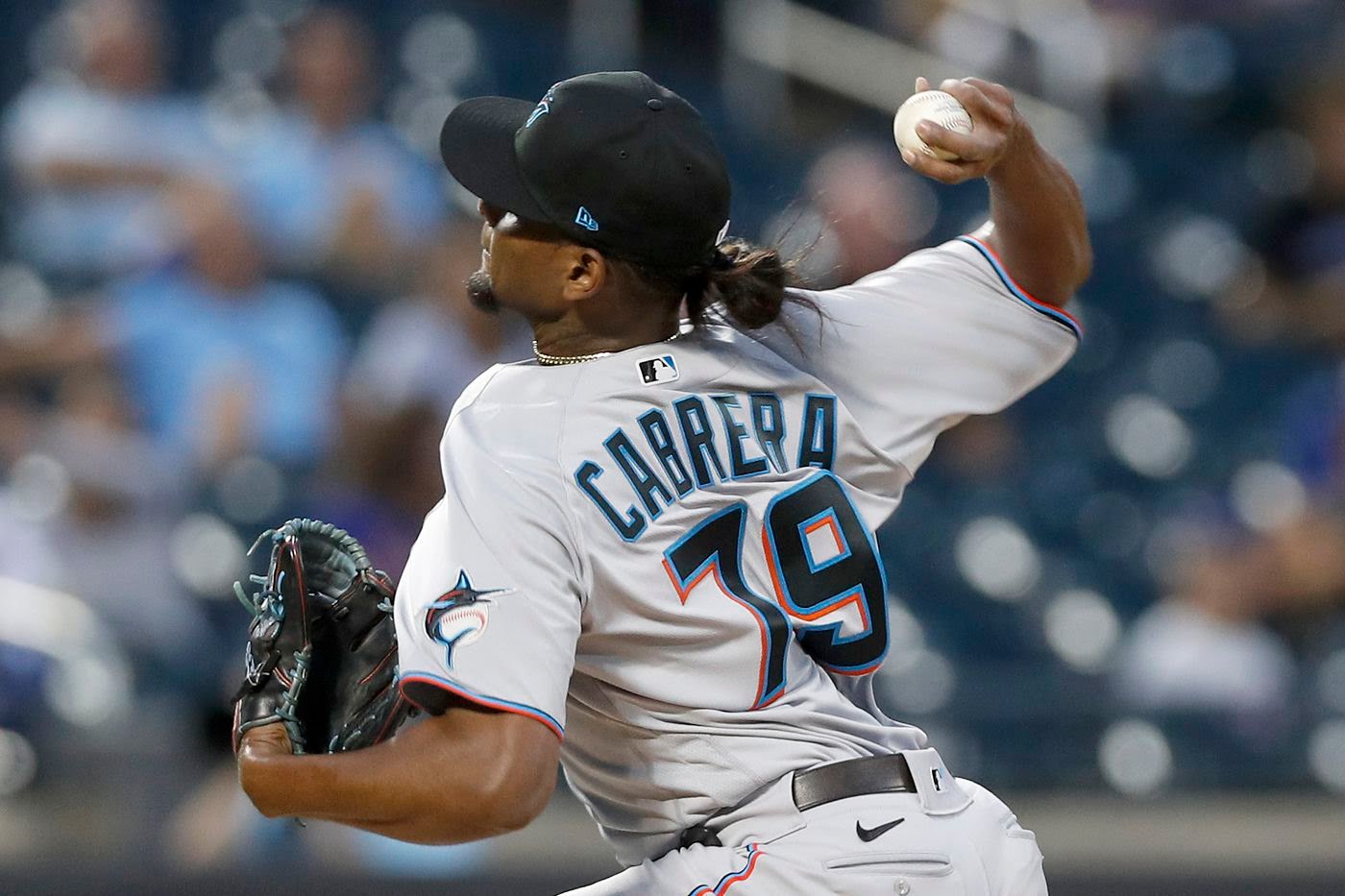 Edward Cabrera's highly anticipated debut came this past season, with the touted prospect throwing the first twenty-six and a third innings of his Major League career. That came over seven games started; Cabrera only threw more than four innings in one start. As the soon-to-be twenty four year old looks to make improvements heading into next season, going deeper in games will certainly be high on the wish list. How can Cabrera accomplish that goal? I went through Cabrera's first seven Major League starts to try and find an answer. My conclusion: Edward Cabrera is going to be a very good Major League pitcher. The fastball, athleticism, movement, breaking balls... there is too much here to not result in an impressive big leaguer. However, it was not long ago when Cabrera was considered to be a likely relief pitcher. The development of his slider and changeup as he matured resulted in this becoming a starter's profile, but command remains the biggest area for improvement before Cabrera can take that next step. It is important to keep in mind that Edward Cabrera has a unique repertoire. His 2021 pitch mix was fairly evenly distributed among four pitches: Pitch Type% of Pitches ThrownAverage Velocity (mph)4-Seam Fastball38%96.9Changeup24%92.2Slider20%87.8Curveball17%83.8Statistics Found via FangraphsFastball Throwing such a low percentage of fastballs is not unheard of, but is unusual, especially for a pitcher so young. One of the first thing scouts are looking for is velocity; Cabrera having a fastball that sits 95-97 and can touch triple digits gained him a lot of notice. Velocity is not everything though, as Cabrera struggled with his ability to command the pitch in his MLB starts. I think this may in part be due to Cabrera trying to make the fastball something that it is not. For instance, Cabrera's pitch has a lot of "tail" on it. The fastball has more of a 2-seam look to it at times, because it is sinking so much and has horizontal movement. Cabrera is massive, at 6'5, and the ball is coming in on a downhill plane. That fastball movement pairs very well with operating low in the zone, getting ground balls, and working with an effective changeup and slider. But, Cabrera does not use the pitch in that way. Instead, he tried to throw it up in the zone often to change the eye levels of hitters. That can be an acceptable strategy, but the movement of the pitch would be much more appropriately located with the goal of getting ground balls in mind. It is not enough of a swing-and-miss generating pitch to be used up in the zone. Commanding this pitch is easier said than done. Cabrera had several starts where he had to take something off of the fastball (sitting more around 94-95) in order to get it over the plate. That is less than ideal, so Cabrera needs to make sure he can throw the pitch at it's usual velocity for a strike when he needs it. In his September 7th start at home against the Mets, Cabrera made the mistake of throwing consecutive fastballs at the top of the zone to Pete Alonso. The first one got by, but the second sunk right into the bat path of the powerful Alonso. That sinking fastball is going to look attractive to hitters with high launch angles like Alonso, especially if it is thrown up in the strike zone. That is running right into the bat path of these powerful sluggers, as Cabrera learned to his detriment. Curveball Moreover, Cabrera's secondary pitches profile better for a groundball pitcher. He does not possess a big, 12-6 curve like many pitchers who throw up in the zone consistently do. Those pitches pair well together, for a variety of reasons including tunneling, and make it difficult on the hitter. Think of Justin Verlander or Walker Buehler as these styles of pitchers. They have the type of fastballs that hitters often describe as "rising" (even though this is not actually the case). The curveball is the pitch in Cabrera's repertoire that has the most vertical break, but it is still not a traditional 12-6 breaker. Instead, it is a slightly slower, more vertical version of the slider. Many scouts did not differentiate between the two pitches because of the similar shape to the pitches. But, Cabrera did use the pitches a bit differently in his 2021 starts. He liked to use the curveball as a "get-me-over" strike in 0-0 counts, and for the most part it worked well to surprise hitters. Cabrera not working in a traditional way was effective in this regard. In his second start, against the Mets, he managed to induce two double play balls off of the curveball because he was not afraid to throw off speed pitches in non-traditional counts. It led to some timing issues for hitters, which became awkward swings and weak contact. In this regard, Cabrera was quite successful in using his curveball. It had the highest pitch value of any of his four offerings in 2021, in part because hitters were so rarely expecting it. Also, Cabrera was able to control the pitch better than any of his other offerings. It was the only off-speed pitch that was actually in the strike zone for the majority of it's offerings from Cabrera. Slider The slider was the pitch that had scouts most excited about Cabrera entering last season, with both Fangraphs and MLB Pipeline rating it as his best off speed pitch. However, there may have been some disagreement with classifying his curveball versus the slider. In his Major League cup of coffee, the curveball was Cabrera's better pitch because he threw it in unexpected counts and was more consistently able to get it over the plate. Still, the slider was easily the pitch that Cabrera was able to command best, other than the curveball. He was often able to get it in on left handers, for a sort of backfoot slider. In his September 18th start against the Pirates, Cabrera effectively located the slider twice in the first inning for swinging strikeouts. It was his best put-away pitch in many scenarios, and resulted in the highest swinging strike percentage of any of his four offerings. This pitch can work so well when paired correctly with the fastball, because it is thrown at a high velocity still while completely breaking in the opposite direction of the tailing fastball. Both pitches work well in the bottom of the zone. Where Cabrera got into trouble with the slider was leaving it in bad locations. Because the pitch is thrown at a high velocity, it can get hit hard if it is left over the plate. This was the case in a few situations where Cabrera was trying to use the pitch as a backdoor slider against lefthanders, but it ended up flat and over the plate. Changeup The pitch that Cabrera struggled with the most in 2021 was the changeup. Yet, this still has the potential to be a plus pitch because of the spin and movement on it. Frankly, it should not be an easy pitch to hit. When located well, it is a downward moving, spiraling pitch that results in some ugly hacks. It is only a few ticks slower than the fastball, which is not typical, so it is not working in the way changeups traditionally do. As a result, Cabrera is not afraid to throw it to right handed hitters. Traditionally, changeups were taught mostly as a weapon against opposite-handed batters. The way Cabrera chose to throw it resulted in a lot of problems. This may be due to mechanical issues that Cabrera and the Marlins coaching staff needs to work through, but Cabrera was often trying to locate the pitch low in the zone and it ended up hanging over the heart of the plate. In his first two big league starts, Cabrera gave up three home runs, all of which came on changeups. He was trying to use it as his out pitch, but it ended up catching too much of the plate. https://twitter.com/Nationals/status/1430701249985490945At other times, Cabrera was not able to get the pitch close enough to the plate. Finding this balance will be imperative in 2022; Cabrera needs the pitch to be competitive enough to entice hitters to chase, while also not catching too much of the zone. Only 44% of his changeups actually ended up in the strike zone. When hitters know that the pitch will often be a ball, they can hone in and look at it only in an ideal location. This led to some trouble for Cabrera with the long ball. This make sense; as a slightly slower version of his fastball, it will be hit hard if it is left right over the plate. Summary Cabrera clearly has a lot of trust in his off-speed pitches, as evidenced by how often he throws them. But, the sinking changeup and the devastating slider work better when paired with that tailing fastball at the bottom of the zone. Those are all pitches that work best low in the zone, so it makes sense to throw them off of each other. The classic "sinker-slider-changeup" type of pitcher does not describe Cabrera perfectly, as his fastball is still a 4-seamer that can be used up in the zone. However, because of it's typically tailing movement, Cabrera may be better off adjusting his own approach and trying to throw it lower in the zone to work more effectively with his other pitches. In Cabrera's final start of the season, in New York against the Mets, he made one notable change that could be a sign of things to come in 2022. He threw fastballs for over 50% of his pitches in that start, which was the first MLB start in which Cabrera had done that. Commanding that pitch is not easy for Cabrera; he walked several batters, and threw five consecutive fastballs out of the zone at one point. However, I think that it is a good sign in that he is trying to build his pitches off of one another. His breaking pitches will be much more effective against MLB hitters when they have to keep the 97 mph fastball at the top of their mind. Ultimately, it may not be the sexy approach, but I think it will lead to Cabrera having the most success in the Major Leagues. Embracing the strengths of his current arsenal will make Cabrera a ground ball pitcher with the ability to still get swings and misses with his breaking balls. This will all have to start with Cabrera gaining a better feel for when to throw his pitches, and not having quite as even of a distribution among the four pitches. Of course, as previously noted, the best thing that Cabrera can do for himself in 2022 is improve his command. That could include his control, as his BB% of 15.8 was far higher than any Major League pitcher will be able to have success with. In a limited sample size, that should not be too much to worry about. Many pitchers struggle throwing strikes early in their Major League careers, as they adjust to nerves, mechanical aspects, and throwing against the world's best hitters. But, if Cabrera can just gain a bit more confidence in getting his fastball over the plate, he will find that hitters will have a much harder time laying off his filthy secondary pitches.
 -
View full article
-
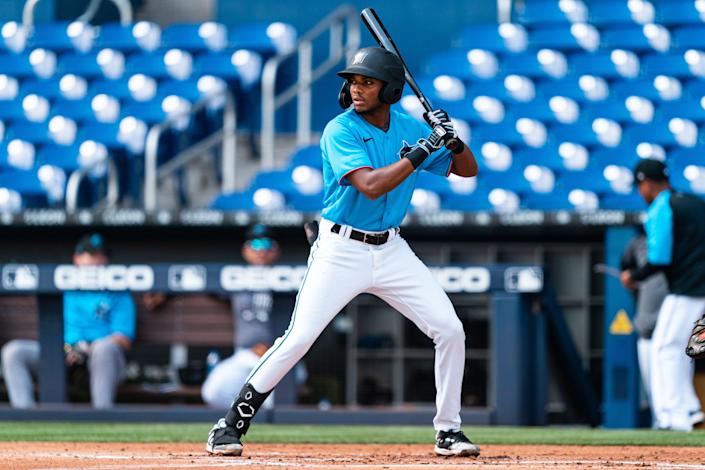 As we grapple with the increasing probability that the lockout will cause, at the very least, a significant delay to the start of the 2022 season, some preseason baseball talk has at least reestablished the hope that Spring will truly arrive eventually. Baseball America and Baseball Prospectus published their annual Top 100 Prospects lists this past week, giving all baseball fans something to distract themselves from the bitter relationship between the big leaguers and the owners. The Marlins featured prominently in those lists, with top prospects Max Meyer and Kahlil Watson among the players to appear. Those players have already cemented their status as top prospects due to amateur hype and minor league performance. The question being examined here is who shall follow their path this season and emerge one year from now as a Top 100 prospect from the Marlins system. For one who is not currently on the list to rise in the experts’ rankings, they will require a breakout season in 2022. Here are ten Marlins prospects who I could see rising to that status by this time next year, in advance of the 2023 season*: * Prospects recently signed during the International Free Agency Period were not included during this exercise. While it is possible that a few could emerge on these lists by next season, we have no idea when they will be debuting with the uncertainty of the pandemic, lockout, etc. Waiting for them to debut first will allow us to form a better judgement next year on players who are so young. Jose Salas, SS 2021 (Rk-A): .305/.391/.405, 14 2B, 2 HR, 51/22 K/BB, 14 SB The main concern for the young Venezuelan prospect entering last season was his ability to make contact consistently. Salas had never appeared in a professional game prior to this season, due to signing late in 2019 and then the pandemic wiping out the 2020 minor league season. So, scouts were eager to see how the hit tool would look with Salas finally in uniform. He put some of those concerns to rest by posting a K% in the low twenties, a reasonable figure at any level. If he can keep the rate below 30% as he jumps through the minors, then Salas should be able to reach the Majors as a power hitting shortstop. That package is always a valuable one, especially with the additionally interesting characteristic of Salas being a switch hitter. Salas also offers some speed, with 14 SB over two levels last season. At 6’2 and nearly 200 pounds, Salas is growing into more power, but there is some concern about his staying at shortstop over time. The Marlins auditioned him at second and third base, so the added versatility should only keep Salas’ stock trending upwards. Some scouts also think his profile would fit in center field. Either way, this is an athletic prospect who should keep getting better. Ian Lewis, 2B 2021 (Rk): .302/.354/.491, 10 2B, 5 3B, 24/11 K/BB The top Bahamian prospect in the 2019 International Free Agent Class, Lewis looked the part in his first professional action following the cancelled pandemic season. He impressed scouts with his ability to make contact, posting just a 14.9 K% in rookie ball. The approach at the plate will need polishing, as Lewis did not walk much and was very aggressive. But, the physical tools are there. The elite trait that Lewis possesses is speed, which is beneficial on the basepaths and in the field. He was playing second in the Florida Coast League mostly due to Salas getting the nod at shortstop, but held his own there and should be able to do the same at short. Lewis is not huge, at 5’10, but does possess some pop that will probably manifest in gap-to-gap power. Once again, Lewis being a switch hitter makes his profile even more appealing. Joe Mack, C 2021 (Rk): .132/.373/.208, 22/20 K/BB Mack passed up a scholarship to Clemson to sign with the Marlins after being drafted thirty-first overall in last year’s amateur draft. He possesses that aesthetically pleasing profile of a lefty hitting catcher, with a gorgeous swing to match. His slash line from a brief Rookie ball debut indicates that Mack has great plate discipline, which was known going into the draft. His struggles with the bat, especially with slugging, is not surprising considering Mack is from New York. Players from cold-weather states typically need to be given a little bit more leeway, as they are not used to playing year-round and typically take a little longer to develop. That should excite Marlins fans, as Mack should continue developing, while it is also clear that he already has the right approach at the plate. Moreover, Mack is expected to stay at catcher as he develops due to a strong arm and plenty of athleticism. Making solid contact this season should be all it takes to get Mack on prospect lists next season. Nasim Nunez, SS 2021 (A): .243/.366/.265, 46/35 K BB, 33 SB Nunez has played just over one hundred minor league games now and has racked up over sixty stolen bases in the process. Prospects with one elite tool can be easy to dream on, and Nunez has one of those tools in his speed. With a success rate over 80% on those stolen bases, Nunez has the potential to be a special base runner. That speed translates very well into the field, where Nunez may be the best fielding shortstop prospect in the system. Furthermore, his arm should be strong enough to stay at the position long-term. Like Mack, Nunez passed up a Clemson scholarship to enter the draft. He needs to keep working on making contact consistently in order to maximize his strength on the basepaths. This will never be a power profile, but one has to like the approach Nunez takes at the plate. He needs to be a bit more aggressive, btu he clearly recognizes speed as his strength and tries to get on-base as a result. If Nunez can just show a little more promise with the bat, then the defense and speed will easily make him a prospect to get excited about. Yiddi Cappe, SS 2021 (Rk): .270/.329/.402 While prospects like Nunez possess an elite trait that makes them projectable, others just physically appear to be future monsters. Cappe would fit into the latter category, with a 6’3, 175 lbs. frame that, at nineteen years old, has room for growth. Cappe already showed an ability to hit the ball hard to all fields in his 2021 professional debut, and scouts expect the power to continue to grow. He is such a promising athlete that Cappe does have the potential to stay at the position, despite his size. Few shortstops have played the position at that height, although Carlos Correa comes to mind. Cappe is that exciting as an athlete. Fangraphs described Cappe as “toolsy” before last season, which perfectly describes why scouts will be excited about him if the production starts to come in the lower levels. Jordan McCants, SS 2021 (Rk): .224/.286/.237 McCants passed up a scholarship to Mississippi State to sign with the Marlins after being drafted in the third round of last year’s draft. In a brief Rookie ball debut, McCants displayed an all-fields, line-drive approach that scouts saw in high school. He struck out more than expected, but scouts do like McCants ability to make contact consistently as he begins to climb up the minor league ladder. More power should also come, as McCants is over six feet tall and should keep adding on muscle. That may not manifest itself in huge homerun power, but hopefully McCants can play gap-to-gap with his speed and athleticism. McCants does have the range to play shortstop, but may move to second base due to a lack of arm strength. Similar to all the guys listed above him here, McCants’ abundance of athleticism will allow him some room for error though, as he could play any of the up-the-middle (SS, 2B, CF) positions well due to in-game speed. Yoelvis Sanchez, OF 2021 (Rk): .151/.311/.279 Sanchez finally saw the field for an extended time in 2021 and showed some of the tools that scouts are excited about. He has the speed to be an up the middle player that can stick in center field. There is a lot of swing and miss in his game right now, but it is only concerning if it continues to happen for someone so young. For now, he is a projectible, athletic bat who is must-watch in 2022 to see if there have been improvements made at the plate. With a 6’2 frame, the lefty Sanchez has the sort of athleticism that can lead to breakouts and quick improvements. Dax Fulton, LHP 2021 (A-A+): 78.1 IP, 84 K, 38 BB, 4.60 ERA This pick feels a bit like cheating, as Fulton did appear on the Baseball Prospectus Top Prospects list this week. However, he has largely flown under the radar, and did not appear on the Baseball America version. He is clearly trending upwards, so it feels like a good bet that Fulton will be on more of these lists next season. Fulton was the Marlins’ second round pick in 2020, but was unable to debut until 2021 due to the pandemic and Tommy John surgery in his senior year of high school. That he showed so much promise in that debut is very exciting, considering Fulton had not been able to pitch in such a long period of time. At 6’7 and 225 lbs., Fulton has the look of an intimidating, monster left handed pitcher. He struck out batters at a high clip last year due to a fastball that sits in the mid-nineties, paired with a curveball that generates a lot of swings and misses. The fastball has a lot of downward movement, leading to an abundance of ground balls. The lack of a third pitch could lead to this being a reliever profile down the road, but Fulton did make progress with the changeup last year. If that keeps developing, he will be projected as a 2-3 starter and will be on all of these top prospect lists a year from now. Evan Fitterer, RHP 2021 (Rk-A): 30.1 IP, 33 K, 10 BB, 4.15 ERA Fitterer was one of the top high school arms in the 2019 draft, but fell to the 5th round due to a UCLA commitment. The Marlins had to give him the equivalent of second round money to entice him to sign. Fitterer is polished for his age, with a four-pitch mix that points to this being a starters profile. All four pitches project as average eventually, and the fastball has sinking action that results in a lot of ground balls. A little more velocity would make that pitch more interesting, and there is a chance for that considering Fitterer’s age and size. His control greatly improved in 2021, with a very low BB rate. That came in a small sample size, but it would be a great sign for Fitterer if that continued considering he lacks a truly dominant out pitch. He was described by MLB Pipeline as a potential Kyle Hendricks with better raw stuff, which is obviously high praise. Jake Eder, LHP 2021 (AA): 71.1 IP, 99 K, 27 BB, 1.77 ERA This is the biggest wild card on this list for a disappointing reason; Eder is not expected to pitch in 2022 after having Tommy John Surgery at the end of last season. If Eder was a Major League pitcher who could contribute to a pennant race, then he might be brought back towards the end of this summer. The knock against Eder going into 2021 was a lack of control, but he was incredibly effective in the Minors because he was able to limit the walks. A 9.4 BB% is not exceptional by any means, but with Eder’s stuff it is good enough to have success at the lower levels. Eder was a first round talent coming out of high school, but stuck to his Vanderbilt commitment instead after being drafted later by the Mets. He had an excellent college career, including closing out a CWS, and showed a fastball that could absolutely play at the next level. The slider is also a plus pitch, and there was some concern he’d be a reliever because the lack of a third pitch and control issues. Yet, Eder developed a decent changeup last year that was not easy on minor league hitters. 2021 was such a promising year for Eder that he should be on the radar for prospect experts the second he returns to the mound, with the hope that he maintains his velocity and the control has not slipped too much.
 -
View full article
-
Adrian Lorenzo Puts Vision for International Operations Into Focus
Alex Carver posted an article in FOF Prospects
Photo by Miami MarlinsAdrian Lorenzo has been working with international prospects in player development for nearly a decade. Now, he will be in charge of developing a system they are forged in. A home town product and a player during his high school days at Belen-Jesuit High School and college days at the University of Pennsylvania, Lorenzo broke into the professional side of the game as an intern for an agency as an assistant to Latin players in 2011. In 2013, he accepted a baseball operations internship with an MLB team, the Red Sox. Eight years later, Lorenzo is back home in the biggest chair he has ever occupied. On January 12th, the Marlins named Lorenzo their senior director of international operations. Lorenzo replaces his outgoing predecessor whom he worked very close with since 2018, Fernando Seguignol. “As an intern back then you were just happy to get any kind of job. To think this far ahead that it could progress to this would’ve been best case scenario,” Lorenzo said. “To do it for any team then to do it with your hometown team that I grew up watching my whole life and rooting for, my parents went to their first game. I grew up a Marlin. So to do it here is very special.” Lorenzo takes the reigns at a very exciting time. Up until now, the Dominican Summer League Marlins played at Academia de Prospecto Complex which belongs to the Cleveland Guardians. In 2022, the club will move into their very own, brand new, state of the art facility. The Marlins broke ground on the facility last June and it is expected to be ready for occupancy this summer. The facility features three playing fields as well as a training field, batting cages, a two-story office building, living quarters, a weight room, educational classrooms and more. Speaking in front of a photo of the facilities’ renderings, Lorenzo was all smiles when speaking about where it will take his department and the Marlins’ presence and growth in Latin America. “I think we are about to have far and away the best complex in the Dominican Republic. There aren’t any complexes in other countries so I would say it’s one of the better complexes in the whole world,” Lorenzo said. “The speed with which it’s going; the scale of it, when you step into it, it’s astounding the scale of it.” Lorenzo went into detail about the player and staff amenities the complex will offer. “The admin building is not just admin; it’s clubhouses, locker rooms, offices, classrooms, computer labs, space for two teams and for tryout players to come in as well, offices for the international scouting staff, player development coaches,” Lorenzo said. “Dorms for players: we are going to have 112 beds for players to come in and even more for staff; we are going to have staff suites and staff dorms and places for them to stay as well.” During this international free agent signing period, the Marlins were very aggressive, signing nearly 40 players so far. According to Lorenzo, the pending opening of the complex and the addition of a second DSL team paved the way for his team’s strategy to spread their bonus pool of just over $5 million around, bringing in many names they believe could be future big leaguers. “I can’t overstate just how much this impacts the organization in terms of establishing our presence in Latin America which is our goal to kind of lead that charge. I think it’s a really viable way to grow your organization,” Lorenzo said. “We’re the Miami Marlins. We are the gateway to Latin America. It’s pretty important that we have a pretty big presence.” Headlining the Marlins’ class this year is infielder Yoffry Solano, MLB Pipeline’s 44th ranked prospect. He earned a $750,000 signing bonus, expected to be, by far, the most lucrative bonus given out by the Marlins in this year’s class. Lorenzo said Solano personifies a lot of what he and his team look for in a prospect. “He’s a guy we’ve had our eye on for quite a bit of time. An up the middle profile player, really strong pound for pound, really twitchy with switch hit ability. He could really perform for us in a lot our evaluations especially offensively,” Lorenzo said. “He checks a lot of the boxes that we like in terms of up the middle athletes with athletic twitchy actions and a chance to hit.” Lorenzo’s excitement and confidence in his inaugural signing class is not limited to just Solano. “We could eat up a few hours just talking about those types of (under-the-radar) players. I have high levels of excitement for each of them.” Lorenzo said before calling out multiple names including OF Antony Peguero, RHP Jhon Cabral, RHP Santiago Suarez, OF Toby Simmons, IF Cherif Neymour, IF Lisandro Bonifacio and others as names that we may hear about “in short order” it’s they start their careers this coming season. While the Marlins and baseball as a whole have focused mostly on the same countries in recent international signing periods, Lorenzo said he wants to begin explore drawing from other markets in the future. “This period we’ve been as aggressive in Venezuela, we’ve been pretty aggressive in the Bahamas which is a market I hope we have identified as being on the upswing… the Mexican player market is also quite interesting, Colombia, Nicaragua, Curaçao is a favorite of mine,” Lorenzo said. “We are very much open to signing players from all places. At the moment, the priority countries have been the DR, Venezuela, Cuba, Bahamas. But we will continue to adjust as we see fit.” Behind the expertise of Lorenzo and his staff including new international scouting director Roman Ocumarez, the Marlins are primed to become the beacon for young professional baseball players in Latin America. Due to the work currently being done by this department, the Marlins will be a preferred destination for international prospects and they will be cared for and developed better than ever. In creating a sustainable winning organization and feeder system, this is a very significant step. -
View full article
-
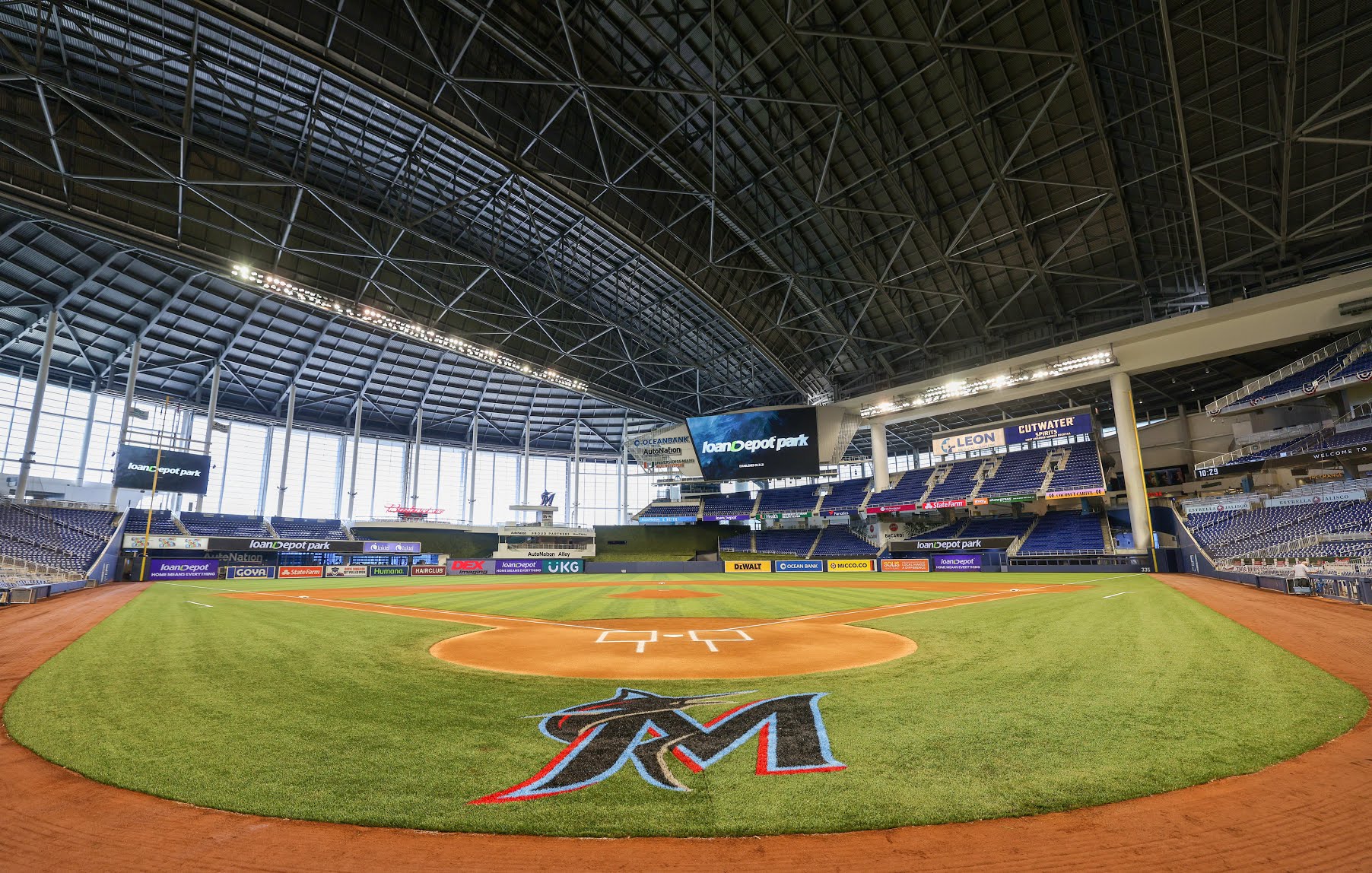 Much has been made of the focus the Marlins should have on improving their offense if they want to take the next step from promising young team to playoff contender. The seeds of such a plan were laid in 2019, when the Marlins swapped elite pitching prospect Zac Gallen for a similarly highly touted position player in Jazz Chisholm Jr. There is a chance that both teams could end up being satisfied with the results of that trade, which is rare in any scenario. Yet, two seasons later, the Marlins still have a clear organizational strength in pitching. On the MLB Pipeline Marlins Top Prospects List, five of the top seven Marlins prospects are pitchers. That list does not include young pitchers who have already made a notable impact in the Majors, such as Sandy Alcantara, Pablo Lopez, and Trevor Rogers. Compared to the position players, where only Chisholm has emerged as a truly promising young position player, the Marlins have a huge imbalance in their organization. This is not necessarily a problem, as great teams have been and will continue to be built on pitching. However, no Major League team is competing for a title when ranked in the bottom of the league in most offensive categories. That was the case for the 2021 Marlins, who ranked 13th in runs allowed, but 29th in runs scored. Truly, all runs are created equally though. A run saved is just as valuable as a run earned, and a ranking of thirteenth in runs allowed shows that the Marlins do have some room for improvement in that regard. The team ranked seventh in the Majors in Defensive Runs Saved, according to Fangraphs. However, out of those 55 runs saved, 24 came from four prominent Marlins who are no longer on the team (Adam Duvall, Lewis Brinson, Magneuris Sierra, and Sandy Leon). Small sample defensive stats are known for being untrustworthy as well, and it is worth noting that Miami only placed 18th in MLB in Statcast’s Outs Above Average measure. So, while the obvious fix may be to acquire big sluggers who can boost the Marlins offense, finding defensive improvements could be the better bargain. It seems like the Marlins front office could be thinking along these same lines based on their pre-lockout acquisitions. In a trade of organizational pitching depth for a position player, Miami managed to land Pittsburgh’s Jacob Stallings to be their new starting backstop in 2022. The 2021 Gold Glove winner was deserving of the award, with a +21 DRS and +8.8 in framing runs saved. Those are elite defensive statistics, and Marlins pitchers should love throwing to Stallings with all the extra strikes he can get for them. Moreover, Stallings represents a massive upgrade from last season when no Marlins catcher saved over 2.4 runs via framing. Stallings remains under team control for three more seasons, which makes him a valuable and cost-effective piece for the Marlins. A starting catcher who can hold his own with the bat, as shown by Stallings’ .246/.335/.369 and 95 wRC+ in 2021, has not been seen in Miami since JT Realmuto was traded. Don Mattingly should be able to pencil his name into the lineup and not think twice about it. Another defensive improvement was also made in the Avisail Garcia signing. While the acquisition is certainly being made with the hope that Garcia’s big bat will thump in the middle of the Miami lineup, his glove is also nothing to scoff at. Garcia was +8 in right field for Milwaukee last season. Defensive metrics have not always been as kind to Garcia, and he could have benefited from the great range of fellow Brewers Jackie Bradley Jr. and Lorenzo Cain. However, as long as Garcia can hold his own it should prevent the Marlins from playing less worthy outfielders out of position, as they were forced to do with Garrett Cooper and Jorge Alfaro in the past. So, come the end of this lockout, I will be looking to see if the Marlins can continue to make defensive improvements that will benefit the pitching staff. Statcast’s wOBA on contact measures the quality of contact that opponents generate against Marlins pitching. Their .361 wOBA on contact was a respectable ninth in the league, while their expected wOBA on contact of .365 shows that Marlins fielders did an adequate job of turning outs into runs. However, compare it to an elite defensive team in the Cardinals. The Cards defense turned an expected wOBA on contact of .365 into a .332 actual wOBA on contact. So, their pitchers were performing similarly to the Marlins squad, but the defense was making the difference. The Marlins and Cardinals would make a ton of sense as potential trade partners. St. Louis has great defenders all around the diamond, but still lacks starting pitching depth even after signing Steven Matz to a multi-year contract. The framework of a deal could include elite defensive centerfielder Harrison Bader and the recently benched Paul DeJong. Both are under team control for multiple seasons at reasonable rates, making them incredibly valuable. It would take a sizable package in return, but both Bader and DeJong would represent defensive upgrades that would also fortify Miami’s lineup. If a DH is added into the NL, then signing Kyle Schwarber or Nicholas Castellanos would make a ton of sense for Miami. It would provide a much-needed slugger without having to play a poor fielder. Ideally, that ends up being the scenario, and then the Marlins can focus on improving their defense instead of just looking for bats. One potential position to pursue could be up the middle defense. Statcast’s OAA measure did not view Jazz Chisholm or Miguel Rojas favorably, and the measurement factors in range considerably. Both rated better by DRS, which is worth noting, but an improvement could at least be made in finding an adequate backup for those middle infield positions. Isan Diaz cost the team -7 OAA, and was also dreadful with the bat. Miami could hope to let him develop further in AAA, while finding a stopgap to handle the position in 2021. Joey Wendle should be able to help in this area, although he played more at third base last season. All in all, when examining the Marlins roster as currently constructed, it is clear that they have already made some defensive upgrades. Garcia, Stallings, and Wendle will all be able to contribute and turn more balls in play into outs for their pitchers. This will be vital as the Marlins try to develop a run suppression machine through their plethora of elite pitching prospects. More can be done however, beyond just focusing on adding offense for the rest of the offseason. Giving Lewin Diaz more playing time would be another way to further improve the defense, although Mattingly will have to weigh that against keeping the big bats of Jesus Aguilar or Cooper in the lineup. Another area for defensive improvement the team has already considered is center field, where we know the Marlins were in the bidding for bringing back Starling Marte. Clearly a weak spot in the current depth chart, a solution may have to be found on the trade market. However, a monumental move for a star like the Orioles’ Cedric Mullins, or the aforementioned Bader, would be a great way to improve on both offense and defense. The Cardinals were carried by their great defense into the postseason in 2021, showing just how much a great defense can save runs for their pitchers. The Marlins should hope to do the same in 2022. With the highest ground ball percentage allowed in baseball last year, Miami will need infielders who have the range to make those plays.
 -
View full article
-
 Photo by A. Messerschmidt/Getty ImagesAfter the major league dream is realized, another takes its place: making it to Cooperstown as a Hall of Famer. Every year, the Baseball Writers Association of America holds those aspirations in their hands when they fill out their ballots. This year, they had their hands very full. Several candidates, specifically those connected to steroid usage, in or nearing their last year of eligibility were joined by a new class of potentially deserving players in their first year on the ballot.How should voting shake out? Who should be part of the class of 2022? Here is our vision.— Barry Bonds There are certain names that just simply synonyms with the game of baseball, names that everyone the world over is aware of whether they are an avid fan or a disinterested party. Names such as Babe Ruth, Mickey Mantle, Ted Williams, Hank Aaron, Willie Mays… and Barry Bonds. But why is Bonds so well known and how many of those reasons are positive cases for him to receive a Cooperstown plaque? In my opinion, many. Bonds’ first known steroid offense was in 1998 which undoubtedly assisted Bonds during the second half of his career. But before his first known offense, Bonds was already on a path to Cooperstown. From 1986 through 1997, Bonds hit .288/.408/.551 with 374 homers, an absurd 1.28 walks to strikeouts ratio and 417 stolen bases along with a 13.3 dWAR. He was already the epitome of a five tool player. Though tainted by his PED use, the moments Bonds took part in during the late 1990s and early 2000s are part of baseball lore. The entire world looked on as he, Mark McGwire and Sammy Sosa battled to be the first player to break the single season home run record in ‘98 and the whole world was watching and following along as Bonds sent his record breaking 762nd career home run into the night at Oracle Park in 2006. Simply put, in those days, Barry Bonds was baseball. The name Barry Bonds is also synonymous with cheating. The pressing issues are unfortunately also part of baseball lore: his aforementioned steroid usage beginning in that unforgettable 1998 season, the fact that he was on trial for lying under oath as well as a number of other charges and the media tornado he was at the center of for many years. But inasmuch as Bonds’ usage created at least somewhat of an advantage, he played during an age where a good portion of the league was using alongside him, some of which graces the Hall today. For a very long time, both before, during and after the height of the steroid era, from spitballs to trash cans to science, baseball players have been looking for an advantage. In a recent interview, Hall of Fame pitcher Bob Gibson, speaking about steroids, said that if he was in the position in which he recognized the opposition gaining an advantage on him and he noticed a way to get it back, he may have made the same choice. Considering he could have made a case for the Hall if he retired after the 1997 season, those who omit Bonds for his steroid usage seems like punishment for getting caught and furthermore a failure to come forward. The same can be said for others on this exact ballot. It is high time for some of these omissions, Bonds’ included, to come to an end. There are other secondary factors which hurt Bonds’ case for Cooperstown. He was known as a subpar teammate and per David Samson, an equally subpar staff member during his tenure as hitting coach in 2016. But inasmuch as voters are tasked with taking an entire individual’s career into account, both on and off the field, they are also asked to consider an individual’s mark on the history of the game. Simply put, you cannot tell the story of baseball without Barry Bonds. He may not be a stand up guy, but his imprint on this game is just too deep. Barry Bonds needs to be a Hall of Famer. Roger Clemens Not too far removed from the shoes of Bonds is Roger Clemens. The other main culprit in the Mitchell Report and the other most predominant figure in a media and legal frenzy that spanned nearly an entire decade, Clemens’ name holds the same tarnish due to suspected PED usage. Like Bonds though, Clemens was well on his way to a plaque before his first suspected use case in the same year, 1998. After debuting in 1984, Clemens was 213-118. He held down a 2.97 ERA via a 1.147 WHIP and got very close to eclipsing the 3000 strikeout mark within his first 14 seasons. During that time frame, he walked just 924, giving him a strikeouts to walks ratio of 3.12. Accordingly, before ‘98, Clemens won an MVP and four of his seven Cy Young awards. More so than Bonds, Clemens, who last toed the rubber in 2007, was dominant without any known use of steroids for the bulk of his career and very likely would be there had he retired after the 1997 season. But also more than Bonds, Clemens holds some major character issues. His approach to pitching garnered him the moniker of ‘headhunter’. He’s also well known for a complaint about having to carry his own baggage, having a clause in his contract that did not require he join his club (the Yankees) on road trips he wasn’t pitching in later in his career and multiple run ins with media. But, again, a Hall of Fame vote has not and should not and has not required the tag ‘nice guy’. The best storyteller could not possibly depict baseball without Clemens who was Hall of Fame caliber while sober for much of his career. And for that reason, Roger Clemens is a Hall of Famer. Andruw Jones One of the more polarizing figures on the ballot, Jones coupled immense power with absolutely astounding defense. A .254/.337/.486 career hitter, Jones was the equivalent of Giancarlo Stanton (so far) at the plate for 17 seasons but his defense sets him apart. In addition to ranking within the top 40 on the all time career home run list with 434 and the fact that he hit at least 30 in seven of his 16 full seasons, Jones supplanted his lack of batting average with a 24.4 dWAR, a mark which ranks 22nd all time in MLB history. In 2007, Jones won a 10th consecutive Gold Glove tying him with the likes of Al Kaline, Ichiro Suzuki and Ken Griffey Jr. Jones declined very suddenly late in his career which apparently wears heavy on the mind of voters as he only garnered a minuscule percent of the vote during his early years on the ballot but voters were kinder to Jones in 2021 when he garnered 43% of the vote. Based on his prodigal power and wizardry on defense, Andruw Jones is a Hall of Famer. David Ortiz Big Papi is a .286/.380/.552 hitter, Ortiz is responsible for invigorating one of the most iconic teams in baseball and propelling them out of their curse and to three World Series titles. And he did not not stop until the day he retired. In his age 40 season in 2016, Ortiz had one of his best seasons as a pro, leading the MLB in doubles with 48, slugging percentage at .620 and OPS at 1.021. One of the most prolific home run threats in recent history, Ortiz slammed 30+ long balls in five straight seasons from 2002-2007. He hit 20+ homers in 15 straight seasons from ‘02-2016. While some may blame the lefty hitter’s success on Fenway Park, he actually hit more homers away from Boston (319) than at it (222). On top of his on field success, David Ortiz was a leader and a community steward. And he should be a Hall of Famer. Scott Rolen Rolen is one of the best third basemen to ever play baseball. His 70.4 WAR ranks him 10th all time in that category behind all but one player (Adrian Beltre) who is not in the Hall. Included in that is a 21.2 career dWAR which allowed Rolen to do things like this at the hot corner: Rolen was considered one of the best players in baseball for the first eight years of his career, including his rookie season in which he won Rookie of the Year. From 1997-2004, he slashed .287/.379/.524 with 222 homers, a 917/587 K/BB and a 10.8 dWAR. After being derailed by injury in 2005, he was the second best position player on the 2006 St Louis Cardinals. He hit .296/.369/.518, propelling them to the World Series title. He was also still a force up until his age 35 season when he made his sixth of seven All-Star games and hit .285/.358/.497. Off the field and in the clubhouse, Rolen had an overall good rapport and continues to stay involved in it to this day. In 2010, he was awarded the Reds’ Good Guy Award. Despite some friction between he and his first team, the Phillies, his former teammate Curt Schilling has been campaigning for Rolen on social media. In 2018, Rolen became a coach at the University of Indiana, a post he still holds. One of six only third basemen to hit 300+ homers with an OPS+ of at least 120 (four of the other five are in the Hall) and the 10th best guy to ever man the hot corner man per JAWS, Scott Rolen belongs in the Hall of Fame. Curt Schilling Schilling is a very polarizing case. One of the most outspoken figures in the world of baseball and other arenas since his retirement particularly on social media, he enters his last year on the ballot. But he didn’t want to be on it. After coming 16 votes shy of election in 2021, Schilling requested that his name be removed from the ballot this year. However, Schilling’s request was denied and he will be up for election for the 10th and final time in 2022. With 3,116, Schilling ranks 15th on the all time strikeouts leaderboard. Every player ahead of him has a plaque in Cooperstown. Amongst those 15 players, Schilling has the best walks to strikeouts ratio at 4.38. Those command figures rank him second all time amongst players with at least 1,000 IP. Despite somehow never winning a Cy Young award, Schilling placed twice three times. He is one of only six players of all time to post three 300+ strikeout seasons. Since the start of his career in 1988 to the present day, Schilling ranks third all time in complete games with 83 behind only Greg Maddux and Randy Johnson. Furthermore, Schilling was a crutch in the postseason, going 11-2 with a 2.93 ERA and 0.97 WHIP in 19 games. He pitched into the 6th inning in all but two of those games, tossed four complete games and allowed one run or less in 12 of them. Schilling was relied upon in elimination games four times. His squad won each of those contests. He was named the NLCS MVP in 1993 and co-MVP of the 2001 World Series. Schilling’s provocativeness since his retirement has caused some writers to leave his name unchecked in his nine years on the ballot and his recent denouncement of the BBWAA may cause more writers to do the same in his final year of eligibility. He has many character issues that have haunted him since his retirement and his reputation as a teammate was not the greatest. The BBWAA would be risking quite a bit giving Schilling a free microphone at his potential induction ceremony. The question is did Schilling do enough negative off the field to take his vote away? In my opinion, he did not and as one of the best pitchers in baseball for the bulk of two decades, he gets a check mark. Gary Sheffield A shoe in for 20+ homers every season, Sheffield was one of the best power hitters in baseball for much of his 22 year career. The offensive metrics speak for themselves: .292/.393/.514, 509 HR, 1676 RBI. Sheffiled was a 1997 World Series champion with the Marlins, a nine time All-Star and placed within the top three in MVP voting three times. Possibly the most staggering statistic Sheffield posted was his supremely low strikeout rate of 10.7%, rare to find in a pure slugger. Amongst the members of the 500 home run club, Sheffield’s is the third lowest. These numbers are certainly becoming of a Hall of Fame plaque. But there is a lot of evidence which has caused Sheff to fall well short of election his first six years on the ballot. Firstly, he was a defensive liability, posting a -27.7 dWAR. Secondly, he was mentioned in the Mitchell Report and admitted taking part in the BALCO scandal in sworn testimony. And thirdly, Sheffield didn’t make many friends among the media during his career. He was also in legal trouble at a very young age and is known for several negative instances with team management and fans which brought questions regarding his professionalism and character to the surface, questions that swirled around Sheff for much of his career. The ultimatum: do Sheffield’s offensive metrics hold enough weight to propel him to Cooperstown or not? I believe they do. Like Bonds, while he may not have been the best guy, Sheffield was an indomitable offensive force whenever he stepped to the plate for two decades. His signature bat waggle and incredible strength and bat speed was known all around the baseball world and is still often imitated to this day. Sheffield is one of 22 players of all time to hit 500+ home runs and post a 140 OPS+. 15 of those players are current Hall of Fame members. Though Sheffield has trended upward in recent years, it is in doubt that he will make it before his years of eligibility are up, but in our mind, he’s a Hall of Famer. And he’s wearing a Florida Marlins hat. Billy Wagner As a one inning specialist who doesn’t see much action, you need to be pretty special to warrant a Hall of Fame case. Wagner was that good. Wagner debuted in 1995 and took over the Astros’ closer role almost immediately. After posting nine saves in 1996, he posted at least 20 in 10 of his next 11 campaigns, the only omission being an injury hampered 1998 season. Wagner’s control numbers were absolutely ridiculous. His 11.9 K/9 is the highest in major league history for anyone who threw at least 800 IP. He contrasted that with a 2.99 BB/9. In addition, he Wagner was a master at limiting damage. His 0.998 WHIP, the second lowest WHIP in MLB history, proves that he was nearly untouchable and one of the best shutdown arms to ever toe the rubber. Looking at Wagner next to Trevor Hoffman who got his plaque in 2018, the similarities are pretty glaring. StandardRkNameFromToAgeWLW-L%ERAGGSGFCGSHOSVIPHRERHRBBIBBSOHBPBKWPBFERA+FIPWHIPH9HR9BB9SO9SO/W1Trevor Hoffman1993201025-426175.4492.8710350856006011089.1846378347100307581133904943881413.081.0587.00.82.59.43.692Billy Wagner1995201023-384740.5402.31853070300422903.0601262232823002611963314336001872.730.9986.00.83.011.93.99Provided by Stathead.com: View Stathead Tool Used Wagner’s case when compared to Hoffman produces either support or the ability to leave him off depending on which point of view you share. On the plus side for Wagner, he struck out 63 more hitters than Hoffman in less innings while posting a very comparable WAR of 27.81 (Hoffman’s was 28.1). On the other side, is the argument about workload. Hoffman held down a 2.87 ERA in 1089.1 IP while Wagner held down his 2.31 ERA in 903 IP. Did Wagner do enough to warrant the Hall of Fame selection? It seems to be a split vote as Wagner garnered 46.4% of the vote last year. I am of the opinion that as one of the stingiest arms of all time in high leverage situations for nearly two decades, Billy Wagner belongs in Cooperstown. Just Missed Manny Ramirez A lot like Sheffield, Ramirez struggled defensively but he could certainly make it on his offensive metrics alone. Over 19 seasons, he was a .312/.411/.585 hitter with 555 home runs which ranks 15th on the all time list. A triple crown threat in many of his seasons, a 12 time All-Star, a nine time Silver Slugger and a two time World Series champion, Manny is undoubtedly one of the greatest offensive threats the game has ever seen. But there is a big problem: Manny spent too much time being Manny. Ramirez did not appeal or make any sort of public statement; he just left. Before that, there were frequent moments of controversy that tarnish Ramirez’s name beyond repair. In 2008, Ramirez, one of the most beloved figures among Red Sox fans, was traded to the Dodgers after he assaulted a 64-year-old traveling secretary. In 2011, Ramirez arrested charged with domestic battery in an altercation with his wife. Beyond those instances, Manny Ramirez was a selfish player. And it goes past the time he take a coffee break inside the Green Monster during a game or made an inexplicable dive to cut off an outfield relay throw. During his time in Cleveland, he was known for regularly showing up late to team events and he regularly skipped fan friendly events and All-Star Games for unexplained reasons and phantom injuries that miraculously cleared up right afterward. In our opinion, Ramirez just had far too many character issues, which voters are encouraged to take into account. Although you don’t have to be mother Theresa to make Cooperstown, you need to be better than this. I simply cannot in good confidence put his face next to ultimate sportsmen and stewards such as Derek Jeter, Ken Griffey Jr, Cal Ripken Jr and others. Alex Rodriguez A-Rod’s on field merits are the stuff of legend. Over 500 home runs, over 3,000 hits, three MVPs, 14 All-Star selections, a World Series and the 16th best WAR of all time. On the field, he was one of the best baseball players of all time. But every single one of his accomplishments is marked with an asterisk due to his infamous use of steroids. After breaking into the MLB at the height of the steroid era where many of his role models were using, it is doubtful we ever saw who A-Rod, the natural specimen, truly was. Two suspensions, a web of lies and deceit, a hand in spreading the word about South Florida based biogenesis to players around the league and not enough evidence as to who he was without PEDs. A-Rod’s legacy is simply too tarnished to warrant election. Todd Helton When Larry Walker made the Hall last year and broke the barrier of players who called Coors Field home for much of their career, Helton backers hoped it would open the Hall doors for him. While Helton gets very close as a career .316/.414/.539 career hitter, there are some striking differences between he and Walker. Firstly, Walker played in and was good in other home parks. Helton spent his entire career with Colorado, taking advantage of the altitude and small dimensions of the most hitter friendly stadium in baseball. Secondly, Walker was a good defender, posting a plus 2 dWAR in the outfield. Helton, playing the least demanding defensive position on the diamond, first base, was the opposite. He posted a dWAR of -5. Along with the typical Coors-influenced skewed home/road splits, Helton’s BABIP was equally skewed in his favor. He had good fortune wherever he went, BABIPing .342 at home and .319 on the road. Helton’s offensive numbers are impressive but with the Coors factor, good luck and bad defense, he just misses our ballot. Sammy Sosa Sosa was one of three players involved in the baseball spectacle of the 90s, the race to 62 home runs. He is reknowned as one of the greatest power hitters of all time, ranking ninth on the all time home runs list with 609 and the final member of the 600 home run club. But he had a lot of help. Before his first suspected use of steroids in that 1998 season, Sosa was not anywhere close to being on the Hall of Fame track. From 1989 to 1997, Sosa hit .257/.308/.469 with 207 homers. After his first suspected use, he hit .287/.372/.588 with 402 homers over the course of his last nine seasons, including at least 40 in each season between ‘98 and 2003. On top of steroid usage, Sosa had other performance enhancing issues, namely the discovery that he was inserting corks into his bats in 2003. Unlike Bonds, Sheffield and Clemens who were on a Hall of Fame track before their first suspected use case, steroids and other performance enhancing measures made Sosa a completely different specimen. Without them, it is arguable he would have gotten close to the accolades he managed. And for that reason, he is not a Hall of Famer. — Presenting my 2022 mock ballot:
 -
View full article
-
Marlins Hire Roman Ocumarez As Internatinal Scouting Director
Alex Carver posted an article in Marlins
Roman Ocumarez (Photo by @Rocumarez/Twitter)On Monday afternoon, it was broken on Twitter by Enrique Rojas of ESPN that the Marlins have a new international scouting director: Roman Ocumarez. The position with Ocumarez will occupy became vacant when the organization moved on from Fernando Seguignol earlier this offseason. Seguignol was responsible for bringing both Victor Mesa Jr and Victor Victor Mesa to the Marlins in 2018 prior to heading up a potentially incredible 2019 international class including Eury Perez, Jose Salas, Ian Lewis, Junior Sanchez and others. Last season, Seguignol successfully signed the 10th ranked international prospect, shortstop Yiddi Cappe as well as outfielder Kevin Guerrero and catchers Ronald Hernandez and Edward Duran all of whom rank well inside Fish on the Farm’s top consensus 100 prospects. With his recent overall success, Seguignol’s release came at an intriguing time. According to Craig Mish speaking on , Jeter and company must have had their eye on someone.That someone was apparently Ocumarez who has quite the track record of his own. Ocumarez comes to the Marlins from the Houston Astros where he served as a scout and as as Latin American scouting supervisor. He is credited with signings the likes of Cristian Javier, Framber Valdez, Enoli Paredes (each for $10,000 bonuses) Luis Garcia, Cristian Gonzalez (Astros #14 prospect per MLB Pipeline), Dauri Lorenzo (Astros #26) and many more throughout his tenure with the current American League champions. Past his ability to scout and sign projectable big leaguers, Ocumarez uses several practices that should benefit the Marlins’ deep system, particularly at the rookie ball levels. In contrast to Seguignol who signed at least one big name each international class and a handful of guys after, Ocumarez, working with a smaller bonus pool, is known for sighting many guys each international period. To get them all playing time, the Astros used the two team approach in the FCL and DSL. Both teams played their home games at the same complexes and were differentiated by a color code, Astros Blue and Astros Orange. If adopted by the Marlins, not only will this strategy be beneficial for the future, it will aid prospects already in the organization who had their on field time severely limited in 2021, specifically pitchers and those at middle infield spots. Ocumarez, known for finding quality international players deeper down in classes, brings a bevy of scouting expertise from a variety of roles. With the Marlins already linked to right handed pitcher Julio Mendez in the upcoming signing period, if Ocumarez can continue finding talent for minimal bonuses, expect to see many new names come in to the system and one day to the Marlins via the international draft in years to come. An organization that prides itself on its international roots and the closest one to Latin America, Ocumarez will have a hand in making the dreams of more young international players a reality just miles away from home in a Miami Marlins uniform.
