


Marlins Video
For many years, the Marlins have been lauded for the way they develop pitching, creating numerous effective MLB hurlers out of both homegrown players and those discarded by other organizations. Considering the raw talent currently in their minor league system, that reputation has a very good chance of permeating. But the Marlins’ new brass has implemented a significant change to how pitches are selected during MiLB games, and players are still getting acclimated to it.
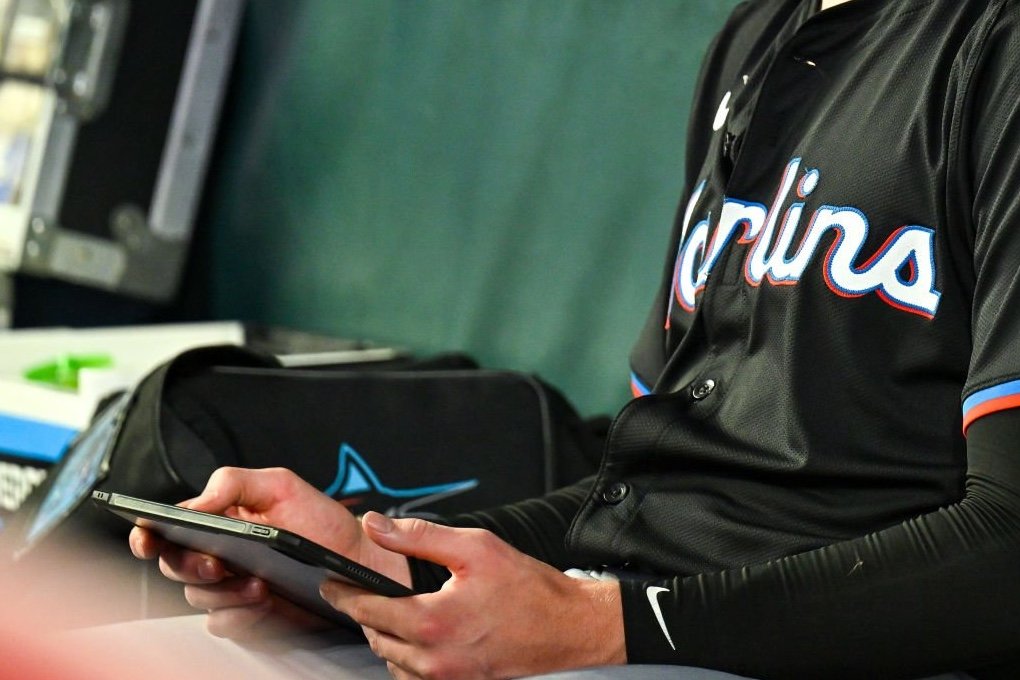
As first reported by Craig Mish of FanDuel Sports Network, pitches are no longer being called by catchers in the minor leagues; that responsibility belongs to the coaches, who relay their decision to the catcher from the dugout, then the catcher transmits the call to the pitcher. Fish On First reached out to sources to better understand the process, which was implemented during the 2024 season, and how it differs from traditional game-calling.
“Last year in pitchers meetings, we would look at hitters' heat maps and what they struggle to hit early and late in counts,” one source said. “Our focus now is to 'throw your nastiest stuff middle-middle.'"
“Coaches have a sheet that says what their best pitches are so you throw those more than pitches that don’t grade out as well,” another source stated.
In addition, every pitcher in the Marlins organization is being coached to have the same mindset in terms of location and sequencing.
“It’s middle-middle until two strikes or 3-2 count,” a source stated. “Get to two strikes then throw as many breakers as possible to get a strikeout. So 0-2, 1-2, 2-2 is all go get the punchout.”
The main reason why this strategy is being used, particularly early in counts, is that across MiLB, under 10% of pitches thrown middle-middle over a multi-year sample have resulted in hits. The other results are largely takes, fouls, errors or outs. The Marlins view this as a prime ability to get ahead in counts early and build pitcher confidence. After the first pitch, coaches are basing their pitch-calling on the present pitcher’s arsenal and what have historically been their most effective pitches. They are also using the most readily available pitch data game to game and even inning to inning to determine what they're capable of throwing in the strike zone.
“They are pitch-calling based on what pitch will have the best outcome of being an out,” a source said. “For example, an average slider gets more outs than an above-average fastball. Therefore, (they’d) throw more sliders.”
“It’s, 'Can I throw that pitch for a strike?' If not, he plan adjusts to a pitch that you can throw for strikes that day.”
From Wednesday's Pensacola Blue Wahoos game, here is left-hander Robby Snelling facing Knoxville Smokies infielder Ed Howard in the top of the third inning. Catcher Sam Praytor can be seen turning toward the Blue Wahoos dugout between each pitch for the call, then he signals it to Snelling. Three curveballs were thrown during the four-pitch strikeout sequence
Within the new system, pitchers still have the ability to shake off the initial call being made by their coaches, but due to time constraints, they are not always able to pivot to their preferred offering.
“(Pitchers) have the ability to shake, but with the pitch clock going, sometimes we get the numbers too late and have to give them a sign around 6-7 seconds which gives them no time to shake and come set to deliver pitch," a source said. “So (we) almost always just go with what coach calls.”
The Marlins are only making an exception to this approach at the Triple-A level, where catchers are game-calling 20% of the time. Another source said a huge piece of the pitcher-catcher relationship has been removed and they are concerned about their sequencing becoming too predictable.
“It’’s just about 'throwing nastiest stuff the most,' which teams can obviously start sitting on because we aren’t using heaters as often,” a source said. “The calls are based on Stuff+ grades.”
Some Marlins pitchers have expressed disappointment about the new strategy. Others are trying to take the change in stride.
“I don’t think into it too much,” another source said. “I’m mostly focused on the getting ahead aspect compared to the middle-middle approach.”
From a statistical standpoint, the Marlins' upper-level affiliates are thriving. Double-A Pensacola has a 2.51 ERA, the lowest among all 120 full-season Minor League Baseball teams. Triple-A Jacksonville has a 2.95 ERA (seventh-lowest) and the third-highest strikeout total in the minors.
However, it's been a different story for the lower-level affiliates, whose pitchers are less experienced and cannot command their "nastiest stuff" with as much precision. Low-A Jupiter has the Florida State League's highest ERA (5.72) to go along with 22 hit batsmen in just 17 games.

The minor leagues are first and foremost meant to prepare players for what they will be doing at the major league level. Unless the Marlins plan to eventually institute this same process in Miami, it is going to make the transition more challenging for both pitchers and catchers.
This is another bold step the Marlins are taking within their revamped analytical approach. They are more than willing to challenge conventional baseball wisdom. Will it work long term and continue to put their pitching development ahead of other organizations? Time will tell.
When will 2027 Opening Day take place?

Interested in learning more about the Miami Marlins' top prospects? Check out our comprehensive top prospects list that includes up-to-date stats, articles and videos about every prospect, scouting reports, and more!
View Marlins Top ProspectsWhich Marlins player do you trust most at the plate with the game on the line?

Follow Fish On First For Miami Marlins News & Analysis



Think you could write a story like this? Fish On First wants you to develop your voice and find an audience. We recruit our paid front page writers from our users blogs section. Start a blog today!
More From Fish On First
— Latest Marlins coverage from our writers
— Recent Marlins discussion in our forums
— Become a Fish On First SuperSub


Recommended Comments
Create an account or sign in to comment
You need to be a member in order to leave a comment
Create an account
Sign up for a new account in our community. It's easy!
Register a new accountSign in
Already have an account? Sign in here.
Sign In Now