



Alex Carver
-
Posts
427 -
Joined
-
Last visited
-
Days Won
16
Content Type
Profiles
Tutorials & Help
Miami Marlins Videos
2026 Miami Marlins Top Prospects Ranking
Miami Marlins Free Agent & Trade Rumors, Notes, & Tidbits
Guides & Resources
2025 Miami Marlins Draft Picks
News
2025 Miami Marlins Draft Pick Tracker
Forums
Blogs
Events
Store
Downloads
Gallery
Everything posted by Alex Carver
-

2017 Minor League Player Of The Year - Brian Miller
Alex Carver posted a topic in Miami Marlins Talk
View full article -
2017 Minor League Player Of The Year - Brian Miller
Alex Carver posted an article in Fish on the Farm
 Mark Prior, Jason Marquis, Jayson Nix, Brian Jordan. These names make up an esteemed class of MLB draftees who have made a profound impact on the game after they were selected with the last pick of the first round of their respective drafts. After being drafted in that same slot last season, outfielder Brian Miller took a huge leap towards joining that group. Reading up on Brian Miller's background you might learn that after going undrafted he made the North Carolina Tarheels as a true walk on. However, as Miller tells us, it wasn't exactly like that. "It was actually a little different than a typical walk on situation. I ended up doing a workout for one of the assistant coaches at Carolina in the early summer, then they offered me," Miller explained. "They added me to their class as a late addition because they were going to lose a lot of high school commits to the MLB draft. So I was technically a preferred walk on. I didn't have to do a tryout during the year or any of that stuff to "make" the team." Despite not having to go through a formal try out though, Miller still had to prove himself worthy of cracking one of the nation's best baseball programs. That would happen a little later that summer when he was amongst nearly 50 players trying to crack a 25-man roster. "We had like 44 guys on the team in the fall, and had to cut it down to 35 by the end of the fall," Miller said. "The whole fall felt like my actual tryout." Miller made the team as the Tarheels' starting center fielder and proceeded to hit .288/.375/.326 as a freshman. He stole 10 bags in 12 attempts and was second on the team in K/BB% with a lowly 0.84 marker (16/19). A native of Raleigh, North Carolina, Miller often spent time on the other side of the fence at Boshamer Stadium, dreaming of pulling on the Carolina blue and white. Now, that dream was a pleasant reality, even if not in the way Miller envisioned it. "North Carolina was everything I could've asked for as a baseball program and school as a whole," Miller said. "I've been a huge UNC fan since I was very little so it was definitely a dream come true being able to go there. Growing up going to games and being around campus a lot I sort of formed my own image about what it would be like to go there, but then when I actually fulfilled that dream I realized the experience was a lot different than I had expected... in a good way!" After his solid rookie campaign, Miller took his talents to the Coastal Plain League where he placed second in BA (.389) and led the league in OBP (.476) via its most hits (77) and also racked up a league-most 38 steals. He parlayed that to his sophomore year at UNC, where he absolutely exploded, hitting .345/.440/.469. His batting average ranked amongst the top 15 in the ACC, his 21 steals (in 26 chances) ranked fourth in the conference and his 56 runs scored ranked 10th. The 19-year-old continued to exhibit excellent plate vision, posting a 0.85 K/BB, a nearly identical mark to that of his rookie year and in almost 100 more ABs. During that breakout year, Miller started to become acclimated with the close-knit fabric that binds that UNC Baseball program together. According to Miller, it was a major catalyst in his success. "There's a huge feeling of comfort at UNC knowing that you're a part of such a tradition of winning and excellence on and off the court/field. I think all of my teammates and peers would agree with that feeling. I can say very confidently that if I hadn't played ball at UNC I would be no where near the player I am today," Miller said. "The knowledge, resources, and facilities that we have access to helped me grow tremendously as a player in all areas of my game." After a .327/.369/.387 showcase in the 2016 Cape Cod League, Miller's comfortability and compatibility with the UNC program continued to show true in his junior season last year when he hit .343/.422/.502. The biggest addition to his game here was a surplus of power as he slammed seven homers after managing just two in his first two seasons at the collegiate level. Once again, the emphatically patient Miller walked more than he struck out (38/35 BB/K), and he continued to be a menace on the basepaths where he added another 24 steals in 30 chances. He appeared on multiple ACC leaderboards including BA (11th), total bases (136, 9th), steals (2nd), hits (93, 2nd) and runs (61, 5th). All of it came in 271 ABs, most in the league. Miller was a key contributor to the Tarheels' 23-7 record, their division title and their #11 ranking in the nation. Indeed, Miller and the rest of his UNC teammates did big things that year, but if you ask any of them, including Brian, they will tell you they weren't the least bit surprised in themselves. According to Miller, the team is accustomed to success and counts on it day in and day out. According to Miller, this attitude had a profound impact on his career. "The ideology surrounding the program is just to win and compete," Miller said. "We expect to win and once I was surrounded by other players and coaches that embodied that mindset it really helped me improve as a baseball player." Enter Draft day 2017. Miller, by way of his five-tool type junior year, entered projected to go off the board in the second round only to hear the Marlins, with their competitive balance pick, call his name in the first round, 36th overall. Yes, the same Brian Miller that went unrecruited out of high school had become a first round draft pick. However, while he admits it was exciting hearing his name get called so early in the draft, Miller says his draft stock wasn't really a concern while he was playing for UNC. Instead, Miller had his sights set on making his friends and family proud. "Getting picked in the first round was pretty cool, but it's not really a goal I had all along because I just wanted to play for a team that valued me and gave me a chance to succeed," Miller said. "There are a lot of very very good baseball players that didn't get picked that high and will have great careers. Your junior year there's so much noise out there about you as a player or where you might get picked. I was very blessed to have great friends and family around me that helped me tune all of that out and just play as hard as I could for my school." Upon being selected, the Marlins forwent sending Miller to short season Batavia and instead sent him to full season A in Greensboro. This was music to Miller's ears as it was a short 80 mile trek from his home in Greensboro and an even shorter 50 mile hike from Chapel Hill, meaning he would continue to be surrounded by his friends and family and could keep reaping the benefits of his college coaches' expertise. "Being close to home was such a blessing," Miller said. "Having my parents and other family/friends at a lot of games was a really cool environment to start my career in." Feeding off the in-person support of his family and friends, Miller, despite being over a year younger than the average South Atlantic League player, started his big league career by slashing .322/.385/.416. He tore up the basepaths, stealing 21 bags in 27 attempts and scored 42 runs, quickly solidifying himself as the Grasshoppers' leadoff hitter. Though he admits there was a noticeable leap in the opposition's skill level that he had to adjust accordingly, Miller credits the successful start to his big league career to the time he spent facing some of baseball's top rising stars in the ACC such as fellow 2017 first rounder Brendan McKay (Tampa Bay) and 2016 second rounder Connor Jones (St Louis) and picking the brains of his star rotational teammates, Astros' 2017 first rounder Jacob Bukauskas who owned a 3.06 K/BB at UNC and Cardinals' 2016 third rounder Zac Gallen who posted a 3.67 K/BB in Tarheel blue. "The competition level was definitely a step up from college ball but I think the ACC helped prepare me for mostly everything I faced this past season in Greensboro," Miller said. "I wasn't really familiar with many pitchers or players in the SAL, so it took a little bit of time to adjust to how different teams and pitchers like to throw. There are some really good players in the SAL and it was fun being able to compete against them all for a few months." A contact-or-bust singles swinger, Miller uses his plus-plus jets to collect extra bases. He exhibits fantastic plate vision and patience via a knowledge of the strike zone well beyond his years, allowing him to work at least deep and usually favorable counts. Miller's swing is one of the quickest in Miami's system. Using his excellent vision, he is able to wait out the break of a pitch and follow it all the way to the back of the glove. When he engages, Miller's swing flashes through the zone straight and narrow. His split stance allows him to step both in and out to his contact point and allows him to barrel up virtually any pitch on either side of the zone. All of that sounds and is great. But if you ask Miller himself, his mechanics are so soundly second-nature that he isn't concerned with them. Instead, he approaches his at-bats with a very simple, refined attitude. "My approach is pretty simple in the box. I just try to be on time and hit a ball hard up the middle of the field. I think always staying to the middle of the field puts me in a good position to succeed because it helps me hit any pitch at any location in the strike zone," Miller said. "Also, when I mishit a ball I have a good chance of beating it out with my speed because the middle guys have to move the most and sometimes make far throws on the run." Where Miller wants to do the most of his offensive damage and where he believes he can disrupt the game most advantageously is on the bathpaths. "When I'm on the bases I'm always trying to steal," Miller said. "I always want the defense to be on their toes and feel pressured, which can also help my teammate in the box get a better pitch to hit if the pitcher and catcher is concerned with throwing me out." Miller uses that same speed to cover ridiculous ground in the outfield, making him one of the best range defenders in the system, rivaling the likes of teammate Aaron Knapp and former/future teammate Corey Bird. If the Marlins' current system is rich with one thing it's speedy, top of the order outfielders. However, due to left-handedness, his pre-pro pedigree and his untenable patience and the fantastic beginning to his career, Miller may have the highest leg up on all of them. While the recently turned 22-year-old only competed in 57 games worth of affiliated action last year and while he will have to prove that he can endure a full season's worth of games, due to his coming virtually out of nowhere, turning into a first round draft pick, skipping short season ball and becoming one of the Greensboro Grasshoppers' most valuable players, Brian Miller earns our Minor League Player of the Year Award. We expect this will be the first of many times you hear his name this coming year. He should start the season in Greensboro (after a possible spring training invite) but with continued success, could move up to A+ Jupiter by the midseason mark.
 -
View full article
-
 There's an old saying that goes, "When it's your time to go, it's your time to go." No one disproves that statement better than Jose Fernandez, a young man so full of life it seems a sin and 365 days later, still seems impossible that it was taken from him and that this seemingly innocent, playfully childish and infinitely joyful soul is no longer turning everything he touched from a baseball to other's lives to pure gold. On the afternoon of September 22, 2016, my girlfriend surprised me with an early birthday present: tickets in Diamond Club at Marlins Park. For those unfamiliar with the stadium, these are the all-inclusive seats directly behind home plate that can and usually do cost upwards of $200 a game. From the seats, you can easily peer down into the Marlins' third base dugout. As players started filing from the clubhouse, a young group of autograph seekers sitting just above the canopy called to each of their heroes. While some stopped to sign a few and exchange a quick pleasantry, Jose Fernandez went above and beyond expectations. Not only did Fernandez ink every peice of memoribilia presented to him from one side of the dugout to the other, he invited fans who asked for a photo with him to traverse a small set of steps to the right of the dugout and just to the left of the backstop screen. This wasn't just a case of catching Jose on a good day; this was who Jose was: a man who wanted to share the happiness and joy life in America and in baseball had given him with as many people as possible. There is little doubt that seeing that joy in others, making their day, creating smiles and hearing laughter was more paramount to Jose Fernandez than his own well-being. Watching Jose on the mound and in the media, you became a fan. After one two minute interaction with him, you felt like family. The effect he had on others was just as incomparable as his stuff on the mound. After the National Anthem was sung and he returned to the dugout, Jose took up his normal alter on the right side of the bench in his high chair against the railing. This two minute span between the anthem and first pitch was the most use that chair would get. You see, even though he only physically took the field once every five nights, his teammates took him to the field with them every single night. The first to get to his feet when the ball was hit deep, the first to raise his arms when a big out was about to be recorded and the first in line to greet a teammate with a congratulatory celebration on their triumphant return to the bench, Jose was invested in every game just as much as he was invested in his own starts. There were no days off. This is who Jose was: a man who cared about the success of others as equally if not more than he was concerned with his own virtue. The Marlins took Jose with them to the mound those nights, they have done so every day since last year's tragedy and they will do so forever. That's the legacy he would have wanted and the legacy he has successfully created. Even in the afterlife, Jose Fernandez has remained successful. After all, I don't even think Jesus Christ himself could touch that slide piece. However, as selfless as this man -- the same one who, as a teenager, jumped into the middle of the ocean to save his mother from drowning -- was, he was still a human being. And human beings make mistakes. When I heard the news of Jose's choices that night after his start was pushed back and after he had a disagreement with his girlfriend, I was admittedly awash with emotions, confusion and anger included. Those same emotions overcame me months later when the toxicology reports were released. However, on both occasions, I refused to let one night of bad decision making trump a lifetime of altruistic nobility. Retire the number, build the statue, name the street, make a spot for him in the Hall Of Fame. He's more than earned it. He more than deserves it. One year and I can rewind the events of that day and week in my head with perfect accuracy. How I refused to believe the news when it was first reported, how it was confirmed to me by a former member of the board of directors who frequented my place of employment, the usual party-like atmosphere of the ballpark being replaced by that of a funeral on September 26, every tear I shed into the concrete underneath my seat in right field at the sight of every player donning '16', at the sight of Dee Gordon barely being able to round the bases following his lead off homer and at the visual of 30+ Marlins hats left on the field by Jose's brothers on the spot where he was king, I can tell you about it all. What I can't tell you is when this wound will heal or if it ever will. As fresh as it still is, it cuts even deeper when I think of the pain in the hearts of Jose's family including his beloved Abuela and his mother. It seers when I see the face of Penelope Fernandez, a child who will grow up never knowing her father and how miraculous he truly was to know. The search for solace is never an easy quest but one place where young Penny and the rest of the Fernandez family can go is to the memories of Jose being the best at everything he set out to do from dominating his craft on the mound to being a good teammate to being a good friend to being a good son and grandson. And there is no doubt he would have succeeded just the same as in fatherhood. As fans, Jose's extended baseball family and the innumerable masses whose lives Jose touched, we can find peace in knowing that by never taking one hour of any day for granted and by filling each one with as much joy and happiness then projecting that unto others, he lived well beyond his years and his spirit will live on in each of us that came to know just how incredible he was forever. To the greatest baseball player I've ever had the distinct privilege of getting to know, of getting to watch grow, of getting to watch dominate the game both on the field and off, continue to rest well. You were good, kid. You were good.
 -
View full article
-
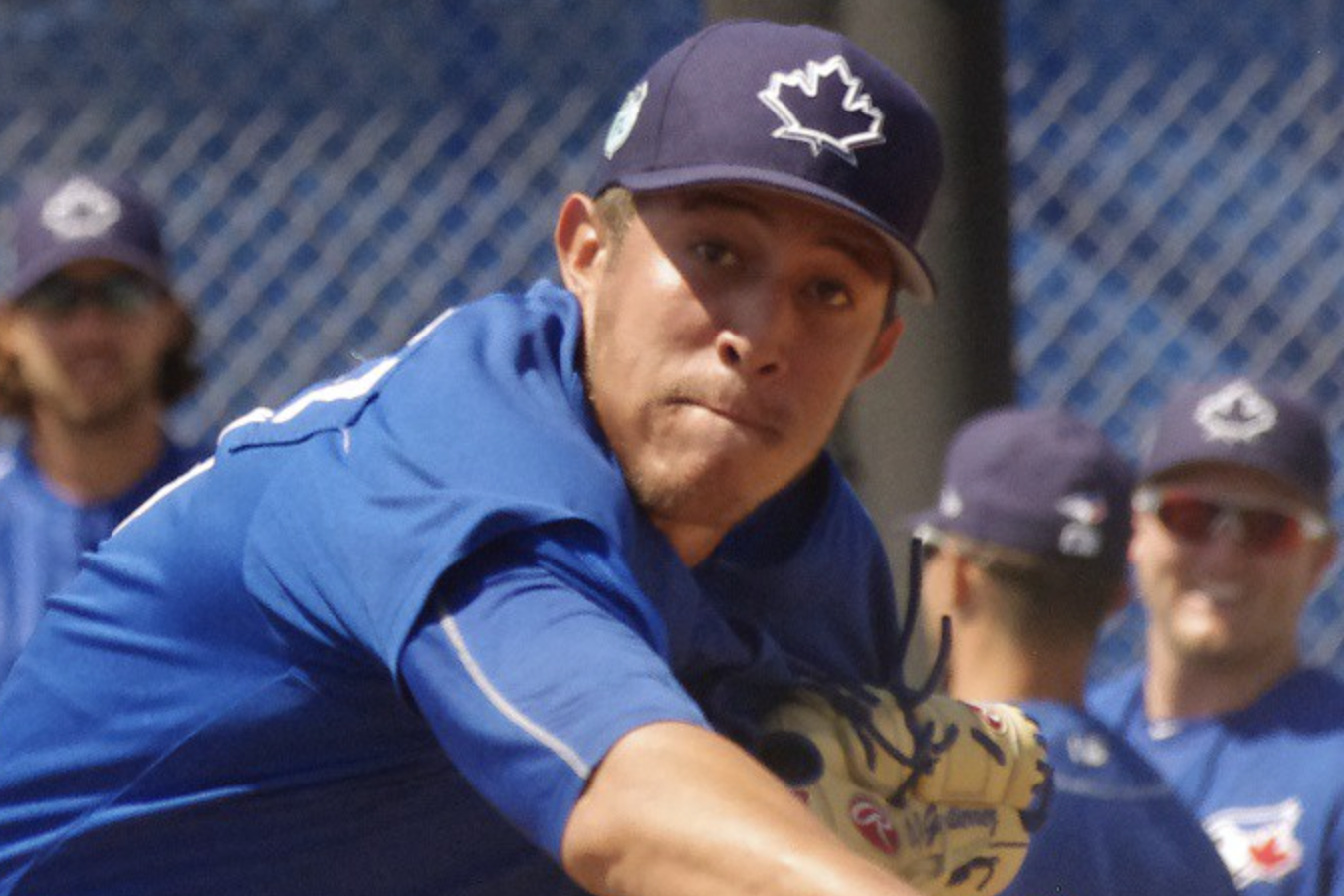 This past month, the Marlins gave troubled starter Tom Koehler (1-5, 55.2 IP, 7.92 ERA, 1.72 WHIP) a change of scenery by trading him north of the border to the Blue Jays for a virtual unknown, Osman Gutierrez. I teamed up with Matt Weber and Tom Dakers of Bluebird Banter to scout and place a potential value on this 22-year-old righty. Gutierrez, a native of the Dominican Republic, was part of the same international draft as part of the same international draft that brought the likes of Yu Darvish, Yoenis Cespedes, Rougned Odor and Roberto Osuna to Major League Baseball. He was signed by the Jays at a time where their GM Alex Anthoupolous had money burning a hole in his pocket. "From when Anthopoulos was hired in late-2009 until the hard restrictions on amateur spending with the 2011 CBA came into force in 2012, the Blue Jays were really aggressive in the spending in the draft (heavily skewed to high school pitchers) and internationally." Matt told me. Matt's claim is backed up by the fact that Toronto, in the international draft alone, spent upwards of $20,000,000 in that three year span. Gutierrez himself, a late round pick, cost Toronto upwards of $200,000. In the coming years, while his fellow international selection names like Osuna and Hechavarria and his minor league teammate stateside draft names such as Syndergaard, DeSclafani and Nicolino quickly established themselves as legitimate prospects and began a quick journey through the minors, Gutierrez, due to both his still teenage years and the pure rawness of his talent, remained in rookie ball in the Dominican for three years and rarely saw the mound in the first two. However, after holding down an impressive 1.91 ERA in 47 innings and 10 starts in 2014, he was able to make it to North American ball by his age 20 season, quite average for a player of his B type caliber and quite advantageous considering the amount of high priced talent the Jays were currently circulating. Clearly, the organization saw something in this kid. Gutierrez came to the US in 2015. It was then during his tenure in the GCL that his reinvention began and coaches got to work on teaching him how to pitch strategically rather than allowing him to continue leaning on simply blowing his stuff past the opposition, a transformation many amateur picks undergo in order to make it as a professional. For the very immature Gutierrez, it is a process that has been lengthy and one that is still going on today. In 2015 and 2016, Gutierrez responded fairly well to his coaches and to the changes. Despite his ERA being victimized by a heightened .330 BABIP, he held holding down good combined control numbers including a 2.91 BB/9 and an 8.67 K/9 and a solid FIP that came in under the 3.70 mark as he began to establish a good breaking ball, piggybacking his fiery heat. "In his July 23rd start, he touched 96 a couple times on the stadium gun, with a mid-80s breaking ball. So there's some quality stuff to go along with the good stat line," Matt wrote on Bluebird Banter back in 2016. "[He's] done everything you want to see: missed bats and worked ahead of batters, and been able to finish them off while still being quite efficient." This season, the 22-year-old made the jump to full season ball. In his first 13 starts with the Lansing Lugnuts Gutierrez -- there's no getting around it -- struggled mightily. On July 21, after a particularly dreadful 3 inning, 6 run, 4 walk, 2 K start, his ERA sat at a hideous 10.13 via an equally dreadful 2.08 WHIP and .295 BAA. Matt chalks the ugly start to his career in full season ball up to an inability to work ahead and a failure to place his pitches, issues that, if not for a serious lack of depth among the Lansing staff, would have landed him either in the pen or back in rookie ball. "The struggles until recently were very simple: lack of control and command. He often struggled mightily to throw strikes, got himself behind in counts and into lots of jams, and then got hit hard when he came in the zone," Matt said. "That he kept a spot in the rotation at all with mostly due to injuries to other players meaning Lansing had little other choice." All of that out of the way, there's something to be said for how Gutierrez has performed recently. Since the aforementioned disaster outing on July 21, the Nicaragua native bounced back by allowing just 14 runs over his next 30 innings pitched (4.20 ERA) which spanned five starts, including a career outing on August 2 in which he went 7 innings, allowing just four hits, one walk and striking out 10 Bowling Green Hot Rods. In his second start with the Marlins' organization, Gutierrez came within one K of matching that total. Both of his first two Muckdogs starts were of the quality variety, lasting six innings each and consisting of four hits and one earned run. Our colleague at Bluebird Banter says that Gutierrez's recent success has been due to his slider taking another step forward and turning into a plus-plus offering and the fact that overall, he is throwing with a lot more confidence. "He's been vastly improved the last last couple months, including a couple of really dominating outings. One of he keys has been that his slider's been a lot better, giving him an out pitch. One of the Lansing broadcasters was talking recently about how the coaches wanted him trust his stuff more, not try to be so fine. And against low-A hitters, his stuff should be plenty." If given time to develop his changeup that is distinctly a mix in offering at the time being, Gutierrez, still 22, could make it as a starter. However, given the fact that the fastball/slider combo thrower dumbs down his velo to the low 90's range in order to make it deeper in starts and the fact that he is a minor league free agent after next season, Matt and I both agree that he profiles best as a late inning reliever. "There will be some impetus to move him along," Matt said of Gutierrez's situation. "He should start next year in high-A regardless but if moved to relief, he could get to AA." In a straight up trade for a troubled starter who barely touched B-type status as a prospect looking at finishing out his career as a swing man, the Marlins could have done a lot worse than a ceiling 4-5 starter, floor late relief/closing option. I give Michael Hill a passing grade on this trade, one of few he's turned in in his tenure as President of Baseball Ops. Look for Gutierrez to participate in the offseason winter leagues overseas before starting 2018 in Jupiter.
 -
View full article
-
 Ben Meyer: A Golden Gopher with a golden arm and a golden future. The Minnesota alum spent the past 30 days continuing to prove himself worthy of those titles, tossing to a 1.01 ERA via a 0.79 WHIP and in so doing, earned himself another accolade: Fish On The Farm's July Prospect Of The Month. Monthly StatsSeasonal Stats35.2 IP, 1.01 ERA, 0.79 WHIP100.1 IP, 2.06 ERA, 0.94 WHIP39/3 K/BB, 10.0 K/9, 0.75 BB/9121/21 K/BB, 10.9 K/9, 1.88 BB/9.188 BAA, .266 BABIP, 73.3 LOB%.204 BAA, .298 BABIP, 76.8 LOB% Benjamin K. Meyer was born on January 30, 1993 in Minneapolis, Minnesota. In his high school days at Totino-Grace, Meyer lettered in both baseball and basketball but upon his graduation, Ben, who comes from very athletic bloodlines, followed in his father's footsteps rather than his twin siblings and gave up the court in favor of the mound. In 2012, he became a second generation University of Minnesota pitcher proceeding his dad, Bob and by so doing, made a childhood dream reality. "I wanted to do the same [as my dad] ever since I was younger," Meyer said regarding toeing the rubber for the Golden Gophers. Although he became a quality basketball player late in his amateur career, Meyer says he didn't fully acquire the physical size for it until his high school tenure was finished which made him focus more on and gain more of a passion for baseball. "I was a late grower, so I was better at baseball at a young age," Meyer said. "I wasn't done growing until my freshman year of college, so my basketball skills developed later in my high school career." Even though his basketball days are behind him now, Meyer credits his time on the hardwood to his ability to adjust to his body, remain well conditioned and most importantly for him, keep baseball fresh and exciting. "I think it's important for kids not to specialize in one sport too early to keep from burning out," Meyer said. "Basketball helped me become a better all around athlete which correlates to success on the mound." Focusing solely on baseball, Meyer quickly became the anchor of the Golden Gophers' bullpen, holding down a 2.37 ERA via a 1.08 WHIP in his first 38 collegiate innings. This all came after he dropped two subpar offerings from his arsenal and rapidly developed two brand new pitches that backed up his low 90s cut fastball more advantageously. Meyer credits his Minnesota coaches for immediately turning him in to an effective collegiate arm and for starting him down the road to becoming a professional rotational arm. "When I got to college I switched out my splitter and curveball for a changeup and slider," Meyer said. "I worked a lot with my college pitching coach to improve their consistency and make them look more like my fastball out of the hand to keep hitters off balance. I've also found a bigger need for the changeup at the pro level as hitters bat speed is quicker." In his sophomore year, Meyer began the transition to the rotation, playing in 15 games and starting eight, doubling up his inning count from the year previous. The increased workload showed a bit as his WHIP rose .2 points and he gave up 2 more hits per nine than the year previous but he still held his ERA under 3 (2.80), improved his BB/9 by .45 points, tossed two eight inning shutouts and one complete game shutout, proving he belonged in the rotation. The Golden Gophers staff took notice of Meyer's overall successful tenure as a starter and made him one full time in his junior year. Despite taking on an even bigger workload and putting by far the most stress on his arm he ever has, tossing in his conference's third most innings (98), Meyer placed sixth in the Big 10 in ERA (2.39), 12th in WHIP (1.13) and fifth in strikeouts (67). His K total combated the only area where the high inning total showed any effect on him, his heightened but still respectable walk rate (2.57). That career high BB/9 was completely offset by his career low 7.62 H/9. After starting the Big 10's second most games in his junior season, Meyer once again proved his durability by tossing in 14 more in his senior year. However, that same season and his draft year, Meyer's stats became the victim of circumstance when the Big 10 modified their official baseball in an attempt to increase offensive production. Although his great control persisted (7.29 K/9, 2.46 BB/9), the result for Meyer was a 4.31 ERA by way of a H/9 over 9 and a HR/9 over 1.00, causing his draft stock to plummet. In hindsight though, Meyer says the change was an advantageous for him in that it allowed him to hurdle over some common struggles for young professionals at an earlier age. "My last year of college they lowered the seams on the baseball. This made it more similar to a minor league baseball, which was a good transition for me," Meyer said. "It taught me to pitch more effectively down in the zone and forced me to mix my pitches a little more." Meyer admits he sweated through the draft process as he watched the rounds pass him by, hoping to not have a bad case of deja vu from the year previous when he was not selected. His relief came on the final day in round 29 of 40 when he got his call from Stan Meek and the Marlins. "The last day of the draft was definitely the longest day of my life as well as one of the most exciting, especially after I didn't get drafted after my junior year of college." Meyer said. "I was just hoping for an opportunity and was very grateful when the Marlins called saying they were going to take me." After seven innings in the GCL and five in Greensboro, Meyer lived out the rest of 2015 in Jupiter pitching against competition a year and a half older than him. That fact along with the wear on the 22-year-old's arm (he racked up a total of 120 innings pitched, by far a career high), led to a 1.54 WHIP via a 9.13 H/9 and 11.7 BB% but thanks to a 76% LOB%, Meyer was able to hold down a 3.18 ERA, which was very respectable when all things are considered. His overall successful cup of coffee with Jupiter that year planted a good seed within the organization as he found himself just outside of its top 20 prospects. Meyer lived out 2016 in Greensboro where he began his transition to starting as a pro. It was a bit of a learning curve for Meyer as he went 0-8 in 10 starts with a 4.23 ERA and 1.41 WHIP. He was much more effective out of the pen. Throwing in eight more innings as a reliever as opposed to a starter, he held down an ERA a full point lower (3.10), walked one less (10 vs 11) and striking out nearly twice as many (60 vs 34). However, Marlins didn't give up on the prospect of one day seeing Meyer in their big league rotation. After beginning the year regaining his confidence tossing out of the Grasshoppers' bullpen where he held down a 2.15 ERA and 0.95 WHIP, the Marlins brought Meyer back to A+. There, Meyer has started 10 of his 16 games appeared in and rewarded the confidence the organization has shown in his ability by producing a 2.03 ERA by way of a 0.93 WHIP, marks which rank second and first in the Florida State League among qualified players (>70 IP). Within that same group, Meyer's 28.7 K% and 23.4 K/BB% each rank second. Even though he divulges that all of the moving around between the rotation and bullpen was a bit tedious, taxing on his body and wracking on his nerves, Meyer, ever the "big picture" guy, says the experience was a major catalyst in making him the pitcher he is today, able to pitch in any circumstance, understanding the mind of a hitter and mastering the art of pitch selection and location. "Moving to the bullpen after college was a big transition for me because I was only in the bullpen for my freshman year of college. I had to learn how to warm up quicker, and come into the game with a different mentality," Meyer said. "When I moved back into the rotation in 2016, the biggest adjustment for me was learning to throw on a 5 day rotation vs the college 7 day. It took some time to get my body to bounce back quicker. This year, my velocity has been up a little bit, which has helped, and my slider has been more consistent than it was last year. I have had more confidence in my slider to throw in more situations and keep hitters off balance." The impetus behind Meyer being allowed to experience all the things he has, learn from them and grow so quickly has been excellent health. In his entire baseball career, even though the stress on his body has doubled and sometimes even tripled, Meyer has never made a trip to the disabled list and has never been out of action for more than a few days. In addition to his overall fantastic athletic background imparted on him at birth and fully realized very early in his amateur career, Meyer attributes his good health to good fortune, staying active every day, and to the medical regimen assigned to him by the attentive Marlins' medical staff. "I have been very fortunate to stay healthy over the years," Meyer said. "The Marlins have a great arm care program that I follow between starts, as well as running every day and staying on top of our strength program has helped keep my body and arm healthy." The fact that Meyer once succeeded as a basketball player is evident as he stares down his opposition from his towering 6'5", 180 build. Meyer maintains his height advantage over hitters as he winds up from a straight up-and-down stance but creates deception as he planes his pitches in downhill. Viewing the strike zone from a birds eye, overhead angle, Meyer commands it wonderfully with all of his pitches, something he has done his entire career, something which he is very satisfied with and the basis of his confidence as a hurler. He plans to ride that confidence to the upper levels of the minors and beyond. "I have always prided myself on my command of 3 pitches and ability to work ahead in the count. I would rather give up a hit than walk somebody and give them a free base," Meyer said. "It's definitely tougher as the competition gets better as the strike zone shrinks, and hitters get better eyes, but it comes down to trusting my stuff and preparation." Meyer will rarely touch any higher than 94 MPH with the fastball but his plus plus secondaries both of which he created in college and has established during his great minor league run more than make up for it. He throws all three of his pitches with the same arm speed which adds to his nearly impossible to pick up motion and mixes them beautifully which makes him nearly impossible to time or wait out. As a result, Meyer works quick tidy innings and limits pitches. Six of his 10 starts, including four in a row in July, have been quality outings. Meyer's best pitch is his go-to slider which sits in the 82 MPH range, has hard bite and which he likes to run in on the hands of guys inducing plenty of whiffs. He will also bury it in favorable counts and due to the late break, get guys fishing. The Meyer changeup sits in the 86 MPH range. Due to its good depth and his shortened stride to the plate, it is one of the more deceptive pitches in the Marlins' system right now. As with all of his pitches, Meyer will throw it in any count but he shows an affinity for pitching off of it. The change sets up Meyer's "show me" fastball, a 9o-94 MPH offering which he can run to either corner and which he likes to put in the eyes of hitters in two strike counts. In most cases, a three pitch arsenal isn't translatable to Major League rotational success but in the case of Meyer, who throws all three pitches interchangeably with similar arm speed and great control and command, he should be able to succeed with it. If not, judging by how quickly he established two brand new pitches, he has the ability to quickly re-develop and fall back on the split change and 11-6 curve that he threw as a high schooler. A battle tested thinking man's thrower, Meyer sets up as a 4-5 inning eating rotational option and floor bullpen anchor in that same capacity. With similar success in the upper minors which he stands to break into soon, the 24-year-old should be fast-tracked to his MLB debut, realizing not only his dream but fulfilling a family legacy. But for now, Meyer, as per usual, as staying level headed and letting the process work itself out. "Playing in the big leagues would obviously be a lifelong dream of mine. I've put in a lot of hard work, and still have a ways to go, so I don't want to get too far ahead of myself," Meyer said. "I'm just trying to stay day to day and get better each outing." Meyer should make the jump to AA next season.
 -
View full article
-
 Adjustment and perseverance. If there are two words that sum up the career of Chris Mazza, these are them. Despite having to adjust to pitching after spending most of his amateur career as a shortstop and although he had to persevere through some difficult mental and physical circumstances including ignoring his doubters and naysayers, coming back from a serious injury and being released by his first team which nearly forced him to contemplate life after baseball, Mazza did it. He overcame. Today, he is one of the best starting pitchers in the Southern League, on the verge of realizing his Major League dream. The latest of his fantastic exports this season is a month of June in which, despite some more rough luck proven by a .322 BABIP, he limited damage, stranding 83% of his runners and holding down a 1.04 ERA lowering his seasonal ERA to 2.71 sixth best in his league. Mazza's June not only continued to prove his ability to pitch effectively but proved once again his ability to rise above. For those reasons, he is our June Prospect Of The Month. Monthly StatsSeasonal Stats26 IP, 1.04 ERA, 1.46 WHIP79.2 IP, 2.71 ERA, 1.23 WHIP14/10 K/BB, 3.5 K/BB%51/23 K/BB, 8.5 K/BB%.277 BAA, .322 BABIP, 82.5% LOB%250 BAA, .287 BABIP, 76% LOB% Chris Mazza was born on October 17, 1989 in the San Francisco area as not-so-distant relative to Joe DiMaggio. He has wanted to follow in the Hall Of Famer's footsteps ever since he could pick up a baseball. "He was my grandmother's cousin," Mazza said. "I've wanted to play since I was 6 years old." Mazza attended high school at Clayton Valley High in nearby Concord where he barely reached a nonathletic 5'6", 120 pounds and struggled statistically, hitting just .238/.322/.266 in his junior and senior years, causing him to go recruited. So Mazza took his talents to nearby Menlo Oaks College where he spruced (pun intended) up and began realizing his true potential. After making the team in tryouts his freshman year, Mazza became the college's all time leader in home runs and triples. In his junior year, Mazza would usually start games at his normal shortstop but would be called upon to pitch in save situations. Doing so, he posted a team low 2.37 ERA, and 19 saves, another school record thus making him a prominent fixture in Menlo's first ever Conference Title run. Following his success leading both the offense and defense that year, Mazza, for the first time ever, garnered the attention and selection of clubs at a variety of levels, including prestigious collegiate schools, independent ball and affiliated ball. One of those clubs was the Minnesota Twins who drafted Mazza as a pitcher in the 27th round of that year's MLB Draft. Although a mixture of flattered, excited and nervous, was faced with what he describes as a very difficult decision in terms of where to and how to continue his baseball career. But with a bit of guidance and some motivation provided by his Menlo squad mates, Mazza chose to accept the Twins' offer. "It was a really tough decision to make because we had just won our league and made it to the conference tournament for the first time in school history. It was also tough because I had teams that looked at me to play shortstop and that's really what I wanted to do because wasn't 100% ready to give up playing shortstop and becoming a pitcher only," Mazza said. "But after having a long talk with teammates, my high school coach Bob Rolsten who played in the Twins organization, and my dad, we came to the decision that this was a once in a lifetime opportunity and that I didn't really have anything else to prove in college ball. Also my college teammates said they would kick my butt if I came back for my senior year." Mazza broke into his pro career with the rookie ball GCL Twins and Elizabethtown Twins. Even though the numbers looked great over his 18 appearances in his rookie season, (30.2 IP, 2.05 ERA, 0.95 WHIP, 28/2 K/BB), Mazza attributes that success to throwing to a similar level of hitters as those he faced in college who were also just beginning to get acclimated to using wood bats. He divulges that despite the solid numbers, he really didn't have a full understanding of what he was doing on the mound. "The biggest adjustment for me was learning how to pitch. When I got to pro ball, I didn't really know how to actually pitch," Mazza said. "In college, I just got on the mound and threw as hard as could. And when you throw in the mid 90's in college, you get away with a lot things." Here Mazza was, virtually a brand new pitcher who was simply taking the mound and putting the stress of throwing as hard as he can with every pitch on his arm with underdeveloped mechanics. Accordingly, just seven starts into his 2013 season, his arm blew out. Despite every effort to avoid surgery, Mazza eventually went under the knife. It cost him more than an entire season's worth of playing experience. "I went on the DL because of an issue with my ulnar nerve. The nerve was popping in and out of the groove every time I would throw cause my arm to go numb. It was like getting hit in the funny bone every time I threw," Mazza described. "At first, we just tried resting it for about four weeks of no throwing. I was in a brace where I could bend my elbow. After that, I started up a throwing program to build my arm up. About three weeks into the throwing program, my arm started going numb again because of the nerve. About a week later, I had to fly up to Minnesota and have surgery to move my nerve. They call it an ulnar nerve transposition. So I ended up missing the rest of the season." Upon returning to the mound on May 26, 2014, Mazza went on to play the best ball of his career. In 25 appearances out of the Cedar Rapids' bullpen, he held down a 2.79 ERA via some of the best control numbers in the league. Striking out 62 and walking just 11, his 25.5 K/BB% ranked 4th in the Midwest League. He also had the second lowest FIP in the league (1.93). However, much like his rookie season, a lot of Mazza's success would come at another hefty price. Unbeknownst to Mazza, he threw the final two and a half months of that season with a broken right wrist. "I fell up the stairs one night during a power outage and broke my scaphoid bone between my hand and wrist on my throwing arm. At first I didn't even know it was broken. I thought I just jammed my wrist really bad because I could still move it. So I didn't throw for five days then when I started playing it hurt a little bit but not enough for me to say that I can't throw. Plus when I would actually pitch it didn't hurt at all." Then, that offseason, things came another very unfortunate head. "During the offseason, it was still bugging me a little bit until I was working with my dad and I went to hand him up a pile of bricks and my wrist bent back I just collapsed in pain," Mazza said. "So this whole time from when I fell in July to me handing up my dad some bricks I couldn't do a push-up or anything that caused my wrist to bend back because it hurt. But since it didn't hurt to throw a baseball I didn't think anything of it." A few days later, Mazza found himself back in another waiting room with the prospect of once again being absent from baseball for a lengthy period of time very real, if not a forgone conclusion. The diagnosis and treatment curtailed exactly that. "I finally went a got my wrist looked at and got an MRI and the doctor said I had a broken scaphoid nonunion in my right hand. He told me he doesn't know how I was even able to throw a baseball. I just said I've always had a high pain tolerance which in this case isn't always a good thing," Mazza said. "I had surgery in November of 2014 and they had to put a screw in my scaphoid bone to fuse the bones back together. So I had to be in a cast for 6 months because of course the scaphoid bone is the worst bone to break in your entire body because it only has two little veins blood supply so the healing process takes longer." Almost eleven months from when he was last permitted to pick up a baseball, Mazza finally did so again on July 3, 2015, beginning a rehab assignment with the GCL Twins. After five appearances there, Mazza was ready to return to Cedar Rapids, to get back on the horse. However, after just two outings back in single A, he was knocked back off said horse once again when the Twins. Being forced off the mound once again after he had just returned from a second hiatus was admittedly a tough pill for Mazza to swallow, especially after the promise he showed when he was healthy (and sometimes even when he wasn't 100% healthy) but the close relationships he built within the organization including the one he had with his head coach helped keep Mazza afloat in a deep sea of adversity. "When he called me in to his office I had a pretty good idea was getting released," Mazza said. "One thing that helped was Jake Mauer who was my manager for three years in the Twins' organization. Being with Jake for three years, we got to know each other really well and became pretty close. So hearing get choked up as he's telling me he has to release me because they simply don't have a spot for me kept positive that this wasn't the end of my baseball career." Mauer had that same confience that he hadn't seen the last of Chris Mazza and vowed to put in some calls to some independent league teams that he had connections with. But before those calls came to fruition, Mazza got a call of his own. "About a week later, me and my brother are out golfing and we are on the 14th green getting ready to putt and my phone rings and when I answer it Brett West is on the other end and tells me that the Marlins want to sign me as a free agent," Mazza recalls perfectly. "I was so excited. I was getting a second chance." Mazza, who was able to stay professional through two lengthy injuries, the disappointment of being cut and through one of the best and most relieving phone calls he's ever received hung up the phone. From there, the emotion poured out of him and created a scene that must have resembled one from Happy Gilmore. "When I got off the phone I told my brother and he started screaming," Mazza said. "We were jumping around looking like two idiots out on the golf course." After Mazza signed his minor league deal on August 4, 2015 he headed to Jupiter to begin his Marlins' career as a Hammerhead. After he finished out that season by tossing to the tune of a 3.60 ERA with a 1.07 WHIP over 15 innings and following another 15 innings worth of 1.09 ERA, 0.93 WHIP ball to begin 2016, the Marlins would present Mazza with the biggest challenge of his career: transitioning to the rotation and adjusting to life as a starting pitcher. "As I got to about my seventh start is really when I felt the number of innings start to catch up to me and wear my body down. At the time I was just doing the same body maintenance that I did as when I was a reliever. So I just I just had to start doing more, whether it was running more, getting more physical therapy or extra work in the gym," Mazza said. "It was tough because my body wasn't ready for that extra work load. Unfortunately it led to inconsistency the last month and a half of the season. It was a definitely a learning curve but helped me prepare for the offseason. It gave me an idea on how much more I had to get my arm and body in shape so I can take on the innings of a starter." Although he was still relying on the same stuff he used as a reliever, Mazza admits it was tricky having to face hitters more than once and thus having to learn how to select pitches advantageously as he got into more deep counts. However, with some help from his battery mates, he was able to conquer that feat. "Things really didn't change much on my approach to attacking hitters that year. I was only a three pitch pitcher so I still went after hitters the same way," Mazza said. "The biggest thing was not to get stuck in the pitch sequences but I had a lot of help from my catchers with that." As much as Mazza learned from himself and his teammates that year, the best piece of advice he got came from Hammerheads' pitching coach Joe Coleman in spring training. It was then Coleman noticed a hitch in Mazza's game that the Twins never did, an issue that when fixed, would allow Mazza to become a much more effective hurler and will allow him to succeed at the next level. The issue lay in the amount of effort Mazza put behind each pitch, sometimes throwing the ball as hard as he could trying to blow hitters away and the other painting corners and trying to induce weak contact. Coleman informed Mazza that whichever brand of pitcher he wanted to be, a max effort late relief type or a more methodical innings eating back end starter, was acceptable but he could no longer be both at the same time. "Joe sat me down and asked me what kind of pitcher do I wanna be. He said after my first couple outings in spring training it looked like I was trying to be two different kind of pitchers at the same time. The first was the pitcher that want to throw the ball past guys and the being the pitcher that wants to sink the ball and get ground balls," Mazza said. "He told me yeah, I have a plus plus sinker but when I try to throw the ball past guys, it stays straight and doesn't sink. He said if you want to be a guy that throws past guys, that's fine and if I wanted to be a guy that sinks the ball. that's fine too. We just need to pick the guy that you want to be so can have a plan when you are on the mound. Then told me with a sinker like mine, he felt like I would be more successful and have a better chance of getting to the big leagues. So the next day I went up to him and told him that I wanted to be a guy that sinks the ball and ever since then, my career has been going in a positive direction." Following his transitional year in 2016, via the assistance of Coleman and his most extensive year of uninterrupted on field experience, Mazza entered the 2016 offseason with a firm grasp on being part of the rotation as well as his own identity as a pitcher. With that knowledge, he dedicated the next six months to one thing: truly becoming a starting pitcher. "I went in to the offseason last year telling myself that I'm going to get in shape to be a starter. I worked really hard on developing a change-up because it's just a pitch that you need to have as starter. Even though I'm most really on my sinker and cutter I can throw my change-up a few times a game to keep hitters honest." Mazza said. "I also need to thank my strength coach Rob and trainer Cesar who have kept me in shape and kept up with physical therapy to make sure I'm healthy and ready to go." Coleman's ability to recognize and fix Mazza's issue in trying to throw two different styles from pitch to pitch during spring training in 2015 and Mazza's own drive and extra work put in that offseason had him well on his way to becoming an effective starter. But he still had some work to do mechanically and mentally. That's where Jacksonville pitching coach Storm Davis' expertise has come into play. "I've been more consistent in my delivery and being able to make the adjustment when I get out of wack one or two pitches rather then it taking me two or three batters to get back to where I need to be. And that's all because of Storm Davis," Mazza said. "Whether it's looking at film, fixing my arm slot, seeing how hitters are reacting to certain pictures I throw during the game or talking about pitch selection. And when we make a mistake, asking why did we make that mistake and how do we change our approach so we don't make that mistake again and so much more. He's really helped me mature as a pitcher." Through all of Mazza's trials and tribulations whether it be going unrecruited, suffering two major injuries early in his career, being released after he finally began to enjoy some success and so many more factors that would have made a lesser man throw in the towel, Mazza is finally a near finished product this year. The exports of that finished product speak for themselves: a 3.01 ERA that ranks 12th in the Southern League, a 1.29 WHIP that ranks 17th, a 7.0% walk rate than ranks 15th and a 75% LOB% that ranks 13th. All of this has been made possible by a very balanced arsenal which includes his bread-and-butter groundball 90 MPH sinker, a 92 MPH cut fastball that he can ramp up to 94 and which he will throw interchangeably with the sink peice to keep hitters guessing, an 84-86 MPH changeup that is emerging as the secondary pitch Mazza has the best feel for despite his learning how to throw it this past winter and a slider that has lessened to a mix-in offering since his surgery but which he will still bury for strikes in pitcher's counts. Much like the way he has approached his baseball career, Mazza won't shy away from any challenge. He is an in-your-face style pitcher who won't pick at corners but instead comes right after his opposition and dares them to beat him. He can get in trouble doing so at times, giving up baserunners, proven by his 8.5 hits per 9 innings but his ability to keep the ball down almost exclusively and induce groundballs keeps runs off the board and his pitch counts in check. According to Mazza, that bulldog, win-above-all style mentality approach to pitching as well as every other aspect of his life is something that was inborne in him and has, above all else, been his biggest and best companion along the way. As long as he hasn't let the beast run completely wild. "I hate losing. I hate losing more than I like winning. I've always been that way. I don't care if I've given up 10 runs, I want the ball in my hand and I'm not coming out off the game. Even though Storm has told me I gotta keep the bulldog on a leash at not let him run out of control," Mazza said. "I've just always been super competitive ever since i was a little kid. It doesn't matter if it's baseball or tic-tac-toe; I'm going beat you. My mom gets mad at me cause I don't let my six year old nephew win when we play video games together. With the Marlins on the verge of a firesale and Mazza continuing to turn in quality outings, he is on the verge of realizing his Major League dream and in so doing, beating all of those individuals, teams, schools and organizations who thought he would lose. For the 27-year-old and those who have been by his side since the start no matter what, his call to the big leagues will symbolize the biggest win of his life. Without having to actually speak a word, Mazza will tell a lot of people "I told you so." "It's crazy to think about sometimes. I've had lot of people tell me I wasn't able to play at the the next level and the started in high school. I got told I was too small or you good but you're not good enough to play college ball. And when I got to college it was the same thing people would say, "Go to a Division III school, you can't play pro ball."", Mazza said. "I just always had that chip on my shoulder to prove people wrong." Attention all naysayers and doubters: grab your foot and prepare to insert it into your own mouth. Chris Mazza is about to arrive.
 -
View full article
-
 2016 Team Stats .218/.298/.294 20 HR/133 XBH 651 IP, 5.00 ERA, 1.53 WHIP At the midway point of the season and with All-Star Games are happening all over affiliated baseball, the start of a brand new season is upon us. The short-season single A campgain kicks off this week, including in the New York Penn League and for your Batavia Muckdogs. There, manager Mike Jacobs, a former Marlins' favorite, leads the likes of Thomas Jones, JC Millan, Shane Sawczak and the rest of a young spirited bunch hoping to become that and more.At the midway point of the season and with All-Star Games are happening all over affiliated baseball, the start of a brand new season is upon us. The short-season single A campgain kicks off this week, including in the New York Penn League and for your Batavia Muckdogs. There, manager Mike Jacobs, a former Marlins' favorite, leads the likes of Thomas Jones, JC Millan, Shane Sawczak and the rest of a young spirited bunch hoping to become that and more. After a seven year playing career, Mike Jacobs begins his first season behind the bench at the helm of this year's Batavia squad. Jacobs was known best for his power hitting game proven by his .253/.313/.473 career slash line and 100 career homers, most of which came in his tenure as a Fish. His career year came in 2008 when he slugged .514, 15th in the NL, slammed 32 homers, 14th in the NL and drove in 93 runs, 20th in the NL all while playing in a pitcher-friendly home park, Pro Player Stadium. The Dawgs are already reaping the benefits of Jake's power hitting background. Where last year's squad scored 47 runs via 18 XBH in the entire month of June, this year's squad has already scored 44 runs via 13 XBH in their first five games. Jacobs' staff is rounded out by assistant coach and former Muckdogs' OF TJ Gamba, hitting coach Rigobertio Silviero who enters his ninth season as a Marlins' affiliated coach and pitching coach Jason Erickson, another former NYPL player (for State College as part of the Pirates' orgainzation) and third-year pitching skipper. Lineup 2B Jhonny Santos CF Thomas Jones 1B Lazaro Alonso RF Zachary Daly DH Terry Bennett 3B JC Millan LF Mathew Brooks C David Gauntt SS Marco Rivera [mlbvideo id="1223918783" width="400" height="224" /]Center fielder Thomas Jones is the Marlins' third round draft pick out of Laurens High School in South Carolina. He enters 2017 as the club's sixth ranked overall prospect and third ranked positional prospect. A football standout in high school who earned some of the nation's best overall rankings as a safety and had multiple offers on the table from some of the nation's top football programs including Duke, Wake Forest, North Carolina and South Carolina, Jones forwent that career to play baseball in Miami. According to Jones, he used football to improve his athleticism and get his name into the first round of multiple sports' drafts, but it was always baseball he saw himself making his career in. "The decision was easy. I always wanted to play baseball," Jones said of his decision to sign witht the Marlins. "I did well in football which gave me a lot of exposure. Playing football helped me to be quick on my feet. Playing free safety in football and center field in baseball have similar characteristics." The characteristics Jones speaks of include blazing speed that allotted him a 4.31 40-yard dash time as well as 16 stolen bases in 17 attempts his senior year and the overall ability to cover both center field gaps advantageously, fantastic hands that allowed him to easily create turnovers as well as maintain superior bat speed and an extremely athletic frame that let him outmuscle opposing wide receivers, bench 260 pounds and squat 500, and which has scouts projecting him to become a 20+ homer threat as he fills out and matures. Of course, Jones has some things to iron out in order to reach that offensive potential. He needs to add some fluidity and repeatability to his timing and mechanics which currently look slightly stiff at times. He also needs to add some loft to his straight-through swing in order to make the most of his power potential. Jones does well at getting his lower half involved in his approach but he will need to perfect his footwork which currently sees him almost hopping into swings before his back foot pivot, leading to him frequently falling out of the box on his follow-through. While he needs some seasoning, the few hitches in his offensive game are quite understandable for a two-sport athlete and should all work themselves out as he commits all of his time to baseball. Though he admits filling in the holes in his game has been and will continue to be a trial, Jones is trusting the course of action and putting in all the necessary effort to succeed. "All my time is focused on baseball now," Jones said. "I'm training to become consistent with all my tools. It's a process but I continue to grind it out." With plus present speed and power and average defensive skills, all of which stand to improve, Jones has a five-tool make-up which makes it easy to see why he comes into this season as the Marlins' second best positional prospect. However, the intuitive Jones who owned a 3.66 GPA in high school and shows maturity well beyond his years isn't worried about rankings and he isn't going to let anything deter his focus from his modus operandi. "I always keep a positive mind, no matter what," Jones said. "This game is already hard itself. So I don't even think about the outside talk and I just play the game." Yasiel Puig: $42 million, Yoan Moncada: $31 million, Luis Robert: $25 million. You probably remember reading about these massive international deals being reached which instantly turned poverty-stricken Cuban kids and families into multi-millionaires, all for their services on the baseball field. One you probably didn't read about was Lazaro Alonso, a 20-year-old native of Pinar Del Rio who signed with the Marlins for $100,000. Although he didn't receive the fanfare nor the payday his countrymen received upon arriving in America, Alonso hopes, that through hard work, both the money and the adulation will one day come. "I was just a boy in Cuba, with no history," Alonso told El Nuevo Herald. "I have only just started in everything. My life is a book to be written. I hope to make noise soon." Alonso will attempt to get the band tuned up this short season with Batavia. Regarded as Cuba's eighth best prospect last season after he hit .299/.436/.494 as a rookie during Serie Nacionale's 2014-15 season and .395/.495/.535, the second best hitter in Cuba's 23-and-under summer league last year, Alonso is a massive physical specimen, standing 6'3", weighing 230. Accordingly, his best tool is his incredible raw power which scouts contend could someday produce 25+ home runs if in the lineup every day. Alonso's best secondary tool is plus- pitch recognition ability that allotted him more walks than strikeouts in his rookie season. The disciplined plate approach allows Alonso to see a lot of pitches and force oppositions into making mistakes, a trait rarely found in power-first hitters. If Alonso is to fully reap the benefits of his prodigious power and his solid plate presence though, he is going to need to vastly improve the mechanics behind his swing. With his back leg bent and front leg straight, he strides from a very off-balanced load and fails to get his hands and arms linear to the ball. His inability to get ahead of pitches leads to very subpar timing and a very long swing. Alonso also fails to cover the plate, struggling against pitches on the outer half, particularly against lefties, a downfall that doesn't bode well for his future against pitchers at the next level who can go corner to corner. Top to bottom, Alonso's mechanics need a near complete overhaul. He's also currently quite limited position ally due to below average athleticism and speed. Needless to say, Alonso definitely has some work ahead of him, making him one of the rawest prospects in the organization. However, he has already taken a positive first step in realizing his true potential by formulating the understanding that he has a long road ahead of him, accepting it and having the will to learn and grow. "My swing is not perfect, my mechanics in the box must improve a lot," Alonso said. "But I trust that I have the strength to improve." Terry Bennett is a Marlins' 12th round draft pick from 2015 out of Atlantic Coast High School in Jacksonvlle. Before signing with the Fish, the exponentially athletic Bennett accepted an offer to continue playing both football and baseball at FIU. However, when Miami came calling, Bennett didn't think twice. "Baseball has always been my first love & being drafted was always dream for me growing up," Bennett said. "After my senior season of football, I knew that I was done playing. My love for doing it everyday wasn't there." After spending the last two seasons getting acclimated to playing baseball full time in the GCL, the Marlins believe Bennett is ready to make the jump to single A. A .340 senior year hitter in high school and Atlantic Coast's first ever baseball draftee, the 6'0" 205 Bennett, who was also a stout yet sneaky quick running back in the football world, owns a good combination of power and speed. When it has come to focusing solely on baseball, Bennett says he has made the acclimation quite naturally, not forgetting or completely abandoning his roots but also not being accustomed to change. "The transition has been really good. I love baseball so know matter if I'm going good or bad I still want to come out everyday and try to get better," Bennett said. "Football gave me that tough edge so that always comes in handy because baseball can break you down if you aren't tough enough. I've gotten tremendously better from being in high school to now. I also have a lot of room for improvements but the coaches work us hard and know their stuff." The lefty hitter favors the pull variety of hitting but has also shown the ability to go to all fields. Mechanically, everything looks pretty good here. Bennett stands from a straight away stance, triggers with a front foot heel turn and steps into the ball. He keeps his back knee and shoulder linear and his head stationary before he engages a quick lofty swing. The only knock here is that Bennett doesn't load up much on his back foot and instead relies almost completely on his arms at the expense of his looseness and some of his power potential. Also, his back elbow doesn't move far from his body which negates even more of his strength and leads to trouble barreling up. However, these are common mechanical flaws for undergraduate hitters, especially those who play more than one sport. If Bennett can get his lower half more involved in his swing and learn to reach back more on his swing while his body matures and his knowledge of the strike zone improves, he could become a solid middle of the order doubles-first threat with the ability to reach fences at any part of the park. Though his throwing arm has some growing to do, Bennett's aforementioned furious athleticism and good jets give him eligibility at all three outfield spots. He's spent most of his time in center field which is likely where he will line up most of the time for the Dawgs this year. Like Alonso, Bennett is another guy who has a lot of growing to do but at just 19 and at the expense of just a 12th round pick, he will not be pressured at all. At this point, he's viewed as a long-term project but his able-bodiedness, energetic attitude and sponge-like brain could allow him to make leaps instead of steps. J.C. Millan's backstory is one which will resonate with many in the Miami community and hit close to home for any Marlins fan who became familiar and got to know the late Jose Fernandez. Millan was born on January 18, 1996 in Havana, Cuba. A middle child in a family of limited means and the son to a father who he rarely saw due to him chasing his own baseball dreams, life wasn't easy for Millan growing up. "Living in Cuba wasn't easy for us. My parents had to work really hard to always find a way for me and my sisters to always have food on the table, especially my mom since my dad was most of the time." During his teenage years, J.C.'s parents came upon the opportunity to relocate some of the family to the United States. Some of the family, but not all. Still, Millan's mother jumped at the opportunity and although life in America wasn't much easier at first, J.C. eventually found comfort. "We had the opportunity to come to the US and my parents never hesitated because they wanted the best life for us and for me and my sister to one day succeed," Millan said. "At first it was hard for us to adjust to the system here, especially me going to a new school, speaking no English and sitting in classes when I didn't understand a word the teachers would say. But as the years passed by, we settled in." Much like Jose Fernandez and his family were faced with and made the difficult decision to leave Jose's grandmother and his entire extended family behind in hostile Cuba in order to better their own lives, J.C. and the Millans parted from one of J.C.'s two sisters and her child, J.C.'s nephew, when they made their trek to Florida, a process and experience which has admittedly taken its toll on him. "It's pretty hard to take sometimes, leaving mostly your entire family behind and not being able to see them every day and instead maybe once every couple years," Millan said. "I would love for them to be here but I don't know if that will ever happen." Before each game, after he takes the field, Millan has made it a ritual to spirtually show gratitude what he has been given these past few years. Then, he audibly recites the same phrase for both his parents who allotted him the opportunity to take that field and for those whom he was made to leave behind back home. "Every game I get on one knee in any position I play and give my thanks to the man above," Millan said. "Then I verbally say, "This game is for my family."" When told the story of how the organization made it possible for Jose's grandmother to flee Cuba and join him in the United States to share in the realization of his dream, Millan, although still a bit skeptical given the still arduous political relations between Cuba and America, is a bit more hopeful of one day playing on an MLB diamond in front of his entire family, including his sister and nephew who, for the time being, remain in Havana. "I feel like it's impossible for my other sister and nephew to be here right now," Millan said. "But it would mean everything in the world for them to be here with us, and I wouldn't know how to thank them for that." Millan, a 6'0" 185 pounder attended Brito Academy in Miami before spending a season at Broward College where he hit .324/.407/.443/.850, placing fifth in BA, third in OBP, fourth in SLG and third in OPS. His 18 steals ranked second in his conference and his .846 BB/K by way of a 26/22 K/BB also ranked third. From there, he took his talents to the GCL. There, as he got his first taste of big league ball, his stats weren't nearly as glorified but as long as he was learning, Millan wasn't concerned with them. He enters this year in Batavia with the same mindset: control what he can control and not get too far ahead of himself. "I learned a lot at Broward as far as always being prepared before at bats and always have a plan when i go to the plate," Millan said. "GCL wasn't the year I wanted to have numbers wise but I'm not worried much about how my numbers were as long as I felt I was competing every single at bat and not getting overmatched. I have the same mindset coming into this year with the Muckdogs: compete every at bat, be on time and get a good pitch to hit. That's all I can control. From there on, the ball will take care of itself." From a wide split stance that stretches to both ends of the box, Millan bends his plant leg and straightens his front leg as he leans over the strike zone, leading to a preloaded approach. He forgoes a timing trigger by being able to determine location and exhibit patience well beyond his years. The swing itself generates plenty of contact via the use of his quick hands but the timing needs to improve, specifically on breaking pitches where it can get a bit long. On the basepaths, Millan has the speed and ability to wreak havoc. A long striding runner who gets good jumps, what he lacks in power he makes up for by turning any on-base chance into extra bases with his legs. That same speed serves Millan well in the field where he can play a pluthera of positions. He has eligibility at all three outfield spots, second base and third base and he will play all of them and then some in the same night, as long as it keeps him on the field. "I feel comfortable at all three outifled spots but I feel like I have worked really hard in the infield to be where I am," Millan said. "I can play second and third with no pressure but I'll play any position that keeps me on the lineup every night, even if I have to pitch an inning or catch a whole game. Whatever it takes to be on the lineup, I'll do it." Thankfully for Millan, his skill set as a singles-first bat with good speed and good range to both sides of the field projects him best as a top of the order second baseman. After a challenging start to life which born in him the need to grow up and mature fast, things are finally beginning to go Millan's way. With success in Batavia, he should get the chance to finish out the year in Greensboro and get a look at the full-season level. As long as Millan's road has been to this point, he still has a long way to go in perfecting his game and reaching the upper minors but a few years to him probably sounds like a few minutes. The right mindset and will to succeed should carry him a long way to pulling on a Marlins jersey sometime in the 2019-2020 range. Pitching Rotation 1. Sam Perez 2. Edward Cabrera 3. Alejandro Cabrera 4. Alberto Guerrero Sam Perez is a Marlins' fifth round pick from last year out of Missouri State University. Exclusively a reliever over his four year collegiate career with the Bears, Perez tossed to a 3.31 ERA and 1.15 WHIP via fantastic control numbers including a 9.33 K% and a minuscule 2.75 BB%. But the Marlins saw something more in Perez than a late inning reliever. Last year in Batavia, they eased him into starting as he got the ball to begin a game in eight of his 16 appearances. Usually a long, strenous and difficult process and frequently a failed experiment, Perez, despite having to modify his game quite extensively, got through the transitional process to the rotation quite smoothly, holding down a 3.72 ERA by way of a 1.38 ERA. "The adjustment to the rotation wasn't as hard as I thought it would be but it was somewhat stressful at first mainly due to the mindset," Perez said. "Out of the bullpen, you would get a signal to start throwing and you would try to get hot as fast as possible. In your head it's, "okay, who's up to bat, who's on deck, go, go, go, get hot." Being in the rotation you have so much time you have to make sure to pace yourself in the pregame warmup." Another big change for Perez as part of the rotation has been pitch selection. A zone pounding interchangeable fastball/slider thrower with a very infrequently used changeup out of the pen, he has had to develop the changeup to the point where he can throw it with just as much confidence as the slider and more frequently than it. In order to keep stress down but also keep his velocity consistent, he's also had to learn how to set hitters up with the fastball rather than just coming right after them. Despite being a lot to tackle, it seems Perez has his recipe for success forumulated. "As a starter I am throwing more fastballs instead of high stress pitches. The goal for most starters is usually to get as many outs as possible with your fastball and use your offspeed pitches when necessary," Perez said. "But I would say that fastball and changeup usage go hand in hand with trying to go deeper in games. My velocity hasn't suffered in order to go deeper in games. My pitch selection is what should allow that. Throwing a pitch with full conviction is a must for all pitchers, starters included, therefore my velocity has remained the same. The ability to be an efficient pitcher is what should help me go deeper in games." It's a testament to Perez's work ethic the strides he's been able to make with his changeup which less than a season ago was nothing more than a mix-in waste pitch. Since, it has become arguably as good as his bender, and, at 82, a perfect companion to his mid-90s heat. Thrown with the same arm speed as his slider, he effectively keeps hitters guessing, no matter how many times through the order he goes. Perez attributes his success as a starter and ability to get deeper into games to that pitch. "The changeup is a must for any starting pitcher. This is a big change from the bullpen because you attack hitters with your best stuff as soon as you're in the game. As a bullpen pitcher you're lucky if you go through a lineup once. That's why my changeup wasn't used as often as my slider: I wasn't having to think of how to approach hitters more than once. The only times I threw changeups out of the bullpen was in a hitter's count and they were expecting a fastball over the plate," Perez said. "I feel as though my changeup has good movement and enough speed differential to help my fastball play even better. I have great confidence in my changeup and that allows me to throw it in any count to any batter, right or left. In order to become the most successful starting pitcher I can be, my changeup will be thrown more often in order to make the fastball more effective. For me as a starter I use the changeup to help set up the fastball and induce ground balls." With an obvious great understanding of how to effectively eat innings despite coming up as a reliever and his ability to make great strides with his changuep, Perez has successfully molded himself into a future 4-5 starter and the ace of this year's Muckdogs staff. With a good 95-82 velo mix, a tricky slide step to short arm right handed delivery, and the aforementioned similar arm speed on all three of his pitches, Perez can still live all around the zone without getting hit too hard. He will need to improve his command and ability to get his stuff to the corners and not catch as much of the plate as he matures to the upper minors but that should all come as he logs more innings. At 22, Perez should be among those called up to Greensboro at short season's end. With continued success there, he could be pushed rather aggressively to A+ and beyond, making him a candidate to contribute to the pitcher-needy Marlins in some capacity by 2019. Shane Sawczak, a local kid out of Lake Worth and former student at Palm Beach State, was selected by the Marlins in the 19th round of last year's draft. As Sawczak puts it, he was thrilled just to be drafted but to be drafted by his hometown team which has allowed his family to continue to share in his dream on a regular basis, turned the moment from great to amazing. "Being drafted in general was a dream come true, but being drafted to the Marlins was an incredible feeling," Sawczak says. "I would like to thank the organization for giving me the opportunity to pitch for them. I just got lucky I'm from south Florida. I grew up watching and attending the Marlins games with my family. It gives me better opportunities to see my family still and get to train and prepare myself for the upcoming season." After the draft, an energetic and pumped up Sawczak spent 2016 stifiling hitters to the tune of a 1.93 ERA via a 1.13 WHIP and 26/13 K/BB in 17 appearances for the Muckdogs. After getting a look with the Grasshoppers to end 2016, he is back with Batavia to begin this season as the anchor out of the bullpen. He is one of quite a few returnees that make up the core of this year's Muckdogs squad, a core which Sawczak describes as kindred, making showing up to work every day comfortable and fun. "This year, the Muckdogs have a special bond," Sawczak said. "We all have spent a year together and are having fun playing together on the same diamond. We all have each others' backs and we pick each other up." Sawczak relies on mid-90s moving heat, an 84-86 mph changuep and an upper 70s breaking ball. He pounds the zone with the fasbtall which he has found success with at the lower levels but he will need to learn to place the breaking stuff to succeed in the upper minors. If he can, Sawczak lines up as a quality late reliver based on a lively fastball with projectable secondaries. Keep him on the radar as a future closer. Projected 2017 Team Stats 39-41 .245/.322/.336 38 HR/157 XBH 647 IP, 4.26 ERA, 1.42 WHIP
 -
View full article
-
 Woah, it's Nelly! Not only is it befittingly his Twitter handle, it's the exact phrase the South Atlantic League, its scouts, the Marlins' organization and anyone who follows it are exclaiming regarding James Nelson's season to date. One look at the stats including his absolutely unprecedented month of May, it's easy to see why. Monthly StatsSeasonal Stats.372/.425/.540.338/.404/.50034/10 K/BB45/17 K/BB5/1 SB/CS5/1 SB/CS Nelson was born on October 18, 1997 in Rex, GA and attended Redan High School in nearby Stone Mountain. Other than the budding Nelson, Redan is famous for producing MLB talents such as Wally Joyner and Brandon Phillips. As Nelson relates to, Redan is a place that is very proud of that past and their long-tenured heritage and Raiders players, including Nelson, coaches and parents quickly learn that. Rahter than just being part of for four years, they are part of a brotherhood forever. "Baseball tradition at Redan is probably the best I've ever been a part of," Nelson said. "It was all about winning and being a part of a family." After his graduation in 2015, Nelson was selected by the Red Sox in the 18th round of that year's Draft. However, Nelson forwent signing with Boston to attend junior college in Cisco, Texas in an attempt to raise his draft stock. "Going to Junior college was probably the biggest and best decision I could've made to be honest," Nelson said. "I don't think I got enough exposure in high school as far as seeing the pitchers I did." Despite his great high school tenure, Nelson only hit four total home runs in his junior and senior seasons. In his one year at Cisco, a bulked up Nelson hit 17. After going off the board 531st overall a year prior, some scouts had Nelson going off the board as early as round 12. The Marlins selected Nelson with the 443rd overall pick in round 15 thus making his decision to attend Cisco a success. This time, Nelson forwent the rest of his college career to sign a pro contract at the age of 19, another big choice and another one he and his family does not regret. "Baseball is what I loved to do and I believed I was ready to take on the next level," Nelson said. "My family was proud. Everyone thinks it was a great decision and I get all the support I need." Upon his arrival in the professional ranks last season, Nelson supported evidence that he was indeed ready to make the jump. In 43 games in the Gulf Coast League, he hit .284/.344/.364. His BA ranked 15th in the league and his OBP ranked 20th. Among his impressive countable stats were 24 RBI and a 7/3 SB/CS. Despite appearing at the plate just 162 times, the Marlins were impressed enough to promote Nelson to full season ball at the ripe age of 19, 2 1/2 years younger than the average Sally League player. After a bit of a feeling out process in his first eight games in April when he hit .207/.324/.345, Nelson absolutely exploded in May, responding and rewarding the Marlins' vote of confidence by becoming one of the best hitters in the league and a sure-fire choice for the upcoming All-Star Game. His ridiculous month of May consisted of a .372/.425/.540 slash line along with 8 doubles, a triple, 3 homers, 17 RBI and a 5/1 SB/CS. Overall this season, Nelson's .338 BA ranks third in the Sally, his .404 OBP ranks fourth and his .500 SLG ranks ninth. He ends the month of May riding a 17-game hitting streak. So how has this teenager with just a year's worth of college experience and 43 games worth of pro experience under his belt, responded so well to playing against the best competition that he ever has gone up against while being under the pressure and microscope that goes along with being regarded as the club's 10th best prospect and how will he keep it up over the course of a 140 game season, three times as many games as he's ever played in in a single year? Simple: he won't change a thing and most importantly, he will not get too far ahead of himself. Because after all, whatever level you're at and wherever you are or aren't ranked within the organization, the game remains the same. "It's baseball, man. I'm just taking it day by day, making sure I'm staying healthy and staying on top of my game," Nelson said. "I just take it one at bat at a time. If I don't get it done one at bat, just get it done the next, and also keeping my routine I've been doing is a major deal as well. It's all about playing baseball, it's the same game, just with better competition. The biggest thing is focus, if you don't focus you won't succeed how you want to." If there was a knock on Nelson's offensive game from his days in the GCL it was his production against lefties which he hit at just a .231/.286/.269 clip. This season, again, against much more advanced competition, he has remedied that by hitting southpaws at a .388/.492/.694 pace. Once again, Nelson credits what he believes is the end-all, be all, vision. After that, it has been his ability to stay inside the ball a lot more consistently that has made the difference. "All about the focus," Nelson said "From last year to this year, I think my middle-oppo approach has gotten a lot better and I am actually driving the ball to right field and I think that was a big advantage against lefties, especially this season" Nelson has accomplished all of these offensive accolades over the past two years while also learning how to play a new position, third base, where the Marlins believe his growing frame, plus power and strong arm will be better suited in the long run. While learning the hot corner has been and will continue to be a process for Nelson, he doesn't mind; as long as he's on the diamond. "I took the news [of the switch] great. If they see me playing there in the future then I'd be happy to be there," Nelson said. "Any way I could help the team. I love shortstop, but as long as I am on the field, I'd play catcher." Nelson's at-bats are a sight to behold. After the 6'2" specimen stares down his opposition from a straight vertical stance, he times his swing with a front leg trigger that is less reminiscent of a batter and more so of a pitcher. From there, there's only one word to describe him: explosive. Stretching his arms all the way back for as much power as possible while somehow maintaining extremely good balance and very rarely, if ever, falling off to either side of the plate, Nelson's bat is barely recognizable as it whips through the zone with uppercut action. After exhibiting some of the best bat speed within the organization, he stays through the ball with two hands on the bat and two eyes down all the way and looks the ball off the barrel, keeping him from pulling off. Mechanically, everything looks close to perfect for the still-maturing Nelson, making him a near lock to become a 20+ home run hitter. While on base which Nelson has been a ton this season, he has more than above average speed, especially for a guy his size. Add to that the ability make great reads and you have the acumen of a 20+ base stealer. As a GCLer in 2015, he stole seven bags and was caught three times. In less games this year, he has already swiped five while being caught just once. If there has been one consistently below-average area of Nelson's offensive game throughout his career it's been his ability to walk, common for any power-first hitter but not an area which Nelson is willing to go to the wolves. He has proven that by walking more in less ABs this season compared to last season and which he hopes to improve even further by advancing and utilizing his plate vision, no matter the situation. "The biggest thing is not wasting at bats, bearing down and getting the job done with runners on or not," Nelson said. "If they are gonna give me a walk, I gotta take it and not press." Nelson will be the first one to admit he is far from a finished product and he has work to do. However, the 19-year-old who will not even turn 20 for another two months, defines the word 'athlete', has a baseball IQ well beyond his years, and is already on the verge of a call-up to A+. With 20/20 club type talent, the ability to hit for both average and power and great fielding instincts, footwork and hands, he is a 5-tool type talent that could arrive in the majors as early as 2019. But for now, the extremely modest and level-headed Nelson ins't worried about that. "Baseball is a crazy sport man," Nelson said. "I'm just trying to trust the process, so I'm just doing me." Keep doing you, James. If baseball is crazy, you've found the remedy.
 -
View full article
-
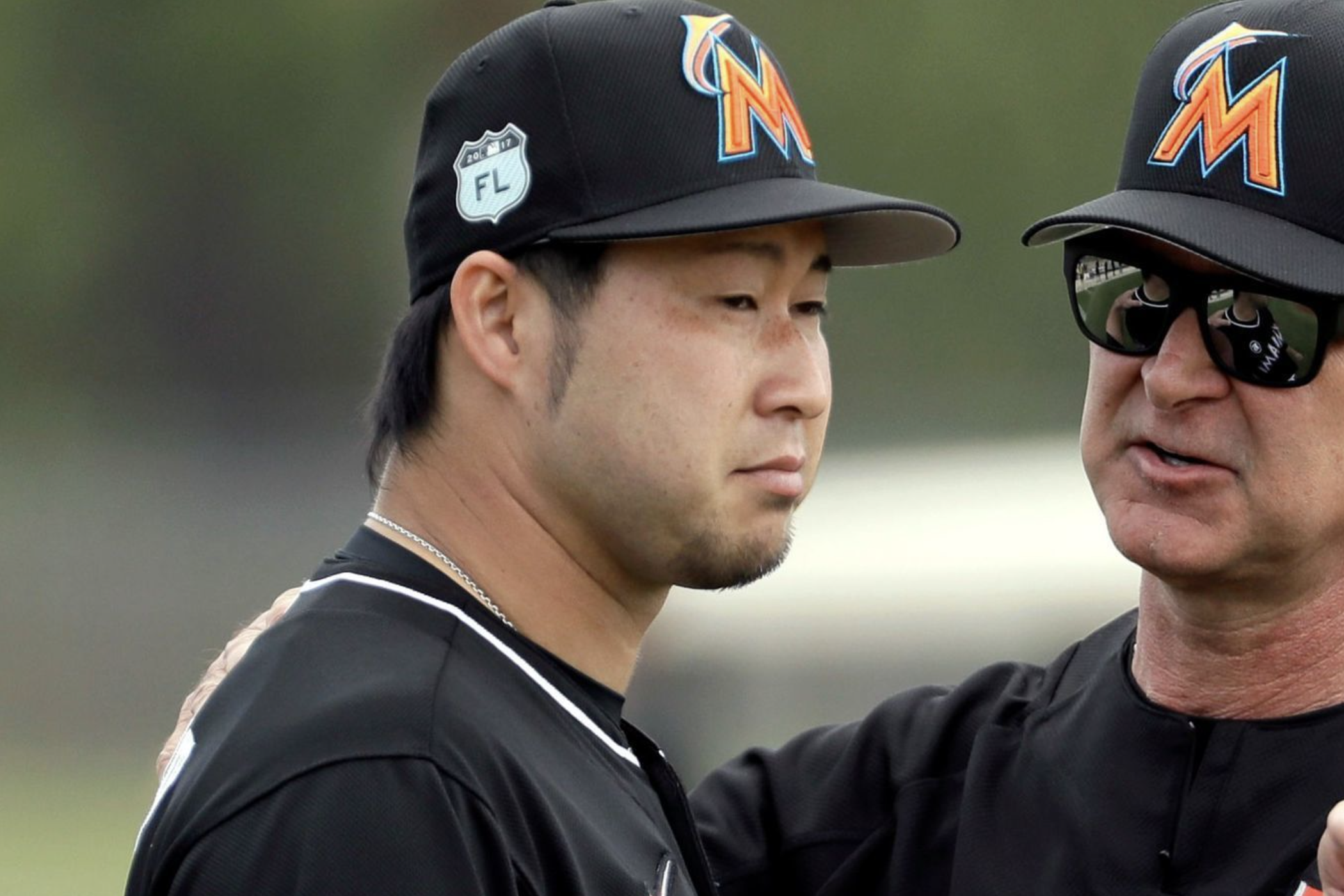 There's bad, then there's Junichi Tazawa in 2017 bad. One of the best relievers in the league in 2015 has become anything but this season, leading him to be placed on the "disabled" list just a month and a half into the year. However, it appears as though his "injury" may just be a bad excuse for what has turned out to be a signing just as heinous as Tazawa's exports in a Miami uniform. Through 15 games, Tazawa owns a 6.60 ERA bt way of a 6.84 FIP and a 4.8% walk rate. His 26.7% ground ball rate is the eleventh lowest in baseball. If those figures aren't alarming enough, he also owns a lowly .195 BABIP meaning he has been very fortunate not to give up even more damage. In 2015, Tazawa held down 4.14 ERA via a 3.05 FIP and an extremely low 1.99 BB% all while having pretty bad luck on balls in play (.349 BABIP) at hitters' haven Fenway Park. Last year, he had a much more Fenway-like 15.8 HR/FB ratio of 15.8 and a more neutral BABIP of .292. However, he regulated himself by striking out nearly 10 hitters per 9 innings (9.79) and inducing ground balls at a 40% rate and stranding 79% of his runners. This season though, in the much more pitcher friendly Marlins Park, the wheels have completely fallen off. The question is why? The Marlins are using the excuse that Tazawa is injured, saying that he has rib cartilage inflammation. While there may be some truth to the fact that Tazawa recently tore something in his rib cage, it's hard to believe they would ever let him take the mound if he was suffering from the main symptom of costochondritis which is chest pain. Accordingly, there must be another explanation for the way Tazawa has struggled for the entire season. Pitching coach Juan Nieves spoke more closely to that reason when he said Tazawa needs time off not for his chest, but for his head. "He needs time off to make a mental adjustment," Nieves said. That would definitely be a great place for Tazawa to start. From there, he can work on fixing his mechanics. In order to compare an effective Tazawa to whatever this is he has become, here is a stop motion image of his fastball circa 2014 and one of his fastball this year. Out of respect for any sort of injury Tazawa might have suffered recently, the second image is of a fastball he threw to a virtually powerless Yuli Guriel that got taken for a grand slam during his first outing of the season when he was pretty much undoubtedly 100% healthy, right out of camp. In both images, the same pitch is being called for and thrown: fastball in. Tazawa has maintained similar velocity from then until now but the command is night and day. The reason for this appears to be that, probably not purposefully, Tazawa is throwing from a higher plane and arm slot which he cannot control. At the apex of his leg kick which has gone from high to even higher, it is easy to notice that Tazawa's glove is also much higher in the air his arm is at a much more horizontal angle and a lot closer to his body. This is where Tazawa's problems begin and stem from. From there, they get even worse. Where he used to swing his arm nearly straight horizontally behind his back while keeping the top of his hand facing the hitter, hiding his grip on the ball advantageously and leading to a fluid turnover of his palm, this new windup leads to Tazawa having to drop his arm straight down vertically, giving hitters a clear view of the baseball and his fingers followed by him barely getting his arm fully extended backward and a rotation of his wrist that looks forced. Where Tazawa used to almost literally sit back on his pitches, leaning all the way back on his back leg to the point that he almost falls over before powering through his delivery, he is now almost completely relying on his arm, barely transferring any weight whatsoever. This leads to him flying open to the third base side before overthrowing his pitches and throwing off his release points. The end result of all of those factors are pitches that miss his targets and wind up way out over the plate. Opposing hitters are taking full advantage of this version of Tazawa, being patient early in counts, allowing Tazawa to get behind in the count early (he has a first pitch strike percentage of just 60%) and staying patient allowing them to work themselves into a favorable hitter's count (he gets into just as many 3-0 counts (6.2%) as he does 0-2 counts), virtually disabling Tazawa's once-filthy offspeed secondaries and making him rely on the fastball/forkball changeup combo which accounts for 79% of his pitches thrown. Between them sitting on his stuff and Tazawa misplacing it, guys are making contact at an 80.5% rate, including a 90% rate on pitches inside the zone, both career highs for Tazawa and recording swinging strikes 8.3% of the time, a career low. Deception and the ability to get in guy's heads are completely gone from Tazawa's game as he is only generating chase swings outside the zone at a 28.2% rate, another career worst. Not only are hitters making contact often against Tazawa, they are making loud contact. The average Tazawa pitch leaves a hitters' bat at 89 MPH and goes 210 feet. The latter of those figures is the 21st-highest average distance in baseball, proving Tazawa has been lucky to not give up even more homers and thus an have an even higher HR/FB% which currently sits around 14%. Hitters are barreling up against Tazawa once in every five of their ABs. All of this proves that thanks to his .195 BABIP and the fact that he's pitched in mostly pitcher friendly parks, Tazawa has been arguably the luckiest man in baseball not to have an even higher WHIP than his already mediocre 1.33 mark and his absolutely horrendous 6.60 ERA. Even more fortunately for Tazawa and most unfortunately for the Marlins is that he has job security. Tazawa is under contract for the remainder of this season as well as next season. With it becoming more and more unlikely that he will opt out after this year due, the Marlins, who are paying him $6 million a season until 2019, need to hope Tazawa gets his stuff right ASAP. Upon his return from injury, Tazawa will almost certainly get a rehab assignment in the minors. What the Marlins do with Tazawa immediately after that will be a good barometer of where they are in the towel-throwing-in process for the year. If they are still playoff hopeful, Tazawa will work out his issues in the minors. If not, he will be allowed to do so with the Marlins, likely leading to more fans' pain and suffering. Wherever he attempts to work out his woes, the Marlins better hope for the sake of not wasting $12 million that he is able to do so because right now, Tazawa isn't worth 12 Yen (10 cents American).
 -
View full article
-
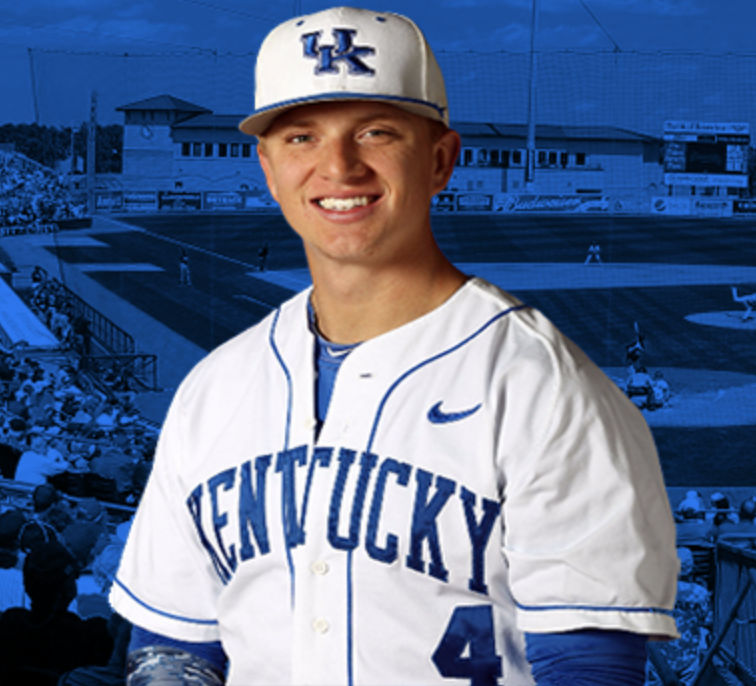 Monthly Stats Seasonal Stats .330/.376/.372 .330/.376/.372 18/5 K/BB 18/5 K/BB 5/2 SB/CS 5/2 SB/CS Jupiter Hammerhead's outfielder Stone Garrett came into 2017 as the sixth ranked prospect in the organization. But through 22 games, Garrett's Jupiter teammate, fellow outfielder and owner of a similar surname has been the one playing up to that title. Introducing our April Prospect of the Month, Kyle Barrett. Kyle Barrett, a Georgia native, was born August 4, 1993 and spent his college days in Wildcat blue at the University of Kentucky. There, he spent three seasons amassing a .324/.386/.391 slash line with an 8% walk rate and 21 steals in 34 tries, beginning to lay the foundation for the type of bat he is currently becoming. Playing in the same conference as current top MLB prospect Andrew Benentendi, in his junior year, Barrett finished seven spots underneath the league leading Benentendi in BA, hitting .354. He also appeared just inside the top 10 in his freshman year when he hit .349. Following the 2015 collegiate season, Barrett entered the MLB Draft and was selected 446th overall in round 15 by the Marlins. He signed on June 19 of that year and took his talents to Batavia to begin his big league career. However, the excitement of being drafted and the prospect of making a quick first impression soon came to a grinding halt. In his fourth game with the Muckdogs, Barret broke his right hand, an injury that cost him the rest of the year. Going from the high of being drafted only to, after just 11 ABs, land on the DL for an extended period was an experience Barrett admits was very frustrating. "I was pretty crushed," Barrett said. "I worked so hard my whole life to get drafted and it happens and I start my career off on the wrong foot." Even though Barrett was able to return for the start of the 2016 season and although he made the jump to full season ball strictly on a confidence vote by the team, he still wasn't completely over the injury. Despite rehabbing during the offseason, the strength in his dominant hand still hadn't completely returned and it showed. In his first 22 games as a Grasshopper, Barrett went just 12-72 with a 17/6 K/BB. For Barrett, it was probably the lowest he's been mentally in his baseball career. "It really affected me that off season because I really wasn't able to hit without being pain free," Barrett said. "I got the opportunity to go to Greensboro that year and I really struggled at first because I was out of baseball for nine months." However, despite a disappointing start to his career that lasted 11 months and must've seemed like 11 years, the pure talent of the grinder Barrett finally prevailed. On May 29, he went 3-5 with a walk and scored two runs in a 6-2 Greensboro win. It began a stretch in which Barrett would reach via a hit in 55 of his last 79 2016 games, a stretch in which he went 88/282 (.312 BA). "I finally got some mechanical things adjusted and the success and confidence came," Barrett said. After ending that season hitting .282/.333/.345, very respectable considering how the year started, Barrett got his second call up in as many years which was, all things considered, spectacular. This season with the Hammerheads, a 100% healthy Barrett has once again become the guy the Marlins drafted out of UK. Hitting at the top of the order, he has gotten on base in 20 of his 22 games and collected at least one hit in 19. He's slashing .330/.376/.372 with a BA and an OBP that rank among the top 10 in the Florida State League. It may have taken him a little longer than he would have liked, but through determination and perseverance through adversity, Barrett has now fully arrived on the Minor League Baseball scene. Barrett was able to overcome the disappointing start to his career not only because of fantastic raw talent but also because of the understanding that in baseball, like any sport, it's not about how the game knocks you down; it's how long you let it keep you down that really counts. "Baseball is full of ups and downs and how you overcome adversity," Barrett said. "You can't let one bad game from the day before affect the next game." Not only is Barrett's bat exporting similar results to those he provided during his time at Kentucky, he is making them happen via the exact same approach and mechanics. Barrett and his coaches agree: if it isn't broken, why fix it? "My approach has stayed the same since I was in college so I'm really comfortable with it," Barrett said. Because of that comfort and the confidence he has in his game, Barrett is playing stress-free despite knowing that he is a few months of similar play away from a call-up to AA. "There's no pressure to keep hitting like this at all," Barrett said. "I don't look too much ahead on whether or not I'll get called up; instead, I control what I can control and I make the most of it and don't take anything for granted." During an average Kyle Barrett AB, there is rarely a strike that goes by without him getting at least some part of the bat on it. A stout 5'11", 185, the lefty hitter minimizes an already small strike zone via an extremely quick snap swing which gives him the ability to wait out the break on pitches, select one he likes and drive it. At the very least, the result of a Barrett swing is almost always some sort of contact, even if it is just to foul off a tough pitch and the result of his ABs, nearly all of which last at least five pitches, either end with him on base or at the very least, with him inside of a pitcher and catcher's heads, setting up his next chance. While most of Barrett's hits go for base hits, he does have some hidden gap-to-gap power which allotted him 12 doubles in his final year in college and has already led to four two-baggers this season. As the 23-year-old completely reaches his ceiling, that number should increase. On the base paths, Barrett exhibits great instincts on top of plus speed. Last year in Greensboro, he swiped 17 bags in 22 chances. This year, Barrett is already 5/7 in stolen base attempts. Barrett puts his plus jets to good use in the field as well where he makes good reads off the bat, runs good routes and exhibits an above average throwing arm. With a swift singles first swing, some disguised strength, good speed and good outfield prowess, Barrett appears to be nurturing a skill set similar to Chris Coghlan and his personal hero, Brett Gardner. Excellent on-field play coupled with an outgoing personality and a sound head for the game make Barrett a great teammate and an extremely easy guy to root for. An all-around great athlete, it isn't out of the realm of possibility for Barrett to reach the bigs by next season. * This is Kyle Barrett's second time being named Prospect Of The Month.
 -
View full article
-
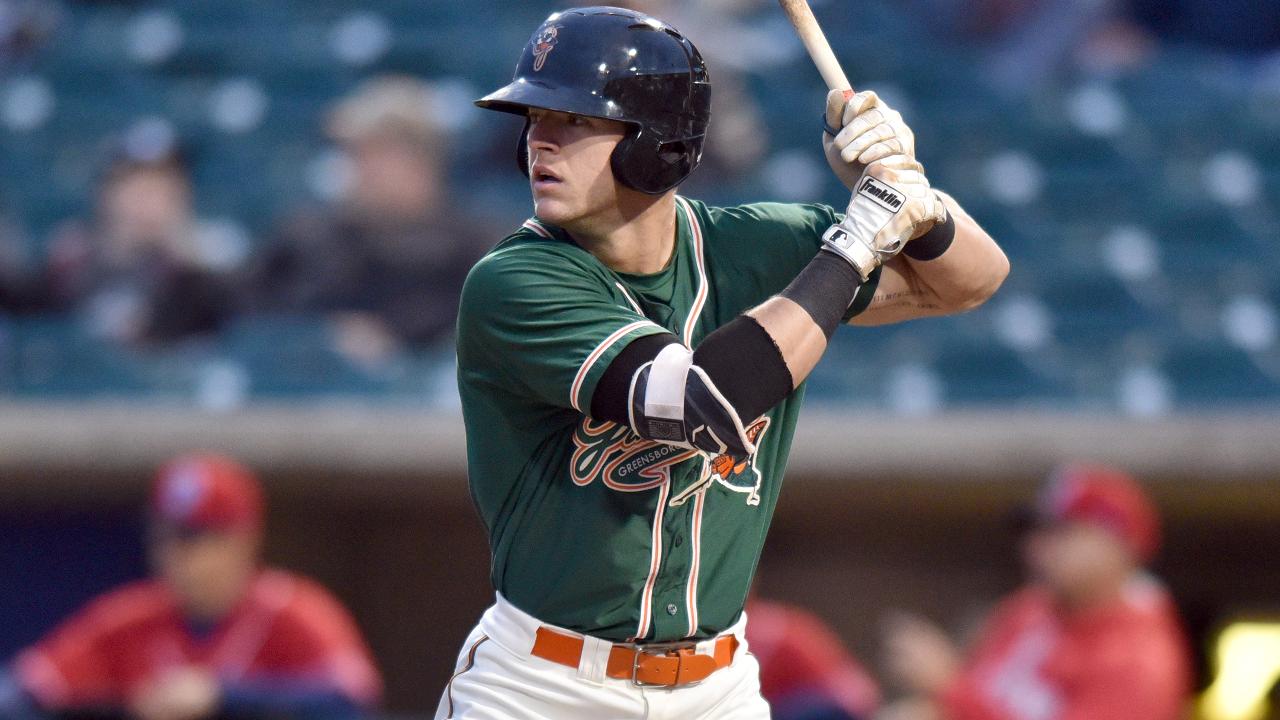 If you happen to make the pilgrimage through the small Central Florida town of Sorrento, you will hardly even recognize that you were there. However, in the near future, the baseball world is sure to recognize one of the town's 765 residents' names. That name is Colby Lusignan. Lusignan was born in 1992 in the unincorporated township of Sorrento, a city that houses just 765 and encompasses just 1.3 miles. Because there are no schools in Sorrento, Lusignan was forced to make an 11.2 mile, 17 minute trip down State Road 46 every day to attend high school in Eustis. Being one of few out-of-towners at Eustis High, Lusignan admits his days there were a bit of a grind, but that staying close to both his immediate family as well as his extended baseball family stregnthened both his personal relationships as well as his professional relationships. "High school days were pretty uneventful. I was a home body andjust liked hanging with the family," Lusignan says. "Growing up in a small town where everyone knows everyone rraly makes you try to stay on top as well as respect the people around you." Upon his graduation in 2011, Lusignan made the decision to attend college at Sante Fe Community College, slightly upstate in Gainesville. Two hours away from Sorrento, it was not too far from home but it was just far enough for him to get the full college experience. "Gainesville was one of the top junior college schools in Florida, and I just felt like it was the right place to go," Lusignan said. "It was an hour and a half from home so I felt like it was far enough and close enough at the same time to be a college kid." After two years of placing within the top seven in OBP, the top 10 in SLG and the top five in BB/K, a combined 73 game span in which he slashed .329/.426/.488, Lusignan was recruited to Lander College in South Carolina. Depsite being as far away from his family and as far out of his comfort zone as he had ever been, Lusignan says making the choice to attend Lander was made fairly easily. "The decision to go to Lander really was a family oriented decision in the sense that the coaching staff and community approached the team with that mindset," Lusignan said. "Distance and not seeing loved ones is obviously not ideal, but knowing that they supported me chasing my dream, and that they made the trip to come see games made it much easier." Benefiting from the close relationships he had with his coaches and teammates including the one he had with his head coach Kermit Smith whom he describes as "a second dad who had great relationships with all the guys and made you feel very at home" and labels as a the leader of an extremely positive clubhouse whose "ideology spread through the other coaches and really made the team a close-knit group", Lusignan hit .325/.429/.591 that season with the Peach Conference's 10th best OBP, seventh best SLG and ninth best OPS (1.020). He also slammed the third most homers in the league (10) and drove in it's eighth most runs (41). With an overall .328/.425/.528 career collegiate line, Lusignan declared for the MLB Draft in 2016. He spent draft day back where it all started in Sorrento surrounded by his biggest supporters, his family and his best professional influences, his Lander coaches. It is those individuals that Lusignan credits most for having heard his name called. Selected in the 28th round at number 833 overall, Lusignan is just the eigth player to be selected out of Lander University. Even though he had to sweat out a lot of nervous hours waiting for his phone to ring that weekend and even begin contemplating his situation should he go undrafted, Lusignan recalls his draft experience as a picture perfect moment. "Draft day was pretty surreal, spending it with my family who has been there all along was great," Lusignan said. "My coaches at Lander were awesome, they really helped me develop my offensive game, and we had a really good team while I was there. Those two things really helped me to get exposure, and I'm proud that I can say I was drafted from Lander University." Not only was his draft day setting perfect, the setting of the result of his selection was nearly as ideal for the easily homesick 23-year-old. Being selected by the Marlins meant that Lusignan would spend time in the Carolinas, within a stone's throw of his Lander coaches whom he could still look to for professional support and in Florida where moral support from his family would also be within very accessible reach. Asked what he thought of being drafted by the Marlins, Lusignan said his preference would not have had it any other way. "It was exactly the way I pictured it to happen," Lusignan said. After beginning his career in the Gulf Coast League last season where he hit .319/.422/.469/.894, marks that ranked fifth, fifth and seventh and third on the circuit, Lusignan made the jump to full season ball in Greensboro this year. There, he has gotten off to a .299/.357/.442 start with a BA that ranks 26th in the Sally and an SLG that ranks 22nd. Most recently, he broke a 2-21 slump by going 5-5 with two doubles and three RBI. The five hits were the most Lusignan has recorded in a single game at any level he's played at. In order to keep his current pace, Lusignan is learning to pace himself and let his body adjust to the rigors of, for the first time, playing 1,260+ innings in 150 days. "I was fortunate enough to break camp with a full season club, and it will definitely be the most taxing year of ball on my body to date," Lusignan said. "I've really been making sure to stretch and foam roll, and make sure to get enough sleep. Just overall body maintenance is something I think is super important to making it through a full season." Lusignan is a massive physical presence who menaces opposing pitchers as he stares them down from his 6'4", 230 stature. He is growing into potentially plus plus power potential that scouts rank at a ceiling of 70 on the 20-80 scale. He owns a mechanically sound approach in which he maintains his looseness well and utilizes a big front foot timing trigger by which he transfers his weight all the way through the ball. Partnered with rotational energy from his back foot pivot and active hips, Lusignan gets the most out of his extra large frame. Due to his size, Lusignan's swing looks effortless and fluid but the deception in that is revealed when he makes contact and the ball absolutely flies off his bat. During his collegiate days, his power numbers ticked up with each passing year until he was ultimately hitting a homer once in every 15 ABs. Of course as he adjusts to much more staunch competition that figure will given and has already given way to a heightened K rate. In 77 ABs, Lusignan has struck out 25 times. However, with a 1.45 career NCAA K/BB and a 1.75 K/BB last year in the GCL, Lusignan shows the potential to be much more than an all-or-nothing power bat. With a great baseball IQ, he also exhibits the knowledge of what it will take for him to become an all-around offensive threat. "I think that really sticking to my approach, and looking for what I want to hit will help to boost my walks, as well as tap into my power potential," Lusignan said. "Staying within myself, not pressing and trying to make something happen will allow me to recognize pitches, as well as take a free smooth swing at pitches I think I can drive out of the yard." A look at Lusignan's hit chart from the last two years will reveal that through excellent plate vision, good bat speed and the ability to fully extend his long arms, he distributes the ball evenly to all fields and can turn any pitch in the strike zone into a hit. Even though said strike zone is large due to Lusignan's extra large frame and straight up and down stance, he covers the plate magnificently and selects swings just as well, making him a contact-first hitter with budding prodigal power. If he can maintain the same plate discipline as he realizes his power potential, there's nothing against Lusignan becoming a 20+ homer/20+ double hitter at first base, currently a very thin position for the Marlins' organization. For those reasons, the 24-year-old Lusignan is a candidate to fast track through the rest of his minor league career and contribute to the Marlins by 2019. Not too shabby for a small town kid with a dream.
 -
View full article
-
 The Fish get fishier in 2017 as the Jumbo Shrimp and Crustacean Nation are born in Jacksonville. There, Brian Anderson, Austin Dean, Dillon Peters and Jarlin Garcia will make up a young colony of shellfish hoping to become sailfish in the near future. Leading the Shrimp into their inaugural campaign will be Randy Ready who gets the promotion from A+ Jupiter where last season he led the Hammerheads to a 68-69 record. After a very decent .259/.359/.387, 10.9 WAR 13-year playing career, Ready began his managing career as skip of the short season Oneonta Tigers where he led a 47-27 division title team and thus immediately became one of MiLB's best managers. After earning the New York Penn League's title of Manager of the Year, Ready began his full season ball managerial career, coaching the Padres' single A affilliate the Fort Wayne Wizards for two seasons before making his AA debut in 2007. That season, for the inaugural year San Antonio Missions, Ready coached the likes of Chase Headley, Will Venable, Nick Hundley and Wade LeBlanc to a Texas League championship. Ready then briefly managed in AAA, coached hitting in the majors, got in the conversation for a MLB head coaching job and returned to AAA first as a hitting instructor then again as a manager before spending fourt years out of baseball. Last January, he was hired by the Marlins. Ready's resume speaks for itself: 34 years total experience in the game, persoanl knowledge playing at five different defensive positions, knowledge to hit as high as .309/.423/.520, two titles as manager, experience managing at each level of the minors and coaching in the majors and an overall fantastic positive attitude. With Randy at the helm, it's safe to say the Shrimp will be Ready for success each time they take the field this season. Lineup Yefri Perez, CF Austin Dean, LF Brian Anderson, RF David Vidal, 2B Taylor Ard, 1B John Norwood, RF Austin Nola, C Alex Yarbrough, SS [youtube https://www.youtube.com/watch?v=fykcBelRxFg]Following a 2016 campaign which saw him hitting .265/.348/.389 between A+ and AA, a season which allotted him the title Marlins' Minor League Player of the Year, Brian Anderson opened some eyes. This offseason and spring training, he has made those eyes pop. First, Anderson took his talents to the Arizona Fall League where, against some of baseball's best young talent, he was the runner up for the offseason league's MVP award by hitting .273/.360/.506 and pacing it with six homers for the league champion Mesa Solar Sox. From there, upon a spring training invite, he joined the Marlins in Jupiter and proceeded to post a .349/.391/.605 slash line with six doubles, a homer, seven RBI and a hit in 12 of 23 games. Because the Marlins want to take it easy with their best positional prospect who has only played 86 games above A ball, he will return to AA to start 2017 but should his offseason success that translated to spring training success follow him to Jacksonville, he should be a fast mover to New Orleans. As for his future as a big leaguer, he has great instincts and range at third base but his throwing arm is very inaccurate. Compounded by the fact that he is blocked there by Martin Prado for the next three years, he is a great candidate to begin his big league career on the right side of the infield. He has experience there in his minors career and shows the same great reads off the bat and footwork to his left as he does to his right. Should Justin Bour continue to struggle vs lefties, Anderson, who hit .350/.444/.517 against southpaws as a Sun last year, could get his major league debut serving in that capacity. With a balanced overall offensive game and the knowledge to not do too much at the plate, smarts which he acquired this past season when he turned a 0.37 BB/K from 2015 into a 0.60 BB/K and gap to gap power from fantastic mechanics including the ability to stay back and transfer power vertically through his 6'3" 185 pound frame most advantageously, Anderson has the potential to become an all-around three-five spot hitter. That potential on top of his above average glove work and lateral movement on defense make him not-so-arguably the most intriguing positional player in the Marlins' system. After his recent accomplishments, Anderson has to know he has a ton of eyes on him, not just within this organization but around baseball and even on a national stage (LINK). Staying within himself and not buckling under that pressure will be his biggest challenge this year. Should Anderson just continue to be himself and favorable circumstances prevail, he will pull on a Marlins' jersey this season. Austin Dean is the Marlins' fourth round pick from 2012, pulled straight from his high school in central Texas. Dean's life in the professional ranks to this point an understandably rocky adjustment process and learning experience, one which wasn't helped along at all by a 2014 season which saw him missing considerable time with three different injuries. Following that disappointing season though, Dean stayed hard at work, putting in the necessary man hours in the Arizona Fall League to make up for lost time. He impressed while doing so, hitting .323/.364/.452 in 16 games, allowing him to crack high A to begin the 2015 regular season. For the 2015 Hammerheads, Dean slashed .268/.318/.366 with 52 RBI, second on the team and five homers, third on the team. The most impressive part of Dean's game that year was how much he improved his plate discipline and cut down on strikeouts in the extremely pitcher friendly Florida State League. His 13.1 K% that year was a career best and a marked improvement over his 16% rate from 2014 and 20% rate from 2013. Hitting at or around the top of the order most of the season, Dean's plus speed was put on full display as he stole 18 bags. However, he was also caught ten times proving his jumps and reads need a bit of work. Dean's solid comeback year allowed him to make the jump to AA last year. There, he hit mostly at the bottom part of the lineup. Though the tough jump and level and demotion in the order resulted in a more free swinging version of Dean proven by his career high 20.5% K rate, he was also able to do enough to at least foul pitches off and work deep counts, as proven by his 77% contact rate. Thus high high K% was evened out by a 9.0% walk rate, his best since his days in rookie ball. Dean also added some loft to his swing and managed to slug out a career high 11 homers, tops on the 2016 Suns and inside the top 15 in the Southern League. He did have a mediocre .238 BA but that can be blamed in part on a lowly .283 BABIP and he did only steal one bag but that is a product of him being sent only three times. All things considered, Dean had a solid building block type first season in AA ball. This year, Dean returns to the AA ranks as many B and C type prospects do but he does so with the knowledge to hit anywhere in the lineup and with a good balance between patience, swinging to get on and swinging for the fences. This plus the familiarity he gained when it comes to hitting in the upper minors last year makes him a prime candidate to have a breakout 2017 campaign and show the world exactly what scouts see in him and what led them to rank as one of the organization's top 15 prospects for three years running. An already 30-40 power bat with potential for more production in that department as he fully matures into what scouts see as a possible 15-20 homer threat, Dean also possesses above average speed and the ability to turn base hits into an XBHs as well as the potential for a ceiling of 15 steals yearly. On top of that, despite being pretty positionally limited, his outfield arm ranks as high as 50 on the 20/80 scale. If Dean can bring his K rate back down to his career norms (around 13%) and maintain the ability to walk that he had last season as well as continue to grow into his fantastic raw power and get more chances to show what he can do on the bases by hitting higher in the lineup, Dean is a guy who could have a huge 2017 and find his way into a Marlins uniform as part of September call ups and into spring training to start 2018. At an intriguing point in his career, we will keep a close eye on the 23-year-old this season. Pitching Rotation 1. Dillon Peters 2. Matt Tomshaw 3. Omar Bencomo 4. Mike Kickham Still building on a 17-7 2.26 ERA, 2.43 K/BB, 1.14 WHIP three year college career in Division I baseball at Texas, Dillon Peters was setting himself up to have his name called early in the 2014 Draft. However, in May of that season Peters suffered an elbow injury, which caused him to miss the Longhorns' regional and College World Series run. Ultimately, Peters underwent Tommy John surgery, which resulted in his draft stock to plundering. The Marlins drafted Peters, who still hadn't resumed any sort of baseball activities, with their 10th round pick. Slated to make at least $504,000 just via his slot recommendation and not including a signing bonus a few months prior, Miami signed him for $141,800 plus a $175,000 signing bonus. Then, it appeared they were taking a big swing at a 21-year-old who just tore a ligament in his throwing elbow. Today, Peters is the fifth best prospect in their organization and they look like geniuses. After spending the 2015 season rebuilding his arm strength, Peters earned that reputation last season tossing to the tune of a 2.46 ERA and 1.11 WHIP in his first 106 innings with the Hammerheads, totals which ranked fifth eighth in the Florida State League. Those numbers came by way of a minuscule walk total of 16 and 89 Ks, spelling out a 5.56 K/BB, best in the FSL. Before being rewarded with organizational All-Star honors as well as postseason All-Star accolades, Peters was rewarded with the call up to AA to end the year. Making the difficult jump in level, he didn't appear to lose a step, holding down a 1.99 ERA by way of a 0.93 WHIP and 16/4 K/BB in his first four Jacksonville starts. Even though he shed some poundage from his draft year, the still stout 5'9", 195 Peters doesn't do much pre-pitch to deceive hitters, throwing from a fairly basic and routine slidestep windup and 3/4 delivery. Alternatively, Peters' success stems from his innate ability to pinpoint his locations with some of if not the best present command and control within the organization. He sets batters up with his 92-94 MPH fastball that shows good downward tilt, throws off their timing with a deceptive changeup which he throws from the same arm angle as the heat and which shows good late life down in the zone and punches them out with his best pitch curveball, a pitch that can get downright nasty bending in under 80 MPH, a 14-15 MPH drop off from his fastball, on either side of the black. For most of his career, Peters has been a to-contact lefty that has relied on groundball outs but with a slight uptick in velo in recent years and the invention of adding a cutter to his arsenal, a pitch that he gets in under the hands of opposing hitters inducing either whiffs or weak emergency hack foul balls by guys who can't shorten up in time, the Ks have started to materialize. His ability to pound the zone and hit the catcher's glove wherever it is set up keep his ABs and innings short, allowing him to work deep into games. In 2016, he worked into at least the 5th inning in all but three of his starts and got through five full in all but six of his 25 outings. With the makeup of a Justin Nicolino type only with more velo, better mound presence and more confidence in all four of his pitches, Peters is the closest thing the Marlins have to a rotational ready prospect. That said, with similar continued success in AA this year and continued good health and after impressing Don Matitngly and the front office in spring training, he could get a shot later this year. [youtube https://www.youtube.com/watch?v=zmnN8UDSxqE]Jarlin Garcia, the Marlins' fourth ranked prospect headed into 2017, will spend his season trying to make up for lost time last season. After posting an ERA under 3, a WHIP under 1.3 and a K/9 of at least 7 in his four of his first five seasons in the organization, Garcia began his first full year in AA, the level which he got a taste of to end the previous season and with more success there, looked primed to possibly make his Major League debut late that season. That possibility looked like it was going to become a reality when after a 3.82 ERA, 1.17 WHIP, .236 BAA start to his year in Jacksonville, Garcia got the call to aid the injury-hampered Marlins bullpen after Miami had been forced to move members of their pen such as David Phelps and Jose Urena into the rotation. However, despite the excitement of getting his first MLB call up and the prospect of taking his first MLB mound, Garcia never appeared in a game. Instead, he sat in the bullpen, on the bench. For eight days. During that time, he missed a scheduled throw day, taking no part in any official baseball activities. On May 28, Garcia was returned to Jacksonville where management tried to ease him slowly back into action, limiting his first start back to just two innings. But the scrupulousness of David Berg and company proved to no avail. In his second start back with the Suns, Garcia left the game in the second inning. He would not return to the mound for nearly three months, the victim (with emphasis on the word victim) of left triceps tendinitis. He was able to return at the very end of the the year and participate in the Arizona Fall League, beginning the comeback process, one which he will continue this year and one that is sure to be gradual as the Marlins ease one of their best prospective arms back into form. Rather than putting 50-80 pitch strain on his arm once every four-five days, he will likely serve as one of the Shrimp's primary relief options this season. While there is still time for Garcia, who is still just 25, to make it back to the rotation, pitching out of the pen is probably a more realistic glimpse at his future as a big leaguer. Garcia has the ability to throw four pitches, a fastball, changeup, slider and curveball. The fastball is of the 92-95 MPH variety and he pumps it in with easy velo, from a downwhill plane stemming from his 6'3" stature. It also flashes good late life and is easily Garcia's best pitch. The heat sets up two quality offspeed pitches, a changeup and a slider. Garcia's delivery which features a slow and deliberate windup only to see him power through his releae allows him to mask the arm speed on both pitches, the change dropping off nearly 10 MPH from the fastball and the slider usually sitting in the 80-82 MPH range with good sweeping action. He controls both pitches well, keeping them down in the zone from the same aforementioned downhill stride. However, the same downhill power delivery has led to his feel for and arm speed on the curveball being very inconsistent. He showed improvement by not overthrowing the pitch in 2015 only to struggle with it again before his injury last year. Though both his slider and changeup are quality major league ready pitches, the slider has been the offering that has generated more whiffs and is beginning to emerge as the best he has to offer to compliment his heat. Additionally, even though he threw in just 39.2 innings last year, his K rate hit a career low 6.13. With all of that, the questionability and uncertainty surrounding his health and his need to develop more command of the strike zone, Garcia's future as a starter is very much in doubt. However, he could still make a very good career as a change-of-pace lefty who is affective against both sides out of the pen and spot starter. Projected Stats 75-66 .262/.328/.370 82 HR/375 XBH 1,210 IP, 3.72 ERA, 1.30 WHIP
 -
View full article
-
 With the second round of cuts made, spring training battles for an Opening Day roster spot are coming down to the wire. Here's a look at who is primed to start the year in the minors and who is beginning to house hunt in the Miami area. * Stats in this post reflect those preceding play on 3/23. One major development that occurred this past week involved starting third baseman Martin Prado. Playing in his fifth game for his home country Venezuela (and hitting .368/.429/.526 while doing so), Prado pulled up lame while running into second base. He was removed from the game and has since been sent back home to Miami to undergo further testing on a gimpy hamstring. The inittal from Don Mattingly who didn't sound too optimistic when breaking the news is that Prado would undergo an MRI Saturday. Prado's Marlins' teammates, trying to voice words of encouragement to an evidently disappointed Captain, didn't sound too cheerful either. The MRI results were revealed Monday. They show that Prado has a grade 1 strain of his right hammy. He will definitely be out for Opening Day and could be out for an extended period of time. According to Mattingly, there is no timetable for Prado's return. It leaves the Marlins with a hole at third base and a roster spot a lot more wide open than before. So how do the Fish fill those voids? Fourth Bench Spot Miguel RojasGot off to a .385/.357/.846 start before suffering an injury of his own when he was hit in the face by a throw to second base. However, the injury proved to be minor. After passing all necessary tests including concussion protocol, Rojas came back no worse for the wear. Now hitting .444/.448/.704 this spring. If Prado is out for an extended period of time, the Marlins will likely platoon Rojas with Derek Dietrich at third base. Though the lefty (and more powerful) Dietrich will get the bulk of the starts at third most days, Rojas will start against lefties and will see an uptick in starts on starters' days off at second base, shortstop and left field. He could also factor into the equation at first against lefties. If the injury to Prado is lengthy, Rojas' versatility should spell at least a busy first half for the super utility and is the precursor for a very active season for the 28-year-old. Rojas got into 123 games last year for the Marlins but mostly as a defensive replacement, getting just 194 ABs. Seeing a different pitcher for the first time in 92 of his 194 ABs rather than getting the opportunity to see his opponent's stuff and time them, Rojas posted a meager .247/.288/.325 with a lowly 5.2 BB%. Although infrequently, when the late inning replacement has seen a pitcher for a second, third and fourth time in his career, he has had success. In those 154 ABs, Rojas has hit .266/.342/.338. So getting in games earlier and staying in games later should work wonders for his slash line. Matt JuengelHas the most experience in the upper minors out of all other candidates and is still hitting this spring, currently slashing .321/.424/.393 in 28 ABs. Strikeouts have always been the main concern for Juengel and continued to be last season in AAA when he K'd at a career high 17.6% rate. However, he helped offset that a bit by walking at a 7.4% rate, the best he's done since 2013 in low A. With the Zephyrs last year, by way of a neutral .300 BABIP, he posted a .263/.325/.431 slash line, very respectable, servicable and translatable numbers for a MLB bench bat. Even though he is as much a likely candidate to be sent down once Prado is back as he is the favorite to earn the last bench spot out of camp, If Juengel, who plays both left and first in addition to a passable third, can continue to work deeper counts as he did last year and be coached to refrain from pulling off on his swings, the rest of his mechanics, all of which are at least average and include plus power that alotted him 12 homers last year and 17 in AA in 2015, he could eventually become a mainstay on the Marlins' bench.UPDATE: A day after this writing, Juengel was cut from spring training and optioned back to AAA. My only guess for his early dismissal is because the Marlins are worried about his career high 17.6% K rate from last season but that's extremely nitpicky considering Juengel also walked at a 7.5% rate, had a .168 ISO, had a career high .431 SLG and was having a fantastic spring. Perhaps the Marlins just don't like Juengel's game. Whatever the reason, he will be a Baby Cake to start 2017. Tyler MooreA Brandon, Mississippi native, he's shown a country strong power bat this spring, slashing .282/.333/.692 with a team leading five homers. However, it has come at the expense of 12 Ks in 39 ABs. As has been the case with Moore in his MiLB career, a tenure which borders on journeyman status and one in which he has an extremely elevated 23% K rate, this is a major area of concern for him. At age 30 with his stone cast and coming off a year in which he played just 29 games before being cut by the Braves, there's plenty of doubt as to if Moore can keep this type of hitting up, even in an off-the-bench capacity. He also only has defensive eligibility at first and left field. With one of Dietrich or Rojas being used as a starter every day, the Marlins will probably look to someone a bit easier to get into games for the final bench spot, especially in such a close competition offensively. All of that said though, Moore has definitely turned some heads this year and could get a shot to return to some sort of the form he showed as a 23 and 24-year-old when he hit 31 homers in back-to-back seasons in A+ and AA back in 2010 and 2011. For the short term though, look for Moore to start the year in AAA.UPDATE: With Juengel being cut, Moore becomes the favorite to make the Opening Day roster. However, he will probably be on a short leesh. Once his bat goes cold which it is almost sure to do, he will probably be sent down. Matt den DekkerShook off a 1-14 slump by going 6 for his last 15 with a two homer game, getting his spring RBI total up to a team leading 12. The way he's gone from hot to cold at the drop of a hat twice this spring has been the way of things for den Dekker for most of his pro career, most of which he has spent in the minors where he has piled up a .272/.339/.440 slash line over seven seasons. He's spent portions of four seasons in the majors, coming almost exclusively off the bench and posting a .236/.318/.359 line. den Dekker's extremely streaky offensive game, his multitude of strikeouts (combined 23% K rate between MiLB and MLB) and the way he can make solid contact when he does barrel up remind me a lot of a Cody Ross light type player. Defensively, den Dekker is pretty gifted and is the area of his game that makes him an above average bench player and late inning replacement. With eligibility at all three outfield spots and time spent at all of them, he has posted a +10 DRS in 786.2 MLB innings. He makes his best reads and covers ground best in right field where he has a +4 DRS and a 3.1 UZR. A poppy doubles first bat and more than solid glove and arm, the Marlins could do much worse than den Dekker in a fourth/fifth outfielder capacity. He will continue to battle Tyler Moore for the final roster spot in the last two weeks of spring training. If he can't catch Moore offensively, he will begin the year in AAA but will probably see at least some time with the Fish this year, marking off his third of five NL East uniforms worn. Brian AndersonContinues to dazzle this spring, hitting .368/.415/.658 giving him the second best OPS on the team this spring (among those with at least 30 ABs), reaching base in 11 of his 18 appearances and playing solid third base defense. Although fans are clamoring for Anderson to make the team and start at third over a Rojas/Dietrich platoon, the Marlins will do the prudent thing with their best positional prospect. Anderson, who has never played in AAA and has only played 86 games above A ball, will be sent to New Orleans to begin the season. However, if the approach he started to flash last year with the Suns when he vastly improved his contact rates and plate presence shrinking his season K rate from 20.6% in 2015 to 17.1% and improving his walk rate from 7.5% to 10.4% as well as the type of contact he exhibited against some of baseball's best prospects in the Arizona Fall League this past autumn where he hit .302/.377/.440 for the AFL Championship winning Solar Sox, it will be very hard to hold this kid down for long. With Prado blocking him at third base and his infield arm still quite inaccurate for this level of development (one of his only downfalls to his defensive game which holds great instincts, including precise reads off the bat and a fantastic first step to the ball and a flashy glove), Anderson's future could be at first base. At 6'3", 185, he certainly has the build for the position and plays it with the same great range to his right as he does to his left when he's at third. Wherever he winds up, Anderson's plus power hitting game by use of a sweet quick stroke, plus bat speed and strong hands is coming to fruition at a very advantageous time. Even though he will start the year in AA, with similar play as he has shown this spring against some of baseball's best, it shouldn't take him very long to make his MLB debut. Look for the lefty masher to get his call as early as June in a possible first base platoon with Justin Bour. If the Marlins stay committed to the JB/J.T. Realmuto experiment at first, in the very least, play some sort of role for the Fish by season's end. Moises SierraA free agent signee in 2015 after he was released by the Royals with whom he spent just a single season, Sierra has absolutely killed the ball in Jacksonville last year, slashing .336/.414/.519. Despite missing a total of nearly two months with two different injuries, Sierra still slugged nine homers, second on the team and 16 doubles, third most. Playing well above the AA level of competition, he walked nearly just as much as he K'd (44/41 K/BB). His hot bat has continued to show itself this spring as he is hitting .417/.462/.583. That BA and OBP lead the Fish among players with at least 30 AB. A 6'1" 185 pound righty who favors his pull side but can go to all fields with a beautifully violent jump-out-of-his-shoes type of swing that is balanced by solid mechanics including a stationary head and good step into the ball from a split stance and an accurate front foot timing trigger. On the rare occasion Sierra doesn't get extra bases out of the box, he is a threat to turn his singles and walks into scoring chances due to plus speed. In his MiLB career, Sierra has stolen 81 bases in 132 chances (61%).The 28-year-old rounds out his game in the field by exhibiting a downright ridiuclous throwing arm that has allotted him 90 outfield assists, nearly all coming from right field. Sierra's offensive success both with the bat and with his legs as well as his prowess with the glove and arm translated to the majors extremely well in 2014. As a member of the White Sox bench, Sierra showcased his potential by hitting .276/.311/.417 with three homers, eight doubles and 28 RBI. He also contributed four outfield assists. Because of his injury hampered 2016 season, Sierra will likely begin the year in AAA where he will attempt to keep his strikeout totals in check, a tough task for him so far in his career at the highest level of the minors (22% K rate over four seasons) and in his his short time in the majors (26% K rate in 180 games). However, if he can do so, he will own a pretty complete all-around skill set. Even though the 6'1", 220 pound specimen is 28, he still has plenty of potential to succeed as a major leaguer. Upon the need for another outfielder and with the aforementioned improvements to his patience, look for Sierra to get that shot with the Marlins shortly. Cuts: Yefri Perez, J.T. Riddle, Austin Nola Fifth Starter Dan StrailyBeing called by his former Reds teammate Ramon Cabrera, he had a solid outing a few days ago, tossing five innings of 3-hit, one run ball and striking out six with 32 of his 33 pitches going for strikes. Despite his overall dim spring campaign, none of his competition is outplaying Straily. So unless the Marlins move David Phelps out of the bullpen, it's time to peruse the probability of him taking this roster spot. In the aforementioned start against Detroit, Cabrera inside-outed Straily's locations perfectly and worked off his changeup despite solely relying on first pitch fastballs, allowing him to induce weak contact all day against a powerful lineup. Again, Straily's command wasn't perfect but he and Cabrera were able to out-think hitters and stay effective. While there is no room for a third catcher on the roster much less one who plays every fifth day thus no room for Cabrera to be Straily's personal catcher, the Marlins would be wise to have A.J. Ellis, who has a lot more experience calling soft-tossing finesse guys, start whenever Straily takes the hill, at least early in the season. Against righties, this would come at the expense of losing J.T. Realmuto's bat in the lineup but considering how Straily has looked throwing to Realmuto this spring, it seems like a necessary evil until he and J.T. get more familiar with each other. Justin NicolinoAlso coming off of a solid four inning start in which he gave up just one earned run on two hits and a walk, Nicolino seems to be regaining the feel and command over his stuff. In his last two outings, he's gone a combined seven frames giving up just the one previously mentioned run on the one walk and five hits. Thirty of his last 35 pitches have gone for strikes. Despite coming into the spring as the overall darkhorse to win this roster spot especially after a remedial 2016 season which he spent going back and forth between AAA and the Marlins with command issues, he is showing the most confidence in his stuff and is probably Straily's best and only competition. Consistency has been a huge problem for Nicolino in his career thus far so it wouldn't be surprising if he went back to not getting the most out of his stuff as we saw last year. However, since my last power rankings, he has been advantageously utilizing his tall frame and gone back to throwing downhill and keeping the ball where he has to keep it, low in the zone and on both sides of the black. The known soft tosser has even shown an uptick in velocity, getting his heat up to as high as 93. It may only be a few spring training starts but at the present moment, Nicolino is performing the best he ever has against major league hitters. While it may not be enough to warrant him a spot in the rotation out of camp, should that continue through the end of his spring campaign, he will at least begin the year in the bullpen and, if Straily struggles, he will be the first in line to take the final rotation spot. Jose UrenaComing off a 4 IP, 3 H, 4 BB, 4 K effort, his longest and best of four so far this spring. Throughout his career, Urena has had trouble stringing outs together and getting settled in to his starts. That has been the theme for him again this spring and in this game (although it was decent and he limited damage). He allowed a baserunner in each of his four innings and worked into a lot of deep counts. While Urena may still have a slight chance to start as a last resort or on a team with horrendous starting pitching depth (like your 2017 Miami Marlins), his control issues and tendency to overthrow paint him as a future mop-up and middle reliever. As of this moment, Urena is most likely a candidate to start the year back in AAA but could be up sometime this year in that capacity.Cuts: Jarlin Garcia, Dillon Peters
 -
 We are eight games in to the 27 game spring training ledger and Opening Day roster battles are in full swing. Here is a look at who's hot and who's not in Marlins camp among those vying to have their name announced and line up along Marlins' Park's baselines on April 11. Fourth Bench Spot Miguel RojasHitting .375/.353/.813 in first eight games, 16 AB and has most recent MLB experience. Also has the most positional flexibility with eligibility at first, second, third, shortstop and left field. He suffered an injury this week when a throw to second from Tomas Telis took a bad hop off wet ground and hit him in the face. He underwent concussion tests as well as other examinations. Everything came back negative. He is the odds-on favorite to win the final bench job, as long as his bat stays hot. Matt JuengelThe Marlins' 24th round draft pick from 2012. After a .284/.304/.378 21 game start to the year in AA, he spent most of last season hitting .263/.325/.431 with 11 homers. His combined 132 game, .266/.322/.423 campaign was his best since his days in low A. Quite possibly the most disciplined hitter of anyone in the running for this final bench spot, he has a career 1.99 K/BB. This spring, he is off to a .313/.421/.375 start with a 3/3 K/BB and has reached in six of his 10 appearances. Primarily a rangey 3B with a decent arm but has eligibility at 1B in LF. Also has experience in CF and RF. The most positionally flexible of all candidates after Rojas, if Juengel keeps showing off his all fields plus power bat, he'll be the next guy in line should anything go awry with the Opening Day roster. Brian AndersonThe Marlins' best positional prospect is not-so-arguably enjoying the best spring of all Marlins' NRIs. Hitting .421/.421/.789 with four doubles and a homer in his first 19 ABs, he's reached base safely in eight of 11 games. Has also flashed great range at third especially for a 6'3", 185 pounder due to good reads off the bat and a quick first step to the ball. Throwing arm is strong but still inaccurate as it has been throughout most of his minor league career including last season when he committed 27 errors. Also has eligibility at second base but power and size project best as future 1B.Despite great showing this spring, he's still only played 85 games above A ball so making the Opening Day roster is probably out of the question. However, if Anderson continues to hit in the upper minors and if the Marlins' experiment platooning J.T. Realmuto with Justin Bour at first and sacrificing offense behind the plate by forcing A.J. Ellis into more starts doesn't work out, Anderson, who has absolutely crushed lefties in his career in the minors (360+/.430+/.520+ including .303/.370/.500 last year) should be next in line after Rojas and Moore to platoon at 1B. Therefore, don't be surprised if you see the 23-year-old at Marlins Park sooner rather than later. Tyler MooreSigned by Miami after electing free agency from the Braves where he most recently had an injury hampered .229/.276/.375 campaign between AAA and rehabilitation rookie ball which came after he missed nearly all of 2015 due to a left ankle sprain, a fully healthy Moore has made a name for himself in a Marlins' uniform on the early spring. Hit home runs in each of his first two spring training appearances and went on to reach base in four of his last seven appearances. Hitting .333/.368/.833 overall. Going off recent history, he is a health risk and has minimal positional flexibility, limited to 1B and LF. However, he's a .290+ BA, .350+ OBP, .560+ SLG minor league bat against lefties who could serve as a platoon partner at 1B and/or heavy late game bat at some point this season. Matt den DekkerFifth round signee by the Mets out of the University of Florida and the SEC in 2010. Once a highly regarded prospect but suffered the fate of a quadruple A player, hitting .272/.339/.440 in his MiLB career but just .236/.318/.359 in his 154 game Major League career thus far. Released by the Nationals after being DFA'd and outrighted last year; signed with the Marlins as a free agent. With a career .988 fielding percentage and a 2.27 range factor on top of 29 assists, den Dekker is a more than solid defensive center fielder who also has eligibility at the corner outfield spots. Has sub-par career numbers anywhere above the AA level. Performed decently early in spring, reaching base in five of his first 11 appearances but starting games for Christian Yelich who is playing in the WBC, has since gone ice cold, going 0 for his last 8. Will need to pick it up a bit with the bat but his defensive prowess makes him a candidate to crack the Opening Day roster as a late game replacement and lefty bat off the bench. Yefri PerezThe fastest man the Marlins have ever seen as he proved last year when he made his MLB debut, nearly exclusively as a pinch runner, getting just two turns to bat in 12 game appearances. Next to Rojas, he has the most positional availability out of anyone going out for this roster spot, eligible at second, short, left and center. However, he's just 2-17 this spring. He should be included in the next round of cuts. That being said, Yefri vastly improved his patience at the plate last year in AA, improving his walk rate to 10.3%, nearly double the 5.5% mark he posted in A+ in 2015. Preceeding that, he also had a great showing in the Arizona Fall League, slashing .270/.349/.297 with a 10.8% walk rate and of course, in true Yefri fashion, seven steals in 18 games. Despite getting just the two ABs, it would appear as though being in a MLB clubhouse worked wonders for the speedster who will return to AA this year. Should he continue to find his way on base as a Jumbo Shrimp, the 26-year-old could be back with the Marlins sometime this year, this time in a much more complete bench player capacity. Brandon BarnesMinor league free agent signee who has had a respectable power producing .260/.320/.437, 99 homer minor league career but translated it to just a .242/.289/.356 major league career in which he has posted a putrid 5.6 K/BB% over 1,153 ABs. 2-19 with eight Ks so far in spring training. Limited to the outfield. He along with his many tattoos will be sent to AAA shortly. Fifth Starter Dan StrailyThe return piece in the Marlins' late offseason trade that was very fortunate to have the season he had last year in Cincinatti. His luck was first proven by his ability to somehow hold down a 2.90 ERA by way of a .197 BAA and a .212 BABIP at one of the most hitter friendly parks in the league (versus a much more Dan Straily like and much more realistic 4.70 ERA via a .242 BAA and .269 BABIP on the road). This spring, his luck last year is being proven by his early allowance of four runs off two homers in just 2.2 IP. Since he came at the expense of the Marlins' second best pitching prospect Luis Castillo, he will probably be given a long leash and stick around until the very end of spring training, but with a straight fastball that barely touches 90 and breaking pitches which he can't command low in the zone, Straily will either start the season in AAA or be sent there not long after the season starts, the product of another doozy by Michael Hill. Jarlin GarciaThe Marlins' third best pitching prospect entering 2017, he missed time with an injury in 2016 when the Marlins called him up to the majors following a 4.04 ERA, 1.15 WHIP, .239 BAA start just to keep him on the bench for nine days. Upon his return to AA, the Suns tried to ease him back into action but his second time back out, he went down with an injury that would cost him two months. He spent the rest of the season in the GCL and in Jupiter getting back in to shape. He arrived at spring training this year back at 100% and has had a good start (albeit in very limited action), not allowing a run over his first three appearances, all which lasted a single inning. He's fun to watch on the mound, winding up slowly before exploding through his delivery which generates mid-upper 90s heat. He shows a good velo range, dropping his piggybacking changeup and best breaking pitch down about 10 miles an hour and mixes in a power curve which he needs to develop a better feel for and throw it from more consistent release points. The Marlins are probably going to take it easy with Garcia who has thrown in just 16 games above A ball. However, while it is possible that Garcia's long term future is in the bullpen, the Marlins, with very little MLB ready rotational depth to speak of, could give Garcia a shot at the back end if he gets back on track in the upper minors to start the year and as soon as the Dan Straily experiment fails. Justin Nicolino6'3" 200 pound lefty who was once a promising prospect, appearing inside the Marlins' top 10 prospects every year from 2013-2015. Made his MLB debut in the last of those seasons, tossing to the tune of a decent 4.01 ERA and 1.24 in 12 starts. Started 2016 in AAA where he was very good. Despite a somewhat embellished 4.13 ERA, he held down a 1.18 WHIP and a 49/13 K/BB, warranting another call to the majors. However, upon his second arrival in as many years in Miami, that's when Nicolino took a turn for the worst. In 18 games (13 starts) and 79.1 IP with the Marlins, he was lit up to the tune of a 4.99 ERA by way of a .307 BAA and 1.46 WHIP. He walked 20 while striking out just 37. His woes have continued this early spring as he's allowed six runs on nine hits in 4.1 innings. It's hard to pinpoint exactly why things have gone so far downhill for Nicolino. His reputation for having impeccable control has followed him to the majors where he limited walks to 2.4 per nine innings in 2015 and improved that metric slightly to 2.4 in 2016. One explanation for his struggles though may lie in his command. Not being a guy who is going to blow any of his pitches which barely reach 90 past anyone, Nicolino has to be a guy who keeps the ball low in order to generate weak contact. Most of the way through the minors and in his first 12 MLB appearances, the 6'3" hurler, throwing from a downward plane, did that advantageously. However, according to his heat maps, this past year, he threw from a much more vertical stature and hit the middle and upper half of the zone much more frequently, leading his 22.7% soft contact rate to drop to 15.4%, his medium contact rate to rise from 47.1% to 51.7% and his hard contact rate to jump from 30.2% to 32.9%. He's still just 25 so his stone isn't cast and there's still time for him to go to the minors and rectify his delivery problems. However, the ceiling he once had as a top end starter is probably out of reach. At this point, he's more of a 4-5 starter or even more realistically, a long relief bullpen option. Jeff LockeAcquired in the offseason as a free agent from the Pirates. A 3.63 ERA, 1.271 WHIP, 3.22 career minor leaguer, had a solid first full season in the majors in 2013, posting a 10-7 record in 30 starts with a 3.52 ERA via a 4.03 FIP and making the All-Star Game. However, that's also when his control problems began. Having never posted a walk rate above 3% in his career, that metric ballooned to nearly 5%. In 2014, Locke was in the strike zone much more often but judging by his walk rate shrinking down to 2.74% but judging by his allowance of more than a homer per nine innings and on 13% of his fly balls, he was getting way too much of the zone. You wouldn't know it if you judged him by his 4.49 ERA but going on his peripherals, 2015 was Locke's best season. That year, his walk rate normalized back to 3.21 but his K rate improved to 6.9%, a MLB career high, his HR/9 shrunk back down to 0.8. Despite a heightened .312 BABIP, he held down a 3.95 FIP and was a 1.6 WAR pitcher. Locke's slow but steady improvement in getting his walks in check while also improving his command to become the guy he was two years ago can be attributed to then Pirates' special assistant to the GM and renowned "pitcher whisperer", Jim Benedict. It is that version of Locke the Marlins hope can be brought back by Benedict who was hired away from the Pirates by Miami last year. What the Marlins don't to see is the Locke that struggled mightily without Benedict last season, the Locke that only struck out 5% of his hitters while walking 3.3% of them, allowed hard contact at a career high 30% rate while inducing weak contact outs at a career low 16% rate, and had a 5.44 ERA (seventh highest in baseball) by way of a 4.84 FIP and 1.53 WHIP (10th highest in MLB).It was the Marlins' hope when signing Locke that being reunited with Benedict would bring Locke circa 2015 back but this spring, it hasn't happened. A lot of the reason for that is because Locke suffered a throwing shoulder injury early in spring training workouts that required an MRI and revealed tendinitis. However, since starting to throw again last week, Locke has apparently not shown much, causing Don Mattingly to label him as "a guy we just don't think is ready". Even though he just arrived in Miami and hasn't thrown much since doing so, there's still doubt surrounding the possibility of even Benedict fixing the 29-year-old for a second time, at least in getting him back into rotational capacity. While he may never get back into a MLB rotation, Locke isn't a complete lost cause. Despite his overall horrible 2016, he finished the year in the bullpen where he held down respectable numbers, including a 3.38 ERA and a 3.0 K/BB. Though he will probably start the year in New Orleans due to all of the missed time with injury this spring, he adds another lefty arm to the Marlins' great relief depth. After getting back in shape in AAA and hopefully making a smooth transition to a full-time pen role, a process that will undoubtedly be aided by Benedict, Locke should make his Marlins' debut out of the pen this season with the possiblity of seeing some spot starts. As for an Opening Day job though, he's completely out of the running.
