



Marlins Video
How Chisholm's passive approach at the plate differs from his successful 2022 season.
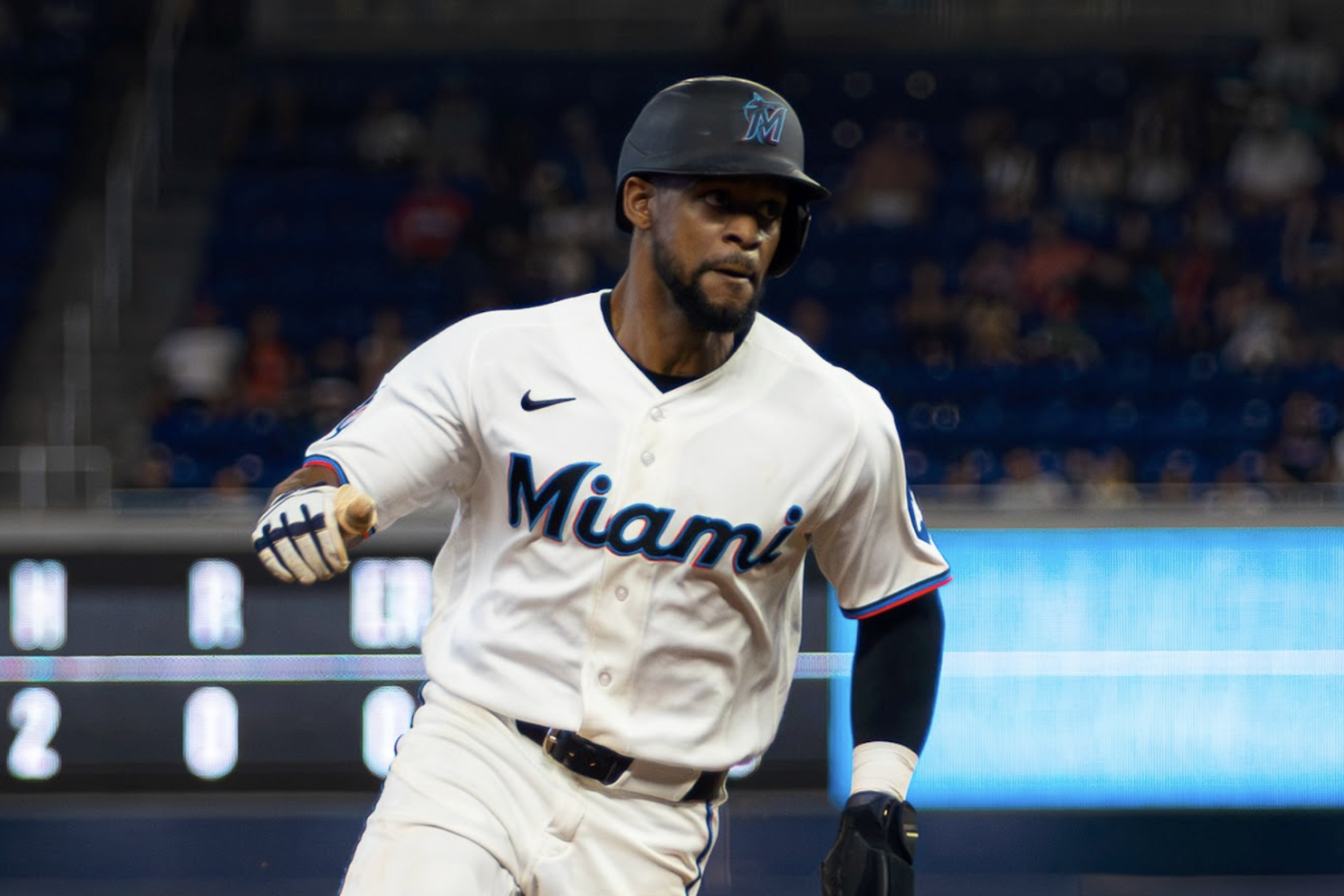
Jazz Chisholm Jr. seemed to be coming into his own before an injury sidelined him for the second half of the 2022 season. The then-24-year-old second baseman was posting the best offensive numbers of his brief career. Fast-forward to 2023, however, Chisholm often seems lost at the plate. Both his approach at the plate and how opposing pitchers are attacking him are completely different from his All-Star-worthy campaign.
Before his unfortunate back injury in 2022, a lot of things were going right. His .365 wOBA was the best mark of his career, along with career best walk (8.7%) and strikeout (27.4%) rates. Through 60 games, Chisholm’s run production was 39% better than league average (139 wRC+). His performance at the plate was the culmination of an ideal offensive approach: hitting balls hard and in the air.
Ideal Plate Appearance (IPA%) is a statistic coined by Pitcher List that quantifies how often a batter’s plate appearance ends in contact that generally leads to positive results. There are three types of batted balls that are considered “ideal”: barrels, solids, and flare/burners.
Now, what makes these types of batted balls ideal? In the interest of brevity, I’ll oversimplify it with the average batting average and slugging percentage for each of the six types of batted balls. Looking at the numbers, it’s a no-brainer:

To get the percent of plate appearances that are “ideal,” you’d then divide by the batter’s number of plate appearances. This is different than other statistics that use batted ball events as the driving numbers because it also takes into account the batter’s strikeout and walk rates.
If you’re wondering why it matters to use plate appearances rather than batted ball events with quality of contact metrics, you can read Alexander Chase’s article at Pitcher List here. The oversimplification is this: batted ball events only looks at what happens if a player makes contact, therefore completely ignoring how good or bad their plate discipline is.
A quick example: In 2022, Tommy Pham and Freddie Freeman had nearly identical, 88th percentile hard-hit rates—Pham with 48.2% and Freeman with 48.0%. Were Pham and Freeman the same caliber of hitters because nearly half of their batted balls were hit at 95 mph or more? Absolutely not. Freeman made contact a lot more frequently than Pham, and focusing only on batted balls doesn't account for the disparity in their walk rates. Overall, Freeman was an elite hitter (157 wRC+) while Pham was below average (89 wRC+).
So now that we’ve established PA > BBE, back to Jazz.
In 2022, Chisholm’s rate of ideal plate appearances was 29.0%. In 2023, that number has plummeted to 21.4%. With the league average IPA of 25.7%, Chisholm was significantly above-average in 2022 and now significantly below average in 2023. I mentioned above that there’s been some distinct differences between the Jazz we saw in 2022 vs. the hitter he’s been in 2023.

Chisholm went from above- to below-average batted ball results from 2022 to 2023, hitting the ball on the ground far more often this season. Unless absolutely scorched, groundballs usually fall into the “poorly/topped” category leading to bad results.
His swing decisions are also puzzling. He’s swinging less, so it makes sense that he’s taking more pitches for strikes. When he does swing, however, Jazz is making contact at a dismal rate. There are only 19 batters (min. 50 PA) that make contact less often than Chisholm does. Some of those names include Trayce Thompson, Trevor Larnach, Christopher Morel, Bryce Harper. These four players however, can be put into two separate categories: Thompson and Larnach swing less often than Jazz Chisholm Jr. Both create runs at a rate that is below league average. In contrast, Morel and Harper swing more often than Chisholm and are considered above-average by wRC+.
My guess is that Morel and Harper’s offensive profiles are able to offset their low contact rate because they’re swinging more often. Harper also has an impressive walk rate and has limited his strikeouts, allowing him to remain a productive hitter even when he fails to make contact. Morel is thriving despite his low contact rate and frequent strikeouts because he’s absolutely demolishing balls when he makes contact. Morel’s batting average on contact is .455, which is in the 99th percentile.
In contrast, Thompson and Larnach don’t have offensive profiles than can sustain them through periods of low contact. Like Chisholm, both hitters have high strikeout rates and swing rates among the worst in the league. I don’t have all the answers, but this approach doesn’t sound like a recipe for success.
As I’ve been watching games early this season, I felt like Jazz Chisholm Jr. was being passive at the plate, at least compared to his approach in 2022. So knowing that the statistics back it up encouraged me to try and see why that might be the case. Is he being pitched differently? Are there differences in performances against pitch types or speeds or anything else that stands out? I came upon a few…
Chisholm crushed breaking pitching in 2022. He slashed a combined .306/.333/.681 against breaking pitches in 2022. The success against those pitches has evaporated in 2023: .158/.273/.395.
From the pitcher’s perspective, I think other teams have made a concrete decision to attack one of Chisholm’s weaknesses: pitches low and inside. He’s seeing more pitches low in the zone than he ever has, and at a rate that puts him in the 95th percentile in baseball. Why? He really struggled against pitches low and in during the 2022 season.
Take a look at the strike zone breakdowns from Chisholm’s successful 2022 vs. the current 2023 season. The weaknesses he had in 2022 (left) are now being exploited in 2023 (right). For the most part, he hasn’t been able to adjust to the way teams are pitching him.
1. Strikeout percentage by zone
Last season, Chisholm was most likely to chase pitches low and inside in two-strike counts. 67% of the time a pitcher threw a ball low and inside, Chisholm struck out. This was by far the quadrant he was most likely to chase with two strikes. If the pitcher buried the pitch for a strike low and in, Chisholm struck out 33% of the time.
This season, Chisholm is struggling with two-strike pitches inside and outside the bottom of the strike zone. He’s chased two-strike, low and inside pitches at the same 67% rate as he did in 2022. But he’s also been unable to protect against chase pitches low and away in 2023. Additionally, his strikeout rate has increased in five of the nine in-zone locations, including all three low-zone locations. As Chisholm has shown he’s unable to handle those pitches this season, pitchers are attacking the lower third of the strike zone at an unprecedented rate. The league average rate for pitches low in the zone is 45.0%; in 2023, 55.5% of the pitches Chisholm sees are low. Again, that figure is in the 95th percentile.

2. wOBA by zone
When pitchers left the ball in the most areas of the strike zone in 2022, Jazz crushed those mistakes. The league average wOBA (weighted on-base average) is .316. He greatly exceeded that figure in six of the nine in-zone locations in 2022 and was just below average in a seventh. One of the two locations he struggled with was again, pitches low and inside. Even though these were strikes that caught that corner, Chisholm had a .147 wOBA.
This season, however, Chisholm is still struggling to cover those low and inside pitches. It improved from a .147 wOBA in 2022 to a .224 wOBA in 2023, but that’s still a well below-average figure. Along with that weakness, Chisholm has been unable to make pitchers pay for leaving pitches low in the zone and on the outer third of the plate. These were balls he teed off on last year. This year? Not so much.

3. Ground ball percentage by zone
We established earlier that hitting balls in the air leads to better success. One of the reasons why Chisholm’s wOBA is so low against pitches low in the zone is because, when he’s making contact, it’s usually ground balls. The pesky low and inside location for Chisholm lead to a ground ball 75% of the time he made contact in 2022. Although that number has decreased to 50% in 2023, nearly every other area of the strike zone is generating ground balls at a higher rate in 2023 than in 2022. Going from a 40.3% ground ball rate in 2022 to a 51.1% ground ball rate in 2023 is a huge increase, and one that Chisholm hasn’t been able to overcome.

The Miami Marlins are putting together one of their most successful starts to a season in recent history. Entering Tuesday, the team is 33-28 and three games back from the NL East-leading Atlanta Braves.
There have been some positives on offense:
- Luis Arraez has been everything the team could’ve hoped for and more.
- Jorge Soler is finally providing the power everyone expected from him.
- Jesús Sánchez and Bryan De La Cruz are producing runs with productive at-bats.
They also seem to be running into quite a bit of luck. That luck has undoubtably overshadowed some of the offensive concerns, namely the lack of production from the catching, shortstop, and third base positions.
With Jazz Chisholm Jr. poised to come off the injured list soon, the Marlins could really benefit from the production he flashed during the 2022 season.
Where will Otto Lopez finish in NL MVP voting?
Should the Marlins keep Brian Navarreto as Joe Mack's backup entering the 2027 season?

Follow Fish On First For Miami Marlins News & Analysis



Think you could write a story like this? Fish On First wants you to develop your voice and find an audience. We recruit our paid front page writers from our users blogs section. Start a blog today!
More From Fish On First
— Latest Marlins coverage from our writers
— Recent Marlins discussion in our forums
— Become a Fish On First SuperSub


Recommended Comments
There are no comments to display.
Create an account or sign in to comment
You need to be a member in order to leave a comment
Create an account
Sign up for a new account in our community. It's easy!
Register a new accountSign in
Already have an account? Sign in here.
Sign In Now