



Alex Krutchik
-
Posts
194 -
Joined
-
Last visited
-
Days Won
15
Content Type
Profiles
Miami Marlins Videos
2026 Miami Marlins Top Prospects Ranking
Miami Marlins Free Agent & Trade Rumors, Notes, & Tidbits
Guides & Resources
News
2025 Miami Marlins Draft Pick Tracker
2026 Miami Marlins Draft Tracker: Picks & Bonuses
Forums
Blogs
Events
Store
Downloads
Gallery
Everything posted by Alex Krutchik
-
 Marlins outfielder Griffin Conine speaks with Fish On First about experiencing Opening Day for the second time in his career, learning first base and much more. View full video
 -
'I treat it like recess': Connor Norby plays first game in outfield
Alex Krutchik posted an article in Marlins
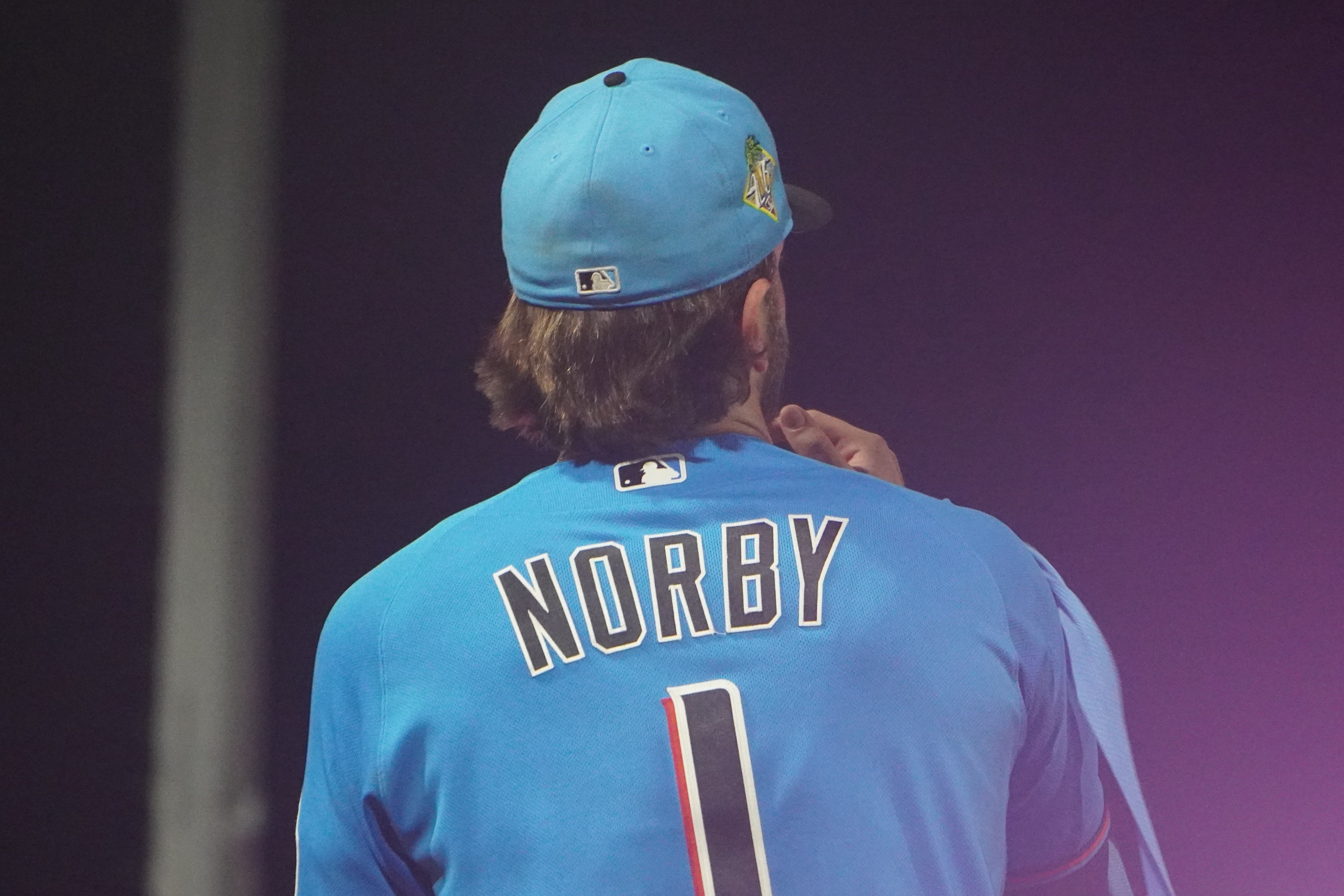 WEST PALM BEACH — Connor Norby joked after Friday’s game that he felt “like a wild horse that they let run free.” It was the 25-year-old’s first game in the outfield as a Miami Marlin, an experiment the team is trying out in order to keep Norby’s bat in the lineup. Norby, a full-time third baseman since arriving in Miami in 2024, has been lackluster in that spot. In each of his last two seasons, he recorded five outs below average at the hot corner, according to Baseball Savant. On Friday against the Houston Astros, he caught all three fly balls hit to him, including one off Jose Altuve on the first at-bat of the game. “You kind of just let your athleticism take over a little bit, and it also helps when you have (center fielder Jakob Marsee) covering your back too,” Norby said. 66rp4p.mp4 It’s that increased freedom of movement that has seemingly injected some life into an already-enthusiastic Norby. “I've had maybe two or three days out there, and I've loved every day so far,” Norby said. “I treat it like recess, almost.” Norby, who was traded from the Baltimore Orioles at the 2024 trade deadline, last played the outfield in 2024 while with the Orioles’ Triple-A affiliate, the Norfolk Tides. He played 77 games between left and right field in 2023 and 2024. Norby's primary position used to be second base, and he had never played third until he joined the Marlins organization. He has also played two games at first base this spring. Despite the struggles at third base and the willingness to play the outfield, Norby maintains he feels most comfortable at third. “I feel great at third,” Norby said. “I feel like my feet are really good right now…I feel like last year, I made really good strides in learning the position and getting better with it. And that's the goal, is to be better there. We have a really good defensive team, especially a defensive infield, and I gotta do my part as well.” Notes -Kyle Stowers left the game in the fourth inning with right hamstring tightness. He missed games earlier in spring with a Grade 1 strain of that same hamstring. -Eury Pérez allowed two runs and four hits in five innings against a Houston Astros lineup that featured most of their starters. -Dillon Lewis hit a go-ahead grand slam in the seventh inning.
 -
WEST PALM BEACH — Connor Norby joked after Friday’s game that he felt “like a wild horse that they let run free.” It was the 25-year-old’s first game in the outfield as a Miami Marlin, an experiment the team is trying out in order to keep Norby’s bat in the lineup. Norby, a full-time third baseman since arriving in Miami in 2024, has been lackluster in that spot. In each of his last two seasons, he recorded five outs below average at the hot corner, according to Baseball Savant. On Friday against the Houston Astros, he caught all three fly balls hit to him, including one off Jose Altuve on the first at-bat of the game. “You kind of just let your athleticism take over a little bit, and it also helps when you have (center fielder Jakob Marsee) covering your back too,” Norby said. 66rp4p.mp4 It’s that increased freedom of movement that has seemingly injected some life into an already-enthusiastic Norby. “I've had maybe two or three days out there, and I've loved every day so far,” Norby said. “I treat it like recess, almost.” Norby, who was traded from the Baltimore Orioles at the 2024 trade deadline, last played the outfield in 2024 while with the Orioles’ Triple-A affiliate, the Norfolk Tides. He played 77 games between left and right field in 2023 and 2024. Norby's primary position used to be second base, and he had never played third until he joined the Marlins organization. He has also played two games at first base this spring. Despite the struggles at third base and the willingness to play the outfield, Norby maintains he feels most comfortable at third. “I feel great at third,” Norby said. “I feel like my feet are really good right now…I feel like last year, I made really good strides in learning the position and getting better with it. And that's the goal, is to be better there. We have a really good defensive team, especially a defensive infield, and I gotta do my part as well.” Notes -Kyle Stowers left the game in the fourth inning with right hamstring tightness. He missed games earlier in spring with a Grade 1 strain of that same hamstring. -Eury Pérez allowed two runs and four hits in five innings against a Houston Astros lineup that featured most of their starters. -Dillon Lewis hit a go-ahead grand slam in the seventh inning. View full article
-
WEST PALM BEACH, Fla.—It’s hard to extrapolate spring training success to the regular season. But Chris Paddack is checking all the boxes. Saturday was Paddack’s third start of the spring, and he continued to look as solid as one can be this early in the calendar. The 30-year-old right-hander pitched three shutout innings, allowing just two hits and walking zero. For all of his struggles the last few years, he has consistently been one of the best in the league at limiting free passes, and he’s carried that control into Grapefruit League play this year with one walk over six innings pitched as a Miami Marlin. “Thought he had a good heater today,” Marlins manager Clayton McCullough said. “He's really playing well. Ability to get right up towards the top, and with the changeup that he has behind that.” lm09cq.mp4 Paddack was originally drafted by the Marlins in 2015 and was traded to the San Diego Padres in 2016, making his MLB debut in 2019. After an impressive rookie season that saw him record a 3.33 ERA, he has struggled to find the same success, pitching to a 5.06 ERA in six seasons since. What will separate Paddack from his previous performances will be the effectiveness of his breaking pitches, each of which have had a negative run value from 2021-2025, according to Baseball Savant. This spring, Paddack added a sweeper to his arsenal. He’s cautiously optimistic about its impact on his game. “We still have some chipping away to do,” Paddack said “It's not going to be that negative-18 (inches of horizontal break), negative-20 that you see some of these guys throw.” Paddack throws with a naturally pronated wrist, meaning his wrist and forearm closes and internally rotates as the ball is released. This doesn’t benefit or detract from his production, but it does lend itself to making certain pitches easier or harder to throw. Four-seam fastballs and changeups, for example, are typically more effective this way. The opposite of pronation is supination, which makes it easier to throw sweepers and other pitches characterized by spin. Paddack has been picking the brains of other pitchers that throw good spin pitches and breaking down film to look at his wrist position. “We're so close for it to catch,” Paddack said. “And it will be negative-12, negative-15 consistently. I would like it to be a little bit harder. It's kind of mirroring the curveball right now.” Last year, the Marlins deployed news training sessions for pitchers called “pitch design” where they throw a bullpen with real-time pitch data. It’s perfect for scenarios like this, where a pitcher wants to tinker with something new. “I get feedback from guys that are on my side, not trying to take my lunch money,” Paddack said. “And if they do clip me, they're able to walk me through, ‘Hey, this is what we saw,' or, 'That one was good—that one was better than the first one you threw.’” Other notes - The second round of cuts from Marlins big league camp consisted of right-hander Karson Milbrandt, first baseman Nathan Martorella and outfielders Dillon Lewis and Fenwick Trimble. Milbrandt, Lewis and Trimble are all Fish On First Top 30 prospects, but none have played above the Double-A level. There are now 61 players left in camp. - Janson Junk (right ankle sprain) made his 2026 Grapefruit League debut on Saturday, striking out two and allowing zero runs in his one inning of work. - Anthony Bender (right tibial stress reaction) and Andrew Nardi (left finger blister) are scheduled to make their first live game appearances of the spring on Tuesday. View full article
-
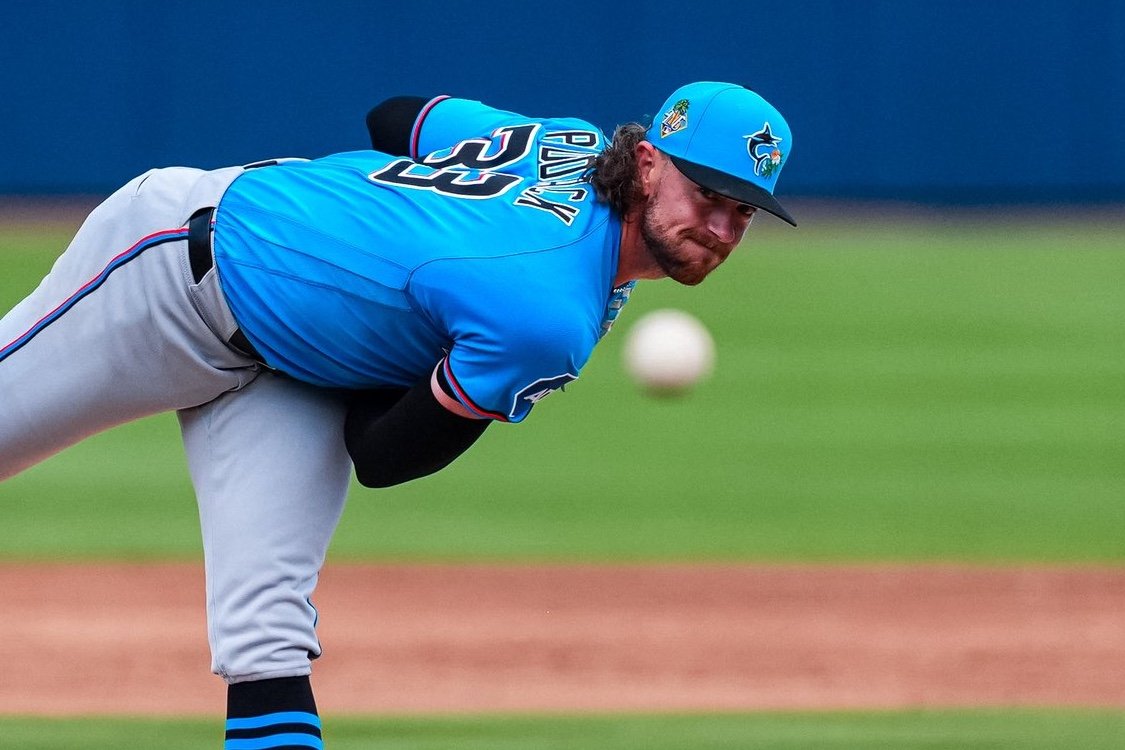 WEST PALM BEACH, Fla.—It’s hard to extrapolate spring training success to the regular season. But Chris Paddack is checking all the boxes. Saturday was Paddack’s third start of the spring, and he continued to look as solid as one can be this early in the calendar. The 30-year-old right-hander pitched three shutout innings, allowing just two hits and walking zero. For all of his struggles the last few years, he has consistently been one of the best in the league at limiting free passes, and he’s carried that control into Grapefruit League play this year with one walk over six innings pitched as a Miami Marlin. “Thought he had a good heater today,” Marlins manager Clayton McCullough said. “He's really playing well. Ability to get right up towards the top, and with the changeup that he has behind that.” lm09cq.mp4 Paddack was originally drafted by the Marlins in 2015 and was traded to the San Diego Padres in 2016, making his MLB debut in 2019. After an impressive rookie season that saw him record a 3.33 ERA, he has struggled to find the same success, pitching to a 5.06 ERA in six seasons since. What will separate Paddack from his previous performances will be the effectiveness of his breaking pitches, each of which have had a negative run value from 2021-2025, according to Baseball Savant. This spring, Paddack added a sweeper to his arsenal. He’s cautiously optimistic about its impact on his game. “We still have some chipping away to do,” Paddack said “It's not going to be that negative-18 (inches of horizontal break), negative-20 that you see some of these guys throw.” Paddack throws with a naturally pronated wrist, meaning his wrist and forearm closes and internally rotates as the ball is released. This doesn’t benefit or detract from his production, but it does lend itself to making certain pitches easier or harder to throw. Four-seam fastballs and changeups, for example, are typically more effective this way. The opposite of pronation is supination, which makes it easier to throw sweepers and other pitches characterized by spin. Paddack has been picking the brains of other pitchers that throw good spin pitches and breaking down film to look at his wrist position. “We're so close for it to catch,” Paddack said. “And it will be negative-12, negative-15 consistently. I would like it to be a little bit harder. It's kind of mirroring the curveball right now.” Last year, the Marlins deployed news training sessions for pitchers called “pitch design” where they throw a bullpen with real-time pitch data. It’s perfect for scenarios like this, where a pitcher wants to tinker with something new. “I get feedback from guys that are on my side, not trying to take my lunch money,” Paddack said. “And if they do clip me, they're able to walk me through, ‘Hey, this is what we saw,' or, 'That one was good—that one was better than the first one you threw.’” Other notes - The second round of cuts from Marlins big league camp consisted of right-hander Karson Milbrandt, first baseman Nathan Martorella and outfielders Dillon Lewis and Fenwick Trimble. Milbrandt, Lewis and Trimble are all Fish On First Top 30 prospects, but none have played above the Double-A level. There are now 61 players left in camp. - Janson Junk (right ankle sprain) made his 2026 Grapefruit League debut on Saturday, striking out two and allowing zero runs in his one inning of work. - Anthony Bender (right tibial stress reaction) and Andrew Nardi (left finger blister) are scheduled to make their first live game appearances of the spring on Tuesday.
 -
At Marlins Media Day, catcher Liam Hicks speaks with Fish On First about building up his bat speed and arm strength during the offseason, and why this team could exceed expectations again.
-
At Marlins Media Day, catcher Liam Hicks speaks with Fish On First about building up his bat speed and arm strength during the offseason, and why this team could exceed expectations again. View full video
-
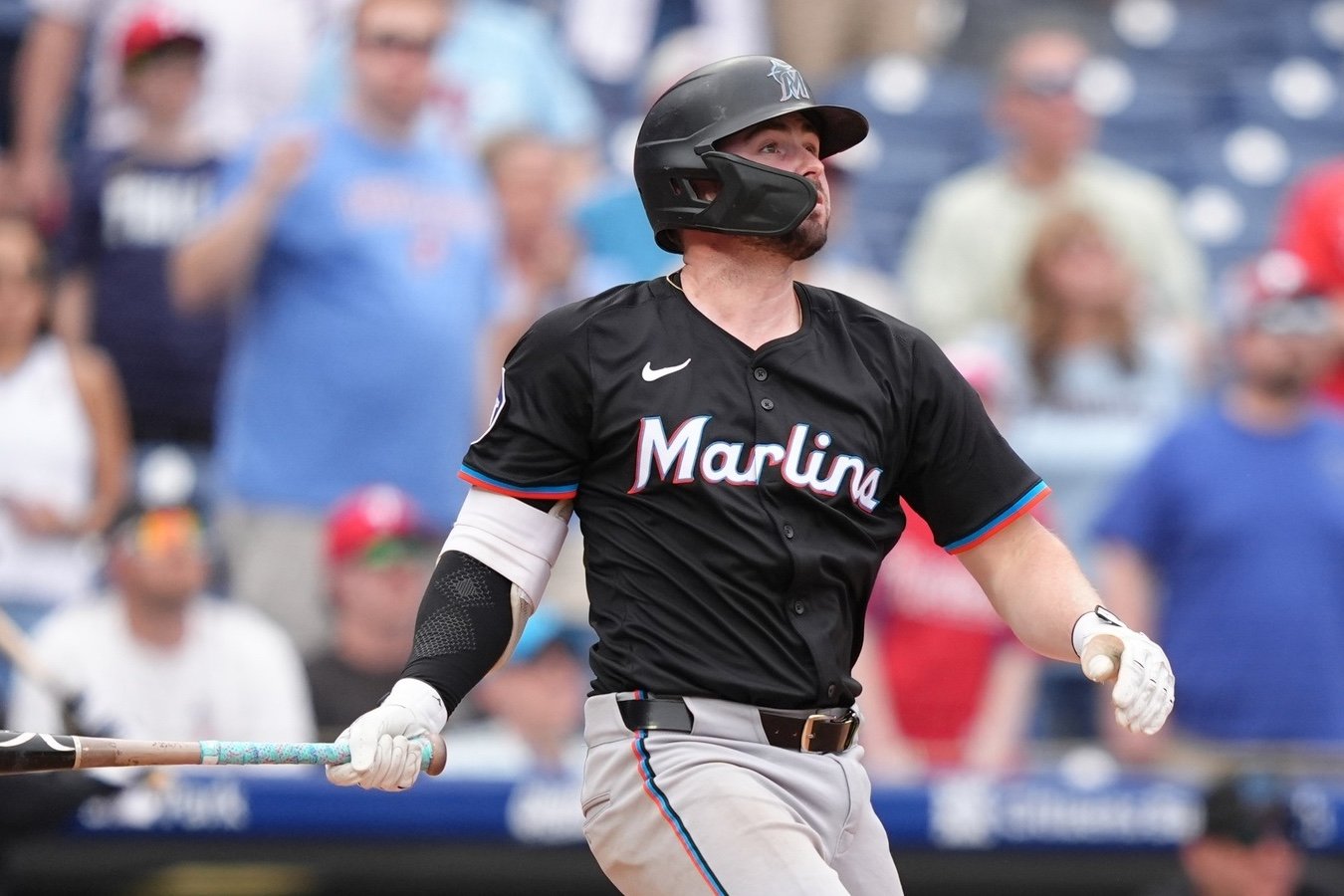 MIAMI—The Miami Marlins knew it would be an uphill battle to get Liam Hicks up to speed at the major league level. They selected him in the Rule 5 draft this past offseason, marking just the fifth time in 15 years a catcher had been taken. Picked in the ninth round of the 2021 amateur draft by the Texas Rangers, Hicks was traded to the Detroit Tigers organization in 2024, and had never played above Double-A prior to this year. Hicks was eligible for the Rule 5 because he was a former college draftee who had been left off his team's 40-man roster at the end of his fourth professional season. That's not uncommon—the development process is more gradual for catchers than players at other positions. They are rarely taken in the Rule 5 because the learning curve is particularly steep for them when making the transition to the majors. For context, you’d have to go back to 2007 to find a catcher who had any modicum of success after being picked in the Rule 5, when the Washington Nationals selected Jesús Flores. The then-23-year-old had a very respectable year in DC, slashing .244/.310/.361 in 79 games and starting 42 of them. He accumulated 0.4 fWAR. The performance was good enough to earn him the starter role next year and carve out a solid career with the Nationals through 2012. Hicks did not have the best start to his rookie campaign. But a pregame conversation with catching coach Joe Singley in late April injected confidence in Hicks that he belonged at this level. It was a road game against the Philadelphia Phillies, and his batting average stood at a paltry .179 with a 20% strikeout rate -- not bad, but certainly too high for someone who prides himself on bat-to-ball skills. Singley told Hicks to stop putting too much pressure on himself and enjoy the opportunity. It was a simple message, but an effective one. Hicks went 4-for-5 later that night with four RBI, and hit his first career home run. "You're just one game away," Hicks said. "You're struggling a little bit, you're just one game away from everything being alright." Five months later, he has etched himself into an expanded role, starting 93 games, with 62 of them at catcher and 23 at first base. His 94 OPS+ is the best from a full-time Marlins catcher since Nick Fortes in 2022. His .346 on-base percentage is sixth-best among rookies with at least 300 plate appearances this year. Offensively, the 26-year-old has a unique hitting profile. He doesn’t hit the ball hard—he only has six home runs and is near the bottom of the league in average exit velocity and barrel rate—but he has near-elite plate discipline and solid bat-to-ball skills. His chase rate of 17.4% is behind only Juan Soto, Gleyber Torres, and Trent Grisham. He’s also in the 92nd percentile in whiff rate at 15.1% and is fourth-best among rookies in walk rate at 11.0%. The hard work to get to this point started a month before spring camp even started. Singley worked with Hicks in January in West Palm, along with minor league catcher Ryan Ignoffo. “He put his nose to the grindstone from day one,” Singley said. "It’s just a testimony to who he is as a human, being able to climb up that battle, make the team, stay here all year. He's worked his tail off literally every single day. And I don't think that's possible if he's not the human that he is." From the start, they worked on being more explosive and athletic, keeping strikes as strikes, blocking the ball, and throwing. Hicks said he and Singley will look back at film from those early workouts and laugh at how unpolished it looked. “We were watching the first video of me receiving—he's literally just flipping the ball to me, and it looks terrible,” Hicks said. “And we were just laughing at how much better it looks now when it's a full-speed MLB game with guys throwing 100 miles per hour, and you're making it look a little bit better than when we were just flipping it underhand.” Ironically, receiving is what Hicks excelled at the most this year. He has recorded plus-one blocks above average and average framing, per Statcast. Singley attributed the improvement to Hicks’ ability to get his body in better athletic shape. “The work he's put in has been tremendous,” Singley said. “Every day, there's a heavy urgency to get better. Grading on a curve, performing at league average as a catcher who never played above Double-A is pretty impressive. But Hicks knows—taking a saying from his catching coach—“there’s still a lot of meat on the bone.” “Average isn't really the standard. We want to be a lot better than that,” Hicks said. “Joe's a guy that's gonna want to work every day. He's gonna hold you accountable. He studies the game so much from a catching perspective. There's no one I trust more about catching than him.” The main critique about Hicks’ 2025 campaign is inability to throw out runners. He’s only caught 10.5% of attempted base-stealers, and his pop time of 2.00 seconds is near the bottom of the league. Singley said the organization is putting catchers through a “throwing boot camp,” with emphasis for Hicks being on improving his mobility, arm strength, and quick release. “Just continue to stack the days,” Singley said. “Hopefully he shows up next year with a rocket and stops everything behind the plate. That's the goal.”
 -
MIAMI—The Miami Marlins knew it would be an uphill battle to get Liam Hicks up to speed at the major league level. They selected him in the Rule 5 draft this past offseason, marking just the fifth time in 15 years a catcher had been taken. Picked in the ninth round of the 2021 amateur draft by the Texas Rangers, Hicks was traded to the Detroit Tigers organization in 2024, and had never played above Double-A prior to this year. Hicks was eligible for the Rule 5 because he was a former college draftee who had been left off his team's 40-man roster at the end of his fourth professional season. That's not uncommon—the development process is more gradual for catchers than players at other positions. They are rarely taken in the Rule 5 because the learning curve is particularly steep for them when making the transition to the majors. For context, you’d have to go back to 2007 to find a catcher who had any modicum of success after being picked in the Rule 5, when the Washington Nationals selected Jesús Flores. The then-23-year-old had a very respectable year in DC, slashing .244/.310/.361 in 79 games and starting 42 of them. He accumulated 0.4 fWAR. The performance was good enough to earn him the starter role next year and carve out a solid career with the Nationals through 2012. Hicks did not have the best start to his rookie campaign. But a pregame conversation with catching coach Joe Singley in late April injected confidence in Hicks that he belonged at this level. It was a road game against the Philadelphia Phillies, and his batting average stood at a paltry .179 with a 20% strikeout rate -- not bad, but certainly too high for someone who prides himself on bat-to-ball skills. Singley told Hicks to stop putting too much pressure on himself and enjoy the opportunity. It was a simple message, but an effective one. Hicks went 4-for-5 later that night with four RBI, and hit his first career home run. "You're just one game away," Hicks said. "You're struggling a little bit, you're just one game away from everything being alright." Five months later, he has etched himself into an expanded role, starting 93 games, with 62 of them at catcher and 23 at first base. His 94 OPS+ is the best from a full-time Marlins catcher since Nick Fortes in 2022. His .346 on-base percentage is sixth-best among rookies with at least 300 plate appearances this year. Offensively, the 26-year-old has a unique hitting profile. He doesn’t hit the ball hard—he only has six home runs and is near the bottom of the league in average exit velocity and barrel rate—but he has near-elite plate discipline and solid bat-to-ball skills. His chase rate of 17.4% is behind only Juan Soto, Gleyber Torres, and Trent Grisham. He’s also in the 92nd percentile in whiff rate at 15.1% and is fourth-best among rookies in walk rate at 11.0%. The hard work to get to this point started a month before spring camp even started. Singley worked with Hicks in January in West Palm, along with minor league catcher Ryan Ignoffo. “He put his nose to the grindstone from day one,” Singley said. "It’s just a testimony to who he is as a human, being able to climb up that battle, make the team, stay here all year. He's worked his tail off literally every single day. And I don't think that's possible if he's not the human that he is." From the start, they worked on being more explosive and athletic, keeping strikes as strikes, blocking the ball, and throwing. Hicks said he and Singley will look back at film from those early workouts and laugh at how unpolished it looked. “We were watching the first video of me receiving—he's literally just flipping the ball to me, and it looks terrible,” Hicks said. “And we were just laughing at how much better it looks now when it's a full-speed MLB game with guys throwing 100 miles per hour, and you're making it look a little bit better than when we were just flipping it underhand.” Ironically, receiving is what Hicks excelled at the most this year. He has recorded plus-one blocks above average and average framing, per Statcast. Singley attributed the improvement to Hicks’ ability to get his body in better athletic shape. “The work he's put in has been tremendous,” Singley said. “Every day, there's a heavy urgency to get better. Grading on a curve, performing at league average as a catcher who never played above Double-A is pretty impressive. But Hicks knows—taking a saying from his catching coach—“there’s still a lot of meat on the bone.” “Average isn't really the standard. We want to be a lot better than that,” Hicks said. “Joe's a guy that's gonna want to work every day. He's gonna hold you accountable. He studies the game so much from a catching perspective. There's no one I trust more about catching than him.” The main critique about Hicks’ 2025 campaign is inability to throw out runners. He’s only caught 10.5% of attempted base-stealers, and his pop time of 2.00 seconds is near the bottom of the league. Singley said the organization is putting catchers through a “throwing boot camp,” with emphasis for Hicks being on improving his mobility, arm strength, and quick release. “Just continue to stack the days,” Singley said. “Hopefully he shows up next year with a rocket and stops everything behind the plate. That's the goal.” View full article
-
MIAMI, Fla.—The script flipped very quickly Friday night. After being held to one hit and no runs in the first four innings, the Miami Marlins put up six runs against the New York Mets in the fifth and coasted to a 6-2 win at loanDepot park. Sandy Alcantara, meanwhile, ended the night by retiring 15 of the last 17 hitters he faced after allowing six hits and two runs in his first three innings, including a leadoff home run to Francisco Lindor. Rookie starting pitcher Brandon Sproat cruised through the Marlins order the first time around. The Marlins didn’t get their first hit until Xavier Edwards singled up the middle to begin the fourth. Liam Hicks then grounded into a double play and Otto Lopez popped out to third base, ending any possible rally. They would not let the next leadoff hit go to waste. Down 2-0, Griffin Conine and Troy Johnston started the fifth with a couple of singles, and were driven home on a Heriberto Hernández triple into the right field corner. After Graham Pauley grounded out to first, Jakob Marsee hit a similar grounder to the same spot. But first baseman Pete Alonso bobbled the ball, allowing Hernández to score and take the lead. The Marlins tacked on three more runs in the frame. An RBI single from Edwards scored Agustín Ramírez, who had stolen third base when Ronny Mauricio was playing deep on the infield and not covering the bag, putting him in position to score on anything in the outfield. That was followed by a two-run pinch-hit home run from Connor Norby. daw7ow.mp4 It was a nice gift of run support to Alcantara, making his final start of 2025. The 30-year-old right-hander needed 55 pitches to get out of the first three innings. He was leaving pitches over the heart of the plate, and throwing his pitches a couple ticks slower than usual—his sinker averaging two miles per hour slower than his season mark during the first three innings. Marlins manager Clayton McCullough attributed the rough start to Alcantara not being able to find his rhythm. It was a problem that he faced earlier this year as he returned from Tommy John surgery that kept him out all of 2024. “Early in the season, not sure how that one would have gone,” McCullough said. “Now, he's just able to put things together much differently. And then he finds another gear late in games.” 21e4dfd2-d37c3504-3d5c5102-csvm-diamondgcp-asset_1280x720_59_4000K.mp4 Alcantara did not allow any runs or hits after those first three innings. The final 12 outs he recorded were groundouts, reminiscent of his 2022 Cy Young season where his 54.2% ground ball rate was in the top 10th percentile. “That's when the action of his pitches is working as they should,” McCullough said. “He's getting over the sinker, you got the changeup with depth, and now with how his spin balls have just improved through the year, that’s Sandy at his best. That's when you know that the action late on the pitches is there. The hitters are seeing it coming in, and then it dive bombs late.” Overall, this was the least effective season of Alcantara's career (5.36 ERA). However, he went a long way toward reestablishing himself as a high-quality innings-eater down the stretch, completing at least six frames in each of his final eight outings. The game was a huge blow to the Mets’ playoff chances. New York came into Friday with a one-game lead over the Cincinnati Reds for the final NL Wild Card spot, who took care of business on their end by defeating the Milwaukee Brewers. The Reds own the head-to-head tiebreaker should both teams finish the weekend with the same record. The Arizona Diamondbacks are also still mathematically alive. The playoff nature of Friday’s game may have contributed to the adrenaline as Alcantara walked off the mound after being pulled in the eighth inning. With trade rumors swirling since last winter, he tipped his cap to the 34,196 fans that gave him a standing ovation. "I was close to crying,” Alcantara said. “I don't know what's going to happen after Sunday. I’m just trying to take every special moment that I have with my teammates. I play for the Marlins. So I'm not going to say this is my last start here in Miami. Let's see what happens. We gotta get ready in spring training and try to win more games than we did this year.” Probable starters for Saturday's 4:10 p.m. game are Eury Pérez and Clay Holmes. View full article
-
.jpg.37f1a3eb776c8e2247c471764ecfbcf8.jpg) MIAMI, Fla.—The script flipped very quickly Friday night. After being held to one hit and no runs in the first four innings, the Miami Marlins put up six runs against the New York Mets in the fifth and coasted to a 6-2 win at loanDepot park. Sandy Alcantara, meanwhile, ended the night by retiring 15 of the last 17 hitters he faced after allowing six hits and two runs in his first three innings, including a leadoff home run to Francisco Lindor. Rookie starting pitcher Brandon Sproat cruised through the Marlins order the first time around. The Marlins didn’t get their first hit until Xavier Edwards singled up the middle to begin the fourth. Liam Hicks then grounded into a double play and Otto Lopez popped out to third base, ending any possible rally. They would not let the next leadoff hit go to waste. Down 2-0, Griffin Conine and Troy Johnston started the fifth with a couple of singles, and were driven home on a Heriberto Hernández triple into the right field corner. After Graham Pauley grounded out to first, Jakob Marsee hit a similar grounder to the same spot. But first baseman Pete Alonso bobbled the ball, allowing Hernández to score and take the lead. The Marlins tacked on three more runs in the frame. An RBI single from Edwards scored Agustín Ramírez, who had stolen third base when Ronny Mauricio was playing deep on the infield and not covering the bag, putting him in position to score on anything in the outfield. That was followed by a two-run pinch-hit home run from Connor Norby. daw7ow.mp4 It was a nice gift of run support to Alcantara, making his final start of 2025. The 30-year-old right-hander needed 55 pitches to get out of the first three innings. He was leaving pitches over the heart of the plate, and throwing his pitches a couple ticks slower than usual—his sinker averaging two miles per hour slower than his season mark during the first three innings. Marlins manager Clayton McCullough attributed the rough start to Alcantara not being able to find his rhythm. It was a problem that he faced earlier this year as he returned from Tommy John surgery that kept him out all of 2024. “Early in the season, not sure how that one would have gone,” McCullough said. “Now, he's just able to put things together much differently. And then he finds another gear late in games.” 21e4dfd2-d37c3504-3d5c5102-csvm-diamondgcp-asset_1280x720_59_4000K.mp4 Alcantara did not allow any runs or hits after those first three innings. The final 12 outs he recorded were groundouts, reminiscent of his 2022 Cy Young season where his 54.2% ground ball rate was in the top 10th percentile. “That's when the action of his pitches is working as they should,” McCullough said. “He's getting over the sinker, you got the changeup with depth, and now with how his spin balls have just improved through the year, that’s Sandy at his best. That's when you know that the action late on the pitches is there. The hitters are seeing it coming in, and then it dive bombs late.” Overall, this was the least effective season of Alcantara's career (5.36 ERA). However, he went a long way toward reestablishing himself as a high-quality innings-eater down the stretch, completing at least six frames in each of his final eight outings. The game was a huge blow to the Mets’ playoff chances. New York came into Friday with a one-game lead over the Cincinnati Reds for the final NL Wild Card spot, who took care of business on their end by defeating the Milwaukee Brewers. The Reds own the head-to-head tiebreaker should both teams finish the weekend with the same record. The Arizona Diamondbacks are also still mathematically alive. The playoff nature of Friday’s game may have contributed to the adrenaline as Alcantara walked off the mound after being pulled in the eighth inning. With trade rumors swirling since last winter, he tipped his cap to the 34,196 fans that gave him a standing ovation. "I was close to crying,” Alcantara said. “I don't know what's going to happen after Sunday. I’m just trying to take every special moment that I have with my teammates. I play for the Marlins. So I'm not going to say this is my last start here in Miami. Let's see what happens. We gotta get ready in spring training and try to win more games than we did this year.” Probable starters for Saturday's 4:10 p.m. game are Eury Pérez and Clay Holmes.
MIAMI, Fla.—The script flipped very quickly Friday night. After being held to one hit and no runs in the first four innings, the Miami Marlins put up six runs against the New York Mets in the fifth and coasted to a 6-2 win at loanDepot park. Sandy Alcantara, meanwhile, ended the night by retiring 15 of the last 17 hitters he faced after allowing six hits and two runs in his first three innings, including a leadoff home run to Francisco Lindor. Rookie starting pitcher Brandon Sproat cruised through the Marlins order the first time around. The Marlins didn’t get their first hit until Xavier Edwards singled up the middle to begin the fourth. Liam Hicks then grounded into a double play and Otto Lopez popped out to third base, ending any possible rally. They would not let the next leadoff hit go to waste. Down 2-0, Griffin Conine and Troy Johnston started the fifth with a couple of singles, and were driven home on a Heriberto Hernández triple into the right field corner. After Graham Pauley grounded out to first, Jakob Marsee hit a similar grounder to the same spot. But first baseman Pete Alonso bobbled the ball, allowing Hernández to score and take the lead. The Marlins tacked on three more runs in the frame. An RBI single from Edwards scored Agustín Ramírez, who had stolen third base when Ronny Mauricio was playing deep on the infield and not covering the bag, putting him in position to score on anything in the outfield. That was followed by a two-run pinch-hit home run from Connor Norby. daw7ow.mp4 It was a nice gift of run support to Alcantara, making his final start of 2025. The 30-year-old right-hander needed 55 pitches to get out of the first three innings. He was leaving pitches over the heart of the plate, and throwing his pitches a couple ticks slower than usual—his sinker averaging two miles per hour slower than his season mark during the first three innings. Marlins manager Clayton McCullough attributed the rough start to Alcantara not being able to find his rhythm. It was a problem that he faced earlier this year as he returned from Tommy John surgery that kept him out all of 2024. “Early in the season, not sure how that one would have gone,” McCullough said. “Now, he's just able to put things together much differently. And then he finds another gear late in games.” 21e4dfd2-d37c3504-3d5c5102-csvm-diamondgcp-asset_1280x720_59_4000K.mp4 Alcantara did not allow any runs or hits after those first three innings. The final 12 outs he recorded were groundouts, reminiscent of his 2022 Cy Young season where his 54.2% ground ball rate was in the top 10th percentile. “That's when the action of his pitches is working as they should,” McCullough said. “He's getting over the sinker, you got the changeup with depth, and now with how his spin balls have just improved through the year, that’s Sandy at his best. That's when you know that the action late on the pitches is there. The hitters are seeing it coming in, and then it dive bombs late.” Overall, this was the least effective season of Alcantara's career (5.36 ERA). However, he went a long way toward reestablishing himself as a high-quality innings-eater down the stretch, completing at least six frames in each of his final eight outings. The game was a huge blow to the Mets’ playoff chances. New York came into Friday with a one-game lead over the Cincinnati Reds for the final NL Wild Card spot, who took care of business on their end by defeating the Milwaukee Brewers. The Reds own the head-to-head tiebreaker should both teams finish the weekend with the same record. The Arizona Diamondbacks are also still mathematically alive. The playoff nature of Friday’s game may have contributed to the adrenaline as Alcantara walked off the mound after being pulled in the eighth inning. With trade rumors swirling since last winter, he tipped his cap to the 34,196 fans that gave him a standing ovation. "I was close to crying,” Alcantara said. “I don't know what's going to happen after Sunday. I’m just trying to take every special moment that I have with my teammates. I play for the Marlins. So I'm not going to say this is my last start here in Miami. Let's see what happens. We gotta get ready in spring training and try to win more games than we did this year.” Probable starters for Saturday's 4:10 p.m. game are Eury Pérez and Clay Holmes. -
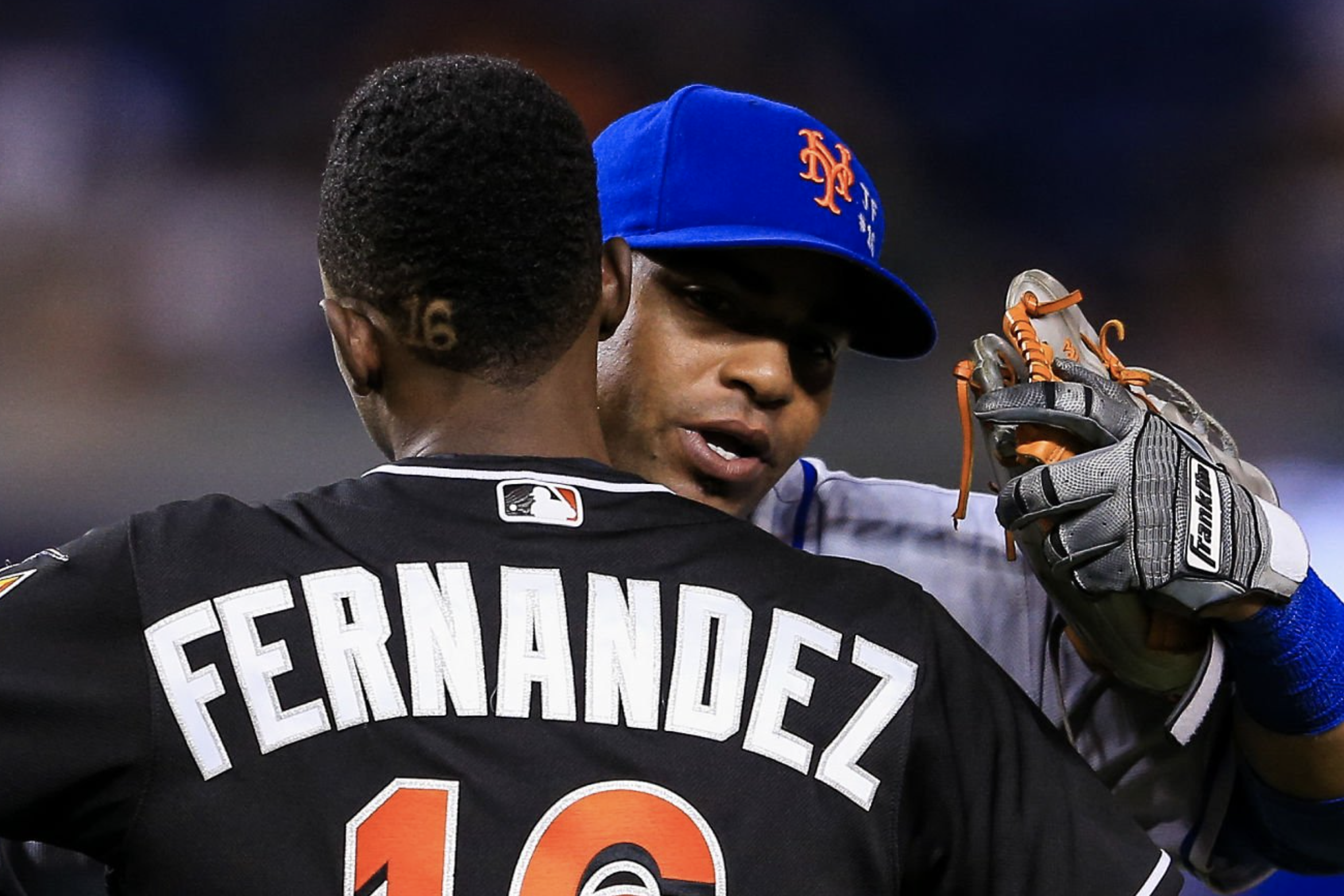 The Miami Marlins and New York Mets have an odd rivalry. The players have never seemed to hate each other, the two teams have never faced each other in the playoffs, and they are rarely both good at the same time. Even so, the Marlins and Mets frequently find themselves producing memorable games when they meet during the regular season. Here’s the subjective list that Miami will hope to add to while playing spoiler during the final series of their 2025 campaign. Marlins Close Down Shea (Sept. 28, 2008) If I had a nickel for every time the Marlins eliminated the Mets from playoff contention on the final day of the season, I’d have two nickels. The Marlins delivered the Mets their 12th loss in 17 games on the final day of 2007, keeping New York out of the postseason. The two were scheduled to conclude the 2008 season as well, which, coincidentally, was the grand closing of Shea Stadium. A near-sellout of 56,059 gathered in Queens on a brisk September day holding out hope that they’d get one more playoff series in the iconic ballpark. The Mets came into the final game tied with the Milwaukee Brewers for the final National League Wild Card spot at 89-72. Florida and New York were tied at 2-2 going into the eighth. The Mets bullpen gave up back-to-back solo home runs to Dan Uggla and Wes Helms in the top of the frame to go down, 4-2. qu2pyk_1.mp4 Marlins relievers Kevin Gregg and Matt Lindstrom shut down the Mets offense for the next two innings, and made Shea’s finale a somber one. Two consecutive seasons. Two consecutive heartbreaks at the hands of the Marlins. The Rain Delay (Sept. 28, 2023) Up half a game on the Chicago Cubs for the third and final Wild Card spot with four games to go, the Marlins mounted a ninth-inning comeback against the Mets. As rain began to steadily fall at Citi Field, Miami took a 2-1 lead thanks to RBIs from Jazz Chisholm Jr. and Yuli Gurriel. With two out in the top of the inning, the rain was too heavy to ignore, and crew chief Alfonso Marquez called for the tarp. After two and a half hours, the Mets grounds crew began removing the tarp as the rain temporarily let up, but let it lay in left field and never fully put it away. This allowed the drizzle to dampen the infield even further, and for the water on the tarp to completely soak the outfield. Marlins manager Skip Schumaker was seen on the broadcast trying to help the grounds crew pull the tarp off—perhaps as a way of protest—and having an animated argument with Marquez and the head of the Mets grounds crew to coax them into restarting the game. The Mets eventually covered the infield again, and the game was officially suspended at 12:58 a.m., with the Marlins having to be in Pittsburgh for a game later that day at 6:40 p.m. Many players said they didn’t get to sleep until around 5 a.m. Luckily for the Marlins, they’d clinch a postseason spot two days later against the Pirates. Had they not, they would’ve had to fly back to Queens the day after their Pittsburgh series finale and finish the final inning. The Adam Greenberg Game (Oct. 2, 2012) Adam Greenberg has one of the most frustrating stories in the history of this game. In his first major league at-bat in 2005, Marlins reliever Valerio de los Santos accidentally hit the Chicago Cubs prospect in the head. The then-24-year-old fractured his skull and suffered a concussion. He’d deal with vertigo, nausea, and severe headaches for at least another year after the injury. Despite multiple comeback attempts in the minor leagues, he never played another game in the majors. After multiple fan petitions over the years, the Marlins agreed to sign Greenberg to a one-day contract in 2012 and let him take one final at-bat—this time, against the New York Mets. Now 31, Greenberg climbed into the box at Marlins Park as 29,709 fans gave him a standing ovation. Of course, because nothing in life is fair, he’d have to take his one and only at-bat against R.A. Dickey. The 37-year-old knuckleballer had revived his career with New York, and 2012 would be his peak, leading the league in innings pitched (233 ⅔) and strikeouts (230) en route to a Cy Young victory. Dickey threw three knuckleballs for a strikeout. A team in mourning (Sept. 26, 2016) This night reminded us that baseball is a fraternal game, despite the bad blood that usually exists between divisional foes. One day after the tragic passing of star pitcher José Fernández, the Marlins did one of the toughest and bravest things in their franchise’s history: they played a baseball game. Both teams stood along the baselines during an emotional pregame ceremony. They then converged in the middle of the diamond, hugging and consoling one another in an unplanned show of solidarity. From the Mets side of that day, perhaps one of the most touching tributes came from the SNY booth of Keith Hernandez, Ron Darling, and Gary Cohen. “I was especially struck by the poignancy of the national anthem,” Cohen said. “A song we hear every day. But for a young man who risked everything to be a part of this country it rang especially true today.” Barely able to speak through visible tears, Hernandez said, “It was just a beautiful ceremony…It’s a tough day.” Everyone will remember Dee Strange-Gordon’s home run in the first inning, nearly collapsing at home plate in tears after hitting his only homer that year. But the classiness from the Mets organization that night will always hold a special place in my heart. It really felt like the Mets had entered a new era last year. Fresh off a postseason run that took them all the way to the National League Championship Series, they re-signed homegrown talent in Pete Alonso to a two-year extension and stole Juan Soto from the Yankees with a record-breaking 15-year, $765 million contract. The underdog Metropolitans who couldn’t stay out of their own way and were constantly second fiddle to their neighbors in the Bronx seemed to be a thing of the past. The Mets have been in the postseason picture all year, leading the NL East by as much as 5.5 games in June. They lost that lead to the Philadelphia Phillies later that month, but would be neck-and-neck with them until early August, when they lost the lead for good. New York has spent the rest of the season clinging to that last Wild Card spot thanks to an abysmal 20-30 record in August and September. Prior to Friday’s series opener in Miami, the Mets hold a one-game lead over the Cincinnati Reds and a two-game lead over the Arizona Diamondbacks. All that stands between New York and a postseason spot is the Marlins and 64 years of conceptual proof that the universe hates the Mets.
 -
The Miami Marlins and New York Mets have an odd rivalry. The players have never seemed to hate each other, the two teams have never faced each other in the playoffs, and they are rarely both good at the same time. Even so, the Marlins and Mets frequently find themselves producing memorable games when they meet during the regular season. Here’s the subjective list that Miami will hope to add to while playing spoiler during the final series of their 2025 campaign. Marlins Close Down Shea (Sept. 28, 2008) If I had a nickel for every time the Marlins eliminated the Mets from playoff contention on the final day of the season, I’d have two nickels. The Marlins delivered the Mets their 12th loss in 17 games on the final day of 2007, keeping New York out of the postseason. The two were scheduled to conclude the 2008 season as well, which, coincidentally, was the grand closing of Shea Stadium. A near-sellout of 56,059 gathered in Queens on a brisk September day holding out hope that they’d get one more playoff series in the iconic ballpark. The Mets came into the final game tied with the Milwaukee Brewers for the final National League Wild Card spot at 89-72. Florida and New York were tied at 2-2 going into the eighth. The Mets bullpen gave up back-to-back solo home runs to Dan Uggla and Wes Helms in the top of the frame to go down, 4-2. qu2pyk_1.mp4 Marlins relievers Kevin Gregg and Matt Lindstrom shut down the Mets offense for the next two innings, and made Shea’s finale a somber one. Two consecutive seasons. Two consecutive heartbreaks at the hands of the Marlins. The Rain Delay (Sept. 28, 2023) Up half a game on the Chicago Cubs for the third and final Wild Card spot with four games to go, the Marlins mounted a ninth-inning comeback against the Mets. As rain began to steadily fall at Citi Field, Miami took a 2-1 lead thanks to RBIs from Jazz Chisholm Jr. and Yuli Gurriel. With two out in the top of the inning, the rain was too heavy to ignore, and crew chief Alfonso Marquez called for the tarp. After two and a half hours, the Mets grounds crew began removing the tarp as the rain temporarily let up, but let it lay in left field and never fully put it away. This allowed the drizzle to dampen the infield even further, and for the water on the tarp to completely soak the outfield. Marlins manager Skip Schumaker was seen on the broadcast trying to help the grounds crew pull the tarp off—perhaps as a way of protest—and having an animated argument with Marquez and the head of the Mets grounds crew to coax them into restarting the game. The Mets eventually covered the infield again, and the game was officially suspended at 12:58 a.m., with the Marlins having to be in Pittsburgh for a game later that day at 6:40 p.m. Many players said they didn’t get to sleep until around 5 a.m. Luckily for the Marlins, they’d clinch a postseason spot two days later against the Pirates. Had they not, they would’ve had to fly back to Queens the day after their Pittsburgh series finale and finish the final inning. The Adam Greenberg Game (Oct. 2, 2012) Adam Greenberg has one of the most frustrating stories in the history of this game. In his first major league at-bat in 2005, Marlins reliever Valerio de los Santos accidentally hit the Chicago Cubs prospect in the head. The then-24-year-old fractured his skull and suffered a concussion. He’d deal with vertigo, nausea, and severe headaches for at least another year after the injury. Despite multiple comeback attempts in the minor leagues, he never played another game in the majors. After multiple fan petitions over the years, the Marlins agreed to sign Greenberg to a one-day contract in 2012 and let him take one final at-bat—this time, against the New York Mets. Now 31, Greenberg climbed into the box at Marlins Park as 29,709 fans gave him a standing ovation. Of course, because nothing in life is fair, he’d have to take his one and only at-bat against R.A. Dickey. The 37-year-old knuckleballer had revived his career with New York, and 2012 would be his peak, leading the league in innings pitched (233 ⅔) and strikeouts (230) en route to a Cy Young victory. Dickey threw three knuckleballs for a strikeout. A team in mourning (Sept. 26, 2016) This night reminded us that baseball is a fraternal game, despite the bad blood that usually exists between divisional foes. One day after the tragic passing of star pitcher José Fernández, the Marlins did one of the toughest and bravest things in their franchise’s history: they played a baseball game. Both teams stood along the baselines during an emotional pregame ceremony. They then converged in the middle of the diamond, hugging and consoling one another in an unplanned show of solidarity. From the Mets side of that day, perhaps one of the most touching tributes came from the SNY booth of Keith Hernandez, Ron Darling, and Gary Cohen. “I was especially struck by the poignancy of the national anthem,” Cohen said. “A song we hear every day. But for a young man who risked everything to be a part of this country it rang especially true today.” Barely able to speak through visible tears, Hernandez said, “It was just a beautiful ceremony…It’s a tough day.” Everyone will remember Dee Strange-Gordon’s home run in the first inning, nearly collapsing at home plate in tears after hitting his only homer that year. But the classiness from the Mets organization that night will always hold a special place in my heart. It really felt like the Mets had entered a new era last year. Fresh off a postseason run that took them all the way to the National League Championship Series, they re-signed homegrown talent in Pete Alonso to a two-year extension and stole Juan Soto from the Yankees with a record-breaking 15-year, $765 million contract. The underdog Metropolitans who couldn’t stay out of their own way and were constantly second fiddle to their neighbors in the Bronx seemed to be a thing of the past. The Mets have been in the postseason picture all year, leading the NL East by as much as 5.5 games in June. They lost that lead to the Philadelphia Phillies later that month, but would be neck-and-neck with them until early August, when they lost the lead for good. New York has spent the rest of the season clinging to that last Wild Card spot thanks to an abysmal 20-30 record in August and September. Prior to Friday’s series opener in Miami, the Mets hold a one-game lead over the Cincinnati Reds and a two-game lead over the Arizona Diamondbacks. All that stands between New York and a postseason spot is the Marlins and 64 years of conceptual proof that the universe hates the Mets. View full article
-
First game of the pitch-calling experiment (mostly) a success
Alex Krutchik posted an article in Marlins
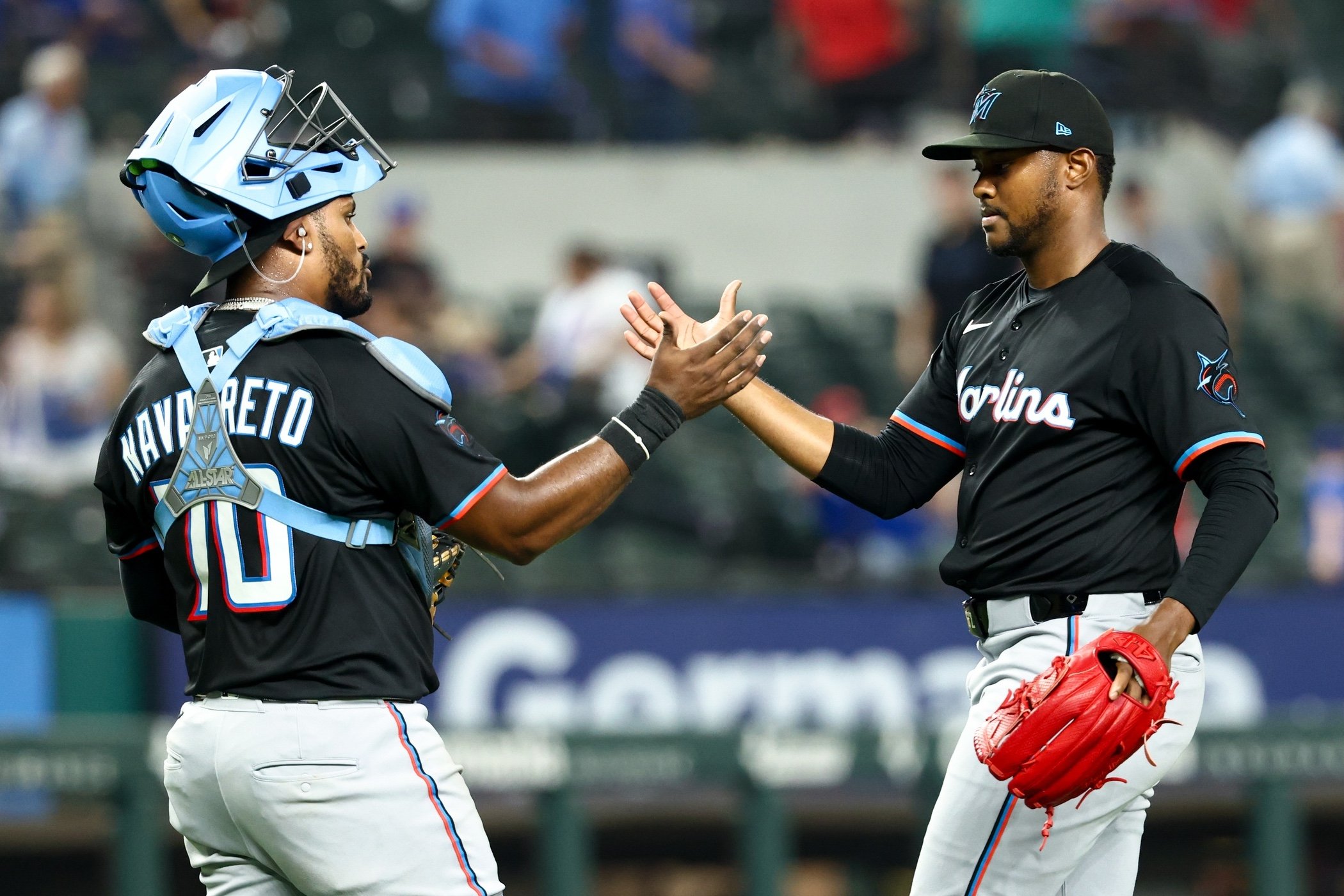 Much will be made about the Miami Marlins’ experiment of calling pitches from the dugout. Early in the 2025 season, the Marlins’ minor league teams began doing it. Their coaches would relay signs to the catcher, who would then transmit the call to the pitcher. Marlins manager Clayton McCullough said prior to Friday’s game in Arlington that they made the decision to bring this process to the major league level, with assistant pitching coach Alon Leichman relaying the signs to catcher Liam Hicks. There is video evidence that strongly suggests Hicks received several pitch calls from Leichman during his previous catching appearance on Wednesday—Hicks has spent the entire season in the majors, so that allowed him to accumulate some in-game experience before the new pitch-calling procedure was fully implemented. Friday was a great first data point—at least for the vast majority of the night. Starting pitcher Janson Junk was in top form, allowing one run over seven innings in a 6-4 win against the Texas Rangers. Junk allowed just three hits, struck out five, and walked zero. From the end of the second inning to the sixth, the 29-year-old right-hander retired 12 straight hitters. As far as pitch selection goes, it was largely similar to what we usually see from Junk. He relied mostly on his four-seamer and slider, those two accounting for 75% of his 91 pitches, compared to his season average of 64% on that combination. He still offered a dozen sweepers—all to righties—and then a handful of changeups and curveballs to lefties, which is all consistent with his scouting report. Pitchers can still shake off what the coach calls, but with the pitch clock, it can be hard to send a new call in time. Whether Junk agreed to most of the calls or not, he was not hit with a pitch-clock violation during his outing Friday. Lake Bachar and Cade Gibson delivered the game to extras with two scoreless innings, clinging to a 1-1 tie. While Gibson was facing Jake Burger with two out and nobody on in the ninth, there was a breakdown in communication. As he was waiting for the call on a 2-1 count, Hicks kept spinning his finger towards the dugout to urge Leichman to get the call in as the pitch clock ticked down to five seconds. Burger wound up calling timeout anyway, making it a moot issue. enuodi_1.mp4 The Marlins took a 3-1 lead in the 10th on an Otto Lopez RBI double to center field. Lopez would score two batters later on an Xavier Edwards single. However, a two-out, two-run home run by Rowdy Tellez off of Michael Petersen's 2-0 cutter gave Texas renewed life. Each of the previous pitches Petersen threw to Tellez were also cutters. It was the 11th pitch of the inning, and the ninth time he threw the cutter. Petersen seemed to be the only Marlins pitcher Friday whose pitch selection was significantly different. Twelve of his 21 pitches over two innings were cutters, and only nine were four-seamers. It’s usually the inverse for him, using his fastball 57% of the time and the cutter 39.7%. Even when he used his fastball Friday, eight of them were thrown to righties, even though he’s slightly more liable to use it against lefties this year. The Marlins retook the lead in the 12th on a Jakob Marsee double to right field. Brian Navarreto, replacing Hicks defensively in the 10th, tacked on another run with a double of his own. George Soriano pitched a perfect final two innings to earn the win, only allowing the placed runner to score in the 12th on two consecutive flyouts. The Marlins now have eight wins in their last nine games, which matches their best nine-game stretch of the entire season.
- 1 comment
-
- 2
-

-
- alon leichman
- janson junk
- (and 1 more)
-
Much will be made about the Miami Marlins’ experiment of calling pitches from the dugout. Early in the 2025 season, the Marlins’ minor league teams began doing it. Their coaches would relay signs to the catcher, who would then transmit the call to the pitcher. Marlins manager Clayton McCullough said prior to Friday’s game in Arlington that they made the decision to bring this process to the major league level, with assistant pitching coach Alon Leichman relaying the signs to catcher Liam Hicks. There is video evidence that strongly suggests Hicks received several pitch calls from Leichman during his previous catching appearance on Wednesday—Hicks has spent the entire season in the majors, so that allowed him to accumulate some in-game experience before the new pitch-calling procedure was fully implemented. Friday was a great first data point—at least for the vast majority of the night. Starting pitcher Janson Junk was in top form, allowing one run over seven innings in a 6-4 win against the Texas Rangers. Junk allowed just three hits, struck out five, and walked zero. From the end of the second inning to the sixth, the 29-year-old right-hander retired 12 straight hitters. As far as pitch selection goes, it was largely similar to what we usually see from Junk. He relied mostly on his four-seamer and slider, those two accounting for 75% of his 91 pitches, compared to his season average of 64% on that combination. He still offered a dozen sweepers—all to righties—and then a handful of changeups and curveballs to lefties, which is all consistent with his scouting report. Pitchers can still shake off what the coach calls, but with the pitch clock, it can be hard to send a new call in time. Whether Junk agreed to most of the calls or not, he was not hit with a pitch-clock violation during his outing Friday. Lake Bachar and Cade Gibson delivered the game to extras with two scoreless innings, clinging to a 1-1 tie. While Gibson was facing Jake Burger with two out and nobody on in the ninth, there was a breakdown in communication. As he was waiting for the call on a 2-1 count, Hicks kept spinning his finger towards the dugout to urge Leichman to get the call in as the pitch clock ticked down to five seconds. Burger wound up calling timeout anyway, making it a moot issue. enuodi_1.mp4 The Marlins took a 3-1 lead in the 10th on an Otto Lopez RBI double to center field. Lopez would score two batters later on an Xavier Edwards single. However, a two-out, two-run home run by Rowdy Tellez off of Michael Petersen's 2-0 cutter gave Texas renewed life. Each of the previous pitches Petersen threw to Tellez were also cutters. It was the 11th pitch of the inning, and the ninth time he threw the cutter. Petersen seemed to be the only Marlins pitcher Friday whose pitch selection was significantly different. Twelve of his 21 pitches over two innings were cutters, and only nine were four-seamers. It’s usually the inverse for him, using his fastball 57% of the time and the cutter 39.7%. Even when he used his fastball Friday, eight of them were thrown to righties, even though he’s slightly more liable to use it against lefties this year. The Marlins retook the lead in the 12th on a Jakob Marsee double to right field. Brian Navarreto, replacing Hicks defensively in the 10th, tacked on another run with a double of his own. George Soriano pitched a perfect final two innings to earn the win, only allowing the placed runner to score in the 12th on two consecutive flyouts. The Marlins now have eight wins in their last nine games, which matches their best nine-game stretch of the entire season. View full article
-
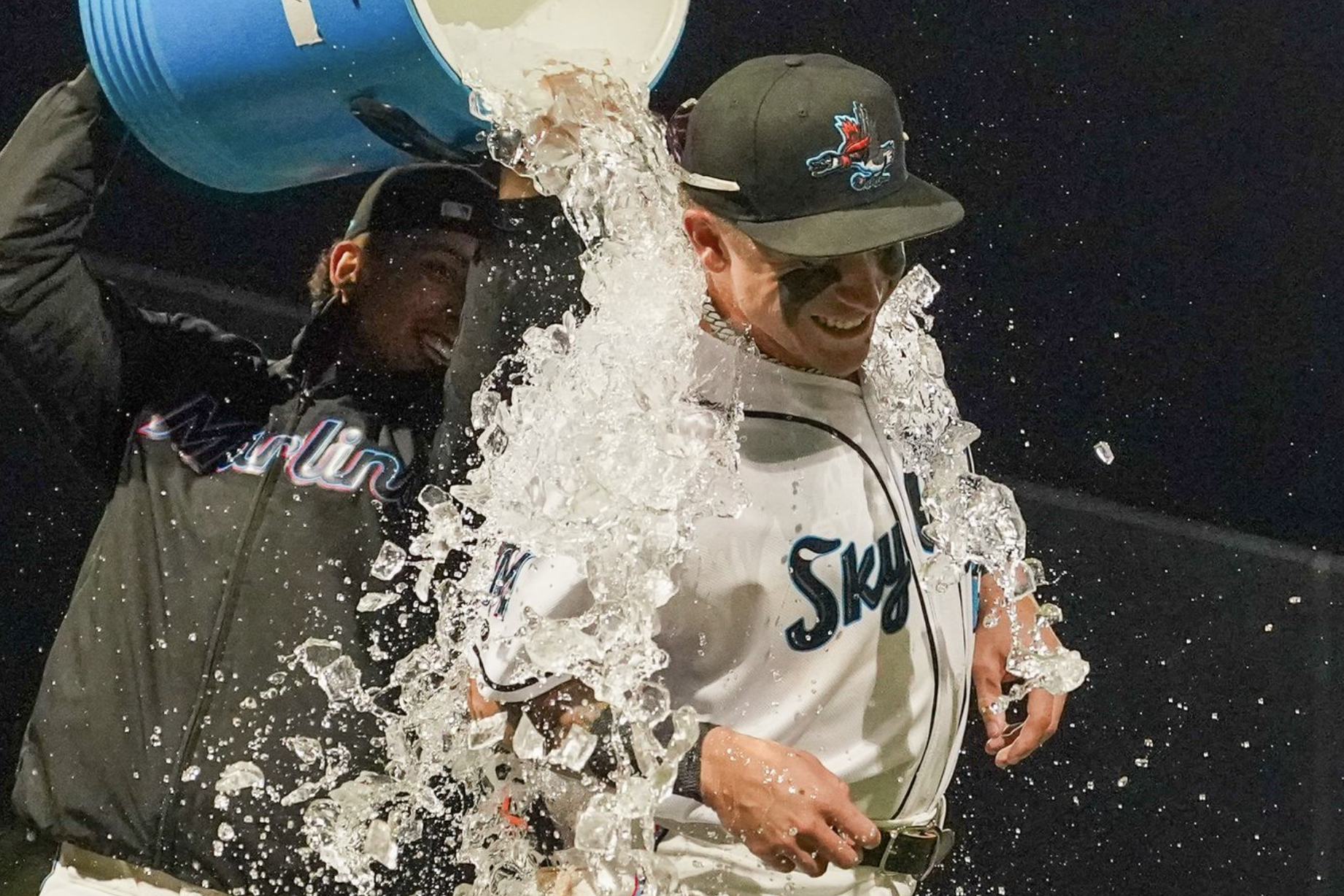 Maybe the tide really is turning for the Miami Marlins. Well, not the Marlins, per se. At least not yet. More so, it’s looking up for the Jupiter Hammerheads, Beloit Sky Carp, Pensacola Blue Wahoos, Jacksonville Jumbo Shrimp, and their complex league teams in Jupiter and the Dominican Republic. Entering the final weekend of the Triple-A regular season, the seven Marlins minor league affiliates have combined for a .525 winning percentage (a 374-339 combined record). To put that in perspective, their farm system hasn't performed that well in the standings since 2008. Of course, winning isn’t what’s important when you’re trying to develop young players. But it is a byproduct of having multiple layers of talent at each position. Let’s go back to a couple of years before that aforementioned 2008 season. The year is 2006, and the Marlins were deploying their youth movement at the major league level, much like they are doing in 2025. Baseball America had seven Marlins—Jeremy Hermida, Hanley Ramirez, Scott Olsen, Anibal Sanchez, Yusmeiro Petit, Josh Johnson and Chris Volstad—on their Top 100 prospects list. Volstad was the only one in this group that spent more than a couple of months in the minors that year, with Sanchez and Petit being called up mid-season, and the rest being major league regulars from the beginning. This left the minor league system barren for the time being. Of the top 10 players by plate appearances across the farm, there were only four future major leaguers: Robert Andino, Brett Carroll, Jason Wood, and Edgar González. If you extend it to the top 20, you still get an underwhelming list of Mike Kinkade, Eric Reed, Jai Miller, and Brad Davis. The farm system put up a .450 winning percentage that year. The Hammerheads—then a High-A team—were an abysmal 55-80. They were led offensively by Miller and Davis, with Carroll playing there for a little over two months before going to Double-A Carolina. None of their top five pitchers by innings made it to the majors in their career. The Carolina Mudcats went 61-79, with Carroll and González being the only two future major leaguers in their lineup. Kevin “Smoke” Randel, who was recently let go after spending his entire professional baseball career with the Marlins org in various roles, led that team with 12 home runs. The only starting pitchers that eventually made the majors were Aníbal Sánchez and José García, who made five relief appearances for the Marlins that year. Fast forward to 2008, when Marlins affiliates finished a combined 399-361. Across the entire system, each of the top seven players by plate appearances eventually made it to the majors. And, with respect to the 2006 group, this collection of guys was far more impressive. The farm was littered with talent up and down the affiliate ladder: future MVP Giancarlo Stanton in Low-A; future Rookie of the Year Chris Coghlan in Double-A, along with Cameron Maybin and Gaby Sanchez; Logan Morrison in High-A; and Bryan Petersen and Scott Cousins making stops everywhere in between. The 80-60 Mudcats rotation was anchored by five future major leaguers of varying success, including Volstad and Rick van den Hurk. The Low-A Jamestown Jammers went 47-29 with Tom Koehler and Dan Jennings in their rotation. Now, in 2025, the Marlins minor league affiliates are being led by players acquired from multiple scouting and development regimes. Joe Mack, drafted in 2021, has emerged as one of the best catching prospects in baseball with Triple-A Jacksonville. Robby Snelling, acquired by president of baseball operations Peter Bendix in a trade last year, has a 2.51 ERA between Double-A and Triple-A. Next week, Mack and Snelling will attempt to propel the Jumbo Shrimp to the International League championship. Evaluators have raved about the youngest talent in the Marlins pipeline as well—prospects who played in the Dominican this past summer. Both of Miami’s DSL teams ranked in top five in their league in OPS and stolen bases, while their pitching staffs cracked the top three in strikeouts. Will these team stats trickle up to the major league level? Time will tell. But seeing in-season call-ups like Jakob Marsee, Agustín Ramírez and Heriberto Hernández hit the ground running against MLB competition has to be encouraging as we look ahead to the next wave of reinforcements that'll arrive in 2026.
 -
Maybe the tide really is turning for the Miami Marlins. Well, not the Marlins, per se. At least not yet. More so, it’s looking up for the Jupiter Hammerheads, Beloit Sky Carp, Pensacola Blue Wahoos, Jacksonville Jumbo Shrimp, and their complex league teams in Jupiter and the Dominican Republic. Entering the final weekend of the Triple-A regular season, the seven Marlins minor league affiliates have combined for a .525 winning percentage (a 374-339 combined record). To put that in perspective, their farm system hasn't performed that well in the standings since 2008. Of course, winning isn’t what’s important when you’re trying to develop young players. But it is a byproduct of having multiple layers of talent at each position. Let’s go back to a couple of years before that aforementioned 2008 season. The year is 2006, and the Marlins were deploying their youth movement at the major league level, much like they are doing in 2025. Baseball America had seven Marlins—Jeremy Hermida, Hanley Ramirez, Scott Olsen, Anibal Sanchez, Yusmeiro Petit, Josh Johnson and Chris Volstad—on their Top 100 prospects list. Volstad was the only one in this group that spent more than a couple of months in the minors that year, with Sanchez and Petit being called up mid-season, and the rest being major league regulars from the beginning. This left the minor league system barren for the time being. Of the top 10 players by plate appearances across the farm, there were only four future major leaguers: Robert Andino, Brett Carroll, Jason Wood, and Edgar González. If you extend it to the top 20, you still get an underwhelming list of Mike Kinkade, Eric Reed, Jai Miller, and Brad Davis. The farm system put up a .450 winning percentage that year. The Hammerheads—then a High-A team—were an abysmal 55-80. They were led offensively by Miller and Davis, with Carroll playing there for a little over two months before going to Double-A Carolina. None of their top five pitchers by innings made it to the majors in their career. The Carolina Mudcats went 61-79, with Carroll and González being the only two future major leaguers in their lineup. Kevin “Smoke” Randel, who was recently let go after spending his entire professional baseball career with the Marlins org in various roles, led that team with 12 home runs. The only starting pitchers that eventually made the majors were Aníbal Sánchez and José García, who made five relief appearances for the Marlins that year. Fast forward to 2008, when Marlins affiliates finished a combined 399-361. Across the entire system, each of the top seven players by plate appearances eventually made it to the majors. And, with respect to the 2006 group, this collection of guys was far more impressive. The farm was littered with talent up and down the affiliate ladder: future MVP Giancarlo Stanton in Low-A; future Rookie of the Year Chris Coghlan in Double-A, along with Cameron Maybin and Gaby Sanchez; Logan Morrison in High-A; and Bryan Petersen and Scott Cousins making stops everywhere in between. The 80-60 Mudcats rotation was anchored by five future major leaguers of varying success, including Volstad and Rick van den Hurk. The Low-A Jamestown Jammers went 47-29 with Tom Koehler and Dan Jennings in their rotation. Now, in 2025, the Marlins minor league affiliates are being led by players acquired from multiple scouting and development regimes. Joe Mack, drafted in 2021, has emerged as one of the best catching prospects in baseball with Triple-A Jacksonville. Robby Snelling, acquired by president of baseball operations Peter Bendix in a trade last year, has a 2.51 ERA between Double-A and Triple-A. Next week, Mack and Snelling will attempt to propel the Jumbo Shrimp to the International League championship. Evaluators have raved about the youngest talent in the Marlins pipeline as well—prospects who played in the Dominican this past summer. Both of Miami’s DSL teams ranked in top five in their league in OPS and stolen bases, while their pitching staffs cracked the top three in strikeouts. Will these team stats trickle up to the major league level? Time will tell. But seeing in-season call-ups like Jakob Marsee, Agustín Ramírez and Heriberto Hernández hit the ground running against MLB competition has to be encouraging as we look ahead to the next wave of reinforcements that'll arrive in 2026. View full article
-
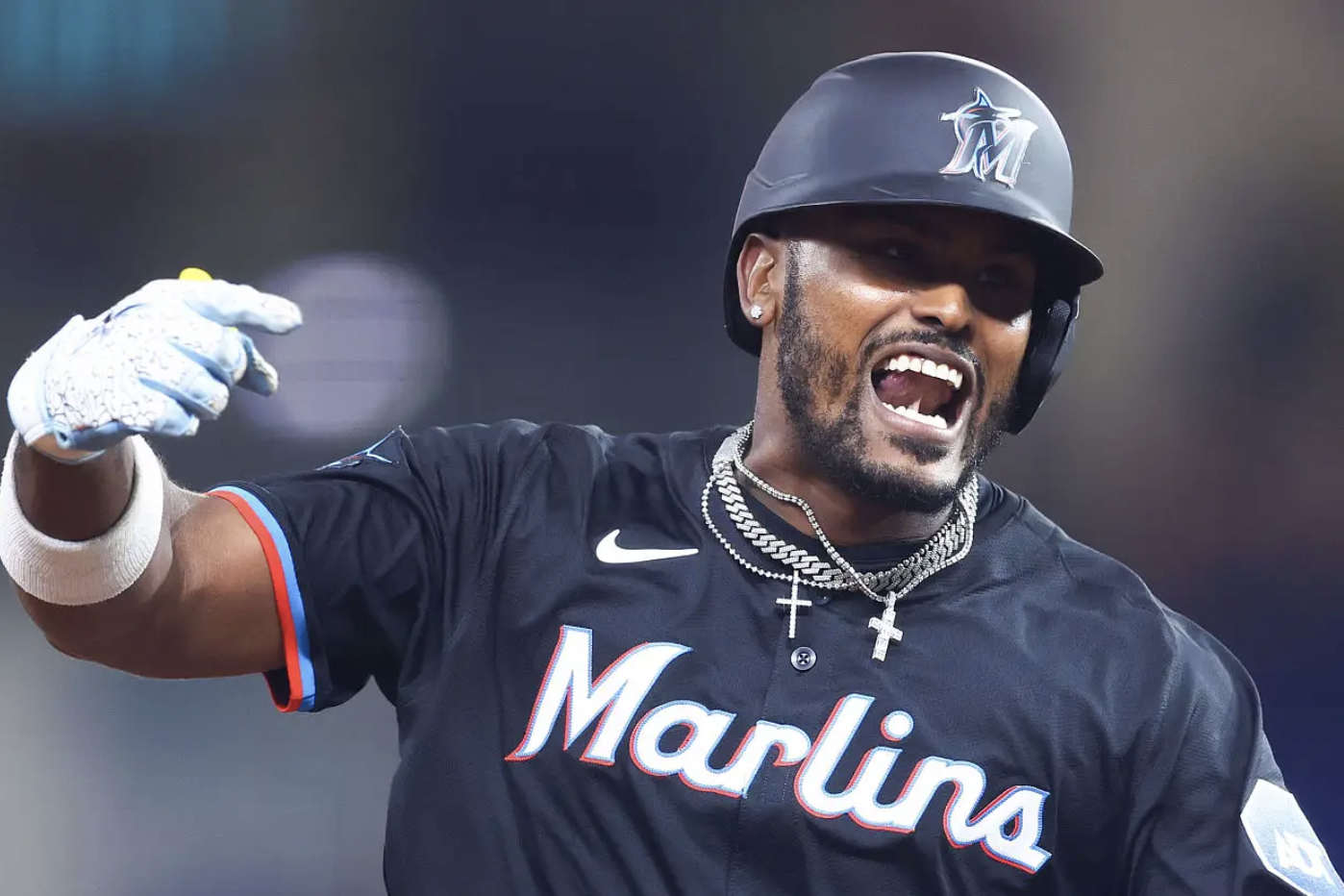 MIAMI, Fla.—When offense is hard to come by late into a ballgame, the manager often looks down at his bench and asks himself which one of these guys will insert some juice into the evening. Sometimes it’s the tired veteran who needs a day off. Other times, it’s the young but promising prospect who couldn’t fit into the starting lineup that particular day. On Friday night, though, it was Brian Navarreto. He is neither of these aforementioned prototypes. He played two games back in 2020 for the Miami Marlins. Until Friday, that was all of his major league experience. That is, until he climbed into the batter's box in the eighth inning of a 9-1 game against the Philadelphia Phillies. Tanner Banks left a fastball middle-in and the 30-year-old catcher drove it to deep center field and over the wall. One thousand, eight hundred and thirty-seven days after his last major league appearance, Brian Navarreto had his first career home run. “As cruel as this game can be sometimes, it reminds you of why we all love it,” Marlins manager Clayton McCullough said. “The game has a way of honoring those that just go about doing the right thing. And that’s Brian Navarreto.” Navarreto had spent time kicking around the minor leagues with the Marlins and Milwaukee Brewers since then. His contract for the 2025 season was not fully processed until early March, preventing him from even participating in major league spring training this year. "There were a couple of times that, as a human being, you expect that you’re not going to make it,” Navarreto said. “But that’s when the family comes, supports you, and gives you the strength to be here,” Navarreto said. One of those family members Navarreto kept close to his heart during this journey was his son D’Brian, born in 2021. Navarreto said he’s a big reason he kept fighting to get back to the majors. “Now that I have a son, I can say to him that I had a homer in the big leagues when he started growing up,” Navarreto said. Phillies win off the long ball Seven of Philadelphia’s nine runs came off the long ball, reminiscent of the style of play seen at the band box they play at back home—thanks to a right field power alley that’s 18 feet shorter than loanDepot park, and a left field that’s about 10 feet shorter. It’s hard to get the ball out of the park in Miami. It’s even harder to make it look easy. The home runs the Phillies hit were not of the wall-scraper variety: a 410-foot home run from Max Kepler off Valente Bellozo in the second inning; a 420-foot home run from Brandon Marsh against Lake Bachar in the fourth; and a 410-foot shot from Harrison Bader in the following at-bat. Kepler and Marsh both hit the second-deck home run porch in right field. 9e03b9a6-52f39f91-a070c65e-csvm-diamondgcp-asset_1280x720_59_4000K.mp4 The Phillies extended the lead with another three-run homer from Bryson Stott in the seventh against right-handed reliever George Soriano. As a team, the Marlins have allowed seven home runs in their last two games, including in their 10-5 loss to the Washington Nationals on Wednesday.
 -
MIAMI, Fla.—When offense is hard to come by late into a ballgame, the manager often looks down at his bench and asks himself which one of these guys will insert some juice into the evening. Sometimes it’s the tired veteran who needs a day off. Other times, it’s the young but promising prospect who couldn’t fit into the starting lineup that particular day. On Friday night, though, it was Brian Navarreto. He is neither of these aforementioned prototypes. He played two games back in 2020 for the Miami Marlins. Until Friday, that was all of his major league experience. That is, until he climbed into the batter's box in the eighth inning of a 9-1 game against the Philadelphia Phillies. Tanner Banks left a fastball middle-in and the 30-year-old catcher drove it to deep center field and over the wall. One thousand, eight hundred and thirty-seven days after his last major league appearance, Brian Navarreto had his first career home run. “As cruel as this game can be sometimes, it reminds you of why we all love it,” Marlins manager Clayton McCullough said. “The game has a way of honoring those that just go about doing the right thing. And that’s Brian Navarreto.” Navarreto had spent time kicking around the minor leagues with the Marlins and Milwaukee Brewers since then. His contract for the 2025 season was not fully processed until early March, preventing him from even participating in major league spring training this year. "There were a couple of times that, as a human being, you expect that you’re not going to make it,” Navarreto said. “But that’s when the family comes, supports you, and gives you the strength to be here,” Navarreto said. One of those family members Navarreto kept close to his heart during this journey was his son D’Brian, born in 2021. Navarreto said he’s a big reason he kept fighting to get back to the majors. “Now that I have a son, I can say to him that I had a homer in the big leagues when he started growing up,” Navarreto said. Phillies win off the long ball Seven of Philadelphia’s nine runs came off the long ball, reminiscent of the style of play seen at the band box they play at back home—thanks to a right field power alley that’s 18 feet shorter than loanDepot park, and a left field that’s about 10 feet shorter. It’s hard to get the ball out of the park in Miami. It’s even harder to make it look easy. The home runs the Phillies hit were not of the wall-scraper variety: a 410-foot home run from Max Kepler off Valente Bellozo in the second inning; a 420-foot home run from Brandon Marsh against Lake Bachar in the fourth; and a 410-foot shot from Harrison Bader in the following at-bat. Kepler and Marsh both hit the second-deck home run porch in right field. 9e03b9a6-52f39f91-a070c65e-csvm-diamondgcp-asset_1280x720_59_4000K.mp4 The Phillies extended the lead with another three-run homer from Bryson Stott in the seventh against right-handed reliever George Soriano. As a team, the Marlins have allowed seven home runs in their last two games, including in their 10-5 loss to the Washington Nationals on Wednesday. View full article
-
MIAMI, Fla.—Edward Cabrera’s slumps are getting shorter, and outings like he had on Monday are becoming the norm. After giving up a total of nine earned runs and 18 hits combined over 9 ⅔ innings against the Cleveland Guardians and St. Louis Cardinals, it would have been easy for fans to get anxious that the old, inconsistent Cabrera was peeking through. He settled those nerves with a performance against the Atlanta Braves on Monday that rivals any start he’s had this year. The 27-year-old right-hander tossed seven scoreless innings, striking out 10 and allowing one hit and two walks. Cabrera told reporters after his most recent start against St. Louis that his breaking balls—his curveball and slider—weren’t landing properly. He had to throw more fastballs, which the Cardinals took advantage of. He seemed to have a better handle on his curveball, along with his changeup Monday. Seven of his strikeouts came on those two pitches, with six swings-and-misses on each of them. “Throw every pitch one at a time with no fear, and just trust yourself,” Cabrera said through interpreter Luis Dorante Jr. “Once you start feeling that fear that you cannot throw or you’re not going to land a strike, no matter the count, no matter the situation of the game, it starts to affect you.” xgaadp_1.mp4 Perhaps the greatest piece of evidence that we are witnessing a new version of Cabrera is his ability to avoid spiraling. In the past, Cabrera would allow a leadoff baserunner—usually by way of a walk—and melt down from there. He allowed four leadoff runners on Monday. In each instance, he came back with three consecutive outs. As good as Cabrera was, he was only a couple of pitches better than his counterpart, Spencer Strider. The only run the Marlins could get across in Strider's seven innings of work was a Troy Johnston RBI double in the fifth inning that scored Otto Lopez. Johnston has gone 7-for-19 at the plate (.368 BA) during this prolonged homestand. dd77532f-6f3c6dbe-46ffa3dc-csvm-diamondgcp-asset-4000K.mp4 With a pair of the club's most trustworthy relievers, Ronny Henriquez and Tyler Phillips, both down after pitching back-to-back days, the Marlins needed Tyler Zuber and Josh Simpson to get them through the eighth with a 1-0 cushion. For Zuber, it was the second time since 2021 that he had pitched while his team was ahead, with the other instance coming earlier this month in Cleveland when the Marlins were up by nine. The 30-year-old right-hander got the first two outs before allowing a double to Jurickson Profar and getting pulled for Simpson. The rookie southpaw hit Matt Olson with a pitch and then responded by getting Ronald Acuna Jr. to ground out to third base. It was the first time Simpson had pitched in a high-leverage spot since he loaded the bases in a tied game in the ninth inning against the Boston Red Sox. He was pulled for Calvin Faucher after failing to record an out, and Faucher wound up allowing the winning run. “A lot of these experiences, we hope, are going to be beneficial for a number of players that are in our clubhouse right now, moving forward,” Marlins manager Clayton McCullough said after Monday’s win. “You just have to get back on the horse sometimes when it doesn't go your way...It’s one thing to be thrust into one of those moments. To come out and have some success plays a big part in filling up that confidence bank in guys.” Maximo Acosta gave Miami some insurance in the eighth with a home run to center field. He has three hits since making his major league debut on August 18 and all three are home runs. The run came in handy. Calvin Faucher allowed a solo home run to Drake Baldwin in the ninth, but still closed the door on a 2-1 win. In just nine games against the Fish, Baldwin has 16 RBI. View full article
-
Edward Cabrera snaps slump, bullpen walks tightrope in series opener
Alex Krutchik posted an article in Marlins
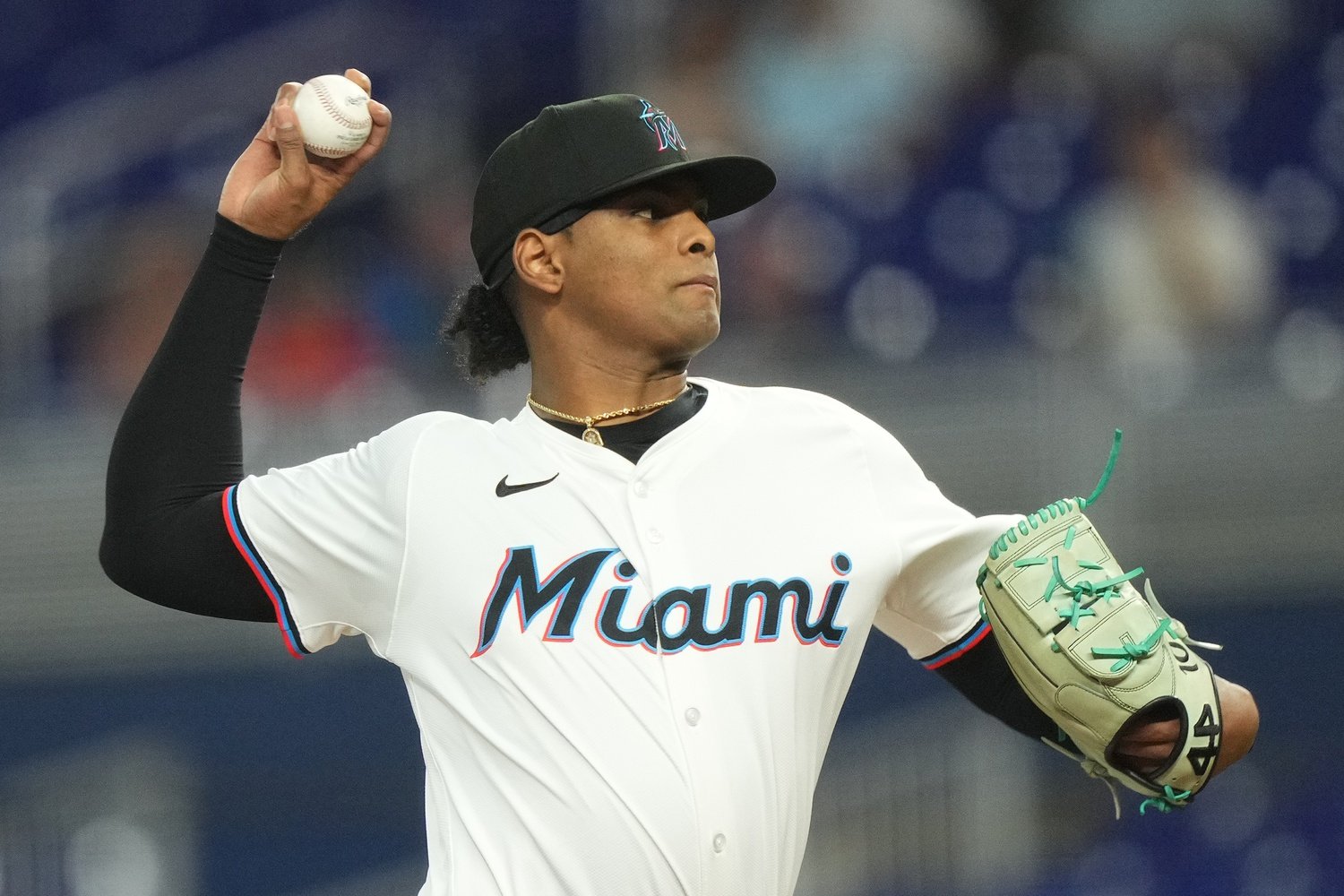 MIAMI, Fla.—Edward Cabrera’s slumps are getting shorter, and outings like he had on Monday are becoming the norm. After giving up a total of nine earned runs and 18 hits combined over 9 ⅔ innings against the Cleveland Guardians and St. Louis Cardinals, it would have been easy for fans to get anxious that the old, inconsistent Cabrera was peeking through. He settled those nerves with a performance against the Atlanta Braves on Monday that rivals any start he’s had this year. The 27-year-old right-hander tossed seven scoreless innings, striking out 10 and allowing one hit and two walks. Cabrera told reporters after his most recent start against St. Louis that his breaking balls—his curveball and slider—weren’t landing properly. He had to throw more fastballs, which the Cardinals took advantage of. He seemed to have a better handle on his curveball, along with his changeup Monday. Seven of his strikeouts came on those two pitches, with six swings-and-misses on each of them. “Throw every pitch one at a time with no fear, and just trust yourself,” Cabrera said through interpreter Luis Dorante Jr. “Once you start feeling that fear that you cannot throw or you’re not going to land a strike, no matter the count, no matter the situation of the game, it starts to affect you.” xgaadp_1.mp4 Perhaps the greatest piece of evidence that we are witnessing a new version of Cabrera is his ability to avoid spiraling. In the past, Cabrera would allow a leadoff baserunner—usually by way of a walk—and melt down from there. He allowed four leadoff runners on Monday. In each instance, he came back with three consecutive outs. As good as Cabrera was, he was only a couple of pitches better than his counterpart, Spencer Strider. The only run the Marlins could get across in Strider's seven innings of work was a Troy Johnston RBI double in the fifth inning that scored Otto Lopez. Johnston has gone 7-for-19 at the plate (.368 BA) during this prolonged homestand. dd77532f-6f3c6dbe-46ffa3dc-csvm-diamondgcp-asset-4000K.mp4 With a pair of the club's most trustworthy relievers, Ronny Henriquez and Tyler Phillips, both down after pitching back-to-back days, the Marlins needed Tyler Zuber and Josh Simpson to get them through the eighth with a 1-0 cushion. For Zuber, it was the second time since 2021 that he had pitched while his team was ahead, with the other instance coming earlier this month in Cleveland when the Marlins were up by nine. The 30-year-old right-hander got the first two outs before allowing a double to Jurickson Profar and getting pulled for Simpson. The rookie southpaw hit Matt Olson with a pitch and then responded by getting Ronald Acuna Jr. to ground out to third base. It was the first time Simpson had pitched in a high-leverage spot since he loaded the bases in a tied game in the ninth inning against the Boston Red Sox. He was pulled for Calvin Faucher after failing to record an out, and Faucher wound up allowing the winning run. “A lot of these experiences, we hope, are going to be beneficial for a number of players that are in our clubhouse right now, moving forward,” Marlins manager Clayton McCullough said after Monday’s win. “You just have to get back on the horse sometimes when it doesn't go your way...It’s one thing to be thrust into one of those moments. To come out and have some success plays a big part in filling up that confidence bank in guys.” Maximo Acosta gave Miami some insurance in the eighth with a home run to center field. He has three hits since making his major league debut on August 18 and all three are home runs. The run came in handy. Calvin Faucher allowed a solo home run to Drake Baldwin in the ninth, but still closed the door on a 2-1 win. In just nine games against the Fish, Baldwin has 16 RBI.
 -
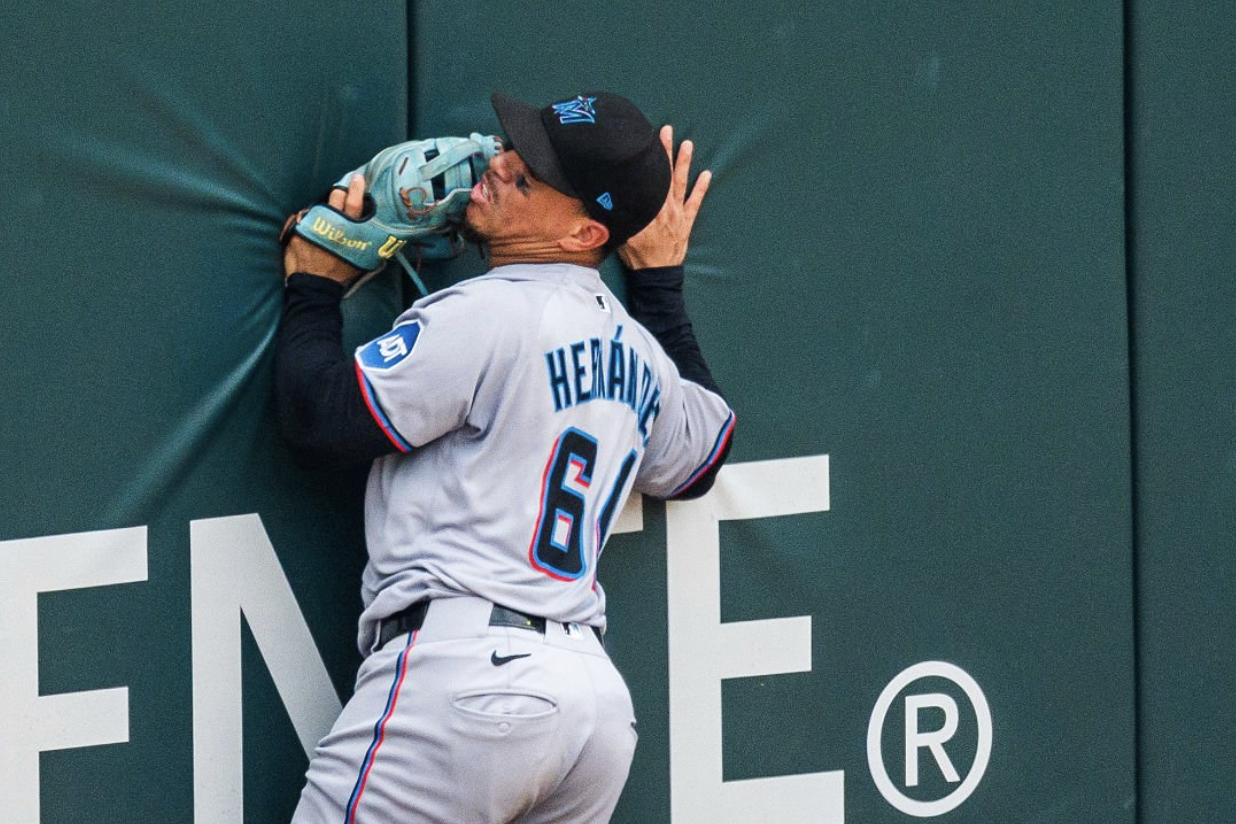 The Miami Marlins came into Atlanta as one of the hottest teams in baseball, looking to beat up on an uncharacteristically weak Braves team that’s had Miami’s number for over a decade. Sunday capped off a series that reminded everyone that this is still the Atlanta Braves, and a cloud of misfortune still hovers over the Marlins whenever they visit the Peach State. For the third time in this rare five-game series, the Marlins lost a lead, albeit this time it was a razor-thin one-run lead going into the fourth inning. Marlins starting pitcher Cal Quantrill allowed a solo home run to Matt Olson with one out in the frame. It was the only run he’d allow, and just the second of three hits Atlanta could muster off of him. Oddly enough, after completing the fourth with only 47 pitches thrown, Marlins manager Clayton McCullough pulled the 30-year-old righty in favor of Tyler Phillips. That’s where everything went downhill. Phillips, pitching for the first time in eight days, allowed two runs in the fifth—an RBI double off the right field wall by Jurickson Profar, and a bases-loaded wild pitch to Sean Murphy that scored Profar. McCullough said Quantrill had been feeling under the weather coming into Sunday and the team knew it would likely be a short outing for him, "Keeping up with him throughout the innings of the outing, we talked things through after the third inning or so," McCullough said. "Getting us through four there with what he was able to do is what we needed today, and he was able to give it to us." For what it’s worth, the Braves were hitting Quantrill hard, despite the effective final line. Ten of their 12 outs came via the flyball, with a couple of catches on the warning track. Still clinging to a manageable 3-1 deficit in the seventh, Tyler Zuber allowed a three-run home run to Marcell Ozuna. It was the former Marlin's fourth homer of the series. It was his 22nd home run in 76 games against Miami. He came into Sunday hitting .314 with a .940 OPS in previous head-to-head matchups. Eighteen of Atlanta’s 31 runs this weekend came from the sixth inning on. "When (Atlanta) had their opportunities, they were able to come through with some hits with runners in scoring position, put up some crooked numbers that ended up swinging games or changing the course of the game," McCullough said. "They put together innings and came up with more hits with guys on than we were able to this series." Another sign that the new-look Marlins just didn’t have it in Atlanta was their feeble showing on offense. The only run the Marlins put on the board was a Liam Hicks RBI single in the second inning. Claimed off of waivers last month, Braves starter Joey Wentz allowed four hits over 5 ⅔ innings. The Braves bullpen allowed two singles the rest of the way. Unless the Marlins sweep the three-game set between these teams later this month, 2025 will be the 11th consecutive season series victory for the Braves.
- 1 comment
-
- 2
-
-
- cal quantrill
- marcell ozuna
- (and 1 more)
-
The Miami Marlins came into Atlanta as one of the hottest teams in baseball, looking to beat up on an uncharacteristically weak Braves team that’s had Miami’s number for over a decade. Sunday capped off a series that reminded everyone that this is still the Atlanta Braves, and a cloud of misfortune still hovers over the Marlins whenever they visit the Peach State. For the third time in this rare five-game series, the Marlins lost a lead, albeit this time it was a razor-thin one-run lead going into the fourth inning. Marlins starting pitcher Cal Quantrill allowed a solo home run to Matt Olson with one out in the frame. It was the only run he’d allow, and just the second of three hits Atlanta could muster off of him. Oddly enough, after completing the fourth with only 47 pitches thrown, Marlins manager Clayton McCullough pulled the 30-year-old righty in favor of Tyler Phillips. That’s where everything went downhill. Phillips, pitching for the first time in eight days, allowed two runs in the fifth—an RBI double off the right field wall by Jurickson Profar, and a bases-loaded wild pitch to Sean Murphy that scored Profar. McCullough said Quantrill had been feeling under the weather coming into Sunday and the team knew it would likely be a short outing for him, "Keeping up with him throughout the innings of the outing, we talked things through after the third inning or so," McCullough said. "Getting us through four there with what he was able to do is what we needed today, and he was able to give it to us." For what it’s worth, the Braves were hitting Quantrill hard, despite the effective final line. Ten of their 12 outs came via the flyball, with a couple of catches on the warning track. Still clinging to a manageable 3-1 deficit in the seventh, Tyler Zuber allowed a three-run home run to Marcell Ozuna. It was the former Marlin's fourth homer of the series. It was his 22nd home run in 76 games against Miami. He came into Sunday hitting .314 with a .940 OPS in previous head-to-head matchups. Eighteen of Atlanta’s 31 runs this weekend came from the sixth inning on. "When (Atlanta) had their opportunities, they were able to come through with some hits with runners in scoring position, put up some crooked numbers that ended up swinging games or changing the course of the game," McCullough said. "They put together innings and came up with more hits with guys on than we were able to this series." Another sign that the new-look Marlins just didn’t have it in Atlanta was their feeble showing on offense. The only run the Marlins put on the board was a Liam Hicks RBI single in the second inning. Claimed off of waivers last month, Braves starter Joey Wentz allowed four hits over 5 ⅔ innings. The Braves bullpen allowed two singles the rest of the way. Unless the Marlins sweep the three-game set between these teams later this month, 2025 will be the 11th consecutive season series victory for the Braves. View full article
-
How far off is Agustín Ramírez in NL Rookie of the Year race?
Alex Krutchik posted an article in Marlins
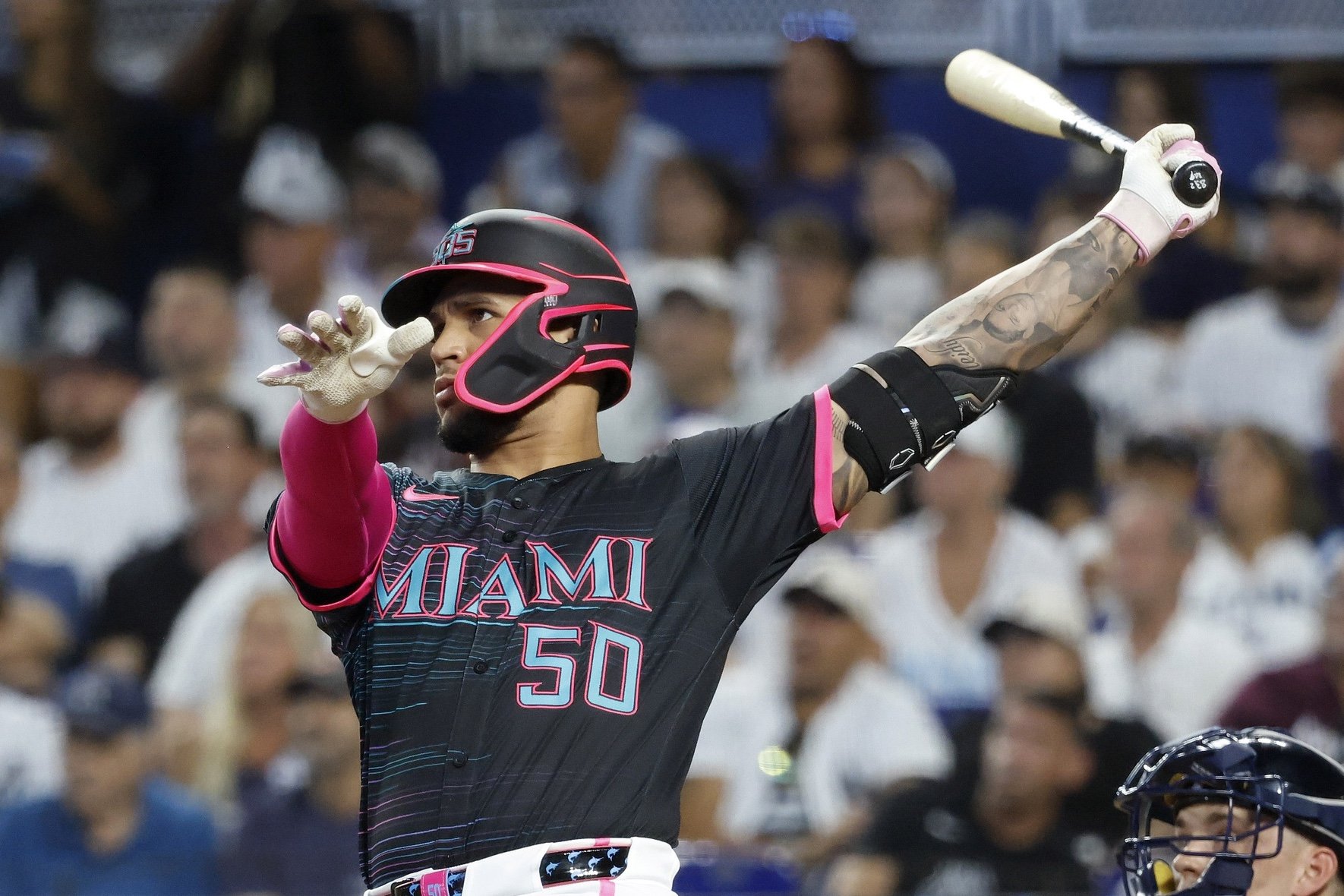 It’s been a long time since the Marlins last had a rookie bat make as instant of an impact as Agustín Ramírez. Especially in a year like this when other National League teams aren't relying much on first-year players, Ramírez sticks out. Lauded for his slugging ability when the Marlins acquired him from the New York Yankees at the trade deadline last year, the 23-year-old catcher already has 17 home runs in 87 games with Miami, which leads all NL rookies. He's also first in hits (84), runs scored (48) and runs batted in (50). His .464 slugging percentage is second-best, right behind teammate Heriberto Hernández. So what’s holding him back from being the clear-cut favorite to win the award? There are a few other candidates with more balanced player profiles, albeit in smaller sample sizes. Drake Baldwin, catcher for the Atlanta Braves, currently has the best odds to win NL ROY on most sportsbooks. He’s also the easiest player to compare to Ramírez given their positions. The 23-year-old Brave is second among NL rookies in RBI (41) and home runs (11), trailing only Ramírez in both categories. He also has a whopping 60-point advantage in on-base percentage (.348 to .288). Baldwin does all of this without being a liability at his position. His blocks above average (2), caught stealing above average (-1), and pop time (1.96 seconds) are all pedestrian. But when held up against Ramírez—minus-16 blocks above average, minus-5 caught stealing above average and 2.01 seconds of pop time—he looks like Yadier Molina in comparison. xuae10.mp4 When Statcast rolls all of these components into a ball, it estimates that Ramírez has produced a negative-7 run value at his position, while Baldwin is steady at zero. Ramírez’s defense is a huge reason why his bWAR is 0.1 despite his great offensive production. Following the departure of Nick Fortes last week, Ramírez's workload behind the plate is expected to increase, so hopefully those added reps will make him more proficient. Isaac Collins, left fielder for the Milwaukee Brewers, is another one who can impact this race. He doesn’t slug and he’s not as flashy as Ramírez and his violently powerful swing, but his 131 wRC+ is highest among NL rookies. This is thanks in large part to his 12.9% walk rate, which is more than double that of Ramírez’s, along with a .281 batting average. Collins is among the best in the field, too. He leads all major league left fielders with eight outs above average. The preseason favorites in this race, Roki Sasaki and Dylan Crews, faded from contention long ago due to injuries. Dominant Milwaukee pitcher Jacob Misiorowski briefly emerged as a sexy pick, but he was just placed on the 15-day IL himself with a left tibia contusion. In seven MLB starts, he has put up a 2.70 ERA, 3.10 FIP, and a 36.4% strikeout rate in 33 ⅓ innings. Even in a best-case scenario, there would only be enough time left to double that sample size, an innings total which would pale in comparison to any other starting pitcher who has received Rookie of the Year honors in either league. So can Ramírez overcome his paltry defense to win the award? It’s happened before. Look at former Florida Marlin Chris Coghlan, who won NL ROY in 2009. He leveraged his .321 batting average and 122 OPS+ despite recording negative-19 defensive runs saved in left field. Wins above replacement wasn’t really at the forefront at that time, but for whatever it’s worth, Coghlan’s 1.1 bWAR was an entire win better than what Ramírez has put up so far. With slight improvement down the stretch on both sides of the ball, Ramírez still has a path to victory.
 -
It’s been a long time since the Marlins last had a rookie bat make as instant of an impact as Agustín Ramírez. Especially in a year like this when other National League teams aren't relying much on first-year players, Ramírez sticks out. Lauded for his slugging ability when the Marlins acquired him from the New York Yankees at the trade deadline last year, the 23-year-old catcher already has 17 home runs in 87 games with Miami, which leads all NL rookies. He's also first in hits (84), runs scored (48) and runs batted in (50). His .464 slugging percentage is second-best, right behind teammate Heriberto Hernández. So what’s holding him back from being the clear-cut favorite to win the award? There are a few other candidates with more balanced player profiles, albeit in smaller sample sizes. Drake Baldwin, catcher for the Atlanta Braves, currently has the best odds to win NL ROY on most sportsbooks. He’s also the easiest player to compare to Ramírez given their positions. The 23-year-old Brave is second among NL rookies in RBI (41) and home runs (11), trailing only Ramírez in both categories. He also has a whopping 60-point advantage in on-base percentage (.348 to .288). Baldwin does all of this without being a liability at his position. His blocks above average (2), caught stealing above average (-1), and pop time (1.96 seconds) are all pedestrian. But when held up against Ramírez—minus-16 blocks above average, minus-5 caught stealing above average and 2.01 seconds of pop time—he looks like Yadier Molina in comparison. xuae10.mp4 When Statcast rolls all of these components into a ball, it estimates that Ramírez has produced a negative-7 run value at his position, while Baldwin is steady at zero. Ramírez’s defense is a huge reason why his bWAR is 0.1 despite his great offensive production. Following the departure of Nick Fortes last week, Ramírez's workload behind the plate is expected to increase, so hopefully those added reps will make him more proficient. Isaac Collins, left fielder for the Milwaukee Brewers, is another one who can impact this race. He doesn’t slug and he’s not as flashy as Ramírez and his violently powerful swing, but his 131 wRC+ is highest among NL rookies. This is thanks in large part to his 12.9% walk rate, which is more than double that of Ramírez’s, along with a .281 batting average. Collins is among the best in the field, too. He leads all major league left fielders with eight outs above average. The preseason favorites in this race, Roki Sasaki and Dylan Crews, faded from contention long ago due to injuries. Dominant Milwaukee pitcher Jacob Misiorowski briefly emerged as a sexy pick, but he was just placed on the 15-day IL himself with a left tibia contusion. In seven MLB starts, he has put up a 2.70 ERA, 3.10 FIP, and a 36.4% strikeout rate in 33 ⅓ innings. Even in a best-case scenario, there would only be enough time left to double that sample size, an innings total which would pale in comparison to any other starting pitcher who has received Rookie of the Year honors in either league. So can Ramírez overcome his paltry defense to win the award? It’s happened before. Look at former Florida Marlin Chris Coghlan, who won NL ROY in 2009. He leveraged his .321 batting average and 122 OPS+ despite recording negative-19 defensive runs saved in left field. Wins above replacement wasn’t really at the forefront at that time, but for whatever it’s worth, Coghlan’s 1.1 bWAR was an entire win better than what Ramírez has put up so far. With slight improvement down the stretch on both sides of the ball, Ramírez still has a path to victory. View full article

.jpg.37f1a3eb776c8e2247c471764ecfbcf8.jpg)
